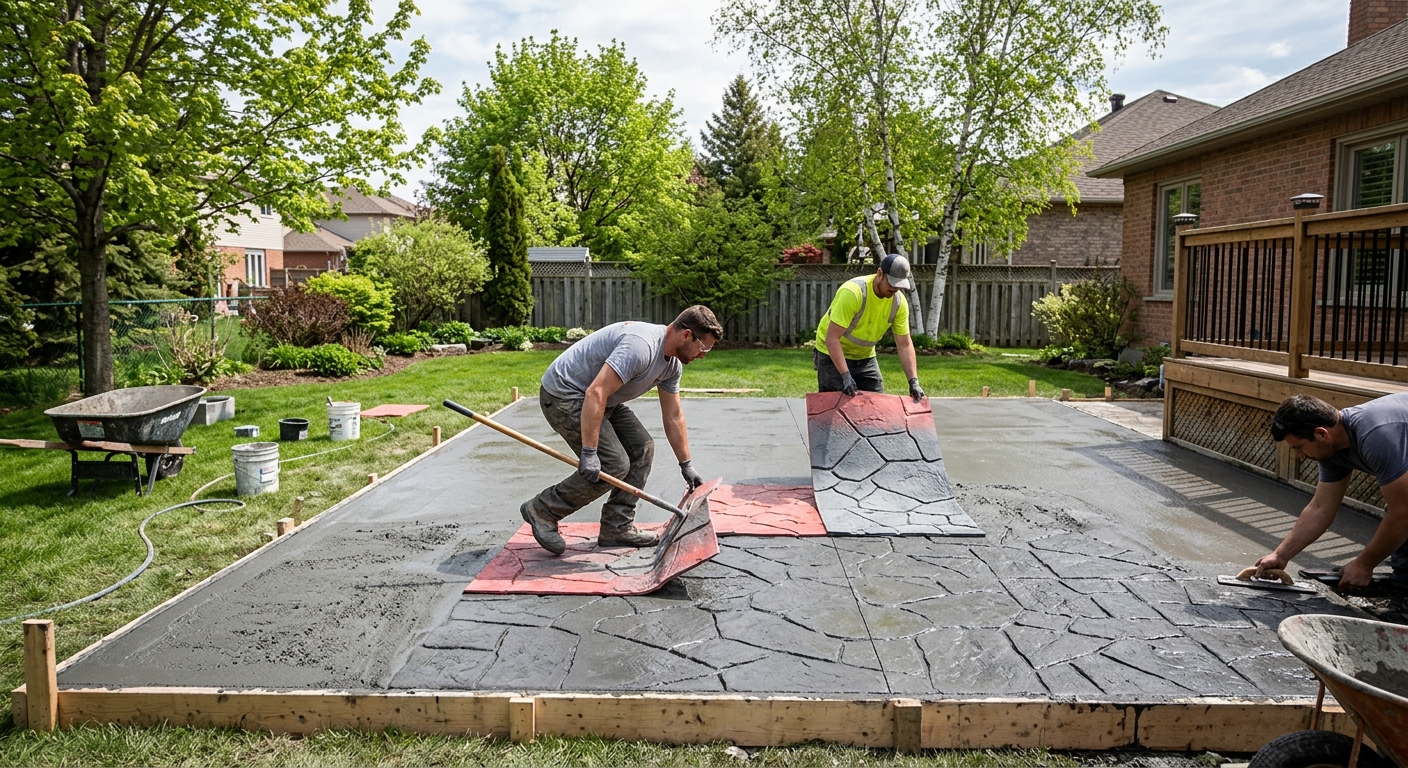
Concrete work options and costs in Little's Corners
Little's Corners, Ontario is where homeowners tend to think in terms of driveways, walkways and patios—because they’re the parts of the property that take the most beating from our freeze–thaw cycle. With a population of 9,413 (Statistics Canada, 2021 Census), this is a steady, local market where trades stay busy, especially around established residential streets and the broader Toronto economic region. Most concrete flatwork demand comes from the region’s detached home pattern, and in practice that means frequent requests for new driveway pours, interlocking-adjacent transitions, and garage slabs that can handle winter salt and spring thaw.
Pricing in the Toronto area doesn’t just depend on “square feet.” Concrete work is strongly shaped by frost depth requirements and how well the base is prepared—both determine footing depth and the formwork/haul costs around your lot. Because the GTA sees humid, wet shoulder seasons and repeated freeze–thaw, contractors typically specify air-entrained concrete and include control joints to manage cracking on exterior slabs. Pour timing matters too: exterior work is usually concentrated in warmer months, and colder pours may require additional protection and longer curing management when temperatures drop toward 10 °C or below. That’s why two contractors can quote different totals for what seems like the “same” broom-finished driveway.
In Little's Corners, this trade is often especially in demand in the older residential pockets where driveways and front walkways show salt-related surface wear. Below is a practical comparison of common options and realistic budget ranges to help you line up quotes and scope before you choose a finish.
| Application |
Typical Size |
Key Spec |
Finish Option |
Price Range |
| Concrete driveway (standard broom finish) |
12 ft x 20 ft (240 sq ft) |
Air-entrained mix, compacted granular base, control joints |
Broom finish |
$4,320–$6,720 |
| Exposed aggregate driveway |
12 ft x 20 ft (240 sq ft) |
Air-entrained mix, proper curing, surface retarder/removal |
Exposed aggregate |
$5,280–$8,880 |
| Stamped concrete driveway or patio |
12 ft x 16 ft (192 sq ft) |
Air-entrained mix, densifier/sealer system, joint control |
Stamped patterns |
$4,608–$7,680 |
| Plain concrete patio or walkway |
10 ft x 12 ft (120 sq ft) |
Air-entrained mix, edge forms, compacted base |
Smooth/plain + light broom edge |
$1,920–$3,120 |
| Garage floor (interior slab) |
20 ft x 20 ft (400 sq ft) |
Vapour barrier/insulation as applicable, proper compaction, finish burnish |
Standard broom or trowel finish |
$7,200–$11,200 |
| Foundation footings (structural, below frost) |
Typical single-detached perimeter (varies) |
Concrete below grade at least 1.2 m; engineered design per house |
Structural pour |
$7,500–$15,000 |
Prices are estimates only and vary by project scope, site access and material selection.
What affects the price of concrete work in Little's Corners
In Little's Corners (and across the Toronto economic region), quotes for the same kind of project can swing by 30–50% because concrete pricing is a “system,” not a single material cost. Two contractors may propose different depths, different base build-ups, and different concrete mix requirements based on your soil, drainage and how close you are to established grades. Also, labour availability changes by season—most exterior flatwork is concentrated in the warmer months—so mobilization and scheduling can shift totals.
The biggest driver is the freeze–thaw cycle. Footings and any structural concrete below grade must extend below the design frost depth (Ontario commonly around 1.2 m or more depending on design and local conditions) to prevent frost heave and differential movement. Exterior slabs also need air-entrained concrete mixes to survive repeated freezing and thawing, and thicker slabs generally perform better under salt and traffic. When colder weather arrives and ambient temperatures drop toward 10 °C or below, contractors often add cold-weather curing precautions—insulating blankets or temporary heating—plus more careful protection and longer curing windows. De-icing salt accelerates surface spalling, so sealing becomes part of a durability-minded approach on driveways and patios.
Here are a few Little's Corners examples that move the needle. If your driveway ties into an uneven curb cut and requires deeper excavation for a consistent slope, you’ll pay more in haul and forming even if the final square footage is the same. If your soil needs extra granular replacement to stabilize base support, that can push the project toward the higher end of the $18,000 – $28,000 driveway band. On the other hand, a smaller, accessible patio with good existing base may land closer to $16,000 – $26,000 patio/walkway levels, especially if reinforcement and joint work can be kept simple.
| Price Factor |
Why It Matters |
Cost Impact |
| Frost line depth — determines footing depth and form height |
Deeper below-grade concrete increases excavation and forming |
Higher footing costs can add a material-labour premium |
| Site preparation — excavation, grading, compacted granular base |
Proper base prevents settlement and keeps slab flat |
Extra haul, granular replacement and compaction increase labour |
| Reinforcement — rebar or wire mesh requirement |
Controls cracking in driveways/garage slabs and supports load |
Material + added labour for placement and spacers |
| Mix design — air-entrainment and compressive strength spec |
Air voids reduce freeze–thaw damage and scaling/spalling |
Higher-performance mix typically costs more per cubic yard |
| Finish type — broom vs. stamped vs. exposed aggregate |
Decorative finishes require extra prep, tooling and product |
Stamped/exposed options usually add the most labour and materials |
| Pour size and concrete truck access to site |
Access determines line-pump needs and staging time |
Pumping, traffic control and waiting time can raise costs |
| Cold-weather curing precautions — heating and blankets |
Ensures strength gain and reduces surface defects |
Additional materials and labour; may shift work later into season |
| Control joint pattern and sealing cost |
Joints manage cracking; sealing helps resist salt scaling |
Sealers and saw-cut/finishing time affect total budget |
Permits & regulations in Ontario
In Ontario, structural concrete work typically needs a building permit. For Little's Corners homeowners, that usually includes work such as foundation footings, foundation walls, grade beams and other load-bearing structural elements—especially where an engineered design is required. Municipal review is often part of the process because these components affect the building’s safety and long-term stability in freeze–thaw conditions.
Concrete flatwork like patios, walkways and driveways often does not require a permit on its own, but it can if it impacts lot grading, interferes with required drainage, touches impervious surface coverage limits, or affects municipal right-of-way/sidewalk permits. Also, if your work changes how water flows away from your foundation (for example, raising a driveway and trapping runoff), municipalities may require additional approvals or revisions to meet drainage expectations.
Step-by-step, here’s how to verify a contractor in Ontario before you sign in Little's Corners: (1) confirm the contractor is properly registered/licensed where applicable and ask for their business information; (2) request a current certificate of insurance (liability) showing coverage amounts appropriate for construction work; (3) ask for proof of WSIB coverage (or the correct clearance documentation if applicable to the contractor’s status); (4) verify the quote references the specific scope (footing depth, base thickness, reinforcement, mix type); and (5) contact references for similar-size residential jobs so you can see workmanship after at least one winter cycle.
Getting concrete right in Little's Corners's freeze-thaw climate
Concrete fails in Little's Corners when water gets into the slab system and can’t drain away, when the base isn’t compacted to the right depth, or when the mix doesn’t include enough air to handle freeze–thaw. The classic symptom is spalling—flakes or scaling on the surface—often made worse by de-icing salt. The fix starts before the pour: the sub-base must be compacted granular material to the right thickness for your soil conditions, and the drainage/grade needs to move water away from the house and down to an approved outlet. A “cheap” pour over weak fill can look fine for a season and then crack or settle.
To spec correctly for Toronto-area winters, insist on air-entrained concrete for exterior flatwork (commonly 5–7% air content) and a minimum compressive strength (commonly 32 MPa for many residential exterior applications). Control joints matter because they give concrete a planned place to crack; spacing should align with established guidelines so you don’t get random, unsightly fracture lines. Curing is also critical: even if the concrete looks hard quickly, it should cure for at least 7 days under proper conditions. If temperatures are cold, ask how they protect the slab and how long they’ll keep it insulated/maintained. Finally, plan for penetrating sealer after cure—typically 28 days post-pour—so the surface resists salt-related scaling.
On cost choices: a stamped patio costs more than plain concrete, but the price difference is justified when you want longevity and curb appeal. For example, if a plain patio lands closer to the lower end of the $16–$26/sq ft band while stamped comes in nearer the $24–$40 range, you’re paying for extra tooling, release/patching labour and sealing complexity—so it’s worth comparing durability specs, not just pattern.
| Spec |
Why It Matters in Little's Corners |
What to Ask For |
Impact if Skipped |
| Compacted granular base (depth?) |
Supports the slab and reduces settlement during thaw |
Base thickness and compaction method (and whether soil is stabilized/replaced) |
Cracking, rocking edges, and uneven settling |
| Air-entrained concrete mix (target air %?) |
Protects the paste from freeze–thaw damage |
Confirm air-entrainment target (commonly 5–7% for exterior flatwork) |
Spalling/scaling and premature surface deterioration |
| Compressive strength (MPa rating) |
Affects strength gain and durability |
Minimum 32 MPa (or project-specific spec) and cylinder/quality approach |
Weaker surface and higher risk of damage under traffic/salt |
| Control joints (spacing per ACI guidelines) |
Manages where cracks appear as concrete contracts |
Joint pattern, saw-cut timing, and spacing on driveways/patios |
Random cracking through the main viewing areas |
| Minimum 7-day curing period |
Ensures strength development in humid/wet shoulder seasons |
Protection plan in cold weather (blankets/heating if needed) |
Surface dusting, reduced durability, and patchy finish |
| Penetrating sealer (when applied after cure) |
Helps repel water/salt that drive scaling in spring/fall |
Confirm penetrating sealer and timing (often 28 days post-pour) |
Faster salt damage and more frequent refinishing |
How to choose a concrete work contractor in Little's Corners
Choosing the right concrete contractor in Little's Corners starts with documentation and scope clarity. First, verify the contractor’s Ontario licensing/registration where applicable and request a certificate of liability insurance—make sure the coverage is current and tailored to construction work (not just a personal policy). Next, ask for WSIB coverage (or the correct clearance letter/status documentation). If a crew can’t provide proof or it’s out of date, that’s a major scheduling and risk issue for you.
Then, get 2–3 itemised written quotes—not lump sums. You want a breakdown that shows excavation/base prep, reinforcement, concrete mix specification (air-entrained and strength), finishing method, joint cutting and sealing plan. A good quote should state whether the contractor pulls required permits (if applicable to the structural scope) and whether disposal/municipal fees are included. If you see vague lines like “concrete and finish,” push for line-by-line scope so you can compare apples to apples.
Warranty matters in our freeze–thaw climate. Ask for the workmanship warranty length, what it covers (cracks versus spalling versus settlement), and whether product/manufacturer warranties apply for sealers or decorative systems. Payment schedules should be conservative: never pay more than about 10–15% upfront, and use a holdback until the job is complete and you’ve confirmed grading, drainage and surface finishing. Finally, require a start date and an estimated completion timeline in writing so your driveway/patio isn’t left half-finished through a cold snap.
- Request insurance certificate and confirm it’s active before work starts.
- Verify WSIB/WCB coverage or proper clearance documentation.
- Ask for references on similar residential projects in Ontario.
- Confirm concrete mix is air-entrained for exterior work.
- Ensure base thickness and compaction requirements are spelled out.
- Check reinforcement details (mesh vs. rebar, spacing, chairs/spacers).
- Confirm control joint pattern, saw-cut timing and sealing plan.
- Ask about curing protection if temperatures drop near or below 10 °C.
- Make sure drainage and slope away from the house are addressed.
- Confirm disposal, debris removal and any restoration are included.
- Use a contract that lists start date, completion date and weather contingencies.
- Keep payments tied to milestones; hold back until final inspection.
Red flags in Little's Corners include: refusing to show insurance/WSIB paperwork, quoting only “per sq ft” with no base/reinforcement/joint details, starting without a clear drainage plan, skipping air-entrainment on exterior slabs, and offering a short “finish only” warranty that doesn’t address freeze–thaw-related issues like scaling/spalling.
Frequently asked questions — concrete work in Little's Corners
How long does a concrete project take in Little's Corners?
For most residential work in Little's Corners, the timeline has two parts: the actual pour-day work and the curing/protection period. Excavation, forming, base prep and reinforcement usually take 1–3 days depending on site access and how much grading is required. The pour itself for a typical driveway or patio is often just a few hours, but finishing, edge detailing and joint cutting can extend the day. After pouring, you should plan on at least 7 days of proper curing before treating the slab as fully set. For outdoor flatwork in the Toronto region, contractors also schedule protection if temperatures dip toward 10 °C or below. If you’re comparing quotes, ask when they plan delivery, how quickly they can saw-cut joints, and what the protection plan is until cure is complete.
What is a concrete overlay and is it suited to Little's Corners?
A concrete overlay is a new thin concrete layer placed over an existing concrete slab (after prep) to improve appearance and extend service life. In Little's Corners and the broader Ontario freeze–thaw climate, overlays can be suited to the right situation—when the existing slab is sound, well bonded, and not lifting or extensively undermined by drainage or soil movement. If your current driveway has major spalling, deep cracking, or areas that rock, an overlay may not address the root cause and may fail sooner. Overlay success depends heavily on surface preparation and bonding system, plus correct slope and drainage. Cost-wise, homeowners often find overlays are positioned as a “lower initial cost” alternative, but the best value comes from fixing the base/drainage problem first. If you’re choosing between replacement (often in the $18–$28 band for driveways) and overlay, ask for a bonding and crack-repair scope, not just a thickness number.
How do I seal concrete to protect it in Little's Corners?
Sealing is one of the most practical durability steps for Little's Corners because de-icing salt and winter moisture can drive scaling/spalling on exterior concrete. The key is timing: let the slab cure fully first, and then apply a penetrating sealer after cure—commonly around 28 days post-pour. Before sealing, the concrete should be clean, dry, and free of construction residue. Use a sealer that’s appropriate for exterior use and cold climates, and confirm whether the contractor recommends reapplication intervals based on your traffic and salt exposure. For basements slabs or interiors, requirements differ, but for driveways and patios the freeze–thaw cycle is why sealing matters. In your quotes, ask whether sealing is included, what product they use, and whether they include surface prep so the sealer can actually penetrate rather than sit on contaminants.
What is the difference between concrete and cement?
Concrete is the full building material mix you place and finish—cement plus water plus aggregates (sand and stone), and often additives like air-entrainment for exterior freeze–thaw durability. Cement is one ingredient within concrete: it’s the powder component that reacts with water to create the paste that binds everything together. In Little's Corners projects, what matters to performance is the concrete mix design—especially for exterior flatwork—such as air content and compressive strength. A contractor can say “we use quality cement,” but you should evaluate the actual concrete spec they’re pouring (air-entrained mix and a minimum 32 MPa rating, for example, in many residential scopes). When comparing quotes, look for details on air-entrainment, reinforcement, base prep, curing and jointing—those influence durability far more than a generic statement about cement brand.
How much does concrete work cost in Little's Corners?
Concrete pricing in Little's Corners depends on finish, excavation/base prep, reinforcement and how the contractor manages freeze–thaw durability. As a starting point, local Toronto-area budget bands commonly place driveway work around $18–$28 per square foot for concrete flatwork, patios/walkways around $16–$26 per square foot, and foundation/footings often priced separately by structural scope (frequently within a $180–$300 per unit basis depending on design and depth). Decorative options cost more: stamped & decorative concrete often lands in the $24–$40 per square foot range because of extra labour, release/densifier steps and joint/finishing complexity. Real projects can rise when site access is tight, when drainage work is needed, or when cold-weather curing protection is required. If you tell me your approximate size and whether it’s a driveway, patio, or footings, I can help you sanity-check whether a quote is aligning with these bands.
How deep must footings be for Little's Corners's frost line?
Footing depth is based on design frost conditions and the engineering requirements for your specific building and soil. In Ontario, local practice and code requirements generally keep structural footings extending at least 1.2 m below grade (around 4 ft) to reduce frost heave and differential movement. In many GTA residential projects, the exact depth can vary by house design, soil conditions and municipal/engineered specifications, but you should not accept shallow footings without a stamped design. This matters because repeated freeze–thaw can lift or move foundations if the concrete isn’t placed below frost influence. For your peace of mind, ask for the engineering drawings or permit details showing footing depth and reinforcement. When comparing contractor proposals, make sure they’re referencing the same structural scope—otherwise quotes may look close even when the footing depth (and performance) is very different.