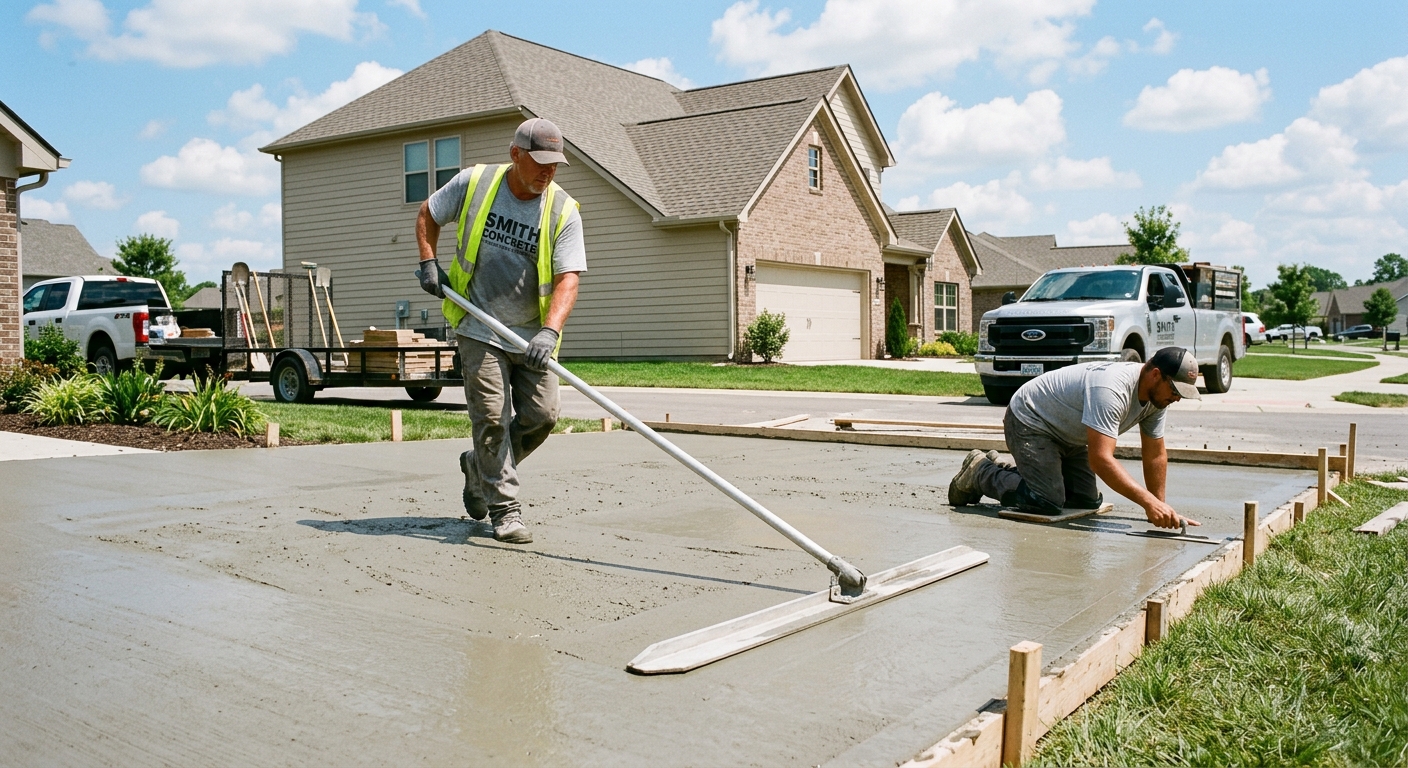
Concrete work options and costs in Grand River North
In Grand River North, concrete work is usually budgeted around the needs of a steady homeowner base shaped by the local housing stock and winter conditions. With a population of 4,765 (Statistics Canada, 2021 Census), demand is smaller than Toronto’s core, but contractor schedules still tie closely to the Toronto-area concrete rush. Most driveways, patios and walkways in this area are built for single-family living, and the same frost-and-salt realities that affect the broader Toronto economic region apply here too—just with pricing and availability that can feel “GTA-like” even when your project is modest.
Costs move because Toronto-area concrete is designed around freeze–thaw: exterior flatwork typically needs air-entrained concrete, proper drainage, and control joints to manage random cracking. Municipal expectations for structural concrete (and the Ontario Building Code practices contractors follow) also influence schedule and materials. In practice, that means many exterior pours are concentrated in the warmer months so curing is reliable; once temperatures slide toward 10 °C and below, you’ll see added protection measures that affect labour time.
If you’re in or near Brighton Estates or the older residential pockets with mature trees and tighter driveways, expect extra time for site protection, access, and base preparation. Those realities are why two contractors can price the “same” driveway differently—so the table below gives you a realistic cost range by option to start your comparisons.
| Application |
Typical Size |
Key Spec |
Finish Option |
Price Range |
| Concrete driveway (standard broom finish) |
400 sq. ft. |
Air-entrained, compacted granular base, control joints |
Broom finish |
$7,200–$11,200 |
| Exposed aggregate driveway |
400 sq. ft. |
Air-entrained, proper curing & washing schedule |
Exposed aggregate (salt-friendly finish) |
$9,000–$13,900 |
| Stamped concrete driveway or patio |
300 sq. ft. |
Air-entrained, thicker placement where required, jointing plan |
Stamp + colour hardener |
$7,200–$12,200 |
| Plain concrete patio or walkway |
250 sq. ft. |
Base prep, slope & drainage, air-entrained mix |
Broom or smooth finish |
$4,000–$6,500 |
| Garage floor (interior slab) |
480 sq. ft. |
Vapour barrier (where needed), proper sub-base, jointing |
Steel-trowel or broom (per use) |
$8,500–$14,500 |
| Foundation footings (structural, below frost) |
~120 linear ft. |
Engineered rebar, forms, pour below frost depth |
Structural concrete |
$21,600–$36,000 |
Prices are estimates only and vary by project scope, site access and material selection.
What affects the price of concrete work in Grand River North
In Grand River North (and across the Toronto economic region), quotes for the same concrete scope can vary by 30–50% because the “hidden work” is different: excavation depth, soil conditions, base design, reinforcement quantity, and how crews protect the pour during cold snaps. Even when you select a similar finish, the job isn’t just “pour concrete”—it’s excavation, hauling, compacted granular base, formwork, reinforcement placement, finishing, curing protection, and often sealing.
Ontario pricing is also driven by freeze–thaw realities. Structural footings must be placed below design frost depth to prevent frost heave and differential movement; that frost-depth-based requirement dictates form height, excavation depth and the amount of concrete (commonly 1.2 m or more below grade in Ontario construction practice). For exterior slabs and driveway/flatwork, contractors typically specify air-entrained mixes so the concrete can survive repeated freeze–thaw cycles. When temperatures drop toward 10 °C or below, crews may need extra cold-weather curing precautions—insulating blankets, wind breaks, and longer protection time—so the slab reaches adequate strength before exposure. De-icing salts then become part of the durability picture; sealing is a common “small cost now, fewer issues later” decision in salt-exposed driveways.
Two local examples show how pricing changes: (1) a sloped lot or wet spot increases base depth and drainage work, pushing a plain patio toward the upper end of the $16–$26 per square foot band; (2) a typical stamped driveway may justify moving into the $24–$40 per square foot band only when jointing, thickness, and curing controls are done correctly—not just stamp impressions. If you’re renovating an older home where existing concrete is removed and the base is unknown, expect excavation and disposal to raise your cost compared with a clean, well-drained infill.
| Price Factor |
Why It Matters |
Cost Impact |
| Frost line depth — determines footing depth and form height |
Deeper excavation increases labour, haul-off, and material volume |
Can add thousands on structural pours |
| Site preparation — excavation, grading, compacted granular base |
Correct base prevents settlement and pumping during wet cycles |
Often 20–40% of the job cost on difficult sites |
| Reinforcement — rebar or wire mesh requirement |
Reduces cracking and improves load capacity for slabs and footings |
Adds material and placement labour |
| Mix design — air-entrainment and compressive strength spec |
Air-entrainment protects against freeze–thaw damage and spalling |
Small per-mix cost; big durability value |
| Finish type — broom vs. stamped vs. exposed aggregate |
Labour time increases with forming, stamping, washing, and curing discipline |
Can widen driveway/patio cost by 25–60% |
| Pour size and concrete truck access to site |
Restricted access can require smaller loads or extra handling |
May add mobilization/extra labour charges |
| Cold-weather curing precautions — heating and blankets |
Helps concrete gain strength before it’s exposed to harsh temperatures |
Increases labour and material rental costs |
| Control joint pattern and sealing cost |
Limits random cracking and reduces salt penetration at the surface |
Relatively modest upfront cost; helps long-term performance |
Permits & regulations in Ontario
In Ontario, structural concrete work—typically footings, foundation walls, and grade beams—usually requires a building permit and, in many cases, engineered drawings reviewed by the municipality. Concrete flatwork such as driveways, patios, and walkways often does not require a permit by default, but it can if the project affects lot grading, impervious surface coverage limits, or involves work near municipal right-of-way (for example, changing a curb cut or altering drainage direction). When in doubt, confirm with your local building department before breaking ground.
Before signing, verify the contractor carries liability insurance and has WSIB/WCB coverage (as applicable). Then check references on similar-scale work in Ontario—especially exterior flatwork exposed to salt and freeze–thaw.
Step-by-step: how to check licencing and coverage in Grand River North:
- Confirm the contractor’s business details and request their certificate of insurance (COI) naming you if required by your agreement.
- Ask for their WSIB/WCB clearance letter or current account verification.
- Look for the contractor’s licence/registration information through Ontario’s public-facing business/licensing resources (or provincial equivalents where applicable to their trade scope), then match it to the company name on the quote.
- Check COI dates—expired coverage is a hard stop.
- Request examples/photos of driveways/patios done under similar winter protection practices.
Doing this early avoids surprises when the forms go up or when the first cold night hits your pour.
Getting concrete right in Grand River North's freeze-thaw climate
Grand River North sees concrete failures most often when the slab is built on weak base or when the mix and protection aren’t tuned to freeze–thaw. The typical homeowner call starts with surface deterioration: spalling at the edges, tiny “scale” flakes, or cracking that grows every winter as water saturates the concrete and then freezes. The Ontario/Toronto-market answer is consistent: spec a properly compacted granular base, an air-entrained exterior mix, a jointing plan, and curing/sealer timing that respects how long strength development takes.
1) Base prep: require a compacted granular sub-base to the right depth for local soil and frost considerations, with grading to keep water moving away from the slab. If drainage is poor, you’re paying for concrete that’s constantly “pumped” by moisture.
2) Mix design: for exterior flatwork, request air-entrainment targeting 5–7% air and a minimum 32 MPa compressive strength. This is the key defence against spalling from freeze–thaw. In winter-exposed driveways, inadequate air-entrainment often shows up early.
3) Control joints: spacing matters; done right, joints take the crack path rather than random cracking through visible areas.
4) Curing: insist on at least 7 days of curing under proper conditions. Cold-weather protection can be essential because late pours can lose strength development.
5) Sealing: apply a penetrating sealer about 28 days after the pour to repel de-icing salts and reduce surface deterioration.
To make the price discussion real: if a plain broom-finished patio lands near the $16–$26 per square foot band, upgrading to stamped concrete might move you into the $24–$40 range—but it’s only justified when thickness, joint placement, and curing protection are also addressed. Stamping without correct freeze–thaw specs usually doesn’t “buy durability.”
| Spec |
Why It Matters in Grand River North |
What to Ask For |
Impact if Skipped |
| Compacted granular base (depth?) |
Reduces settlement and keeps water from expanding against the slab during freeze–thaw |
Base depth plan + compaction method + drainage slope details |
Uneven settling, cracking, and premature edge failures |
| Air-entrained concrete mix (target air %?) |
Protects against freeze–thaw damage and surface scaling/spalling in winter exposure |
Specify target air content: 5–7% for exterior flatwork |
Spalling/scale can appear after a few winters |
| Compressive strength (MPa rating) |
Ensures the slab reaches adequate strength before early exposure |
Minimum 32 MPa (or as engineered for structural work) |
Soft surface, dusting, and increased cracking risk |
| Control joints (spacing per ACI guidelines) |
Directs where shrinkage cracks occur instead of random cracking |
Joint spacing/width plan and sawcut timing |
Random cracking through visible areas and edges |
| Minimum 7-day curing period |
Strength gain is critical when weather swings in Ontario |
Protection method if temperatures drop (covers/insulation) |
Reduced strength and higher long-term deterioration |
| Penetrating sealer (when applied after cure) |
Limits salt penetration and moisture movement at the surface |
Penetrating sealer ~28 days after pour (after curing) |
Faster surface breakdown from de-icing salts |
How to choose a concrete work contractor in Grand River North
Choosing the right concrete contractor matters in Grand River North because exterior work has to last through humid wet seasons, repeated freeze–thaw, and salt exposure. Start by verifying Ontario licensing (for the applicable trade scope) and then confirm liability insurance and WSIB/WCB coverage. How to check: request a current certificate of insurance from the contractor and review the expiry date, then ask for a WSIB/WCB clearance letter or account proof for the period of the job. Make sure the company name matches the quote—no “almost the same” paperwork.
Next, ask for 2–3 itemised written quotes rather than a single lump sum. You want line items that show labour and materials for excavation, forms, base, reinforcement, concrete supply, finishing, sawcutting, and sealing (if included). Confirm whether the quote includes a permit pull (if your scope is structural) and whether disposal/haul-away and site restoration are included. Clear exclusions prevent budget surprises when the crew finds poor sub-base or extra drainage needs.
Warranty also should be spelled out: a workmanship warranty length, what it covers (cracking vs. spalling vs. settlement), whether the product/manufacturer warranty applies, and whether it’s transferable if you sell. Payment matters too—avoid paying more than 10–15% upfront; keep a holdback until the job is complete and cleaned up. Finally, get a start date and completion estimate in writing, because Ontario’s curing window affects scheduling.
- Provide COI and WSIB/WCB proof before work begins
- Match the contractor’s legal business name to the insurance documents
- Ask for a written scope: thickness, base depth, reinforcement type and placement
- Require air-entrainment for exterior flatwork in the spec
- Confirm jointing plan: spacing, sawcut timing, and joint sealing method
- Ask what cold-weather curing precautions they use when it’s near or below 10 °C
- Get curing and sealing timelines (including 28-day sealer schedule)
- Ensure the quote includes excavation and compacted granular base, not “concrete only”
- Clarify disposal/haul-away and restoration of sod/interlock/edges
- Confirm concrete truck access method and any saw-cutting/patching exclusions
- Ask for workmanship warranty terms in plain language
- Set payment milestones tied to inspection checkpoints, not just “time”
Concrete red flags in Grand River North: vague mix specs (no air-entrainment mention), no base prep details, no joint plan, crews working without cold-weather protection when temperatures drop, and “cheap” pricing that only covers concrete without excavation/disposal/sealing.
Frequently asked questions — concrete work in Grand River North
What causes concrete to spall in Grand River North winters?
Spalling in Grand River North is usually a freeze–thaw problem driven by moisture and de-icing salts. Water gets into tiny pores and along edges or cracks; when temperatures drop, freezing expands pressure inside the concrete, and surface scaling can start. The biggest spec issue is often inadequate air-entrainment for exterior flatwork—without the right air void system (commonly targeted 5–7% for exterior), freeze–thaw cycles can pop off the surface over a few seasons. Drainage problems and weak or poorly compacted base can also let the slab “move” and crack, giving water a faster path. If you’re comparing quotes, don’t just look at the $16–$26 patio band or the $18–$28 driveway band—ask whether the contractor is specifying air-entrained concrete, correct thickness, and sealing timing to slow salt penetration.
What is rebar and when is it required in Ontario?
Rebar is short for reinforcing steel bars used to strengthen concrete by helping resist cracking and improve structural performance. In Ontario, whether rebar is required depends on the specific engineered design and loading conditions. For structural elements like foundation footings and foundation walls, reinforcement is commonly required and typically dictated by an engineer’s drawings and the building permit process. For exterior slabs like driveways and patios, reinforcement requirements vary based on slab thickness, soil conditions, and whether it’s a standard flatwork scope or a heavier load area (like a garage floor or areas exposed to more concentrated loads). A good contractor will discuss steel timing and placement (on supports/chaired so it’s in the correct zone), not just “we have mesh.” For below-frost structural work, always expect engineered reinforcement and a permit path.
How long does a concrete project take in Grand River North?
Timeline depends on the size, site access, and the weather window in Ontario. For many small exterior projects in Grand River North—like a basic broom-finished patio—excavation and base prep might take 1–2 days, with the actual pour and finishing typically happening in a single day. Curing is where the schedule matters: contractors plan around a minimum curing period of about 7 days before you treat the surface as fully reliable, and full performance continues to develop beyond that. Sealing is generally scheduled around 28 days after the pour, so you may wait before applying sealer even if you can walk on it earlier. If it’s cold near 10 °C or below, expect extra time for insulating blankets or heating and longer protection. If your quote is in the driveway range of $18–$28 per square foot, part of that difference is usually access, base work, and finishing complexity rather than “how fast they can pour.”
What is a concrete overlay and is it suited to Grand River North?
A concrete overlay is a new concrete layer placed over an existing slab after surface preparation. It can be a cost-effective approach when the existing slab is generally stable and the main goal is to improve appearance and level out minor wear—not to “fix” a slab that’s actively moving. In Grand River North and the wider Toronto area, overlays can be suited to the climate provided the contractor addresses what caused the original deterioration: moisture, drainage, and whether the old concrete is still structurally sound. Overlays still face freeze–thaw; if the bond fails or water migrates from below, cracks and spalling can reappear. A reputable contractor will explain whether they recommend overlay vs. removal based on patch history, thickness, crack activity, and base condition. Overlay pricing can sit lower than a full replacement, but if you’re dealing with widespread cracking, poor base, or significant settling, full replacement often performs better in the long run—especially in salt-exposed driveway areas.
How do I seal concrete to protect it in Grand River North?
To protect concrete in Grand River North, sealing is about controlling moisture and reducing salt penetration at the surface. The most common approach for exterior slabs is a penetrating sealer applied after the concrete has adequately cured—typically around 28 days after the pour. Before sealing, the slab should be clean, dry, and free of curing compounds, dust, and contaminants that block penetration. Timing matters: sealing too early can trap moisture and reduce performance. Also match the sealer to exposure; driveways and patios that see winter de-icing salts benefit most from salt-resistant penetration. When you compare quotes, ask if sealing is included and which product type is used (penetrating vs. film-forming). If your driveway budget is in the $18–$28 per square foot band, sealing is usually a relatively modest add-on compared with the cost of replacing spalled areas from freeze–thaw.
What is the difference between concrete and cement?
Concrete and cement are related, but they’re not the same. Cement is a binder (a powder) that reacts with water to create paste. Concrete is the final building material made from cement plus water and aggregates (sand and gravel/crushed stone), often with admixtures like air-entraining agents for freeze–thaw durability. In Ontario’s exterior work, the “concrete mix” is the real performance system—air content, strength requirements, and curing properties. That’s why you’ll hear contractors talk about air-entrained concrete for driveways, patios, and walkways, not about “cement only.” When comparing quotes in Grand River North, avoid a contractor who can only discuss cement brand/quantity. Instead, ask for the mix specifications: air-entrainment target (often 5–7% for exterior flatwork), minimum strength (commonly 32 MPa for flatwork), and the curing and jointing plan that prevents cracks from widening and trapping moisture.