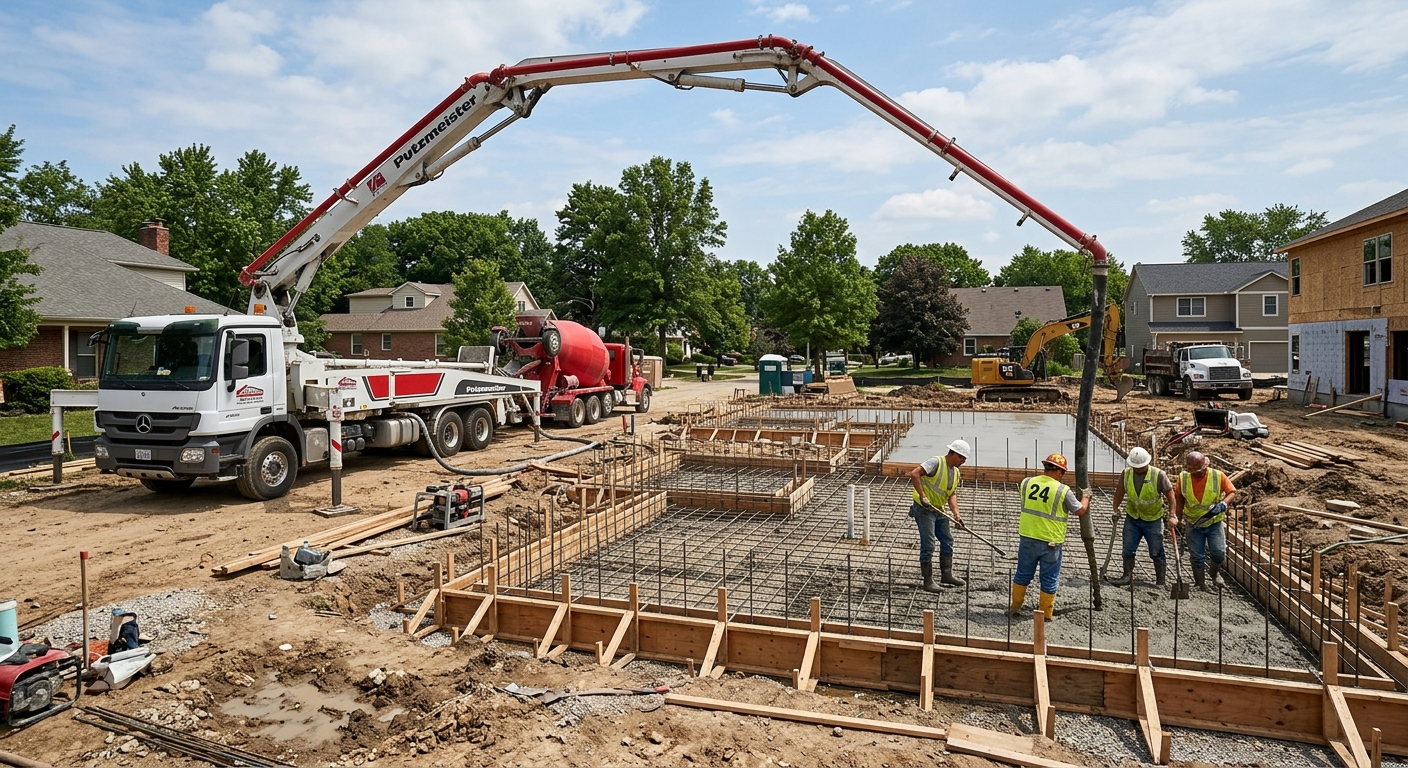
Concrete work options and costs in Shuniah
Shuniah is a small community on the shores of Lake Superior, and that matters for concrete: exterior slabs and sidewalks are constantly dealing with long, cold winters and repeat freeze–thaw cycles. In a housing market where single-detached homes make up 97.2% of dwellings (Statistics Canada, 2021 Census), most concrete calls are for driveways, patios and walkways—plus occasional interior upgrades like garage floors. With 1,350 homeowner households (Statistics Canada, 2021 Census), you’ll usually find competitive scheduling for flatwork during the main pour window (late spring through early fall), but mobilizing for a short season can still push prices up when weather is questionable.
In Northwestern Ontario, contractors price for deeper frost protection and careful base prep. Frost penetration can approach or exceed 5–6 ft in some areas, so footings are often taken to about 4–6 ft below grade to manage frost heave. Exterior concrete also needs air-entrainment to reduce scaling and cracking from freeze–thaw, and you’ll often see higher labour and materials costs due to more granular base, formwork, and slower strength gain in colder shoulder-season pours. In Shuniah, demand is especially steady in the West Shuniah / Thunder Bay border area, where property upgrades tend to align with driveway and walkway replacements.
Below is a practical comparison of common options—use it to sanity-check quotes before you lock in design specs, curing, and finish.
| Application |
Typical Size |
Key Spec |
Finish Option |
Price Range |
| Concrete driveway (standard broom finish) |
300–500 sq. ft. |
Air-entrained mix for exterior, granular base, control joints |
Broom finish, sealed (recommended) |
$5,500–$11,000 |
| Exposed aggregate driveway |
300–500 sq. ft. |
Air-entrained mix; proper timing for wash/exposure |
Exposed aggregate, optional sealer |
$7,500–$15,000 |
| Stamped concrete driveway or patio |
200–450 sq. ft. |
Air-entrained exterior mix; thicker topping for durability |
Stamp pattern + colour integral or release/broadcast |
$6,000–$14,000 |
| Plain concrete patio or walkway |
120–300 sq. ft. |
Proper base and air-entrainment for freeze–thaw resistance |
Broom or light trowel finish, optional sealer |
$2,000–$6,000 |
| Garage floor (interior slab) |
400–600 sq. ft. |
Vapour barrier (where required), thicker slab for durability |
Steel trowel finish (often slip-resistant option) |
$6,000–$13,000 |
| Foundation footings (structural, below frost) |
Typical light residential: 200–500 linear ft. |
Footings set to frost depth, rebar as per engineer/soil conditions |
Structural concrete (no decorative finish) |
$12,000–$28,000 |
Prices are estimates only and vary by project scope, site access and material selection.
What affects the price of concrete work in Shuniah
In Shuniah and across Northwestern Ontario, it’s common to see the “same” concrete job quoted 30–50% apart. The difference usually isn’t the concrete itself—it’s the spec behind it: how deep the base goes, whether the mix is air-entrained to survive freeze–thaw, what reinforcement is used, and what it costs to mobilize a crew during the short pour season. In Ontario, the local frost line and the freeze–thaw cycle dictate design depth and durability details, and those directly affect excavation, granular supply, formwork height and labour time. Frost penetration can reach 5–6 ft in parts of northern Ontario, so exterior footings are commonly set around 4–6 ft below grade, which is more digging and more material than southern Ontario projects.
Exterior slabs are also exposed to de-icing salts on winter roads and driveways. That chemical exposure, combined with freezing temperatures, accelerates surface scaling and spalling if the concrete isn’t properly air-entrained and finished. In Shuniah, cold-weather curing precautions are another pricing driver: when temperatures drop near the minimum for proper strength gain, contractors may need insulating blankets or heated enclosures—raising costs but improving long-term performance. If you’re comparing options, it helps to remember the region’s price bands: a standard broom-finished driveway tends to land around the $14–$22 per sq. ft. range, while decorative work like stamped concrete often starts closer to the $20–$32 band for the higher material and labour intensity.
Two examples of how local conditions change costs: (1) a backyard patio poured on poorly drained soil typically requires thicker granular base and drainage adjustments; (2) a replacement driveway in an area with older soils (over half of homes were built before 1981) often needs deeper removal and regrading to correct settlement, which pushes excavation and disposal costs upward.
| Price Factor |
Why It Matters |
Cost Impact |
| Frost line depth — determines footing depth and form height |
Controls frost heave risk and heaping movement over winter |
Can add major excavation and formwork time; typically noticeable on foundation/footing scopes |
| Site preparation — excavation, grading, compacted granular base |
Good base reduces voids and prevents cracking and pumping |
Higher if removal is deeper, soil is wet, or haul/disposal is needed |
| Reinforcement — rebar or wire mesh requirement |
Reduces cracking and improves slab durability under loads |
Material + placement labour; cost increases with thicker/engineered slabs |
| Mix design — air-entrainment and compressive strength spec |
Air-entrainment resists freeze–thaw scaling and spalling |
Small per-yard increase but high value; usually shifts the quote meaningfully if a cheaper mix is proposed |
| Finish type — broom vs. stamped vs. exposed aggregate |
Impacts labour, timing, and curing/coverage requirements |
Stamped/exposed typically adds labour and specialty materials |
| Pour size and concrete truck access to site |
Access affects pump/placement time and crew productivity |
Hard access can require smaller loads, pumping, or extra labour |
| Cold-weather curing precautions — heating and blankets |
Strength gain depends on temperature; cold pours can weaken if not protected |
Extra equipment and time can raise cost on shoulder-season dates |
| Control joint pattern and sealing cost |
Joints manage shrinkage cracks; sealing helps repel salts and water |
Sealers and saw-cutting/patching add line items but reduce early surface deterioration |
Permits & regulations in Ontario
In Ontario, the rules mainly depend on whether your project is considered structural and on how it affects grading and servicing. In most cases, structural concrete work—such as footings, foundation walls, and grade beams—requires a building permit, and it is commonly tied to engineered drawings that a municipality reviews. For concrete flatwork like patios, walkways, and driveways, permits typically are not required unless your work triggers conditions like changes to lot grading, drainage, or municipal impervious-surface/right-of-way requirements.
For homeowners in Shuniah, the safest approach is to treat permit checks as part of your quote review. Step-by-step, you can verify a contractor’s compliance and readiness:
- Ask whether a building permit is required for your scope (especially footings/foundation-related work).
- Confirm the contractor has liability insurance—request an active Certificate of Insurance showing limits and your project address if available.
- Verify coverage for jobsite workers: in Ontario this is usually handled through WSIB (WCB coverage where applicable). Ask for a clearance letter or proof of account status.
- Ask for references on similar concrete scopes (exterior slabs in freeze–thaw climates).
- If the project affects drainage or grading, ask whether they coordinate with the municipality or follow municipal guidelines for setbacks and slopes.
Always confirm directly with the local authority before breaking ground, particularly if you’re reworking drainage or foundation elements.
Getting concrete right in Shuniah's freeze-thaw climate
Concrete failure in Shuniah usually comes down to a few predictable problems: weak base preparation, the wrong mix (or missing air-entrainment), poor joint spacing, and insufficient curing—then all of it is magnified by freeze–thaw and de-icing salts. In practice, the job spec should be built around the climate: (1) base preparation with a well-compacted granular sub-base to the right depth for frost conditions; (2) a mix design that includes air-entrainment (commonly 5–7% for exterior flatwork) and a minimum 32 MPa compressive strength spec; (3) control joints placed to limit random shrinkage cracking; (4) curing for at least 7 days under proper conditions; and (5) sealing with a penetrating sealer applied after the cure period (often at about 28 days) to reduce salt-water penetration.
When you ask technical questions, focus on what prevents spalling. A contractor should be able to tell you how they achieve freeze–thaw durability (air content, curing approach, and how joints are cut/scheduled). A helpful way to frame quotes: if one option is cheaper only because it proposes less granular base depth or omits sealing, you’re usually paying later in patching and surface scaling.
Dollar example: on a typical Shuniah driveway, an exposed aggregate or stamped finish costs more than a broom-finished driveway. If the decorative option is quoted around the $20–$32 band versus the standard broom finish around $14–$22, it can be justified when the contractor also specifies the same freeze–thaw durability details (air-entrainment, base compaction, proper jointing and curing). If the cheaper broom quote cuts corners on mix spec or curing, the visible difference won’t matter—the slab will still be vulnerable.
| Spec |
Why It Matters in Shuniah |
What to Ask For |
Impact if Skipped |
| Compacted granular base (depth?) |
Prevents voids and pumping under winter loading and freeze–thaw |
Granular base type and compacted depth per site conditions |
More settlement and cracking; premature edge damage |
| Air-entrained concrete mix (target air %?) |
Resists scaling and spalling from repeated freeze–thaw |
Confirmation of air-entrainment target (often 5–7% for exterior flatwork) |
Surface deterioration and scaling during winter cycles |
| Compressive strength (MPa rating) |
Supports strength gain despite cold weather fluctuations |
Minimum 32 MPa (or higher if specified by design) |
Higher risk of cracking, reduced durability, and weak performance |
| Control joints (spacing per ACI guidelines) |
Manages shrinkage cracking before it becomes random |
Planned joint spacing, saw-cut timing, and sealant plan |
Random cracks; difficult, expensive repairs |
| Minimum 7-day curing period |
Cold nights can slow strength gain if not protected |
Curing method and protection plan for forecasted temperatures |
Reduced strength and poorer long-term freeze–thaw resistance |
| Penetrating sealer (when applied after cure) |
Repels de-icing salt and water entry in winter |
Sealer type and timing (commonly around 28 days post-pour) |
More staining, scaling, and moisture-driven deterioration |
How to choose a concrete work contractor in Shuniah
Choosing the right contractor matters in Shuniah because freeze–thaw durability depends on details, not just the pour day. Start by verifying Ontario compliance: request their Certificate of Insurance for liability, and confirm WSIB coverage via a clearance letter or proof of account status. If a contractor can’t provide paperwork quickly, that’s a red flag.
Next, get 2–3 itemised written quotes that break labour and materials down clearly. Prefer quotes that list: excavation and disposal, granular base depth and compaction, reinforcement (mesh/rebar), air-entrained mix and strength spec, finishing method, saw-cut jointing, curing plan, and whether sealing is included. Avoid a quote that’s “all-in” without scope—especially for projects in areas with older housing stock (many homes in the Shuniah market were built before 1981), where removal depth and subgrade conditions often surprise people.
Read exclusions carefully: is the permit included if required, is disposal included, and does the price include patching and remediation for minor subgrade irregularities? Confirm warranty terms in two parts: (1) workmanship warranty length, and (2) any manufacturer/product warranty (and whether it’s transferable to a new owner). For payment, never pay more than 10–15% upfront; use a holdback until the job is complete and cleaned. Finally, get a written start date and completion estimate tied to weather windows—crucial in Northwestern Ontario’s short pour season.
- Ask for WSIB proof (clearance letter or account status) before signing.
- Request a current liability insurance Certificate of Insurance.
- Confirm who pulls permits if structural work is involved (footings/foundation).
- Require an itemised quote: excavation, base, rebar/mesh, concrete supply, forming, finishing, curing, joints.
- Look for the mix spec: air-entrainment and minimum compressive strength.
- Confirm joint spacing plan and saw-cut timing (not just “we’ll add joints”).
- Ask how cold weather is handled (blankets/heating if needed).
- Clarify sealing: included or extra; and when it will be applied (after cure).
- Verify reinforcement placement method (on chairs/spacers—no floating mesh).
- Check site access assumptions: truck distance, pump needs, and equipment access.
- Review cleanup and debris haul/disposal in the quote.
- Use a holdback until final inspection and curing protections are complete.
Concrete red flags to watch for in Shuniah: (1) “cheaper mix” talk or no mention of air-entrainment; (2) vague curing promises (“we’ll pour and it’ll be fine”); (3) no plan for control joints (or joints cut too late); (4) overly aggressive upfront payment; (5) quotes that don’t state granular base depth/compaction or reinforcement details.
Frequently asked questions — concrete work in Shuniah
What is rebar and when is it required in Ontario?
Rebar (reinforcing steel) is steel bars placed inside concrete to help carry tensile stresses and reduce cracking. Whether it’s required depends on the engineering design and the structure’s loads and exposure—not just on the thickness of the concrete. In Ontario, structural scopes like footings, foundation walls, grade beams typically involve engineered requirements that specify reinforcement size, spacing, and cover. For exterior flatwork like driveways and patios, reinforcement may be specified based on thickness, subgrade, and load expectations; some projects use wire mesh or alternative approaches rather than heavy rebar. In Shuniah’s freeze–thaw climate, contractors also focus on base prep and jointing, because reinforcement alone can’t compensate for poor drainage or missing air-entrainment.
How long does a concrete project take in Shuniah?
The “calendar time” depends on cure requirements and weather, especially in Northwestern Ontario where you can get cold nights even in late spring. A typical small interior slab (like a garage floor) might take 1 day for forming and placing, but it still needs curing time before you can fully use the space—often at least several days for light use, with full performance developing over time. Exterior flatwork like patios and walkways usually involves excavation and base prep first, then forming and the pour, and then saw-cutting/control joint work shortly after. Even when the pour happens quickly, many contractors plan for adequate curing and protection; for durability, you should expect at least a minimum curing period (often 7 days) before stressing the slab heavily. If you’re comparing quotes for something around the $2,000–$6,000 patio/walkway band, ask each contractor how they handle cold snaps and what curing method they’ll use.
What is a concrete overlay and is it suited to Shuniah?
A concrete overlay is a new concrete layer placed over an existing slab to restore the surface—often used to address spalling or surface deterioration without full removal. It can be suitable in Shuniah if the existing slab is structurally sound, firmly bonded, and properly prepared (cleaning, profiling, and correct bonding system). However, overlays are not a fix for major settlement, deep cracking with movement, or significant base drainage problems. In Shuniah and across Ontario’s freeze–thaw zone, de-icing salts and moisture can keep the underlying slab wet, so surface failure can reappear if the cause isn’t corrected. Whether an overlay makes sense is typically a cost/condition call: if removal and regrading are needed anyway, full replacement may be the better long-term choice—even if the upfront price moves you from a standard flatwork band toward something higher. A contractor should assess cracks, deflection, and drainage before recommending an overlay.
How do I seal concrete to protect it in Shuniah?
Sealing helps reduce how easily water and de-icing salts penetrate the concrete surface, which is important in Shuniah where freeze–thaw cycles accelerate scaling and spalling. The key is timing and product choice. First, the concrete needs to fully cure under proper conditions—often around 28 days for many sealers before applying a penetrating sealer. Second, the surface should be clean and dry; dirt, curing compounds, and moisture can prevent good absorption. You’ll also want to ensure your job already includes correct mix air-entrainment, base preparation and control joints—sealer isn’t a substitute for durability spec. When you receive quotes, confirm whether sealing is included and what type of sealer is proposed. If a contractor says “we’ll seal someday,” push for a clear plan and schedule, especially for driveways where salt is used in winter.
What is the difference between concrete and cement?
Cement and concrete are related but not the same. Cement is a component—often Portland cement—that binds everything together. Concrete is the final construction material made by combining cement, water, and aggregate (sand and gravel), plus admixtures like air-entrainment for exterior freeze–thaw durability. In Shuniah, what you should really pay attention to is the concrete performance spec: the mix must be designed for freeze–thaw resistance using air-entrainment and meet the needed compressive strength (commonly at least 32 MPa for typical exterior applications). When comparing quotes—like a driveway quote in the $14–$22 per sq. ft. band versus a decorative option in the $20–$32 band—make sure you understand what’s included in the concrete mix design and the finishing/curing steps. A low price can sometimes mean the wrong mix or shortcuts on curing, which affects long-term durability.
How much does concrete work cost in Shuniah?
Concrete costs in Shuniah depend on size, site access, excavation and disposal, base depth, reinforcement, finish type, and weather-related curing precautions. For quick reference, local price bands for the area tier typically fall around $14–$22 per sq. ft. for concrete driveways/slabs, $12–$20 per sq. ft. for patios/walkways, and foundation/footings commonly range around $180–$260 per linear ft. depending on scope and frost-depth excavation needs. Decorative work like stamped/concrete flatwork is often in the $20–$32 per sq. ft. band. A standard broom-finished driveway will usually land somewhere within that driveway band, while stamped concrete will typically cost more due to labour and material-intensive finishing. Always ask for an itemised quote that spells out the base prep, air-entrainment, curing plan and jointing—those details are what keep exterior concrete intact through Northwestern Ontario winters.