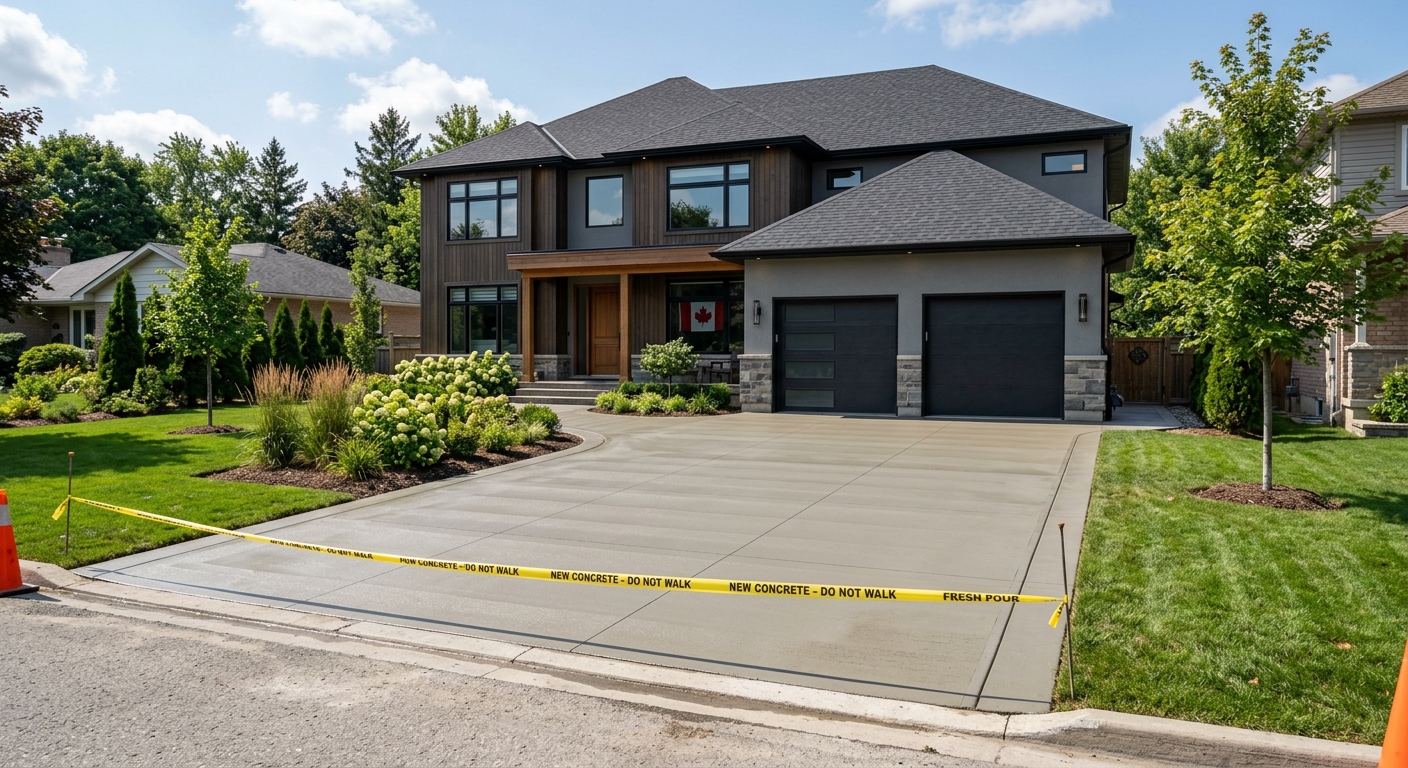
Concrete work options and costs in Mimico
In Mimico, concrete work is a practical choice for driveways, patios, walkways and interior slabs because it handles daily use well and—when it’s built for freeze–thaw—stays solid for years. Mimico sits within Toronto’s broader concrete market, where the housing mix is strongly weighted toward family homes; for example, many households live in neighbourhoods with substantial single-detached home stock (Statistics Canada, 2021 Census). With a local population of 33,964 people (Statistics Canada, 2021 Census), you’ll often find multiple small contractors competing for exterior flatwork jobs, especially around Humber Bay Shores and the Mimico-by-the-Lake area.
What you pay in Toronto/Mimico is driven by frost depth requirements, freeze–thaw cycling, and how the contractor manages curing when temperatures drop toward 10 °C or below. Most structural footings typically extend about 1.2 m (around 4 ft) below grade to reduce frost heave and differential movement. For exterior slabs, Toronto-area contractors commonly specify air-entrained mixes, adequate thickness, and properly spaced control joints to limit random cracking during repeating winter cycles.
The result is that “same-size” projects can still differ significantly in price. A standard broom-finished driveway is usually straightforward, while decorative options—like stamped concrete or exposed aggregate—require extra finishing labour and material management. Use the table below to compare typical scopes you’ll see quoted for Mimico, then we can narrow it down with your site access, drainage plan, and finish selection.
| Application |
Typical Size |
Key Spec |
Finish Option |
Price Range |
| Concrete driveway (standard broom finish) |
400–600 sq ft |
Air-entrained exterior mix, compacted granular base, control joints |
Broom finish, optional colour hardener |
$18,000–$28,000 |
| Exposed aggregate driveway |
400–600 sq ft |
Air-entrained mix, consistent aggregate size, proper curing timing |
Exposed aggregate with sealer |
$22,000–$34,000 |
| Stamped concrete driveway or patio |
300–550 sq ft |
Air-entrained mix, reinforcement as required, jointing plan |
Stamp mats + release, integral/antique colour |
$24,000–$40,000 |
| Plain concrete patio or walkway |
200–500 sq ft |
Compacted base and edge restraint, air-entrained for exterior |
Smooth or broom finish |
$3,200–$13,000 |
| Garage floor (interior slab) |
300–600 sq ft |
Vapour barrier as applicable, 25–32 MPa mix, proper jointing |
Float/smooth trowel, optional densifier |
$7,200–$18,000 |
| Foundation footings (structural, below frost) |
Varies by house plan |
Engineered footing detail, reinforced concrete below frost depth |
Structural pour only (no decorative finish) |
$180–$300 |
Prices are estimates only and vary by project scope, site access and material selection.
What affects the price of concrete work in Mimico
In Mimico and across the Toronto economic region, quotes can swing by 30–50% even when neighbours request “the same size” slab or driveway. The biggest reason is that concrete pricing isn’t just concrete—it’s excavation, compacted granular base, reinforcement, mix design, weather protection, and finishing time. Two contractors can propose similar-looking finished surfaces, but one may include deeper frost-conscious excavation, better drainage prep, more robust air-entrainment specs, or a different reinforcement plan.
Every exterior structural decision is shaped by freeze–thaw cycles. Footings must extend below design frost depth to prevent frost heave and differential settlement (Ontario commonly calls for about 1.2 m or more below grade). For slabs, contractors typically use air-entrained concrete so the mix survives repeated freezing and thawing. In the GTA, the pour season is effectively shorter when temperatures hover and drop toward 10 °C; if heat, insulating blankets, or longer curing controls are needed, labour and equipment costs rise. De-icing salt in winter also accelerates surface spalling if the mix and sealing system aren’t planned properly—so sealing can be a meaningful part of long-term performance.
Here are a few Mimico examples that often raise or lower costs: (1) if your driveway ties into an existing garage apron and requires saw-cut removal and regrading, disposal and demolition labour add up; (2) if soil is wet or poorly drained, you may need upgraded base thickness and sub-drainage to stop saturation-driven expansion/contraction; and (3) if you choose stamped concrete, the extra finishing time pushes pricing beyond a standard broom finish—often aligning more with the $24–$40 band for decorative work.
| Price Factor |
Why It Matters |
Cost Impact |
| Frost line depth — determines footing depth and form height |
Controls excavation depth and protects against frost heave |
Higher depth increases haul, labour, and forming time |
| Site preparation — excavation, grading, compacted granular base |
Proper base prevents voids and pumping during wet/freezing cycles |
More base thickness and rework can add significant labour and materials |
| Reinforcement — rebar or wire mesh requirement |
Reduces cracking and improves slab performance under load |
Material and placement labour can raise costs |
| Mix design — air-entrainment and compressive strength spec |
Air-entrainment improves freeze–thaw durability |
Correct mix may cost more but prevents premature spalling |
| Finish type — broom vs. stamped vs. exposed aggregate |
Finishing complexity affects time, materials, and curing sensitivity |
Stamped/exposed typically costs more than standard broom finishes |
| Pour size and concrete truck access to site |
Access limits batching logistics and affects crew productivity |
Restricted access can require extra labour or smaller pours |
| Cold-weather curing precautions — heating and blankets |
Protects early-age strength gain when temps drop |
Heating/insulation adds equipment and time, especially during shoulder seasons |
| Control joint pattern and sealing cost |
Controls crack locations and helps repel salt-accelerated deterioration |
Sealer and joint detailing add line-item scope but improve longevity |
Permits & regulations in Ontario
In Ontario, structural concrete work such as footings, foundation walls and grade beams typically requires a building permit. In many cases, engineered drawings are reviewed as part of that permitting process, because the structural elements must meet code requirements for loads and durability. For concrete flatwork—driveways, patios, sidewalks and walkways—a permit is often not required, unless the work affects lot grading, impervious surface coverage limits, or municipal right-of-way conditions (for example, where your driveway ties into a public curb or walkway).
To verify your contractor properly in Mimico, do this step-by-step: first, confirm they carry liability insurance and that you receive a certificate of insurance showing you as an additional party (if applicable). Second, confirm WSIB coverage (or the equivalent coverage status letter where required) so you’re protected if a worker is injured on site. Third, ask for their credentials and proof of trade coverage; many experienced crews also provide references on jobs of similar structural scope. If the job includes engineered components, request the engineer-of-record details and check that the drawing submission corresponds to your permit package.
Finally, always contact the local permitting authority before breaking ground if there’s any uncertainty—especially where drainage, foundation tie-ins, or grade changes are involved.
Getting concrete right in Mimico's freeze-thaw climate
Concrete failures in Mimico are most often tied to how the base and mix were built for freeze–thaw. If the sub-base isn’t compacted to the right depth, water can accumulate and create pumping or settlement. If the mix isn’t properly air-entrained, repeated freezing can damage the paste and lead to surface spalling and scaling—sometimes within a few winters. In Toronto’s climate, even if the day’s weather looks workable, curing management matters: exterior pours need steady early-age protection, and when temperatures trend lower, contractors must maintain curing conditions long enough for strength gain.
To spec the job correctly, insist on five core elements. (1) Base preparation: compacted granular sub-base sized for your soil and local frost conditions; correct drainage prevents saturation-driven expansion/contraction. (2) Mix design: air-entrained concrete with 5–7% air for exterior flatwork, plus a minimum 32 MPa compressive strength spec. (3) Control joints: spacing that limits random cracking to planned joints. (4) Curing: a minimum of 7 days under proper conditions, with extra protection when it’s cold. (5) Sealing: a penetrating sealer applied after full cure (commonly around 28 days) to repel de-icing salts.
Price-wise, the “premium” is sometimes justified: for instance, upgrading from a standard broom driveway in the typical $18–$28 band to exposed aggregate often costs more, but the extra curing discipline and finishing time can be worthwhile when you also add proper sealing and jointing. If, however, a quote jumps because of decorative options while cutting back on base depth or air-entrainment, you’re paying for appearance—not durability.
| Spec |
Why It Matters in Mimico |
What to Ask For |
Impact if Skipped |
| Compacted granular base (depth?) |
Stable base reduces movement during wet winters and freeze–thaw |
Confirm excavation depth and granular base thickness + compaction test method |
Settlement, edge cracking, and premature failure |
| Air-entrained concrete mix (target air %?) |
Air voids help resist freeze–thaw scaling/spalling |
Ask for target air content of 5–7% for exterior flatwork |
Surface scaling, potholing, and early deterioration |
| Compressive strength (MPa rating) |
Ensures adequate strength gain for traffic/load performance |
Minimum 32 MPa specification for the slab/footing class |
Increased cracking and reduced longevity |
| Control joints (spacing per ACI guidelines) |
Directs shrinkage cracks to joints, not random locations |
Ask for planned joint layout and approximate spacing |
Random cracking and water intrusion into cracks |
| Minimum 7-day curing period |
Early strength gain is critical in Toronto’s shoulder-season temps |
Ask how they protect the pour when temperatures drop |
Weak surface, increased cracking, and poor wear resistance |
| Penetrating sealer (when applied after cure) |
Helps repel de-icing salt and reduces moisture ingress |
Confirm sealer type and application timing (commonly around 28 days post-pour) |
Faster spalling and staining from winter salts and moisture |
How to choose a concrete work contractor in Mimico
Choosing the right concrete contractor in Mimico is less about flashy photos and more about proof they build for Toronto freeze–thaw. Start by verifying Ontario trade status where applicable, then confirm liability insurance and WSIB/WCB coverage. In practice, you want to see (1) a current certificate of insurance, (2) WSIB clearance or confirmation of coverage, and (3) a workmanship warranty policy in writing.
Next, get 2–3 itemised written quotes instead of one lump sum. Ask for a breakdown that separates labour, concrete supply, reinforcement, formwork, excavation, granular base, vapour/land drainage provisions (if relevant), sawcutting/jointing, sealing, and disposal. If they’re vague about exclusions—like whether traffic control, protection of landscaping, or permit support is included—your final bill can drift upward. Also ask whether they’ll provide engineered drawings for structural elements or coordinate with your permit requirements for footings and foundation work.
For warranty, check two things: workmanship duration (for example, flatwork cracking/spalling standards) and the concrete product or admixture/manufacturer warranty, if any. Is the warranty transferable to future owners? For payments, keep it reasonable: never pay more than 10–15% upfront, and hold back a portion until key milestones are complete. Finally, require a start date and completion estimate in writing so crews can’t “float” the schedule through cold snaps.
- Ask what frost-depth and footing depth they assume for your design and confirm it matches Ontario requirements.
- Require air-entrainment details for exterior slabs (target air content, not just “exterior mix”).
- Request thickness for your driveway/patio and the granular base thickness/compaction approach.
- Confirm reinforcement plan (mesh vs rebar, placement depth, and coverage).
- Get the joint layout and spacing plan in writing (plus whether joints are sawcut or formed).
- Ask how they protect curing when temperatures drop and what blankets/heating they use if needed.
- Require disposal and dump fees to be stated—no “included as available” language.
- Check whether sealing is included and when it will be applied relative to the pour cure schedule.
- Make sure work starts only after site drainage and grading are confirmed.
- Ask for proof of liability insurance and WSIB coverage (clearance letter or status confirmation).
- Use an itemised quote that lists materials and labour separately.
- Confirm warranty terms: what’s covered, duration, exclusions, and how claims are handled.
Concrete red flags I see around Mimico include: promises of “guaranteed no cracks” (no contractor can control shrinkage 100%), ignoring air-entrainment for exterior flatwork, vague curing practices when nights are cold, skipping granular base depth and compaction details, and quotes that don’t mention sealing or jointing—then blaming winter damage after the fact.
Frequently asked questions — concrete work in Mimico
Concrete vs pavers for a patio in Mimico?
In Mimico, both concrete and pavers can work well, but the deciding factor is freeze–thaw tolerance and drainage. Concrete patios built with air-entrained mix, correct base compaction, and properly spaced control joints tend to handle Toronto-area winters reliably. Pavers can also perform great, but they’re more sensitive to base thickness, slope, and edge restraint—if the bedding material washes out during wet periods, you can get uneven movement. Price-wise, plain concrete patios typically fall within the concrete patio/walkway band of $16–$26 per sq ft (scope-dependent), while pavers often cost more once you add excavation, edging, and underlayment. If you want low maintenance and a consistent surface, concrete is usually the cleaner path—especially when combined with a good sealing plan where de-icing salts are common.
How long does a concrete driveway last?
A well-built driveway in Mimico commonly lasts 20–30 years, and sometimes longer, but only when it’s engineered for freeze–thaw and salt exposure. The big determinants are base preparation, air-entrainment in the exterior mix, and whether the contractor controls cracking with the right joint spacing. If the drainage is poor and the sub-base stays saturated, freeze–thaw cycles accelerate scaling and movement. If you’re comparing quotes, don’t just focus on the “per square foot” number—ask whether the driveway is broom finished, whether it includes sealing, and whether the contractor protects curing during cooler weather. You’ll often see broom-finish driveways land in the $18–$28 concrete band, while decorative upgrades like exposed aggregate usually move higher because of extra labour and finishing steps.
What is air-entrained concrete and why does it matter here?
Air-entrained concrete is a mix designed with microscopic air bubbles that give freezing water somewhere to expand. In Ontario, freeze–thaw cycles are a durability stressor, and exterior concrete without adequate air content is more likely to spall (flake) and scale. In Mimico’s Toronto climate, that’s exactly why most reputable contractors specify an exterior, air-entrained mix for driveways, patios, and walkways. A key technical question is: what target air content are you using (commonly 5–7% for exterior flatwork)? This matters because de-icing salt and moisture exposure in winter magnify surface deterioration when the paste isn’t protected by proper air void structure. When you hear “exterior mix” without air-entrainment specs, ask for the details before you approve the quote.
How do I prepare the base for a concrete slab?
Concrete base preparation is where most longevity is decided. For a slab in Mimico, the contractor should excavate to the correct depth for both your slab thickness and frost-conscious granular base requirements, then grade to slope away from structures. After excavation, the sub-base should be placed and compacted in lifts using appropriate compaction equipment, not just “rolled once.” If the subsoil is wet or variable, the scope may expand to include additional granular thickness or drainage improvements so the concrete isn’t sitting over saturated soils that expand and contract with freeze–thaw. Before signing, ask what granular base thickness is included, how compaction is verified, and whether reinforcement is placed at the correct height above the base. These items usually don’t show up as “optional”—they’re essential.
How do I compare concrete quotes?
To compare concrete quotes fairly in Mimico, insist on itemised line items rather than a single lump sum. Compare the same scope across quotes: excavation depth, granular base thickness and compaction approach, reinforcement (if required), concrete mix type (including air-entrainment and compressive strength), and the finish system (broom vs stamped vs exposed aggregate). Also compare what’s included for site protection, disposal, and sealing. Quotes should specify curing protection in cooler stretches; in the GTA, temps dropping toward 10 °C can trigger extra blankets/heating needs. Finally, check pricing against the local bands: a standard driveway often sits in the $18–$28 range, while stamped/decorative work often moves into the $24–$40 band. If a “low” quote can’t explain why it’s lower (or what it’s leaving out), it’s usually a scope omission.
Can concrete be poured in cold weather in Mimico?
Yes, concrete can be poured in cold weather in Mimico, but only with the right precautions and planning. The issue isn’t just the day’s air temperature—it’s the ability to protect early-age concrete so it reaches sufficient strength before freezing. Good contractors use temperature monitoring, curing blankets, and sometimes controlled heating on the formwork or around the pour area. They may also adjust timelines because curing continues to take longer when it’s colder. Ask whether their quote includes cold-weather curing measures and how they handle nights when temperatures can fall well below comfortable curing conditions. If a contractor says “we’ll pour as normal” without mentioning blankets/heating or curing control, that’s a concern. It’s also one reason exterior pours in the Toronto area are often concentrated in warmer months for consistent results.