Concrete work options and costs in Woodbine-Lumsden
Woodbine-Lumsden is a fast-growing part of the Toronto region, with a population of 7,865 (Statistics Canada, 2021 Census). In a neighbourhood like the Bayview/Church corridor (and the broader Woodbine-Lumsden area around local streets), most concrete demand comes from homeowners upgrading driveways, patios, walkways, and occasionally basement work as houses age and families re-plan their outdoor space. The City’s housing stock is typically dominated by single-family properties, which means driveway and flatwork are frequent projects—especially when residents want a cleaner curb look or better drainage where the ground can get wet in spring and fall.
Toronto-area concrete costs are driven by freeze–thaw performance requirements and the need to place concrete correctly in a shorter reliable pour season. Local specifications commonly include air-entrained concrete, adequate thickness, and properly located control joints to manage cracking outdoors. Footings for structural work generally need to extend below design frost depth (in Ontario, often 1.2 m or more, depending on soil and design), which adds excavation, formwork, and concrete volume compared with interior slabs. Availability of skilled labour and scheduling in the warmer months can also affect pricing—many crews focus on exterior flatwork when temperatures support good curing.
Below is a practical comparison of common options you’ll see from contractors in Woodbine-Lumsden, so you can match the finish to your budget and performance expectations before you review quotes.
| Application |
Typical Size |
Key Spec |
Finish Option |
Price Range |
| Concrete driveway (standard broom finish) |
400–600 sq. ft. |
Air-entrained mix, compacted base, control joints |
Broom finish |
$7,200–$16,800 |
| Exposed aggregate driveway |
400–600 sq. ft. |
Air-entrained mix, proper base and finishing timing |
Exposed aggregate (wash/retard system) |
$9,000–$21,000 |
| Stamped concrete driveway or patio |
300–500 sq. ft. |
Air-entrained mix, thicker slab than basic flatwork, sealer |
Stamp + color hardener/release |
$10,000–$20,000 |
| Plain concrete patio or walkway |
200–400 sq. ft. |
Compacted granular base, air-entrained exterior mix |
Light broom or smooth trowel (as specified) |
$3,200–$10,400 |
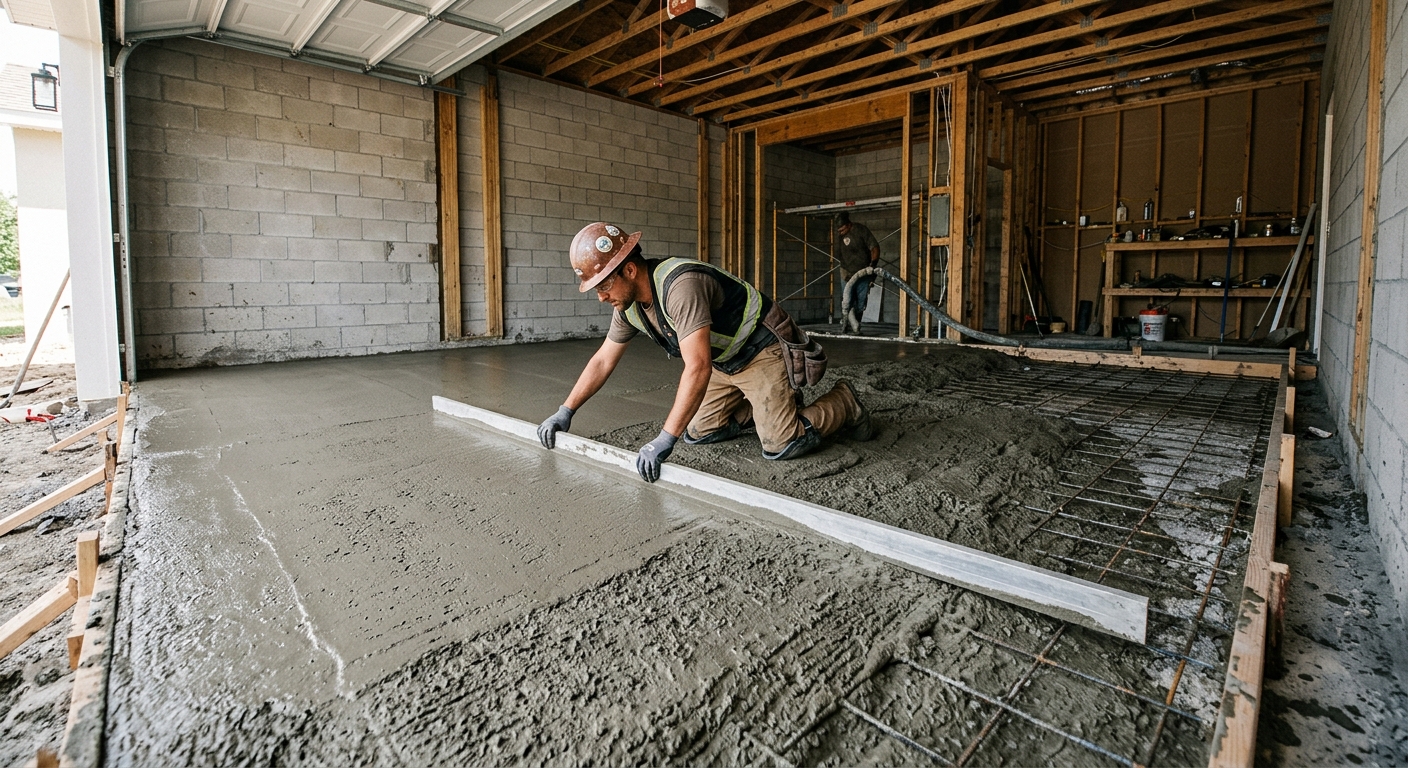
| Garage floor (interior slab) |
300–600 sq. ft. |
Vapour barrier (if required), reinforcement as needed |
Smooth trowel or light broom |
$5,400–$13,800 |
| Foundation footings (structural, below frost) |
Per project (typ. 1–2 pours) |
Engineered dimensions, below frost depth, reinforcement |
Structural form + rebar cage |
$7,500–$15,000 |
Prices are estimates only and vary by project scope, site access and material selection.
What affects the price of concrete work in Woodbine-Lumsden
In Woodbine-Lumsden and across the wider Toronto economic region, quotes for the same “simple” concrete work can land 30–50% apart because the biggest cost drivers aren’t visible from the driveway edge. Two contractors may quote the same slab area, but one may include deeper base preparation, proper drainage detailing, engineered reinforcement, air-entrained mix, and correctly placed control joints—while another relies on lighter specs that don’t hold up to repeated freeze–thaw. In Ontario’s climate, that difference shows up as more cracking risk, faster surface breakdown, and higher repair costs later.
Frost depth and freeze–thaw cycles dictate nearly every structural detail. Exterior footings generally must extend below design frost depth (in Ontario commonly in the 1.2 m range or deeper, depending on soil conditions) to prevent frost heave and differential movement. Exterior slabs are also typically built with air-entrained concrete; that air system is essential for surviving freeze–thaw. When temperatures drop toward 10 °C and below during the pour season, cold-weather curing precautions—like insulating blankets or temporary heat—can be required to protect strength development, adding labour and consumables. De-icing salts used in Toronto-area winters accelerate surface scaling if the mix and curing weren’t done correctly, so sealing is commonly recommended for exterior flatwork.
In Woodbine-Lumsden, I often see cost swing upward when sites have soft, saturated topsoil that needs full removal and replacement with compacted granular base, or when access is tight and smaller trucks/extra labour are needed to move forms and concrete. Conversely, costs can be lower when you’re upgrading from old asphalt with relatively straightforward removal and there’s good vehicle access. For budgeting, a standard broom-finish driveway often sits in the $18–$28 per sq. ft. band, while stamped and decorative work can move into the higher $24–$40 range—so it’s justified when you want the curb appeal upgrade, not just a flat surface.
| Price Factor |
Why It Matters |
Cost Impact |
| Frost line depth |
Determines footing depth and form height |
More excavation and concrete volume; increases labour and equipment time |
| Site preparation |
Excavation, grading, compacted granular base |
Wet/soft soils and thicker base increase cost and drying/compaction time |
| Reinforcement |
Rebar or wire mesh requirement |
Adds material cost plus labour for placement, chairs, and inspection |
| Mix design |
Air-entrainment and compressive strength spec |
Air-entrained exterior mix and spec concrete can raise per-yard costs |
| Finish type |
Broom vs. stamped vs. exposed aggregate |
Decorative finishes add crew time, materials, and sealing steps |
| Pour size and concrete truck access to site |
Placement speed and ability to pump/manhandle concrete |
Poor access can require smaller trucks, pump charges, and extra labour |
| Cold-weather curing precautions |
Heating and blankets to protect strength gain |
In shoulder-season pours, costs rise due to protection measures |
| Control joint pattern and sealing cost |
Controls cracking and reduces water/salt damage |
Proper joints and sealer add line-item cost but reduce long-term failures |
Permits & regulations in Ontario
In Ontario, structural concrete work such as foundation footings, foundation walls, and grade beams typically requires a building permit, and engineered drawings are often reviewed by the municipality before construction starts. For concrete flatwork—patios, walkways, and driveways—permits are usually not required as long as the work doesn’t significantly change lot grading, drainage, or affect impervious surface coverage limits, and it stays within municipal right-of-way requirements. However, you should confirm in Woodbine-Lumsden with the local authority before breaking ground, because small grading changes can trigger requirements depending on how the slope and surface water are managed.
When choosing a contractor, don’t rely on verbal reassurance. To verify an Ontario contractor properly, use a simple step-by-step approach: (1) request their certificate of insurance and confirm liability coverage matches the project scope; (2) ask for WSIB/WCB clearance information (or proof of coverage/registration, depending on how they operate); (3) check licensing/registry information online where applicable and confirm the company name matches the paperwork; and (4) ask for references on similar-scale jobs in the Toronto area—especially exterior flatwork built for freeze–thaw durability.
If it’s structural concrete (footings/walls), ensure the permit is pulled under the correct party and that inspections are scheduled. That paperwork protects you when there’s ever a question about rebar placement, embedments, or inspection sign-offs.
Getting concrete right in Woodbine-Lumsden's freeze-thaw climate
Concrete failures in Woodbine-Lumsden usually come back to one of five things: poor base preparation, inadequate mix design for freeze–thaw, missing or mis-spaced control joints, insufficient curing, or skipping sealing on exterior work. In the Toronto region, repeated freezing and thawing loads water into microscopic pores and around surface layers; if the concrete isn’t air-entrained, that water expansion can cause scaling and spalling. That’s why a “lowest bid” mix that looks fine on day one can crumble prematurely after a couple winters.
To spec the job correctly, start with the base: concrete exterior flatwork needs a properly excavated, compacted granular sub-base to the correct depth so the slab doesn’t settle or pump under traffic. Next, the mix: for exterior flatwork, a typical air-entrainment target is in the 5–7% range, paired with a minimum 32 MPa compressive strength. Then control cracking: plan joint placement so joints absorb shrinkage and thermal movement rather than forcing random cracking. After placement, curing matters—plan for at least 7 days of curing under proper conditions, and use cold-weather protection if temperatures are near or below typical strength-gain thresholds. Finally, sealing: apply a penetrating sealer after the concrete has cured (commonly at 28 days) to help repel de-icing salts and reduce surface scaling risk.
Where the price difference makes sense: if you’re choosing between a plain patio at about $16–$26 per sq. ft. and stamped decorative at $24–$40, the higher cost is usually justified by extra labour, colour materials, and finishing time. But the freeze–thaw “must haves” (base, air-entrainment, joints, curing) should be included in both options.
| Spec |
Why It Matters in Woodbine-Lumsden |
What to Ask For |
Impact if Skipped |
| Compacted granular base (depth?) |
Prevents pumping and frost-related movement through freeze–thaw |
Confirm excavation depth + compacted granular base depth for your soil |
Settling, uneven slab, early cracking |
| Air-entrained concrete mix (target air %?) |
Reduces freeze–thaw damage and helps prevent spalling |
Ask for air-entrainment target (typically 5–7% for exterior flatwork) |
Scaling/spalling after winter freeze cycles |
| Compressive strength (MPa rating) |
Ensures durability and adequate strength gain before exposure |
Minimum 32 MPa compressive strength per spec |
Lower durability and faster surface deterioration |
| Control joints (spacing per ACI guidelines) |
Controls shrinkage and thermal cracking in the right places |
Ask for joint spacing plan and whether joints will be sealed |
Random cracks and water infiltration |
| Minimum 7-day curing period |
Strength development continues after placement, especially outdoors |
Confirm curing method and protection timeline; add cold-weather measures if needed |
Reduced strength and higher crack risk |
| Penetrating sealer (when applied after cure) |
Helps repel water and de-icing salt intrusion in Ontario winters |
Apply after cure (commonly at 28 days); specify product type |
More scaling and faster surface breakdown |
How to choose a concrete work contractor in Woodbine-Lumsden
Choosing the right contractor matters in Woodbine-Lumsden because the “invisible” work—base preparation, air-entrainment selection, joint planning, and curing—determines whether you get a slab that lasts through Toronto winters. Start by verifying Ontario coverage: request a current certificate of liability insurance and confirm it covers contractor operations at your address. Next, ask for WSIB/WCB coverage information (or proof of registration/clearance as applicable). Then confirm the contractor’s identity matches the paperwork and ask for their business registration and any relevant trade qualifications they carry for the type of concrete work.
Get 2–3 written, itemised quotes rather than lump sums. You want a labour + materials breakdown and clear scope: excavation and haul-away, granular base depth, reinforcement details, concrete mix type (including air-entrainment for exterior work), concrete thickness, joint locations, and curing/protection steps. Make sure you know what’s excluded—things like permit pull responsibilities, dump fees, saw-cut depth, or subgrade stabilization when soils are unstable.
Warranty should be in writing. Ask for workmanship warranty length, and clarify whether there’s a separate product/manufacturer warranty for sealer or decorative systems—and if that warranty is transferable. For payment, don’t pay more than 10–15% upfront; hold back the balance until completion and final cleanup. Finally, insist on a start date and realistic completion estimate in writing, because weather in the Toronto region can affect curing and finishing schedules.
- Ask if the exterior mix is air-entrained and confirm the target air range.
- Confirm base depth and compaction method (and whether they test/verify density where required).
- Get slab thickness and reinforcement details in the quote (mesh vs rebar and size/spacing).
- Require a joint plan: spacing, pattern, and whether joints are sealed.
- Ask what curing protection they use if temperatures drop during the first week.
- Confirm sealing product type and the timeline (commonly after full cure, e.g., 28 days).
- Check insurance certificate validity dates and coverage limits.
- Verify WSIB/WCB coverage information before work starts.
- Request references from similar exterior flatwork in the GTA.
- Ensure disposal/haul-away is included if they’re removing existing concrete.
- Look for clear line items—not vague allowances—for excavation, forms, and finishing.
- Set a payment schedule with a holdback until final inspection and cleanup.
Red flags I see in Woodbine-Lumsden include quotes that ignore air-entrainment for exterior work, vague “contractor grade” mix statements with no spec, no mention of curing protection in shoulder-season pours, payment schedules asking for large upfront deposits, and missing insurance/WSIB documentation or reluctance to provide references on freeze–thaw durability jobs.
Frequently asked questions — concrete work in Woodbine-Lumsden
What is the difference between concrete and cement?
In everyday Ontario conversations, people say “cement” when they mean the whole material. Cement is actually one ingredient inside concrete: Portland cement (powder) plus water, aggregates (sand/gravel), and usually additives. Concrete is the finished engineered product that’s poured and hardens through a controlled chemical reaction. In Woodbine-Lumsden, the practical takeaway is what you ask for in the mix—especially for exterior flatwork. For freeze–thaw durability, contractors should specify an air-entrained exterior mix rather than just using a generic “concrete” description. When you get quotes, ask about the mix design and target air content, since poor air-entrainment is a common cause of spalling after winters.
How much does concrete work cost in Woodbine-Lumsden?
Pricing in Woodbine-Lumsden typically follows Toronto-region per-square-foot bands, because excavation and freeze–thaw specs drive material use and labour. As a quick budgeting reference, concrete driveways often land around $18–$28 per sq. ft. for standard broom-finish work, while stamped or decorative options commonly move into the $24–$40 per sq. ft. range depending on labour intensity, colours, and finishing. Patios and walkways are commonly priced around $16–$26 per sq. ft. The range can widen if your soil is saturated and requires deeper granular base, if reinforcement or thicker slab is needed, or if cold-weather curing protection is required to reach strength before exposure.
How deep must footings be for Woodbine-Lumsden's frost line?
In Ontario, structural footings generally need to extend below the design frost depth to prevent frost heave and differential movement. While the exact depth is set by the project design and geotechnical conditions, a common requirement in Ontario is at least about 1.2 m below grade for many residential structural situations. In Woodbine-Lumsden, that means excavation and form height aren’t optional—they’re built into structural reality. The engineer/architect’s footing elevations should govern, and contractors typically rely on those drawings for the exact depth and reinforcement placement. If you’re being quoted without discussing frost protection or footing elevations, ask for the engineered footing spec or geotechnical recommendations.
Why does concrete crack in Woodbine-Lumsden and how is it prevented?
Concrete cracks in Woodbine-Lumsden mainly due to shrinkage, thermal movement, and water-related freeze–thaw stress. Every exterior slab will experience movement; the goal is to control where cracks happen so they don’t turn into random breaks and pathways for water. Prevention starts with a well-compacted granular base, correct slab thickness, and a properly planned joint pattern. Control joints should be cut or formed at spacing aligned with standard design practice so the slab releases stresses at intended locations. Just as important for Ontario winters is using air-entrained concrete outdoors and curing it properly for at least 7 days. Sealing later (often after full cure, commonly around 28 days) helps repel salt and reduces surface damage.
Stamped vs broom-finish concrete — cost difference?
Stamped concrete costs more because it’s a multi-step finishing system: base concrete, additional timing controls, texture stamping, release agents, often colour hardener or stains, and careful curing/protection. A broom-finish driveway or walkway is comparatively straightforward. In the Toronto region, you can usually expect standard concrete flatwork closer to $18–$28 per sq. ft., while stamped/decorative work frequently lands around $24–$40 per sq. ft. That price difference can be justified if you want the visual upgrade and you still get freeze–thaw fundamentals—air-entrained mix, correct thickness, joint plan, and proper curing—because those are what keep stamped surfaces from deteriorating early.
When is the best time to pour concrete in Woodbine-Lumsden?
For Woodbine-Lumsden, the best pours are typically in the warmer months when temperatures support proper curing. Toronto-area crews often schedule exterior flatwork so concrete can be finished and cured before conditions drop toward 10 °C or below. When pours happen late in the season, contractors may need cold-weather curing precautions like insulating blankets and sometimes temporary heating—those add labour and cost, and they’re only effective if planned ahead. If you’re aiming for exterior work like driveways, patios, or walkways, plan for a spring/early summer or early fall window, and ask your contractor how they’ll protect the slab during the first week. This matters for strength development and long-term durability in Ontario’s freeze–thaw cycle.