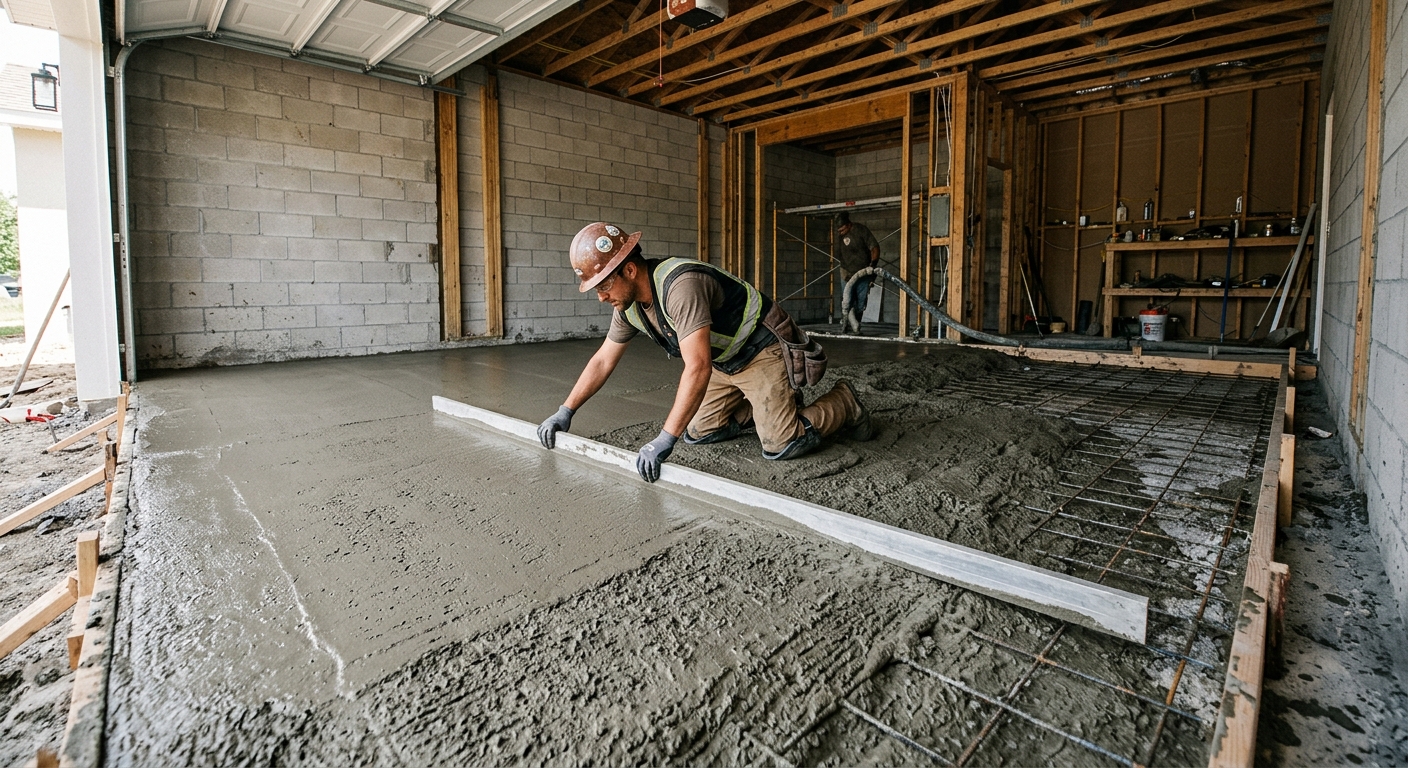
Concrete work options and costs in Metcalfe
Concrete work in Metcalfe, Ontario, often starts with the driveway and backyard flatwork homeowners can see every day. With Metcalfe’s small population of 1,776 (Statistics Canada, 2021 Census), there aren’t endless crews locally, so scheduling can tighten during peak season—especially when nearby towns in the Toronto economic region are also booking exterior pours. The broader Toronto market also includes plenty of family housing where driveways, patios, and walkways see heavy use; in practice, that means concrete contractors stay busy and competitive quotes depend on how quickly your site can be prepared.
In the Toronto economic region, frost depth and freeze–thaw cycles shape nearly every spec. Footings for structural concrete typically need to extend below grade by at least 1.2 m (about 4 ft) to reduce frost heave and differential movement. For exterior slabs and flatwork, contractors commonly use air-entrained mixes, adequate thickness, and control joints—because repeated wetting, freezing, and thawing is exactly how surface scaling and random cracking develop. Wet spring and fall conditions also mean drainage and granular base prep aren’t “nice-to-haves”; they protect the concrete from being surrounded by saturated soil.
Local demand is especially noticeable around established residential pockets like the Metcalfe village area, where families often renovate aging homes and update driveways and patio walkways. Below is a practical cost comparison so you can align your expectations with the typical price bands for this tier, then refine the scope with a contractor.
| Application |
Typical Size |
Key Spec |
Finish Option |
Price Range |
| Concrete driveway (standard broom finish) |
400–600 sq. ft. |
4"–5" slab, granular base, control joints |
Broom finish, saw-cut joints |
$18,000–$28,000 |
| Exposed aggregate driveway |
400–600 sq. ft. |
Air-entrained mix, proper finishing timing |
Exposed aggregate with sealer |
$22,000–$36,000 |
| Stamped concrete driveway or patio |
300–500 sq. ft. |
Air-entrained mix, release agent, color hardener |
Stamped pattern + integral/base coloring |
$24,000–$40,000 |
| Plain concrete patio or walkway |
200–400 sq. ft. |
Sloped for drainage, compacted base |
Smooth/plain finish, edges formed |
$16,000–$26,000 |
| Garage floor (interior slab) |
400–600 sq. ft. |
Vapor barrier (as needed), reinforced slab |
Smooth finish, steel trowel (if desired) |
$6,500–$11,500 |
| Foundation footings (structural, below frost) |
Per footing project |
Engineered dimensions, rebar, below-frost depth |
Normal finish (not decorative) |
$180,000–$300,000 |
Prices are estimates only and vary by project scope, site access and material selection.
What affects the price of concrete work in Metcalfe
In the Toronto region, it’s common to see quotes for the “same” concrete project vary by 30–50% once you account for site conditions and the specs needed to survive Metcalfe’s freeze–thaw winters. A 500 sq. ft. exterior pour might land close to the driveway slab price band of $18,000–$28,000, but add poor drainage, thicker structural requirements, more reinforcement, or better finishing and sealing—and the price can move quickly toward the top end. The reason is straightforward: crews can’t control Mother Nature, so they adjust concrete thickness, base prep, and mix design.
Frost line depth and freeze–thaw cycles dictate every part of the job. Structural footings must extend below design frost depth (Ontario typically 1.5–2.4 m depending on location and design requirements) to prevent frost heave. Exterior slabs require air-entrained concrete to withstand repeated freezing and thawing, and they need adequate thickness plus well-planned control joints to manage cracking. When temperatures drop toward 10 °C or below, crews must use cold-weather curing precautions—insulating blankets, scheduling changes, and sometimes heating—which increases labour and material costs. Finally, de-icing salts accelerate surface scaling/spalling if the slab isn’t properly mixed and later sealed; in Metcalfe, sealing is often the difference between “looks fine for a season” and long-term durability.
In Metcalfe specifically, two common cost drivers push prices up: (1) saturated soils or poor slope around the existing driveway and foundation area—these force deeper granular base and tighter drainage detailing; and (2) tight access for concrete trucks, which may require extra equipment time. Conversely, costs can come down when demolition is minimal, excavation is straightforward, and the pour size stays within a typical workflow.
| Price Factor |
Why It Matters |
Cost Impact |
| Frost line depth — determines footing depth and form height |
Deeper footings reduce frost heave and settlement risk |
Higher formwork and excavation; can add major scope |
| Site preparation — excavation, grading, compacted granular base |
Bad subgrade leads to pumping, voids, and early cracking |
Can swing total cost dramatically on clay/wet sites |
| Reinforcement — rebar or wire mesh requirement |
Controls cracking and supports structural loading |
Material + tying/labour; increases for larger slabs |
| Mix design — air-entrainment and compressive strength spec |
Air helps resist freeze–thaw damage |
Usually modest per yard, but essential for exterior |
| Finish type — broom vs. stamped vs. exposed aggregate |
Finishes change finishing time and labour intensity |
Stamped/exposed typically move you toward $24,000–$40,000 projects |
| Pour size and concrete truck access to site |
Smaller/awkward accesses increase labour time and pumping needs |
Extra handling can add significant labour charges |
| Cold-weather curing precautions — heating and blankets |
Cold slows strength gain and can weaken long-term durability |
Warmer-month scheduling can reduce cost |
| Control joint pattern and sealing cost |
Joints reduce random cracks; sealing helps resist salt scaling |
More cuts/sealing steps adds line-item costs |
Permits & regulations in Ontario
In Ontario, most structural concrete work—think foundation walls, grade beams, and below-grade elements—requires a building permit, and the municipality often expects engineered drawings to confirm reinforcement and dimensions. If you’re building new or changing structural loads, assume permits are required even if the concrete itself is “standard.” Concrete flatwork (patios, walkways, driveways) typically does not require a permit on its own, unless your plan affects lot grading, drainage, or impervious surface coverage limits, or it changes municipal right-of-way areas.
For Metcalfe homeowners, the practical approach is to confirm before excavation. Start by asking the contractor what permits they pull and what inspections are included. You should also verify the contractor carries liability insurance and has WSIB coverage (or WCB coverage where applicable for construction roles). Step-by-step, you can confirm:
- Ask for a current certificate of insurance: liability limits should be clearly stated.
- Request proof of WSIB/WCB account clearance and coverage details before work begins.
- Look for contractor licensing information on the appropriate Ontario business/contractor registry channels (or ask the contractor for their registration number).
- Ask for references tied to similar scope (driveways with base rebuild, or foundation footing pours) rather than only “general concrete.”
- Confirm whether engineered drawings are used for foundations/footings and whether inspections are scheduled.
If you’re unsure whether your driveway or patio triggers grading or drainage review, contact the municipality early—waiting until after demolition is usually the most expensive time to find out.
Getting concrete right in Metcalfe's freeze-thaw climate
The main ways concrete fails in Metcalfe are frost-driven movement and freeze–thaw deterioration. If the sub-base is not compacted to the right depth, saturated soils can expand and contract, pulling stress into the slab. If the concrete mix isn’t properly air-entrained, water trapped near the surface can freeze and expand, leading to scaling and spalling—often around edges and in shaded areas where drying takes longer.
To spec the job correctly for Metcalfe’s Toronto-region climate, start with base preparation: a compacted granular sub-base sized for local soil and frost conditions. Next is mix design. For exterior flatwork, request air-entrained concrete with typical target air content of about 5%–7%, plus adequate minimum strength (often 32 MPa for many structural-type mixes, depending on your design and scope). Control joints are critical: they’re where cracking is allowed to occur in a predictable pattern instead of random splitting. Curing matters too—plan for at least 7 days of proper curing conditions, and protect the slab in cold weather with blankets or heat if temperatures drop. Finally, sealing should happen after the cure period—commonly at 28 days post-pour—so de-icing salts don’t accelerate deterioration.
Ask contractors how they’ll prevent inadequate air entrainment and how they manage timing (finishing before the mix sets, correct cure protection). As an example, choosing stamped concrete may cost more—often landing near $24,000–$40,000 for a driveway or patio—while a plain broom-finished option may sit closer to $18,000–$28,000 for a driveway-sized pour. The key is that the “more expensive finish” should not come at the expense of base and mix quality; the foundational specs are what protect the concrete through Metcalfe winters.
| Spec |
Why It Matters in Metcalfe |
What to Ask For |
Impact if Skipped |
| Compacted granular base (depth?) |
Reduces pumping and frost-related movement |
Granular base depth and compaction method details |
Early cracking, settlement, uneven surface |
| Air-entrained concrete mix (target air %?) |
Resists freeze–thaw damage and scaling |
Target air range about 5%–7% for exterior flatwork |
Spalling, surface deterioration, shortened lifespan |
| Compressive strength (MPa rating) |
Ensures strength gain and durability |
Minimum 32 MPa (or project-specified strength) |
Weaker slab, faster wear under freeze–thaw |
| Control joints (spacing per ACI guidelines) |
Controls where cracks develop as the slab shrinks |
Joint spacing and saw-cut timing plan |
Random cracking and wider repairs later |
| Minimum 7-day curing period |
Allows strength development before freeze exposure |
How they’ll protect curing during cool/wet weather |
Surface weakness, dusting/early scaling |
| Penetrating sealer (when applied after cure) |
Helps repel moisture and de-icing salt intrusion |
Sealer applied after proper cure—commonly ~28 days |
Faster salt damage and surface pitting |
How to choose a concrete work contractor in Metcalfe
Choosing a concrete contractor in Metcalfe is less about “cheapest per yard” and more about verifying they can build the right specs for Toronto-region freeze–thaw conditions. Start with Ontario licensing/registration where applicable, but don’t stop there. You also want liability insurance and WSIB/WCB coverage confirmed before work begins. How to check: ask for a certificate of insurance (liability limits and effective dates), request proof of WSIB/WCB clearance/coverage, and verify the names match the legal business you’ll hire. If they can’t provide current documentation quickly, treat that as a serious red flag.
Next, get 2–3 itemised written quotes. Not lump sums only—ask for labour + materials breakdown, and specifically line items for excavation/disposal, granular base, reinforcement, air-entrained mix, finishing, control joints, and sealing (including when the sealer is applied). The scope should clearly state what’s excluded: removing old concrete, hauling/disposal, permit pull (if required), drainage adjustments, and any concrete truck access limitations.
Warranty should be in writing with a clear workmanship warranty length and whether it covers cracking, scaling, or joints. Also ask about product/manufacturer warranty terms and whether they transfer to you. Payment should follow a sensible schedule: don’t pay more than 10–15% upfront; hold back the final payment until the job is complete and cleanup is done. Finally, insist on a written timeline with a start date and completion estimate—concrete work depends on weather, curing protection, and when temperatures drop toward that critical cold-cure window.
- Request recent references for Metcalfe-area driveways/patios with comparable conditions.
- Confirm liability insurance and WSIB/WCB coverage—ask for documents, not verbal promises.
- Ask what mix design is proposed and verify air-entrainment for exterior work.
- Ensure quotes state slab thickness and base depth (not just “concrete included”).
- Confirm reinforcement plan (rebar size/spacing or mesh) and where it’s placed.
- Get a joint plan: spacing, saw-cut timing, and edge control details.
- Ask how they handle cold-weather curing (blankets/heating) if temperatures drop.
- Clarify sealing: product type and when it’s applied (after cure period).
- Check whether demolition and disposal are included or quoted separately.
- Verify permit responsibility for structural work; confirm flatwork permit triggers if applicable.
- Make sure truck access method and any pumping/extra labour are stated.
- Use a written contract that lists exclusions, cleanup expectations, and warranty terms.
Concrete red flags in Metcalfe include: quoting exterior flatwork without discussing air-entrainment; skipping base compaction details; vague joint/crack-control timelines; no written curing/sealing plan for freeze–thaw exposure; and refusing to show current insurance/WSIB/WCB documentation.
Frequently asked questions — concrete work in Metcalfe
When is the best time to pour concrete in Metcalfe?
In Metcalfe (and across the Toronto economic region), the best time is usually late spring through early fall when daytime temperatures stay reliably warm and curing can happen without extra heating. Once nighttime temperatures trend toward the cooler range (often around 10 °C or below), contractors may need blankets or heat to protect strength gain, which can increase labour and materials. Planning ahead matters because Metcalfe’s small local market means crews can be booked when nearby municipalities also push exterior work. If you’re choosing between finishes, timing still applies: a broom-finished driveway or a patio may stay closer to $18,000–$28,000, while a stamped option can be closer to $24,000–$40,000. In either case, waiting for workable weather usually leads to fewer long-term issues.
How long does concrete take to cure?
Concrete curing happens in stages. You’ll often see initial set within hours, but practical strength and durability depend on proper curing time and conditions. For most exterior projects in Ontario, plan on at least 7 days of curing under suitable conditions before you expose the slab to heavy moisture swings or de-icing activities. Full performance develops over weeks; that’s why sealing is typically scheduled after the cure period—commonly around 28 days—so the penetrating sealer can repel salt and water effectively. In Metcalfe’s freeze–thaw cycle, curing protection is especially important when temperatures drop or if rain is expected shortly after a pour. Your contractor should explain curing blankets/heating plans and when the slab can be used.
Do I need a permit for concrete work in Ontario?
In Ontario, structural concrete work typically needs a building permit—this includes footings, foundation walls, and grade beams. For concrete flatwork like patios, walkways, and driveways, a permit is often not required by default. However, you may need municipal approval if the work affects lot grading, drainage, impervious surface coverage limits, or any municipal right-of-way considerations. For Metcalfe homeowners, the safest approach is to confirm with the local authority before breaking ground, especially if you’re raising the driveway, changing slopes toward a swale, or modifying drainage near a foundation. Also verify your contractor includes the permit process where required and provides evidence of liability insurance and WSIB/WCB coverage.
Concrete vs pavers for a patio in Metcalfe?
Both can work well in Metcalfe, but concrete often wins when you want a uniform, low-maintenance surface with a properly engineered base and air-entrained mix for freeze–thaw durability. Pavers can offer easier localized repairs if a single section shifts, but they still depend on drainage and base prep—if water can pool, both systems struggle. Concrete patios typically fit the “plain patio/walkway” pricing tier, often around $16,000–$26,000 depending on size and site access, while stamped or decorative concrete moves you toward $24,000–$40,000 when you want pattern and colour. If you prefer a more budget-friendly, long-term option, a broom finish with sealing and well-spaced control joints is usually the straightforward choice.
How long does a concrete driveway last?
A well-built concrete driveway in Ontario can last decades, but “how long” depends heavily on base prep, mix design, and winter exposure. In Metcalfe’s freeze–thaw climate, the biggest durability determinants are air-entrainment for exterior slabs, correct thickness, compacted granular base, and a joint pattern that limits random cracking. Sealing after proper curing helps protect against moisture and de-icing salt, which can accelerate surface scaling if the slab isn’t protected. If your driveway was poured years ago without air-entrainment or adequate drainage, you may see spalling along edges and joints sooner. For new pours, the price typically falls in the driveway band of $18,000–$28,000 for standard broom finishes, while upgrades like exposed aggregate or decorative finishes raise the total but can still be worth it when the underlying specs are done correctly.
What is air-entrained concrete and why does it matter here?
Air-entrained concrete is designed with tiny, evenly distributed air bubbles in the mix. Those bubbles give freezing water space to expand, reducing internal damage that leads to scaling and spalling—common problems in Ontario’s freeze–thaw cycles. In Metcalfe and the broader Toronto economic region, exterior slabs are repeatedly exposed to wetting, freezing, thawing, and de-icing salts, which is why contractors typically specify air-entrained mixes for driveways, patios, and walkways. When air-entrainment is skipped or under-specified, you may see deterioration starting near the surface and along joints, even if the slab initially looks fine. A good contractor will state the mix requirements, confirm expected air content targets, and also plan curing and sealing so the driveway or patio performs through many winters.