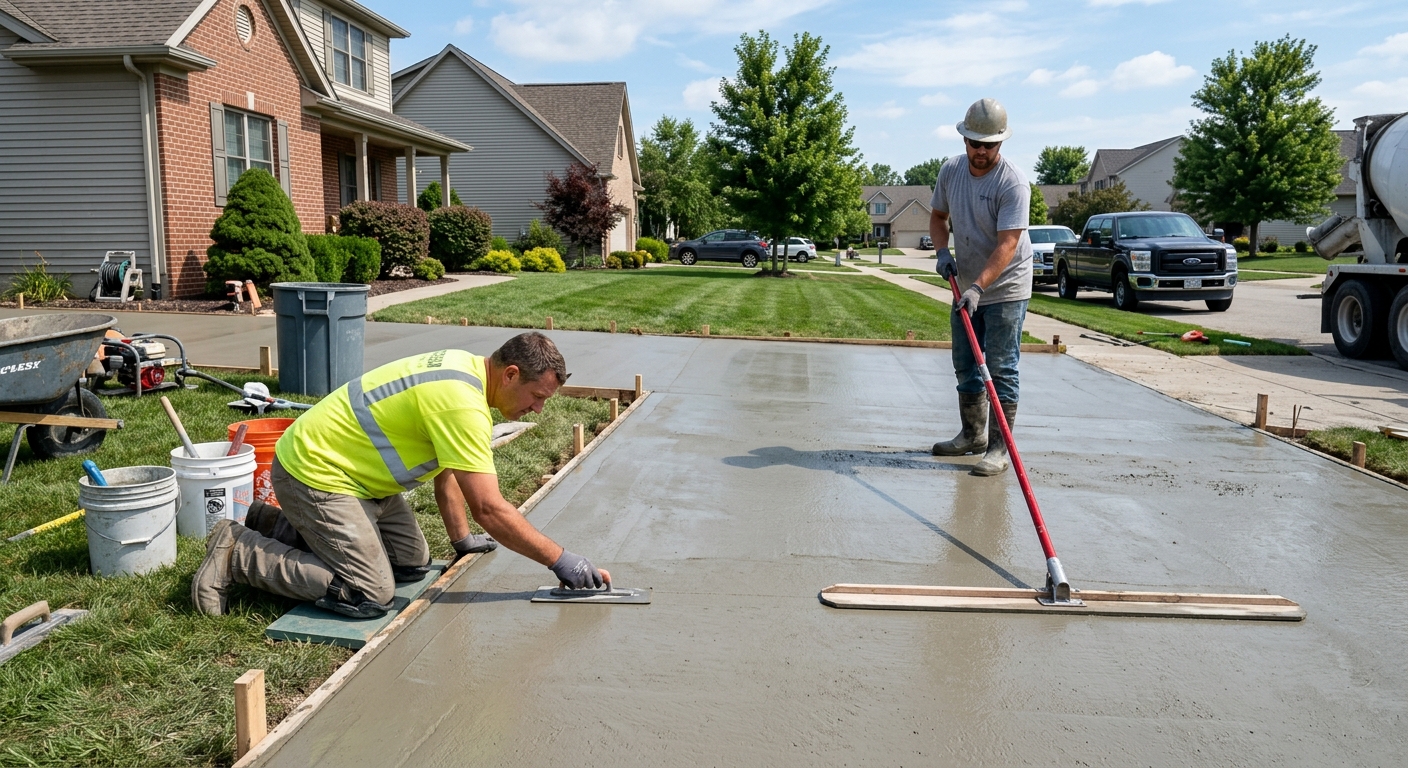
Concrete work options and costs in Clair Hills
Concrete work in Clair Hills is all about getting the right foundation and surface system in place—because your driveway, patio, and walkway sit directly in the same freeze–thaw environment that shapes the rest of Ontario’s building costs. Clair Hills has a total population of 6,145 (Statistics Canada, 2021 Census), and the area’s housing stock tends to be dominated by typical single-property lots where exterior flatwork is a high-visibility upgrade. In this Toronto economic region, expect most concrete estimates to reflect deeper structural requirements for footings and extra attention to drainage and base prep so saturated soils don’t expand and contract against the slab every winter.
Contractor availability and schedule also matter here. GTA crews often concentrate exterior pours in warmer months to ensure proper curing, particularly when night temperatures slide toward 10 °C or below. Even when you’re only building a driveway or patio, the job can cost more if your site needs significant excavation, brings in granular base, or can’t be accessed easily by a ready-mix truck—those factors drive labour and equipment time.
In Clair Hills, trade demand is especially common around established residential pockets such as the Clair Hills–Davisville Road corridor where homeowners frequently renew driveways and add walkways. Below is a practical comparison of common options so you can match the finish and spec to your budget before you book on-site measurements.
| Application |
Typical Size |
Key Spec |
Finish Option |
Price Range |
| Concrete driveway (standard broom finish) |
400 sq. ft. (approx. 20’ x 20’) |
Air-entrained exterior mix, compacted granular base, control joints |
Broom finish, sealer optional |
$18,000–$28,000 |
| Exposed aggregate driveway |
400 sq. ft. (approx. 20’ x 20’) |
Air-entrained mix, proper curing window, base + drainage detail |
Exposed aggregate with seal |
$22,000–$34,000 |
| Stamped concrete driveway or patio |
300 sq. ft. (approx. 15’ x 20’) |
Air-entrained mix, reinforced as required, control joints |
Stamp + release + colouring |
$24,000–$40,000 |
| Plain concrete patio or walkway |
250 sq. ft. (approx. 10’ x 25’) |
Air-entrained mix, well-compacted granular base, jointing |
Smooth or broom finish |
$16,000–$26,000 |
| Garage floor (interior slab) |
500 sq. ft. (approx. 20’ x 25’) |
Minimum reinforcement and vapour/insulation detail as needed |
Trowel finish |
$18,000–$30,000 |
| Foundation footings (structural, below frost) |
1,000 linear ft. (varies by design) |
Concrete placement below design frost, formwork, rebar per engineer |
Structural concrete |
$180,000–$300,000 |
Prices are estimates only and vary by project scope, site access and material selection.
What affects the price of concrete work in Clair Hills
In Clair Hills (Toronto economic region), two quotes for “the same” concrete job can differ by 30–50% because the real drivers are hidden in site conditions and specifications: how deep the frost-protected system goes, how much granular base is required, what reinforcement is needed, and how carefully the contractor manages curing in cooler shoulder-season weather. A lot of homeowners compare finish types only, but labour and materials change dramatically based on excavation depth, drainage routing, and truck access.
The frost depth requirement dictates footing depth and form heights for structural work, and every exterior slab needs a performance-focused approach. In Ontario, footings typically extend at least 1.2 m (about 4 ft) below grade, which pushes formwork, excavation, and rebar scope. Exterior slabs also need air-entrained concrete mixes to survive repeated freeze–thaw cycles; without the right air content, you can see spalling and surface scaling that shortens service life. When temperatures drop toward 10 °C or below, contractors may plan for cold-weather curing precautions (insulating blankets or controlled heating), which adds cost but protects strength development.
For example, a 400 sq. ft. driveway at the lower end of the local band (around $18–$28 per sq. ft.) can jump quickly if your subgrade is soft or wet and needs deeper granular base and drainage. Meanwhile, a stamped driveway (often in the $24–$40 per sq. ft. range) may be worth the premium if you’re replacing a plain broom finish and want improved curb appeal—just don’t expect stamp prices to compensate for poor base prep. Older homes in Clair Hills sometimes have uneven drainage around the foundation; that can add $ for excavation and regrading but prevents the slab from moving with seasonal moisture swings.
| Price Factor |
Why It Matters |
Cost Impact |
| Frost line depth |
Determines footing depth and form height to prevent frost heave |
Higher excavation and more rebar/formwork can add significant cost |
| Site preparation |
Excavation, grading, and compacted granular base control settlement |
If soils are soft or saturated, material + equipment time increases |
| Reinforcement |
Rebar or mesh helps control cracking and supports loads |
More labour and materials, especially for heavier-use slabs |
| Mix design |
Air-entrainment and required compressive strength for freeze–thaw durability |
Spec upgrades can raise material cost but reduce early failure |
| Finish type |
Broom vs stamped vs exposed aggregate affects labour and finishing time |
Stamped/exposed typically costs more than plain broom finish |
| Pour size and concrete truck access to site |
Reach, pumping needs, and pour scheduling affect labour and logistics |
Limited access can add setup time and extra equipment charges |
| Cold-weather curing precautions |
Heating/blankets protect strength gain when temperatures are low |
Can increase costs in shoulder months, but reduces risk of weak/spotty curing |
| Control joint pattern and sealing cost |
Jointing controls cracking; sealing helps repel de-icing salts and moisture |
Better detailing reduces long-term maintenance and premature spalling |
Permits & regulations in Ontario
In Ontario, structural concrete work typically requires a building permit, and many municipalities will expect engineered drawings for foundation-related items. That includes footings, foundation walls, grade beams, and any structural underpinning or major foundation repairs. These are the areas most likely to be reviewed for compliance with load capacity and frost protection. For concrete flatwork—such as patios, walkways, and driveways—the work often does not require a permit, provided it doesn’t affect lot grading, drainage patterns, or impervious surface coverage limits, and it doesn’t encroach on municipal right-of-way. However, you still need to confirm with the local authority before you break ground, particularly if you’re changing slopes, connecting to existing drainage, or modifying access/curbs.
For hiring, verify the contractor carries liability insurance and appropriate WSIB coverage (or WCB coverage, depending on the work context and employer registration). Step-by-step, here’s how a homeowner in Clair Hills can verify:
- Check the Ontario licence/registration details through the appropriate provincial registry and contractor standing information (use the legal business name on the quote).
- Request a current certificate of insurance (COI) showing general liability limits and expiry date; confirm it lists your property address or at least your legal name as an interest where applicable.
- Ask for WSIB/WCB clearance information and the employer account details; ensure it’s valid for the period of the job.
- Get written references for similar-size concrete pours in Ontario, not only decorative work.
If anything is missing—no COI, no WSIB/WCB info, or a vague scope—consider it a red flag before you pay deposits.
Getting concrete right in Clair Hills's freeze-thaw climate
Concrete failure in Clair Hills is usually a combination of moisture, movement, and incomplete curing—especially when freeze–thaw cycles stress the surface. The most common problem I see is spalling caused by inadequate air-entrainment and poor base preparation. If the sub-base is not compacted to the right depth, water can collect under the slab. When that moisture freezes, it can lift edges and create micro-cracks; those cracks then widen over the next winter season, and de-icing salts make the surface deteriorate faster.
To spec the job correctly in the Toronto area, start with base preparation: use a compacted granular sub-base with proper grading and drainage so water doesn’t stay trapped. For the mix, exterior flatwork should use air-entrained concrete—typically targeting about 5–7% air content—and a minimum compressive strength of 32 MPa (unless your engineer specifies higher for specific structural loads). Then control cracking with a joint pattern: put joints where you want the concrete to crack, not randomly. Plan curing carefully: concrete should cure for at least 7 days under suitable conditions, and if you’re close to cold weather, protection (insulation blankets or heating) is often the difference between uniform strength and weak, dusty surfaces. Finally, apply a penetrating sealer after the cure period—often around 28 days post-pour—so the concrete resists de-icing salt attack.
On price: it’s rarely worth cutting corners on base prep or air-entrainment. For instance, moving from a basic driveway plan to a properly air-entrained exterior system and sealing might add a few hundred to about $1,000–$2,000 depending on size and site complexity, but that premium is usually smaller than the cost of a future replacement—especially when exterior pours in Ontario have to be scheduled around the short reliable season.
| Spec |
Why It Matters in Clair Hills |
What to Ask For |
Impact if Skipped |
| Compacted granular base (depth?) |
Moisture control and support to prevent edge lifting and settlement |
Confirm granular thickness, compaction method, and drainage grade |
Higher risk of cracking, rocking slabs, and premature failure |
| Air-entrained concrete mix (target air %?) |
Freeze–thaw durability against scaling and spalling in Ontario winters |
Ask for target air content (typically 5–7% for exterior flatwork) |
Spalling and surface deterioration can show within a few seasons |
| Compressive strength (MPa rating) |
Strength development for load and long-term performance |
Minimum 32 MPa (or higher if specified for structural loading) |
Weaker concrete leads to dusting, scaling, and joint/edge problems |
| Control joints (spacing per ACI guidelines) |
Controls where cracks form during shrinkage and temperature swings |
Joint spacing plan and saw-cut timing |
Random cracking and ugly, costly repairs |
| Minimum 7-day curing period |
Uniform strength gain despite humidity and temperature swings |
Protection plan for cold nights (blankets/heating if needed) |
Weak areas can fail even if the surface looks fine initially |
| Penetrating sealer (when applied after cure) |
Repels moisture and reduces de-icing salt attack |
Apply penetrating sealer after cure (commonly around 28 days post-pour) |
Faster surface wear, staining, and scaling |
How to choose a concrete work contractor in Clair Hills
Choosing the right contractor in Clair Hills is mostly about verification and scope clarity—not just the cheapest number on paper. Start with Ontario licensing (where applicable), liability insurance, and WSIB/WCB coverage. How to check: (1) ask for the company’s legal name and any Ontario business/contractor registration details they rely on; (2) request a current certificate of insurance (COI) showing general liability and the effective dates; (3) ask for WSIB or WCB clearance documentation for the employer who will perform the work. If they can’t provide these promptly, pause the process and request them in writing.
Next, get 2–3 itemised written quotes. You want a breakdown that separates labour, concrete supply, reinforcement materials (if any), excavation/grading and disposal, plus finish specifics (broom, stamped, exposed aggregate). A quote should also say whether permits are included (for structural work), and what is excluded—like replacing damaged forms, hauling over soil limits, or repairing settlement if utilities or subgrade issues are discovered.
For warranty, confirm the workmanship warranty length and whether the manufacturer/material warranty is included (and if it’s transferable to you as the owner). Use a sensible payment schedule: never pay more than 10–15% upfront, and hold back a portion until the full site cleanup and finishing are complete, including sealer timing where included. Finally, insist on a start date and completion estimate in writing so you can plan around Ontario’s temperature swings and curing needs.
- Verify licence/registration status using the legal business name on the contract.
- Request current COIs for liability insurance and confirm expiry dates.
- Ask for WSIB/WCB clearance and the employer name doing the work.
- Get itemised quotes: labour, materials, reinforcement, base prep, disposal, finishing.
- Confirm what’s included in excavation, grading, and compacted granular base thickness.
- Ask for mix specifications: air-entrainment for exterior flatwork and target strength.
- Confirm reinforcement requirements (mesh vs rebar) based on your slab/loading.
- Ask about control joint pattern and saw-cut timing.
- Require a curing and cold-weather protection plan if pour dates are late-season.
- Clarify sealing: product type, application date (post-cure), and coverage.
- Set payment terms: max 10–15% upfront; hold back until final acceptance.
- Get a written schedule: start date, pour day contingency, and completion date.
Concrete contractor red flags in Clair Hills: vague scopes that don’t mention air-entrainment or jointing, quotes that assume “minimal base prep” without stating granular thickness, refusal to provide COI or WSIB/WCB documentation, no clear cold-weather curing plan near the end of the pour season, and promises of “no cracks guaranteed” without a joint layout and finish specs.
Frequently asked questions — concrete work in Clair Hills
Stamped vs broom-finish concrete — cost difference?
In Clair Hills, stamped concrete typically costs more than broom-finish because it adds labour time for stamping, colouring, and extra finishing steps. Based on local Toronto-region pricing bands, a broom-finish driveway commonly lands in the concrete driveway band of $18,000–$28,000 for many typical residential sizes, while stamped driveway or patio projects often price within $24,000–$40,000 depending on square footage, pattern complexity, and whether reinforcement and base upgrades are included. The bigger cost swing usually isn’t the stamp itself—it’s the quality of base prep and drainage detail beneath the slab. If your site is soft or wet, the contractor may need more granular base and better slope grading, which increases both broom and stamped options similarly. Ask both contractors to list the same mix spec, air-entrainment, thickness, and joint spacing so you’re comparing like-for-like.
When is the best time to pour concrete in Clair Hills?
For most exterior flatwork in Ontario’s Toronto region, the best window is late spring through summer when you can maintain consistent curing conditions. Crews often avoid the riskier parts of fall when temperatures start dropping toward 10 °C and below, because strength gain slows and surface damage becomes more likely if the concrete isn’t protected. In Clair Hills, even if the air temperature looks okay during the day, night-time cooling can still interfere with curing—so reputable contractors schedule pours for periods with stable weather or plan cold-weather curing measures like insulation blankets or controlled heating. If you’re aiming for a driveway or patio, try to keep your pour date earlier rather than later; it usually reduces both schedule risk and the likelihood of extra protective labour. If you have to pour near the edge of the season, demand a written curing plan, not just “we’ll keep it warm.”
How long does concrete take to cure?
Concrete curing has two layers: finishing strength and full performance. As a practical guideline, most flatwork should have at least 7 days of curing under proper conditions before you treat it as fully stable for normal use, assuming the mix, weather, and protection were managed correctly. For sealing (which helps repel moisture and de-icing salt damage), many contractors apply penetrating sealer after cure—commonly around 28 days post-pour—once the concrete has developed enough maturity to accept the treatment properly. In Clair Hills and the broader GTA, curing matters because freeze–thaw cycles can expose any weak spots created by cold nights or inconsistent protection. If your contractor pours in shoulder season, ask what they’ll do to protect the slab and how they’ll monitor conditions. The cure time isn’t just a timetable—it’s a quality control step in Ontario’s winter-facing climate.
Do I need a permit for concrete work in Ontario?
In Ontario, structural concrete work generally needs a building permit. That includes footings, foundation walls, grade beams, and major foundation-related repairs or underpinning—especially when engineered drawings are required for review. Concrete flatwork like patios, walkways, and driveways often does not require a permit, unless it affects lot grading, impervious surface coverage limits, drainage, or municipal right-of-way. In Clair Hills, the most common “permit triggers” are changes to how water drains from the home, modifications to access that could impact municipal infrastructure, or any work tied into grading approvals. The safest approach is to ask the contractor to confirm whether your exact scope affects grading or drainage plans and then verify with the local authority before demolition starts. Also ensure the contractor carries liability insurance and WSIB/WCB coverage; documentation protects you even when a permit isn’t required.
Concrete vs pavers for a patio in Clair Hills?
Concrete and pavers can both perform well in Clair Hills, but they fail differently and cost differently. Concrete patios are typically less expensive per square foot for a consistent finish, and they’re easier to specify for drainage if the base is built correctly. In the local Toronto-region bands, a plain concrete patio or walkway commonly sits around $16,000–$26,000 for typical residential sizes, while decorative stamped concrete generally climbs into the $24,000–$40,000 range when you want patterns and colour. Pavers can offer easier spot repairs if a section shifts, but they still require proper compaction and edging to stop movement during freeze–thaw. If you’re adding a patio where de-icing salts will regularly be used nearby, ask both bidders how they manage moisture and joints. For the “best long-term look,” the winner is usually the contractor with the strongest base prep and joint/drainage detailing—not the product name alone.
How long does a concrete driveway last?
A well-built concrete driveway in Clair Hills can often last decades, but longevity depends on specifications and winter exposure. With proper air-entrainment, correct thickness, compacted granular base, correct drainage, and a sensible joint layout, exterior flatwork holds up through repeated freeze–thaw cycles and de-icing salt exposure. Problems usually start when the base is underbuilt or water collects under the slab; then edges lift, cracks form, and scaling/spalling follows. Many homeowners notice deterioration sooner if a sealer wasn’t applied after the concrete cured (often around 28 days) because salt and moisture accelerate surface wear. Price-wise, staying in a realistic driveway budget—like the $18,000–$28,000 band for a typical broom-finish driveway—can still produce long service life if the contractor actually matches those specs. If a quote is dramatically lower, ask what’s being reduced: base depth, air-entrainment, reinforcement, curing protection, or sealing.