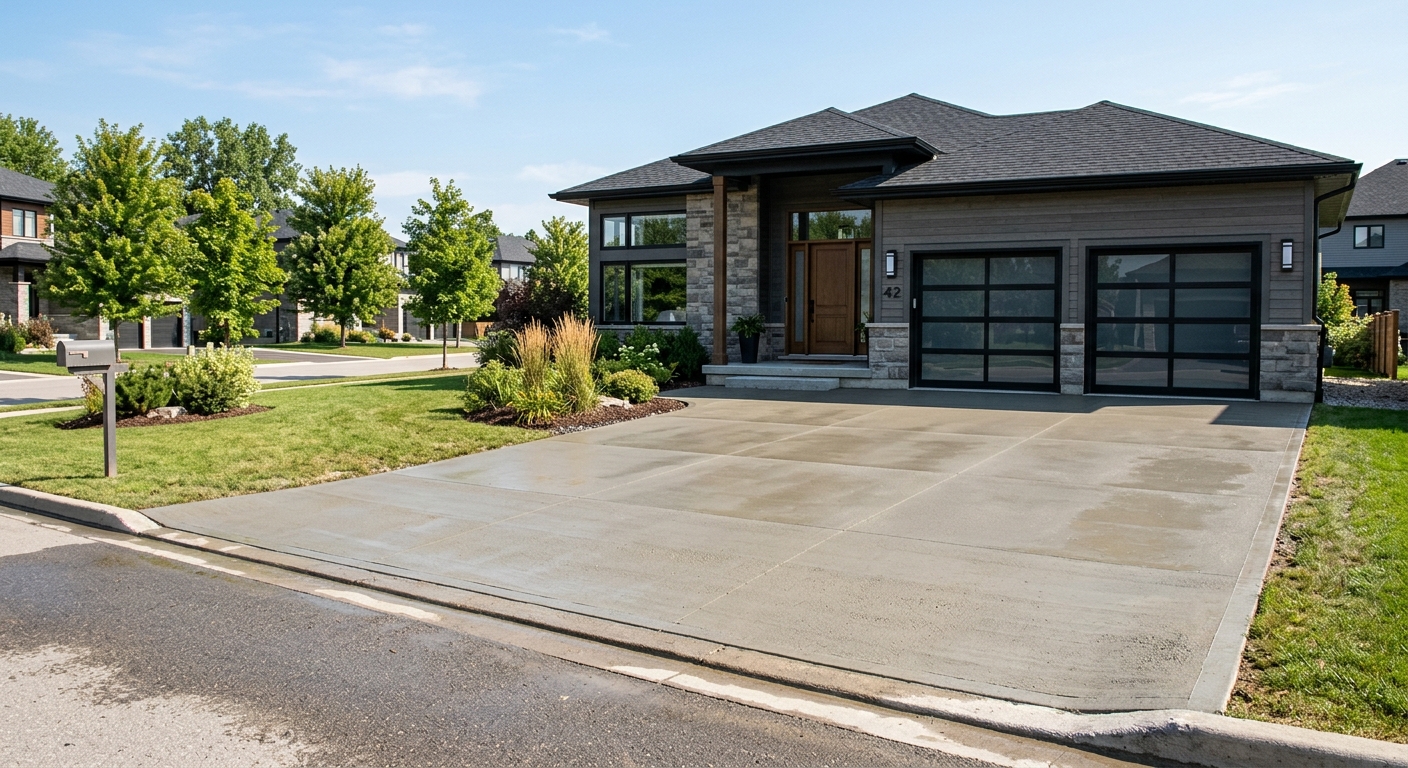
Concrete work options and costs in Bracebridge
Bracebridge is a great place for concrete, but the cost of driveways, patios and foundations is shaped by local soil conditions and the Muskoka–Kawarthas freeze–thaw cycle. In 2021, Bracebridge had 17,305 residents, and most households are owner-occupied (5,755 homeowner households, 79.5% of all households). That mix is important because the majority of concrete flatwork demand—especially single-detached homes (75.6% of dwellings)—comes from homeowners upgrading driveways, adding patios, and improving entryways. You’ll notice this trade is especially active around newer infill pockets near Muskoka Road and the Highway 11 corridor where people are tightening up drainage and improving access.
In this region, frost lines typically run around the 4 ft range, so footings and foundations must be placed below frost depth. That drives deeper excavation, more forming, rebar, and often waterproofing. Freeze–thaw also means exterior slabs need air-entrained concrete, stronger base prep, and a joint pattern that controls cracking. On top of that, the practical pour season is shorter (often April–November), which can compress schedules and raise labour/equipment costs. Curing in lake-and-snow-country microclimates is especially important, so crews commonly plan for longer curing and better protection against cold nights.
Below are typical Bracebridge price bands for common jobs, so you can compare contractor scopes apples-to-apples before you get into design details.
| Application |
Typical Size |
Key Spec |
Finish Option |
Price Range |
| Concrete driveway (standard broom finish) |
10 ft × 40 ft (400 sq. ft.) |
4–5 in slab, granular base + proper drainage, air-entrained mix |
Broom finish, minimal forms |
$12,000–$25,000 |
| Exposed aggregate driveway |
10 ft × 40 ft (400 sq. ft.) |
Air-entrained mix, controlled exposure, thicker/more careful finishing |
Exposed aggregate, slip-resistant surface |
$16,000–$29,000 |
| Stamped concrete driveway or patio |
10 ft × 30 ft (300 sq. ft.) |
Air-entrained mix, colouring, integral release + detailing |
Stamped pattern with colour |
$15,000–$35,000 |
| Plain concrete patio or walkway |
12 ft × 18 ft (216 sq. ft.) |
4 in slab, compacted sub-base, air-entrained mix |
Straight/smooth trowel or light broom, light broom baseline |
$4,000–$12,000 |
| Garage floor (interior slab) |
20 ft × 20 ft (400 sq. ft.) |
Slab-on-grade, typical minimum 4 in, vapour/ground prep as required |
Plain finish; optional broom for traction |
$10,500–$22,000 |
| Foundation footings (structural, below frost) |
Typical single-detached wall perimeter |
Excavation below frost, rebar, waterproofing prep as needed |
Structural concrete + rebar, form-and-pour |
$18,000–$45,000 |
Prices are estimates only and vary by project scope, site access and material selection.
What affects the price of concrete work in Bracebridge
In Bracebridge and the broader Muskoka–Kawarthas region, the same “concrete slab” can come in 30–50% apart from one quote to the next because the real drivers are buried under the finish: excavation depth, base thickness, reinforcement, mix design, drainage, and cure protection. Contractors also price differently when the site is tight for a concrete truck or when the job must be staged for a short pour season. Even if your project is only a driveway or walkway, Muskoka conditions push specs higher than many milder areas.
Frost depth and freeze–thaw cycles dictate every exterior specification. Footings must extend below the design frost depth to prevent frost heave (in Ontario that’s typically about 1.5–2.4 m), and exterior slabs should use air-entrained concrete to survive repeated freezing and thawing. Cold-weather curing precautions are another cost lever: when night temperatures drop, crews often need insulation blankets and sometimes heaters to protect early-age concrete. After install, de-icing salt accelerates surface wear and spalling if the concrete isn’t properly spec’d and sealed—so sealing may become part of the lifecycle plan. The practical season (often April–November) can also compress schedules, affecting labour availability.
In Bracebridge, a couple examples regularly change the total: (1) if your driveway needs significant regrading due to drainage or slope, excavation and form height add cost quickly—sometimes a “standard broom driveway” moves toward the upper end of $12,000–$25,000. (2) If you’re choosing a premium finish like stamped work, the added labour and materials can justify the move toward the $15,000–$35,000 band. Housing age matters too: with 46.4% of homes built before 1981, many sites have older drainage patterns and service penetrations that require careful saw cutting, excavation sequencing, and patching around existing concrete.
| Price Factor |
Why It Matters |
Cost Impact |
| Frost line depth — determines footing depth and form height |
Footings must be below frost to prevent heave and settlement cracking |
Higher excavation + forming; can add thousands for deeper installs |
| Site preparation — excavation, grading, compacted granular base |
Concrete fails more often on weak/variable subgrade than on finish |
Extra trucking/placement + base thickness increases total cost |
| Reinforcement — rebar or wire mesh requirement |
Controls cracking and improves load transfer, especially on driveways |
Rebar supply, chairs/ties, and extra labour |
| Mix design — air-entrainment and compressive strength spec |
Air voids reduce freeze–thaw damage; strength supports durability |
Premium materials and batching; typically part of exterior pricing |
| Finish type — broom vs. stamped vs. exposed aggregate |
Premium finishes need more detailing and specialized finishing crews |
Higher material + labour; spreads fastest on driveways/patios |
| Pour size and concrete truck access to site |
Limited access means pumping/shorter lifts or more labour for staging |
Pumping fees, extra labour time, and more waste handling |
| Cold-weather curing precautions — heating and blankets |
Protects early-age concrete so it reaches adequate strength |
Can increase costs with equipment rental and added crew time |
| Control joint pattern and sealing cost |
Joints manage shrinkage cracks; sealing reduces water/ion entry |
More layout work + sealing materials; small line item, big benefit |
Permits & regulations in Ontario
In Ontario, concrete work is often straightforward, but permits can apply depending on what you’re building. Structural concrete work—like footings, foundation walls, grade beams, and foundation underpinning—requires a building permit and commonly engineered drawings that the municipality may review. For concrete flatwork (patios, walkways and driveways), a permit is usually not required on its own, but it can become required if the work affects lot grading, changes surface drainage patterns, or impacts impervious surface coverage limits, or if it involves work near a municipal right-of-way. Before you start in Bracebridge, confirm with the local authority so you don’t end up redoing forms or drainage once excavation is already complete.
Contractor responsibility is also a big part of Ontario compliance. Ask for proof of liability insurance and WSIB/WCB coverage before work begins. Then verify the contractor’s status and safety credentials:
- Licence/registration: check the contractor details in Ontario’s business and licensing listings, plus their own registration number if they provide one.
- Certificate of Insurance: request a current COI showing general liability (and any additional insured wording if applicable to your property).
- WSIB/WCB clearance: ask for current clearance documentation or payment status confirmation where required.
- References: request 2–3 similar jobs (driveways with comparable slope/access, or structural foundation work if that’s your scope).
Do this step-by-step and you’ll avoid surprises—especially on Bracebridge sites where drainage and frost-depth excavation aren’t optional.
Getting concrete right in Bracebridge's freeze-thaw climate
Bracebridge concrete most commonly fails because freeze–thaw gets into the concrete through weak paste, poor air content, or weak base/drainage—then de-icing salts accelerate surface wear. The fix is to spec the whole system, not just the slab. Start with base preparation: we build a compacted granular sub-base to the correct depth for the soil and frost conditions, with drainage that keeps water moving away from the slab. Next is mix design: exterior concrete should be air-entrained (target about 5–7% air content for many exterior mixes) and designed for minimum durability performance. For compressive strength, many exterior pours are specified around 32 MPa minimum. Control joints matter too: they tell the concrete where to crack so you don’t get random cracks that invite freeze–thaw expansion. Then comes curing: plan for a minimum 7-day curing period under proper conditions, and in cold snaps you may need insulation blankets or heating so early-age concrete doesn’t get set back. Finally, sealing is part of the Bracebridge winter plan—use a penetrating sealer applied after the concrete has cured (commonly around 28 days) to repel de-icing salts.
When you’re choosing options, ask what you’re paying for. For example, if a broom-finished driveway is priced near the midrange of $12,000–$25,000, that cost is usually justified by solid base prep and correct air-entrainment. If you move to stamped concrete toward $15,000–$35,000, the extra is primarily labour and detailing (colouring, stamps, release, more finishing attention), not just “prettier concrete.”
Use this list as your technical checklist so you’re not relying on promises—rely on the specs your contractor will write into the quote.
| Spec |
Why It Matters in Bracebridge |
What to Ask For |
Impact if Skipped |
| Compacted granular base (depth?) |
Correct base reduces pumping and cracking through freeze–thaw |
Base thickness and compaction standard; drainage notes |
Settlement, heaving, and early surface deterioration |
| Air-entrained concrete mix (target air %?) |
Air voids help concrete tolerate repeated freezing and thawing |
Target air content (commonly 5–7% for exterior flatwork) |
Spalling and scaling in winter; rapid loss of surface |
| Compressive strength (MPa rating) |
Strength supports durability and load resistance |
Minimum 32 MPa (or project-specific strength) |
Lower performance, increased cracking and abrasion damage |
| Control joints (spacing per ACI guidelines) |
Controls shrinkage cracking so cracks don’t wander |
Joint spacing plan and whether joints are saw-cut |
Random cracks, water ingress, spalling around cracks |
| Minimum 7-day curing period |
Early-age strength gain is critical in cold nights |
How curing will be protected if temperatures drop |
Weaker slab; scaling and surface damage risk increases |
| Penetrating sealer (when applied after cure) |
Repels de-icing salts and reduces freeze–thaw damage at the surface |
Sealer type and timing (often around 28 days post-pour) |
Faster scaling, colour fading, and spalling |
How to choose a concrete work contractor in Bracebridge
Choosing the right concrete contractor in Bracebridge is mostly about verification and clarity. First, confirm Ontario compliance and coverage. Ask for proof of general liability insurance and WSIB/WCB coverage (or clearance where applicable). Then check how they verify licensing/registration in Ontario—use the contractor’s own information, plus the appropriate provincial/business listings and the documentation they provide. If they can’t provide a clear certificate of insurance and current coverage, that’s a stop sign.
Next, get 2–3 itemised written quotes that break out labour and materials (excavation, base, concrete supply, reinforcement, forming, finishing, sealing if included, and waste/disposal). Avoid “lump sum with no explanation.” Make sure the scope matches: is the base being designed to the correct depth? Are control joints included and are they saw-cut or formed? Is drainage corrected, and are existing concrete edges properly saw-cut?
Warranty matters too. Ask for the workmanship warranty length in writing, whether it covers labour only or also materials, and whether it’s transferable if you sell the home. Product/manufacturer warranties can apply to sealers or decorative systems, but workmanship is what affects cracking and spalling.
For payment, keep it reasonable: never pay more than 10–15% upfront, and hold back a portion until the job is complete and clean-up meets standard. Finally, require the timeline in writing, including your proposed start date and expected completion—important in Muskoka–Kawarthas where cold nights can alter curing schedules.
- Ask for insurance COI date and limits (and any additional insured wording).
- Confirm WSIB/WCB clearance or proof of coverage before mobilization.
- Request 2–3 recent photos of similar Bracebridge conditions (slope, tight access, drainage).
- Insist on itemised pricing (base prep, rebar, concrete mix spec, forming, finishing, sealing).
- Confirm whether disposal/haul-away is included or quoted separately.
- Check whether a permit is included when structural work is involved.
- Ask for their curing plan if nights are cool (blankets/heating as needed).
- Verify mix includes air-entrainment for exterior flatwork.
- Confirm control joint layout and whether it will be saw-cut or tooled.
- Clarify what happens if rain/freeze interrupts the pour schedule.
- Request a written workmanship warranty and what it covers/excludes.
- Use a staged payment schedule with a holdback until final grading/cleanup is confirmed.
Concrete contractor red flags in Bracebridge: vague quotes that don’t mention air-entrainment; promises of “no joints needed”; refusing to discuss base thickness/compaction; collecting most payment upfront; and skipping sealing or curing protection while quoting a low price near the $12,000–$25,000 driveway range.
Frequently asked questions — concrete work in Bracebridge
Can concrete be poured in cold weather in Bracebridge?
Yes, but not “whenever.” In Bracebridge, cold snaps can slow hydration and leave early-age concrete vulnerable if it freezes before it gains strength. Many contractors will pour only if temperatures and conditions can be controlled—typically with cold-weather curing precautions like insulation blankets and, in some cases, temporary heating. The key is protecting the slab for the first several days so it reaches adequate strength. If you’re comparing quotes for exterior work, ask specifically what curing plan they’ll use when night temperatures drop. Also remember that driveway and patio pricing in Ontario often assumes proper air-entrainment and cold-weather protection; skipping those steps can lead to premature scaling and spalling. As a baseline reference, standard driveway projects often start in the $12,000–$25,000 band, but cold-weather protection can push the total toward the higher end depending on access and scheduling.
How do I maintain concrete in Bracebridge's freeze-thaw climate?
Maintenance is mostly about keeping water and salts off the surface and preventing small cracks from becoming pathways for freeze–thaw damage. First, make sure drainage is right: don’t let downspouts dump onto the slab, and avoid creating low spots where water pools. For daily winter care, use de-icing products that are compatible with concrete and apply them in moderation—heavy salt exposure increases scaling risk. Second, sealing helps. A penetrating sealer applied after proper cure (often around 28 days post-pour) can improve resistance to de-icing salts. Third, keep an eye on joints and edges: if caulking or joint sealer is part of your spec, check it seasonally. Bracebridge’s housing stock includes many older homes (46.4% built before 1981), and those sites often need better drainage corrections to protect new concrete. If your contractor offered sealing, it’s usually worth planning for because winters here are hard on unsealed exterior surfaces.
What causes concrete to spall in Bracebridge winters?
Spalling is the flaking or breaking off of the surface, and in Bracebridge it’s commonly driven by freeze–thaw plus salt exposure. The biggest technical cause is inadequate air-entrainment. When the mix doesn’t have the right air content, water in the concrete paste can freeze, expand, and damage the surface. Another cause is weak or improperly compacted base/drainage, which allows water to sit and forces the slab to “move” microscopically with each freeze–thaw cycle. Control joints also matter: if joints are missing, poorly spaced, or not sealed, cracks can occur where water wants to enter. Finally, inadequate curing can leave surface paste weaker. If you’ve seen spalling around driveways after winter, ask your contractor what mix air content is planned and whether they include proper curing protection. A broom-finished driveway built correctly within the $12,000–$25,000 range should still survive winters—cheap shortcuts are what typically cause spalling.
What is rebar and when is it required in Ontario?
Rebar (reinforcing steel) is used to help concrete resist tension forces and control cracking. In Ontario, engineered requirements determine when rebar is needed—especially for structural elements like footings, foundation walls, grade beams and slabs designed to carry loads. For exterior flatwork like driveways and some garage floors, rebar is often included depending on slab thickness, soil conditions, expected loads (like vehicle weight and turning), and how the base is built. It’s not “one size fits all,” but it is a core part of many code-compliant structural designs where there’s a risk of movement or heavier loading. In Bracebridge’s frost-depth environment, the combination of correct base prep, proper reinforcement, and air-entrained exterior concrete is what keeps slabs stable through repeated freeze–thaw. If you’re getting a quote, ask whether they’re using rebar (and size/spacing) or mesh, and whether the plan matches the engineered or municipal expectations.
How long does a concrete project take in Bracebridge?
It depends on the scope and whether you’re building flatwork or structural concrete. For typical exterior flatwork—like a driveway replacement or patio—there’s usually a site prep window (excavation, base compaction, forms), the pour day, then curing and protection. Even if the pour is just one day, you still need time for curing to reach adequate strength and for final touches like sealing to be timed correctly (sealers often go on after full cure). For a small patio, the total on-site timeline might be about a week including prep and curing protection; for larger driveway work, it can be closer to 1–2 weeks depending on access, weather, and whether drainage corrections are included. For structural foundation work, timelines are longer due to excavation below frost, forming, inspections/permits, and multiple work stages. Because Bracebridge’s practical pour season is usually April–November, weather planning matters—ask your contractor to provide a written start date, completion estimate, and contingency plan if temperatures drop.
What is a concrete overlay and is it suited to Bracebridge?
A concrete overlay is a layer placed over an existing concrete slab—often used to restore a worn or uneven surface instead of fully removing the old slab. Whether it’s suited for Bracebridge depends on why the existing concrete failed and how sound the original slab is. If the old slab has deep spalling, widespread delamination, or serious subgrade movement, an overlay can fail too because it inherits the problem. Overlays can work well when the original slab is structurally sound, well-bonded, and primarily needs resurfacing. Overlays also need careful surface prep (grinding/profiling, cleaning) and proper bonding methods—especially in freeze–thaw where moisture can get under thin layers. If you’re in a winter-salt environment like Muskoka–Kawarthas, ensure the contractor plans for sealing and a mix spec that’s appropriate for exterior freeze–thaw. Compare options with real numbers: sometimes the cost difference versus a full replacement is why homeowners look at overlays, but if you’re targeting the $12,000–$25,000 driveway band, you’ll want to confirm whether overlay thickness and prep truly match your durability goals.