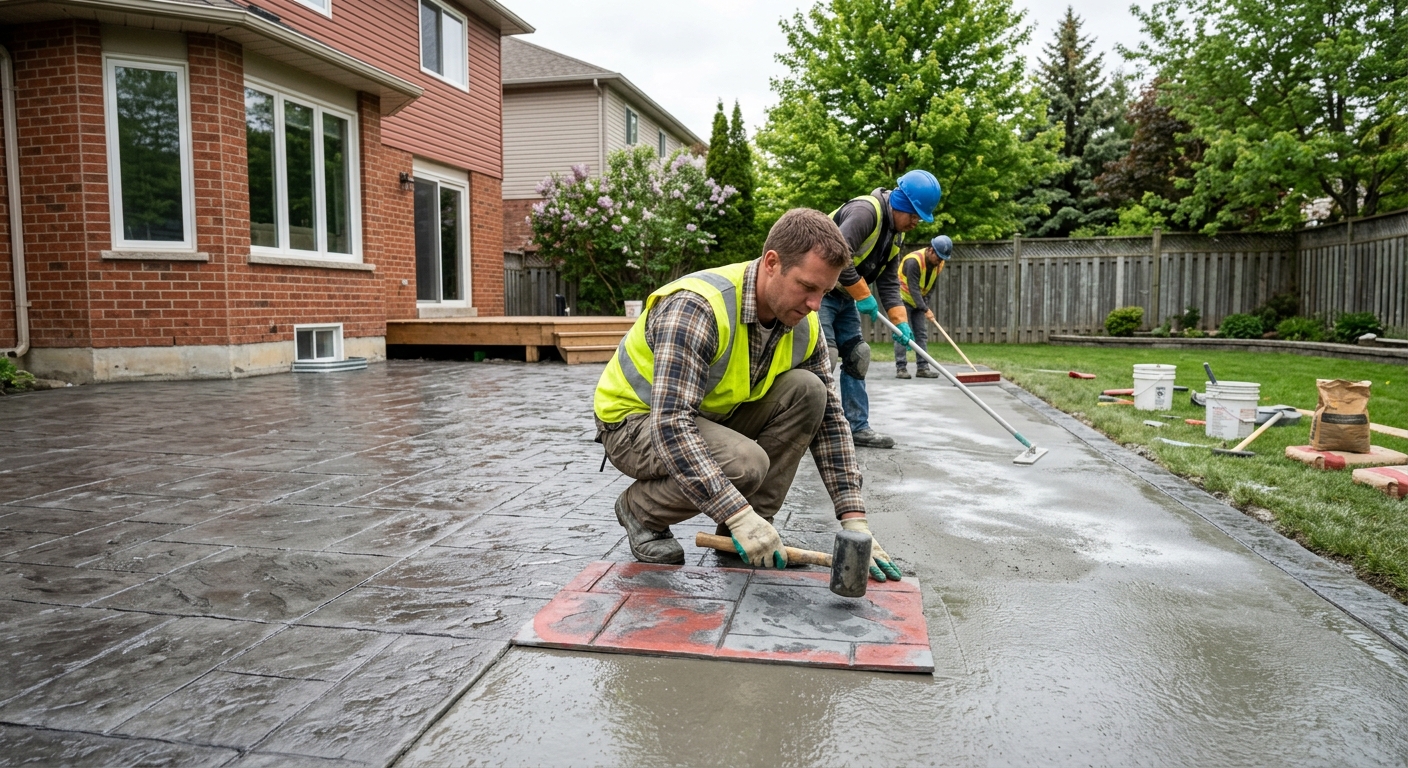
Concrete work options and costs in Northwood
Concrete work in Northwood is a year-round planning decision, even though the heavy outdoor pours usually happen in the warmer part of the season. Northwood’s population is 14,017 (Statistics Canada, 2021 Census), and in the Toronto economic region you’ll notice that most demand for driveways, patios and walkways comes from the large, established stock of owner-occupied homes—especially in neighbourhoods like Finchley Ridge, where renovations and curb-appeal upgrades show up every spring. For many homeowners, that means comparing a standard broom-finished driveway to options like exposed aggregate or stamped concrete, then aligning the right design with Toronto’s freeze–thaw reality.
Toronto pricing can swing noticeably because local concrete specs are driven by frost depth and repeated freezing and thawing. In our area, structural footings typically extend below grade to manage frost heave and differential movement, and exterior flatwork is normally made with air-entrained concrete plus proper base drainage. Pour timing and curing also matter: when temperatures drop toward 10 °C or below, contractors spend more time protecting slabs with blankets and managing curing so you don’t pay twice later for repairs or premature scaling. Labour availability can also tighten when many crews are booked for the same mid-season window, which is why two quotes for “the same size driveway” can differ even when the finishes look similar.
Use the table below as a practical baseline for Northwood, then we’ll break down what drives the price and how to keep quality high.
| Application |
Typical Size |
Key Spec |
Finish Option |
Price Range |
| Concrete driveway (standard broom finish) |
12 m x 3.5 m (approx. 42 m²) |
Typical 100 mm slab over compacted granular base + proper drainage |
Broom finish, control joints |
$2,100–$3,200 |
| Exposed aggregate driveway |
12 m x 3.5 m (approx. 42 m²) |
Air-entrained concrete + consistent aggregate exposure |
Exposed aggregate (wash/expose) + sealing |
$2,900–$4,100 |
| Stamped concrete driveway or patio |
12 m² to 45 m² (example: 35 m²) |
Air-entrained mix, adequate thickness, rebar/wire as required |
Stamp pattern + colour hardener/release |
$3,200–$5,500 |
| Plain concrete patio or walkway |
3 m x 6 m (18 m²) |
Compacted granular base, edge forms, control joints |
Float/medium broom + sealing if desired |
$1,000–$2,000 |
| Garage floor (interior slab) |
7 m x 3 m (21 m²) |
Vapour control where needed + jointing to reduce shrinkage cracks |
Smooth trowel or light broom |
$1,200–$2,600 |
| Foundation footings (structural, below frost) |
Typical partial or full basement footing run (project-specific) |
Engineered design, below-design frost depth and adequate bearing |
Structural concrete only (finish not applicable) |
$180–$300 |
Prices are estimates only and vary by project scope, site access and material selection.
What affects the price of concrete work in Northwood
In Northwood and across the Toronto economic region, quotes can differ by 30–50% for the same “headline” job because concrete cost isn’t just materials—it’s excavation, base prep, reinforcement, mix design and how long the crew needs to do it right in freeze–thaw conditions. A broom-finished slab might look straightforward, but in our climate the contractor must manage frost depth requirements, use air-entrained concrete and build a drainage-ready base so saturated soils don’t expand and contract every winter. When those steps are rushed (or omitted), homeowners often end up paying for patching, joint rework or surface scaling.
Toronto-area concrete specs are strongly tied to frost heave risk. Footings generally need to extend below the design frost depth (often in the 1.2 m range or deeper in Ontario) to prevent differential movement. Exterior flatwork should use air-entrained mixes so the concrete survives repeated freeze–thaw cycles. If the pour window is tight and temperatures fall toward 10 °C or below, cold-weather curing precautions—insulating blankets, temporary heating and longer protection time—add labour and sometimes rental costs. De-icing salt can accelerate spalling, so sealing decisions matter.
Here are a few Northwood examples of what pushes price up or down: (1) soft or clay-heavy soils require deeper excavation and more granular base, raising costs within the $18–$28 driveway band; (2) adding wire mesh or more rebar for a heavier vehicle load increases material and placement time, nudging the driveway toward the higher end; (3) stamped or exposed aggregate work adds forming, extra materials and surface preparation, typically moving patios and driveways from the $16–$26 flatwork band into the premium range.
| Price Factor |
Why It Matters |
Cost Impact |
| Frost line depth — determines footing depth and form height |
Deeper footings increase excavation and concrete volume to prevent frost heave |
Can raise foundation/footings scope toward the upper $180–$300 rate per footing requirement |
| Site preparation — excavation, grading, compacted granular base |
Good base and drainage prevent pumping and seasonal movement of subgrade |
Often adds significant labour; poor access can increase hauling and trucking costs |
| Reinforcement — rebar or wire mesh requirement |
Controls cracking and improves durability under loads and temperature swings |
Mesh/rebar placement can add noticeable materials and crew time |
| Mix design — air-entrainment and compressive strength spec |
Air-entrainment reduces freeze–thaw damage and improves surface longevity |
Higher-spec mix usually increases material cost slightly but reduces failure risk |
| Finish type — broom vs. stamped vs. exposed aggregate |
Complex finishes require more surface work and stricter timing |
Stamped/exposed aggregate typically pushes flatwork toward the higher end of $16–$26 and beyond |
| Pour size and concrete truck access to site |
Truck access affects placement speed and whether additional pumping is needed |
Poor access can increase labour, extensions, and equipment rentals |
| Cold-weather curing precautions — heating and blankets |
Toronto conditions require protection when temperatures drop near/under ~10 °C |
Can add labour/equipment; often the difference between a strong vs. weak surface |
| Control joint pattern and sealing cost |
Joints manage shrinkage cracking; sealing helps repel salt-driven scaling |
More joints and a quality sealer raise cost, but reduce long-term maintenance |
Permits & regulations in Ontario
In Ontario, structural concrete work requires more oversight than most homeowners expect. In Northwood (Ontario), projects like concrete footings, foundation walls, and grade beams typically require a building permit, and many municipalities also expect engineered drawings—especially where there’s a foundation underpinning, new foundation, structural wall changes, or altered loads. Concrete flatwork such as patios, walkways and driveways usually does not require a permit on its own unless it affects lot grading, stormwater drainage, impervious surface coverage limits, or the municipal right-of-way. Before anyone breaks ground, confirm requirements with the local authority so the project stays compliant.
Regardless of whether a permit is required for your slab, verify your contractor is properly set up. Ask for their liability insurance and proof of coverage for workplace safety requirements (WSIB/WCB). In practice, you can spot reliable contractors by how they handle documentation and by whether they can provide references on similar-scale Ontario jobs.
Step-by-step for verifying a contractor in Ontario: (1) confirm the company’s licensing/registration status using provincial and municipal directories where applicable; (2) request a current Certificate of Insurance from the contractor (you’re looking for general liability and that you’re not being asked to accept “coverage details later”); (3) ask for WSIB clearance documentation where they can provide it; (4) review their proof of coverage before scheduling the pour; and (5) verify their references match your scope (driveway, patio, or structural foundation work) and freeze–thaw conditions typical for the Toronto region.
Getting concrete right in Northwood's freeze-thaw climate
Concrete failures in Northwood usually trace back to freeze–thaw damage compounded by poor base preparation, inadequate air-entrainment, or rushed curing. When water saturates under a slab and temperatures cycle through freezing and thawing, the slab can lift or the surface can scale (“spalling”). That’s why the spec needs to be built for exterior exposure in the Toronto region: (1) base preparation with compacted granular sub-base to the right depth for local soil conditions and frost management; (2) mix design using air-entrainment—typically around 5–7% air for exterior flatwork—so the concrete tolerates freeze–thaw; (3) control joints placed to reduce random cracking to predictable lines; (4) curing for a minimum of 7 days under proper conditions, with extra protection when cold nights are expected; and (5) sealing with a penetrating sealer applied after the concrete cure (often around 28 days) to repel de-icing salts and reduce moisture ingress.
When you’re comparing options, the cheapest approach is not always the “plain” one. For example, a 42 m² driveway at the standard broom-finish band (roughly $18–$28 per square foot equivalent pricing translated to total project) can be cost-effective, but only if it includes air-entrainment, drainage base prep and proper jointing. If you choose stamped concrete for curb appeal, the added cost is often justified because the job typically needs more careful finishing, stricter timing, and better surface management to prevent premature wear—especially when Ontario winters attack the surface with salt and moisture.
The most important technical questions to ask: “What air content are you specifying for the mix?”, “What depth and type of granular base are you using?”, “How will you protect the pour during cold nights?”, and “What joint spacing and sealing plan do you follow?” Those answers are the difference between a driveway that lasts and one that starts flaking within a few winters.
| Spec |
Why It Matters in Northwood |
What to Ask For |
Impact if Skipped |
| Compacted granular base (depth?) |
Controls moisture movement and provides frost-resistant support under freeze–thaw cycles |
State granular type, compacted depth, and required compaction method |
Pumping, settlement, and early cracking or scaling |
| Air-entrained concrete mix (target air %?) |
Air bubbles improve freeze–thaw durability on exterior flatwork |
Specify air content typically 5–7% for exterior flatwork |
Spalling and surface deterioration during winters |
| Compressive strength (MPa rating) |
Strength and durability help resist weathering and structural performance |
Minimum 32 MPa (confirm mix design and test plan) |
Higher risk of cracking, scaling and reduced service life |
| Control joints (spacing per ACI guidelines) |
Joints manage shrinkage so cracking occurs where it’s intended |
Ask for planned joint layout and spacing targets |
Random cracking across the slab, uneven appearance and moisture paths |
| Minimum 7-day curing period |
Proper hydration builds strength before exposure to Toronto weather swings |
Confirm curing protection for cold nights and minimum 7 days |
Reduced surface strength, higher risk of scaling and early failure |
| Penetrating sealer (when applied after cure) |
Helps repel de-icing salts and slows moisture uptake |
Apply after cure—often around 28 days—using an exterior-rated penetrating sealer |
Faster salt damage and more frequent repairs |
How to choose a concrete work contractor in Northwood
Choosing the right concrete contractor in Northwood is about verifying credentials and getting a detailed scope that matches our local frost-and-salt reality. First, verify Ontario licensing/registration where applicable, then request proof of liability insurance. Ask for WSIB/WCB coverage documentation as well—reputable crews should be able to provide current clearance letters or equivalent proof without hesitation. If a contractor can’t produce documentation promptly, treat that as a red flag before you book a pour.
Next, get 2–3 itemised written quotes, not just one lump sum. You want labour and materials broken out: excavation and disposal, granular base and compaction, reinforcement (wire mesh/rebar), concrete supply and mix spec (including air-entrainment), finishing, joints, sealing, and any cold-weather protection. Read exclusions carefully: Is permit handling included if it’s required? Who is responsible for material storage, site protection and cleanup? Do they include saw-cut timing for joints, and is sealing included or optional?
Warranty matters in Toronto’s climate. Ask for a clear workmanship warranty length for flatwork and any manufacturer-related product warranty coverage. Confirm whether the warranty is transferable if you sell your home. For payment, avoid big upfront deposits—never pay more than about 10–15% upfront. Hold back a portion until the work is complete and any finishing items (like sealing) are done. Finally, ask for a written start date and completion estimate, because a delayed schedule can push a pour into colder conditions where curing and protection costs increase.
- Provide current proof of liability insurance (Certificate of Insurance).
- Provide WSIB/WCB coverage documentation for the company and workers.
- Confirm experience with Northwood/Toronto exterior flatwork (not just interior slabs).
- Get at least 2–3 quotes with itemised labour and materials—not a single figure.
- Verify the concrete spec: air-entrainment for exterior flatwork.
- Ask for base prep details: granular type, depth and compaction approach.
- Confirm reinforcement plan: mesh vs rebar and where it’s required.
- Ask for control joint layout and spacing targets.
- Confirm curing and protection plan for cold nights (blankets/heating if needed).
- Ask when sealing is applied and whether penetrating sealer is included.
- Review disposal/haul-away and site restoration scope in writing.
- Request a clear warranty in writing for workmanship and materials coverage.
Concrete contractor red flags in Northwood: they won’t discuss air-entrainment or curing; they quote only per “m²” without base depth, joints or drainage details; they ask for 50%+ upfront; they can’t provide insurance/WSIB/WCB proof; and they dismiss sealing as “optional” when you’re in a salt-impacted freeze–thaw environment.
Frequently asked questions — concrete work in Northwood
How much does concrete work cost in Northwood?
In Northwood, most homeowners budget based on the scope: standard exterior flatwork is commonly in the $16–$26 range for patios/walkways and $18–$28 for driveways, while decorative upgrades cost more. For example, a 42 m² driveway at the standard broom-finish level often lands in the lower-to-mid portion of the driveway band once excavation, a compacted granular base and proper jointing are included. If you choose stamped concrete, the added labour and finishing time can move the job toward the higher end of decorative concrete pricing (roughly $24–$40 per square foot equivalent total pricing), depending on colour, patterns and site access. If you’re doing structural foundation footings, pricing is typically handled differently (about $180–$300 for footing/structural requirements, project-specific). For the most accurate Northwood quote, always ask for an itemised breakdown.
How deep must footings be for Northwood's frost line?
For Northwood and the broader Ontario region, structural footings are typically designed to extend at least about 1.2 m below grade (around 4 ft) to reduce frost heave and differential movement, and often deeper depending on soil and engineering requirements. The Ontario building practice and local review focus on placing footings below the design frost depth so the ground can freeze above the bearing level rather than lifting the structure. Your exact depth can also depend on soil conditions, basement type and engineered design. If you’re replacing or underpinning foundation elements, ask your contractor whether the footing design is engineered and how it matches the local frost protection strategy. Don’t accept a “one-depth-fits-all” plan—depth and bearing matter for long-term performance.
Why does concrete crack in Northwood and how is it prevented?
Concrete cracks in Northwood mainly because of shrinkage as the slab cures, plus stress from freeze–thaw and moisture movement under the slab. Random cracking happens when the slab doesn’t have a predictable joint pattern or when the base isn’t prepared to support the slab evenly. Another big factor in our Ontario climate is surface damage: without proper air-entrainment and curing, freeze–thaw cycles can weaken the surface and accelerate wear. Prevention is about design and process: use an exterior air-entrained mix (commonly around 5–7% air), install control joints at appropriate spacing, and include proper drainage and a well-compacted granular base. Sealing also helps by reducing moisture and salt exposure. A properly specified slab can still crack slightly at joints—this is expected—but it prevents uncontrolled cracking and spalling.
Stamped vs broom-finish concrete — cost difference?
In Northwood, stamped concrete typically costs more than broom-finished concrete because it requires extra materials and more labour-intensive finishing. Broom-finish driveways and walkways usually fall within the standard concrete driveway band (commonly $18–$28 for driveways) when base prep and joints are done correctly. Stamped work generally pushes you into the decorative pricing range (often roughly $24–$40 equivalent pricing), because the crew must place, texture and finish on a tighter timeline, then manage pattern lines and curing protection carefully. The good news: if you’re choosing stamped for curb appeal, the added cost is most justified when the slab is built properly—air-entrainment, correct base depth, reinforcement as required, and proper curing. If those essentials aren’t in the base quote, the stamped finish won’t prevent the freeze–thaw deterioration that causes early surface problems.
When is the best time to pour concrete in Northwood?
The best time for exterior pours in Northwood is during the warmer part of the season, when the contractor can reliably control curing conditions. In the Toronto economic region, crews concentrate work in the warmer months because curing is harder when night temperatures drop toward 10 °C or below. That doesn’t mean you can’t pour later—you can, but it usually requires additional cold-weather protection like insulating blankets and, in some cases, temporary heating. Those precautions add cost and they must be planned ahead to ensure the slab reaches adequate early strength. If you’re scheduling a driveway or patio, ask the contractor what temperature range they consider acceptable and what protection plan they’ll use if weather changes. A quote that doesn’t mention curing protection for colder nights is often incomplete.
How long does concrete take to cure?
Concrete has two important timelines: early curing and full strength development. For exterior work in Ontario conditions, plan for a minimum 7-day curing period under proper conditions before treating the slab as fully ready. However, sealing is typically planned around 28 days after the pour, once the concrete has cured sufficiently so the sealer can perform as intended. In Northwood’s freeze–thaw climate, curing management is critical—cold nights and fast temperature drops can slow hydration and reduce early strength, which can later show up as scaling or surface deterioration. When you get a quote, ask how the contractor will protect the pour (blankets/heating if needed), what curing duration they commit to, and whether sealing is included and scheduled appropriately. This is one of the most cost-effective ways to avoid repeat repairs.