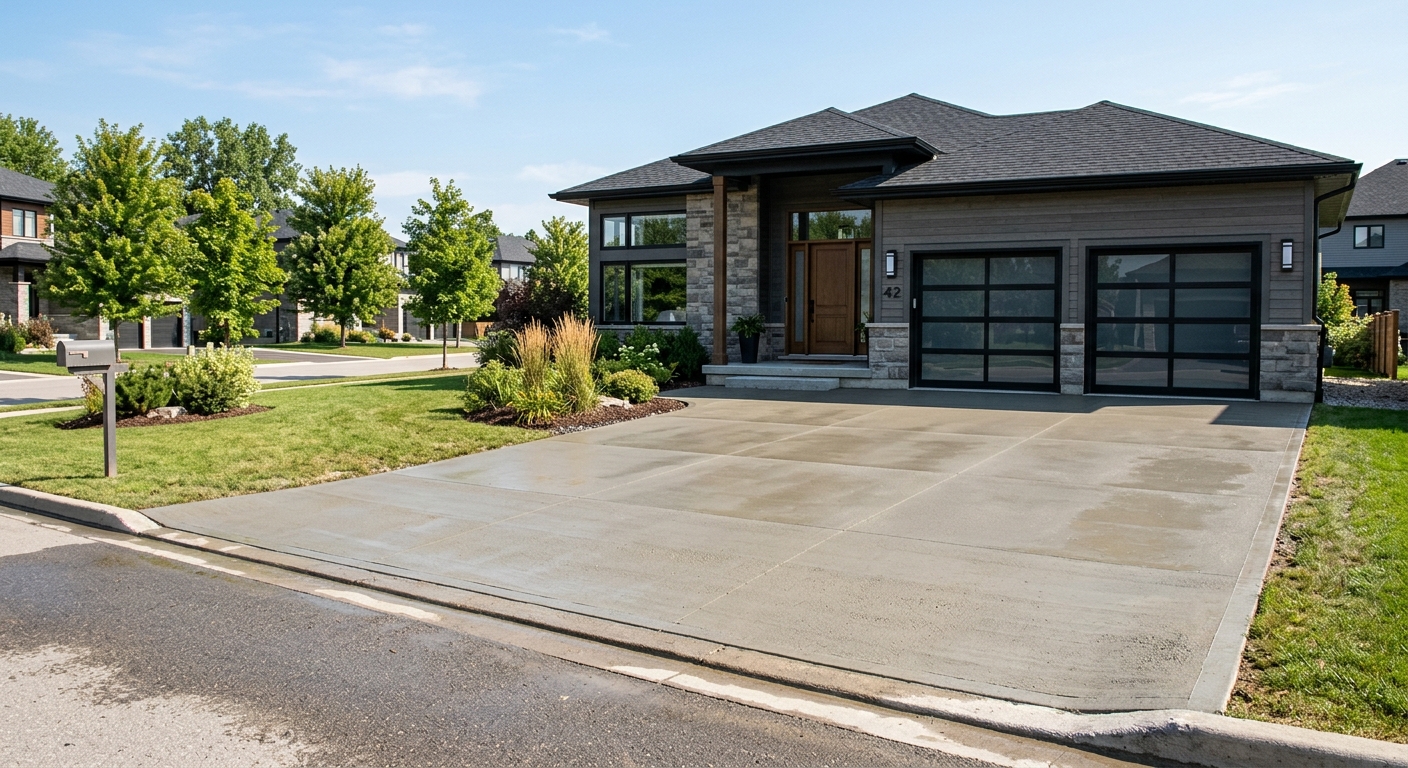
Concrete work options and costs in Yonge-Eglinton
In Yonge-Eglinton, concrete is a go-to for driveways, patios, walkways, and foundation work because the neighbourhood’s lot sizes and driveway layouts fit well with standard flatwork designs. The local housing mix also drives demand: in Toronto’s broader housing stock, a large share of homes are single-detached properties, and those households typically prioritize exterior concrete upgrades every few decades (Statistics Canada, 2021 Census). With a local population of 11,817 in Yonge-Eglinton (Statistics Canada, 2021 Census), you’ll also notice active trades and frequent projects—especially in the late spring to early fall window.
Toronto-region costs are shaped by frost depth and freeze–thaw cycles. Exterior slabs and driveways need air-entrained concrete, adequate thickness, and well-prepared granular base so water can’t sit under the slab and expand/contract against it each winter. Because most exterior pours in the GTA are scheduled for warmer months, contractors often price in the limited pour season and the extra curing protection when temperatures trend toward 10 °C or below. That’s why two driveways with the same square footage can still land far apart in price: the finish type (plain broom versus stamped or exposed aggregate) and the detailing (reinforcement, joints, sealing) typically change the labour and material intensity.
Demand is especially strong in areas like the mid-rise edges closer to Yonge Street and around Eglinton Avenue corridors, where residents commonly upgrade entrances, garage aprons, and backyard patios. Use the table below to compare typical options and what drives the biggest price differences in Yonge-Eglinton.
| Application |
Typical Size |
Key Spec |
Finish Option |
Price Range |
| Concrete driveway (standard broom finish) |
18 ft x 9 ft (162 sq ft) |
Air-entrained mix; compacted granular base; control joints |
Broom finish |
$18,000 – $28,000 |
| Exposed aggregate driveway |
18 ft x 9 ft (162 sq ft) |
Air-entrained mix; proper base; extra finish labour |
Exposed aggregate (wash) |
$22,000 – $34,000 |
| Stamped concrete driveway or patio |
12 ft x 16 ft (192 sq ft) |
Air-entrained mix; colour hardener; control joints |
Stamped pattern & integral colour |
$24,000 – $40,000 |
| Plain concrete patio or walkway |
10 ft x 12 ft (120 sq ft) |
Air-entrained mix; compacted base; joints where needed |
Broom or smooth trowel (non-slip set) |
$16,000 – $26,000 |
| Garage floor (interior slab) |
20 ft x 20 ft (400 sq ft) |
Vapour considerations; reinforcement as required |
Plain broom finish |
$12,000 – $22,000 |
| Foundation footings (structural, below frost) |
Per linear foot (typical footing plan) |
Excavation; formwork; reinforcement; concrete placed below design frost |
Structural concrete (no decorative finish) |
$180 – $300 |
Prices are estimates only and vary by project scope, site access and material selection.
What affects the price of concrete work in Yonge-Eglinton
Even when you’re comparing the “same” driveway or patio across Toronto, bids can differ by roughly 30–50% because contractors price for risk: soil conditions, how much base needs to be rebuilt, how tight access is for the concrete truck, and how many crews are required to keep the pour on schedule. In the GTA, that risk is amplified by freeze–thaw cycles. Structural and exterior concrete specs are built around frost depth—footings must extend below Ontario’s design frost depth (often 1.5–2.4 m) to prevent frost heave and differential movement. For flatwork, the standard expectation is air-entrained concrete (typically 5–7% air content) so the slab survives repeated freezing and thawing without spalling.
Cold-weather curing precautions also show up in the quote. When night temperatures dip toward 10 °C or below, crews may need insulating blankets, heated enclosures for certain pours, and longer scheduling windows to reach proper strength before freeze conditions arrive. Add de-icing salt in the winter and sealing becomes more than “optional”—it’s a durability measure for the surface layer. That’s why a broom-finished driveway in the Toronto market can land in the local $18–$28 range, while stamped or exposed options commonly shift toward the higher end once colour, finishing labour, and additional sealing prep are included.
Two quick local examples that often move the price in Yonge-Eglinton: (1) replacing soft or waterlogged subgrade means deeper excavation and more granular base before any concrete is placed; (2) splitting a project into multiple pours due to access constraints can increase setup time and mobilization. Also, older homes in mature pockets typically have more tie-ins (walks to porches, apron transitions, curb cuts), which means extra saw-cutting, demo, and patchwork—often adding hundreds to over a few thousand dollars depending on removal and disposal scope.
| Price Factor |
Why It Matters |
Cost Impact |
| Frost line depth |
Determines footing depth and required formwork height below grade |
Higher depth increases excavation volume and concrete quantity |
| Site preparation |
Excavation, grading, and compacted granular base determine slab stability |
Soft soil or poor drainage means more removal and base replacement |
| Reinforcement |
Rebar or wire mesh reduces cracking and controls slab movement |
Extra materials and labour can add meaningful cost on driveways |
| Mix design |
Air-entrainment and compressive strength targets affect durability in freeze–thaw |
Specified air content and higher strength can raise mix pricing slightly |
| Finish type |
Broom vs. stamped vs. exposed aggregate changes labour and materials |
Stamped and exposed finishes typically cost more per square foot |
| Pour size and concrete truck access to site |
Narrow access or long carries increase labour and may require planning changes |
Tighter access can add crew time and pumping/placement methods |
| Cold-weather curing precautions |
Heating/blankets protect curing when temperatures fall toward 10 °C or below |
Shorter pour season increases demand and added protection line items |
| Control joint pattern and sealing cost |
Joints manage cracking; sealing helps repel de-icing salts |
More joints, labour for saw-cutting, and sealer material add cost |
Permits & regulations in Ontario
In Ontario, structural concrete work typically requires a building permit. That includes footings, foundation walls, grade beams, and other load-bearing elements that form part of the foundation system. In many cases, municipalities also expect engineered drawings or stamped calculations for structural components. Concrete flatwork—like patios, walkways, and driveways—often does not require a permit by itself, unless it impacts lot grading, stormwater drainage, impervious surface coverage limits, or municipal right-of-way (for example, work tied to a curb cut). Because requirements can vary by scope and location in Yonge-Eglinton, it’s smart to confirm with your local authority before breaking ground.
Homeowners should also verify your contractor’s compliance before work starts. Step-by-step in Ontario: (1) ask for the contractor’s business information and licence number (where applicable through provincial registration systems and municipal requirements); (2) request a current certificate of liability insurance with your project named/valid for the work term; (3) confirm WSIB/WCB coverage and get proof (or an exemption letter if they truly aren’t required—don’t accept verbal assurance); and (4) check references on similar-scale jobs (driveways/flatwork that underwent winter service are a good benchmark). Where to look: use the relevant online registry for the trade/business registration, keep the certificate of insurance on file, and verify the WSIB/WCB clearance status through the insurer/board’s public lookup or by requesting a current clearance letter.
Finally, insist on a written scope that spells out excavation, disposal, protection, curing conditions, and whether permits are included or excluded.
Getting concrete right in Yonge-Eglinton's freeze-thaw climate
In Yonge-Eglinton and the broader Toronto region, concrete problems usually show up after a few winters—most commonly spalling (surface scaling/flaking) and uneven cracking from water movement under the slab. Those failures are usually traced back to three things: (1) base prep and drainage were insufficient; (2) the concrete mix wasn’t properly air-entrained for Ontario freeze–thaw; and (3) joints and sealing weren’t handled correctly, letting water and salt penetrate. Your spec should start with a compacted granular sub-base to the right depth for local soil and the required slab thickness, then move to an air-entrained mix—typically with 5–7% air content for exterior flatwork—plus minimum 32 MPa compressive strength. Finish choices matter too: broom finishes help with traction, while stamped or exposed aggregate need extra attention to curing and sealing to keep the surface durable.
Next, control joints. They’re not cosmetic—they’re how you “choose where cracks happen” by spacing them so the slab relieves stress predictably. Then curing: even though it can look set in a day or two, minimum 7-day curing under proper conditions is what allows strength to develop. If you pour during cooler spells, protect the slab with blankets or curing measures to avoid premature freezing. Finally, sealing: for best durability against de-icing salts, apply a penetrating sealer after the concrete has cured—commonly around 28 days post-pour.
Dollar example: if you’re choosing between a plain broom patio in the $16–$26 band and a stamped option trending toward $24–$40, the price jump can be justified when the contractor also upgrades joint layout, base prep, and the sealing plan. If the quote increases only for “the stamp” but base and curing details are thin, that’s when you’re paying extra without improving longevity.
| Spec |
Why It Matters in Yonge-Eglinton |
What to Ask For |
Impact if Skipped |
| Compacted granular base (depth?) |
Stabilizes the slab and reduces water pumping/freezing under concrete |
State base type and target depth; confirm compaction method |
Settlement, rocking slabs, and accelerated cracking |
| Air-entrained concrete mix (target air %?) |
Protects against freeze–thaw scaling/spalling in Ontario winters |
Target air content (typically 5–7% for exterior flatwork) |
Surface spalling and premature deterioration |
| Compressive strength (MPa rating) |
Ensures the mix reaches adequate durability and strength |
Minimum 32 MPa compressive strength |
Soft surfaces, reduced wear resistance, faster failure |
| Control joints (spacing per ACI guidelines) |
Limits random cracking caused by shrinkage and thermal cycling |
Joint spacing plan and where joints will line up |
Random cracks and water intrusion along fracture lines |
| Minimum 7-day curing period |
Allows strength development before freeze conditions return |
Confirm curing protection steps, especially near 10 °C |
Weak surface, higher risk of scaling after winter |
| Penetrating sealer (when applied after cure) |
Helps repel de-icing salts and reduces water uptake |
Application after full cure—commonly around 28 days |
Faster salt damage and more frequent maintenance |
How to choose a concrete work contractor in Yonge-Eglinton
Choosing the right contractor matters in Yonge-Eglinton because freeze–thaw durability hinges on the details they include in their bid. Start with Ontario compliance checks. For licensing/registration, request their trade registration details and confirm them through the relevant public registry. For liability, ask for a current certificate of insurance showing coverage amounts and that it’s valid for your project dates. For labour coverage, confirm WSIB/WCB status by asking for a clearance letter or equivalent proof—don’t rely on a screenshot older than the job start. If you can’t get documentation quickly, that’s a red flag.
Next, get 2–3 itemised written quotes—not lump sums. The best bids break down labour and materials: excavation and disposal, granular base, rebar/wire mesh, formwork, concrete supply, finishing, joints, and sealing. Clarify exclusions in writing: is permit pulling included (if needed), is site protection included, and who manages haul routes and waste? Warranty is another big differentiator: ask for a workmanship warranty length, whether product warranties apply to sealers/admixtures, and whether any warranty transfers if you sell your home.
For payment schedule, keep it conservative: never pay more than 10–15% upfront. Hold back a portion until the finish is complete and cured per the agreed schedule. Also, demand a timeline with a start date, pour date window, and estimated completion in writing—Toronto’s schedule pressure is real once weather tightens.
- Verify trade registration/licence and keep the reference number on your contract.
- Request a current certificate of liability insurance for the full work period.
- Provide WSIB/WCB clearance proof in writing (clearance letter/screenshot with date).
- Get 2–3 itemised quotes with line items for base, concrete, reinforcement, finishing, and sealing.
- Confirm whether excavation and disposal are included (haul, tipping fees, and cleanup).
- Ask for the proposed concrete mix specification (air-entrainment and strength).
- Confirm thickness and joint layout (spacing and saw-cut timing).
- Ask what happens if weather drops near 10 °C (blankets/heating/curing plan).
- Check that sealing is included and when it will be applied (after cure, commonly around 28 days).
- Review photos of similar freeze–thaw flatwork jobs in Toronto—not only new construction.
- Set a payment schedule: 10–15% max upfront; holdback until completion and cleanup.
- Make sure the contract includes start/completion dates and a weather contingency statement.
Concrete red flags I see around Yonge-Eglinton: contractors who won’t discuss air-entrainment or joint spacing, vague “lump-sum” scopes with no base preparation details, refusing to provide insurance/WSIB/WCB proof, rushing curing in cooler evenings, or quoting stamped/exposed finishes without a clear plan for sealing and protection.
Frequently asked questions — concrete work in Yonge-Eglinton
What is rebar and when is it required in Ontario?
Rebar is steel reinforcing bar used to strengthen concrete and help control cracking by improving the slab’s ability to handle tension. In Ontario, it’s typically required when the design calls for reinforcement due to structural loads, slab thickness, soil conditions, or foundation requirements—especially for structural footings and many foundation elements. For driveways and patios, rebar or mesh may be specified when the contractor is building for heavier loads, managing larger slab spans, or when the base prep can’t be guaranteed to perfectly prevent movement. In Yonge-Eglinton, where freeze–thaw and water management matter, reinforcement often becomes part of the “durability package,” not just a structural add-on. Always rely on the engineered plan or the contractor’s written spec for your thickness and reinforcement, rather than assuming “all concrete needs rebar.”
How long does a concrete project take in Yonge-Eglinton?
In Yonge-Eglinton, the schedule depends on how large the pour is, site access, and weather. The actual placement can be fast—often a day for typical driveways and patios—but curing and preparation drive the timeline. For exterior flatwork, you can usually see normal traffic after short initial set, yet full strength development requires proper curing; a good baseline is minimum 7 days of curing under appropriate conditions. If temperatures drop toward 10 °C or below, contractors may need blankets or heating, which can extend timelines. For larger work like foundation footings, the sequence (excavation, inspections/permits where required, forming, inspection calls, then pour) typically stretches longer than flatwork. When you compare quotes, ask for a start date, pour date window, curing plan, and a realistic “ready for use” date—weather control is a major cost driver in the Toronto area.
What is a concrete overlay and is it suited to Yonge-Eglinton?
A concrete overlay is a new concrete layer poured over an existing slab surface (after surface preparation), usually to restore appearance and ride quality without fully removing the original driveway or walkway. In Yonge-Eglinton, overlays can be suited when the original slab is still fundamentally sound (no major heaving, no deep structural cracking, and good drainage). Overlays are less suitable when the base has failed, because the new layer can crack or debond as the old slab moves through freeze–thaw cycles. Also, if the existing concrete has significant scaling from de-icing salts, thorough prep is essential to ensure bond. On price, overlays may be cheaper than full replacement in some cases, but the value depends on preparation scope. If you’re already in the $18–$28 band for standard driveway work, compare overlay bids that include full grinding/surface prep and patching versus those that treat the project like a simple topcoat.
How do I seal concrete to protect it in Yonge-Eglinton?
Sealing in Ontario is about controlling water and salt movement into the concrete surface. In Yonge-Eglinton’s freeze–thaw climate, penetrating sealers are commonly used because they reduce water uptake and help slow down salt-related scaling. Timing matters: ask for a penetrating sealer applied after the concrete has fully cured—often around 28 days post-pour—so the concrete surface isn’t sealed too early. Before sealing, ensure the slab is clean and dry; contractors typically pressure wash or use appropriate cleaning methods and allow it to dry fully. Avoid sealing over dust or standing moisture, which can trap contaminants. In your quote, confirm the sealer product type, coverage rate, and whether the work includes edge detailing and recoat rules. Sealing doesn’t “fix” poor base prep, but it can significantly improve durability when combined with proper air-entrained mix, joints, and curing.
What is the difference between concrete and cement?
Cement is one ingredient, while concrete is the full engineered mixture. Cement is the binder; it’s combined with aggregates (sand and gravel or crushed stone) and water to create concrete. Many homeowners mix up the terms because “cement” is often used casually to mean the whole product. In practice, contractors specify concrete based on performance—such as air-entrainment for freeze–thaw durability and minimum compressive strength (often 32 MPa or as required by spec). In Yonge-Eglinton, the cement part alone doesn’t determine freeze resistance; the total mix design, including air content and proper curing, does. That’s why two bids can differ even when they use “the same cement brand”—the real difference is the concrete specification, finishing plan, and how the slab is protected during Ontario’s cooler curing conditions.
How much does concrete work cost in Yonge-Eglinton?
Concrete pricing in Yonge-Eglinton depends on size, base prep, reinforcement, access, and finish. For guidance, Toronto’s local market ranges commonly put driveways and slabs in the $18–$28 band, while patios and walkways are often in the $16–$26 range. Stamped or decorative work usually sits higher, commonly in the $24–$40 range due to extra colour and finishing labour. For foundation footings, structural concrete is often priced per linear foot with a typical range of $180–$300 depending on excavation depth, reinforcement, and formwork complexity. Beyond the banded price, your contractor’s scope—especially excavation/disposal and whether they include sealing—can swing the final total. If you’re getting bids, make sure the drawings and specs match; otherwise, it’s easy to compare apples to something that isn’t really apples.