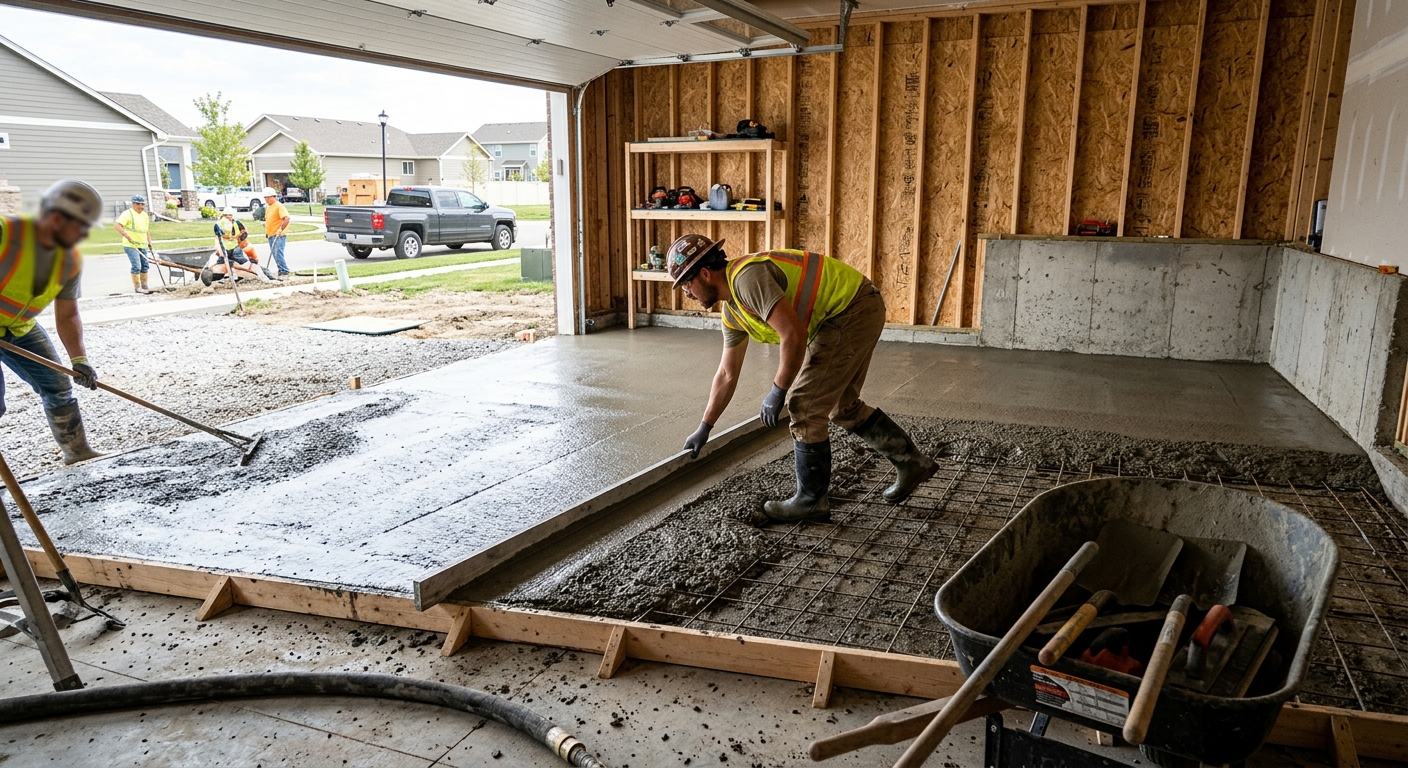
Concrete work options and costs in Perth
Concrete work in Perth is popular because the town’s housing stock is largely older—homes built before 1981 make up 65.4% of local dwellings—so many homeowners are upgrading driveways, patios, and entry walkways. You also have plenty of single-detached homes (50.6% of dwellings), which typically means driveways and slab-on-grade flatwork are top-of-mind projects. In Kingston–Pembroke, concrete pricing is shaped less by “the slab” and more by how the site is built: excavation, drainage, gravel base prep, reinforcement, and whether the crew can pour in a reliable weather window. Frost and repeated freeze-thaw cycles mean exterior work needs disciplined specs (air-entrained concrete, proper jointing, and footings set below frost) and careful curing—especially on shoulder-season pours when strength gain can slow. That scheduling pressure can affect contractor availability around busy areas like the High Street and the neighbourhoods closer to the Tay River corridor, where there are frequent driveway and walkway replacements. Labour costs can also shift with delivery distance and truck access, so two nearby properties can still price quite differently.
Below is a practical guide to common Perth concrete options, including finish level. Use it to sanity-check bids before you sign anything, then connect the final price to your site conditions and finish choices.
| Application |
Typical Size |
Key Spec |
Finish Option |
Price Range |
| Concrete driveway (standard broom finish) |
400 sq. ft. (about 20’ x 20’) |
Air-entrained exterior mix; control joints as needed |
Broom finish |
$120–$180 |
| Exposed aggregate driveway |
400 sq. ft. (about 20’ x 20’) |
Proper base drainage; consistent slump control |
Exposed aggregate (stone reveal) |
$140–$210 |
| Stamped concrete driveway or patio |
300 sq. ft. (about 15’ x 20’) |
Air-entrained mix; stamping release & tighter finishing tolerances |
Stamps + colour (integral/overlay) |
$160–$280 |
| Plain concrete patio or walkway |
200 sq. ft. (about 10’ x 20’) |
Exterior-grade air-entrained mix; edges with form support |
Smooth or broom finish |
$90–$150 |
| Garage floor (interior slab) |
440 sq. ft. (about 22’ x 20’) |
Vapour barrier/insulation as required; steel or mesh if specified |
Float/smooth trowel finish |
$120–$190 |
| Foundation footings (structural, below frost) |
Varies by foundation design |
Excavation to design frost depth; engineered rebar & formwork |
Structural concrete (no decorative finish) |
$180–$320 |
Prices are estimates only and vary by project scope, site access and material selection.
What affects the price of concrete work in Perth
Even when homeowners describe the “same” concrete job in Perth, quotes across Kingston–Pembroke and the broader Ontario market can swing by 30–50%. The biggest reason is that concrete pricing follows site conditions and the weather window just as much as it follows thickness or finish. In Ontario, frost line depth and freeze-thaw cycles dictate the spec: footings must extend below the design frost depth to prevent frost heave, and exterior slabs should use air-entrained concrete mixes to survive repeated winter expansion and contraction. When crews face a shorter pour season and colder shoulder-season temperatures, they often need cold-weather curing precautions (heating, insulation blankets, and tighter monitoring), which adds cost. On top of that, Ontario driveway owners typically use de-icing salt in winter; without the right air content and a penetrating sealer, you can get surface scaling/spalling sooner, which pushes contractors to focus on the “right” details rather than the lowest ticket mix.
In Perth specifically, costs can rise if your lot has wet soils near drainage swales or requires more granular base and regrading; in those cases, groundwork and disposal can become a large part of the budget. Costs can also increase in older neighbourhoods where access is tight—less room for equipment and concrete trucks means more labour and sometimes smaller pours. Conversely, if you’re replacing like-for-like flatwork on a stable, well-drained base, the contractor may stay closer to the driveway band of $120–$180 per sq. ft. for a standard broom finish. If you’re adding colour, stamping, or exposed aggregate, you should expect to move toward the stamped/decorative band of $160–$280, because the finishing tolerance, sealing discipline, and material handling are more labour-intensive. With 65.4% of homes built before 1981, retrofit work is common, and that’s where the dollar differences show up—often in excavation depth, reinforcement needs, and drainage upgrades rather than the concrete itself.
| Price Factor |
Why It Matters |
Cost Impact |
| Frost line depth — determines footing depth and form height |
Footings must be below frost to reduce frost heave and movement |
Can add significant excavation and rebar/formwork cost |
| Site preparation — excavation, grading, compacted granular base |
Good drainage and compaction prevent settling and slab cracking |
Higher if soils are wet, rocky, or require regrading |
| Reinforcement — rebar or wire mesh requirement |
Controls crack width and improves slab performance under loads |
Costs rise with engineered reinforcement or heavy-load specs |
| Mix design — air-entrainment and compressive strength spec |
Air entrainment helps survive freeze-thaw; strength supports durability |
Exterior-rated air-entrained mixes can cost more than basic mixes |
| Finish type — broom vs. stamped vs. exposed aggregate |
Decorative finishes require extra labour and tighter timing |
Stamped/exposed typically cost notably more than broom finish |
| Pour size and concrete truck access to site |
Scheduling and access affect crew size and placement method |
Slower access and limited staging increase labour and mobilization |
| Cold-weather curing precautions — heating and blankets |
Slow strength gain and temperature swings increase surface damage risk |
Adds materials and labour for curing protection |
| Control joint pattern and sealing cost |
Joints help control cracking; sealing helps resist salt scaling |
Sealer and sawcut labour add cost but reduce future deterioration |
Permits & regulations in Ontario
In Ontario, many homeowners only think about permits for big renovations, but for concrete it depends on what you’re building. Structural concrete work—such as foundation walls, grade beams, and engineered components like footings for new construction or major foundation changes—normally requires a building permit, and engineered drawings are often reviewed by the municipality as part of the approval process. Concrete flatwork (driveways, patios, and walkways) typically does not require a permit unless the work affects lot grading, drainage, or impervious surface coverage limits, or it touches municipal right-of-way requirements. Because rules can vary with drainage plans and location, you should confirm with the local authority before breaking ground in Perth.
Regardless of permit requirements, verify the contractor is properly insured and covered. Ask for their liability insurance certificate (to protect you if something is damaged or someone is hurt), and confirm coverage for workers through WSIB (or the applicable worker coverage documentation for the company). Then request references from similar-size projects—particularly exterior flatwork in freeze-thaw conditions—so you can see how they handle base prep, jointing, and curing discipline.
Step-by-step for a Perth homeowner: (1) ask for the contractor’s liability insurance certificate and check the expiry date and project address/coverage details; (2) ask for WSIB/WCB clearance documentation and confirm it covers the employees assigned to your job; (3) look up any applicable business registration details and, if they’re performing structural work, ask for evidence they can support the permit/engineered requirements; (4) verify the permit status with the municipality (or determine who is pulling the permit) before work begins.
Getting concrete right in Perth's freeze-thaw climate
Concrete failures in Perth are usually about preparation and temperature, not the concrete itself. The most common issues are spalling (surface flaking) and cracking that accelerates over winter due to de-icing salt exposure and freeze-thaw cycling. To spec the job correctly, start with base preparation: you want a compacted granular sub-base at the right depth for local soil conditions and frost considerations, plus proper drainage so water doesn’t sit under your slab. Next is mix design. For exterior flatwork, ask for air-entrained concrete with a target air content around 5–7% and a minimum compressive strength of 32 MPa (unless an engineer specifies otherwise). Air entrainment creates room for freezing expansion, reducing the internal damage that leads to scaling.
Then focus on control joints. Joints aren’t an aesthetic step—they’re a cracking plan—so spacing should be designed to limit random cracking from shrinkage and temperature movement. Curing matters as much as the pour: a minimum 7-day curing period under suitable conditions is typical, and cold-weather curing (insulating blankets, monitoring temperature, and careful scheduling) is critical when late-fall temperatures slow strength gain. Finally, sealing: a penetrating sealer is usually applied after the concrete has properly cured (commonly after 28 days) to repel moisture and reduce salt-driven deterioration.
Here’s a real decision point: a broom-finished driveway might come in closer to the driveway band of $120–$180, while a stamped option can land toward $160–$280. If you’re paying that premium, ensure the contractor is also specifying the “durability basics” (air-entrainment, correct base, jointing, and curing). In Perth, you’re not just buying appearance—you’re buying performance through winter.
| Spec |
Why It Matters in Perth |
What to Ask For |
Impact if Skipped |
| Compacted granular base (depth?) |
Limits settlement and helps drainage so freeze-thaw doesn’t pump water |
Base depth and compaction method (underlayer thickness + testing approach) |
Uneven slab, early cracking, pumping and frost-related heave |
| Air-entrained concrete mix (target air %?) |
Reduces freeze-thaw damage and helps prevent salt scaling/spalling |
Specify air content target for exterior (about 5–7%) on the ticket/spec |
Surface scaling and spalling become more likely after winters |
| Compressive strength (MPa rating) |
Strength gain affects durability and resistance to early loading |
Confirm minimum 32 MPa (or higher if engineered/required) |
Weaker surface, increased wear and chipping if opened too soon |
| Control joints (spacing per ACI guidelines) |
Controls where shrinkage/temperature cracks open |
Ask for joint spacing plan and sawcut timing |
Random cracking patterns and wider cracks that trap moisture |
| Minimum 7-day curing period |
Cold or damp conditions slow strength; curing protects the surface |
What curing protection is used if temps drop (blankets/heaters if needed) |
Surface weakness, increased scaling risk, premature damage |
| Penetrating sealer (when applied after cure) |
Helps repel moisture and reduces salt-driven deterioration |
Confirm sealer type and application timing (commonly after full cure, e.g., 28 days) |
Faster water/salt penetration and earlier surface breakdown |
How to choose a concrete work contractor in Perth
Choosing a concrete contractor in Perth should start with verification, because freeze-thaw performance depends on the crew following specs, not just pouring concrete. First, verify Ontario licensing/business details where applicable for the work type your contractor is doing. Then check liability insurance: request a certificate of insurance and ensure it covers the scope of your project and has an active expiry date. For worker coverage, ask for WSIB clearance or the relevant worker coverage documentation for the company (and confirm the employees working on your job are covered). If anything feels vague, pause—on exterior concrete, mistakes are expensive because repairs usually require removal and re-pour.
Get 2–3 itemised written quotes rather than a single lump-sum number. You want labour and materials broken down (excavation, formwork, base material, reinforcement, concrete supply, finishing, joints, curing protection, and sealing if included). Read exclusions: ask whether they include permit pulls (if required), site disposal, sawcutting joints, and any drainage adjustments. For warranty, ask for two pieces—workmanship warranty length and any product/manufacturer warranty for sealers or admixtures—plus whether the warranty is transferable if you sell the home.
Payment schedule matters in Ontario winters. Never pay more than 10–15% upfront; a reasonable holdback is tied to completion and close-out items (sealing cure timing, joint inspection, and any final grading). Require a timeline in writing with a start date and estimated completion, and ensure the contractor explains how they’ll protect the pour during cool weather.
- Ask for liability insurance certificate and confirm active dates and coverage limits.
- Request WSIB/WCB/worker coverage documentation before scheduling the pour.
- Get at least 2–3 itemised quotes (no “mystery lump sum”).
- Confirm base thickness, compaction expectations, and whether base testing/testing is discussed.
- Verify air-entrainment and exterior mix specs on the quote (not just “quality concrete”).
- Ask about reinforcement type (rebar vs. mesh) and where it will be placed.
- Require a control joint plan (spacing and when sawcuts happen).
- Clarify curing method if temperatures drop (blankets/heating and monitoring).
- Confirm sealing: product type and when it will be applied after cure (often after 28 days).
- Check whether excavation includes removal of unsuitable material and disposal.
- Confirm truck access, pour staging, and whether forms are included.
- Make sure the written scope states what’s included vs. excluded (repairs to surrounding surfaces, grading, and finishing).
Perth-specific red flags include: a quote that skips air-entrainment for exterior work, no mention of control joints (or vague “we’ll sawcut later”), refusal to provide proof of liability insurance/worker coverage, promises to pour and open to traffic too quickly after a cold night, and decorative/stamped pricing that doesn’t include sealing and proper curing discipline.
Frequently asked questions — concrete work in Perth
Concrete vs pavers for a patio in Perth?
In Perth, both concrete and pavers can work well, but freeze-thaw tends to reward the system that’s built for drainage and base performance. Concrete patios are typically poured monolithically with control joints planned to manage cracking, and when you use air-entrained exterior concrete you get better resistance to salt and winter scaling. Pavers can look great and are repairable one-stone-at-a-time, but they rely heavily on a properly compacted base and good edge restraints to avoid shifting. If your site is tight around older driveways common in Perth and access is limited, concrete often becomes simpler to schedule. For budgeting, a plain concrete patio usually starts around the $90–$150 range, while pavers can vary widely depending on base depth and edging.
How long does a concrete driveway last?
A well-built concrete driveway in Ontario often lasts decades, but the life span depends on base prep, air-entrainment, and winter maintenance. In Perth’s freeze-thaw climate, the driveway’s weak points are usually where water is trapped under the slab or where surface damage begins from salt exposure. Contractors who set footings and bases properly, include adequate thickness, specify air-entrained exterior mix, and plan control joints tend to see fewer early repairs. Your actual service life can be shortened if the concrete was poured in cold conditions without proper curing blankets or if joints were cut too late. As a homeowner, ask what mix spec they’ll use for exterior exposure and whether a penetrating sealer is included. The cost you pay within the driveway band of $120–$180 for standard broom finish often reflects those durability details.
What is air-entrained concrete and why does it matter here?
Air-entrained concrete is mixed with tiny, uniformly distributed air bubbles that give freezing water somewhere to expand. That matters a lot in Perth because repeated freeze-thaw cycles and de-icing salt accelerate surface deterioration when the mix isn’t properly specified. For exterior flatwork—driveways, patios, and walkways—Ontario practice typically targets about 5–7% air for durability. The difference shows up after a few winters: without air entrainment, you’re more likely to see scaling and spalling, especially near edges and joint lines where moisture collects. If you’re comparing quotes, don’t accept generic statements like “we use quality mix.” Ask for the exterior air requirement and how the contractor will protect curing during cool shoulder-season nights. Even decorative work benefits, because stamped or exposed aggregate still needs the same freeze-thaw resistance basics.
How do I prepare the base for a concrete slab?
Base preparation is where concrete projects are won or lost in Perth. The general goal is a stable, properly graded sub-base with drainage, built on compacted granular material—not on soft topsoil. A contractor should excavate unsuitable material, build granular layers to the specified depth, and compact each layer to reduce settlement. They should also address water movement: if your site sheds water poorly toward the slab, you’ll pay again through cracking and premature scaling. For homeowners in older areas with mature landscaping, base preparation may include removing roots or replacing wet material before concrete placement. Ask your contractor to explain the base depth for your site and whether they’re treating the driveway/patio as an exterior freeze-thaw exposure with air-entrained concrete and jointing. If base prep is vague in the quote, it’s a sign to push for details before signing.
How do I compare concrete quotes?
To compare concrete quotes fairly in Perth, you need like-for-like scope. Start by checking whether each quote includes the same thickness, the same base preparation steps, and the same exterior mix requirements (especially air-entrainment). Then look at reinforcement: some contractors include mesh or rebar only under certain conditions, so confirm what they’re actually using and where it sits in the slab. Next, compare finishing and durability items: broom finish vs stamped vs exposed aggregate can change labour costs, and so can curing protection if temperatures drop. Decorative projects often land in the $160–$280 band, while standard driveway broom work is usually closer to $120–$180. Finally, ensure the quotes state what’s included for disposal, grading, joint cutting, sealing timing (often after full cure), and any permit-related items if engineered/structural elements are involved.
Can concrete be poured in cold weather in Perth?
Yes, concrete can be poured in cold weather in Perth, but it should be done with controls—not just “we’ll pour anyway.” Cold temps slow strength gain, and freezing conditions before adequate curing can lead to weak surfaces or long-term durability issues. A responsible contractor will plan the pour around a workable temperature window and use cold-weather curing precautions such as insulating blankets, controlled heating (when required), and monitoring concrete temperatures. They should also manage timing for finishing and sawcutting control joints. If you schedule late-fall work, ask directly what curing plan they’ll follow for your dates and overnight temperatures. Don’t assume the lowest bid includes those costs. In practice, cold-weather discipline can increase labour and materials, but it protects your investment—especially because Perth’s winters bring freeze-thaw cycles and salt exposure that punish any shortcut taken during curing.