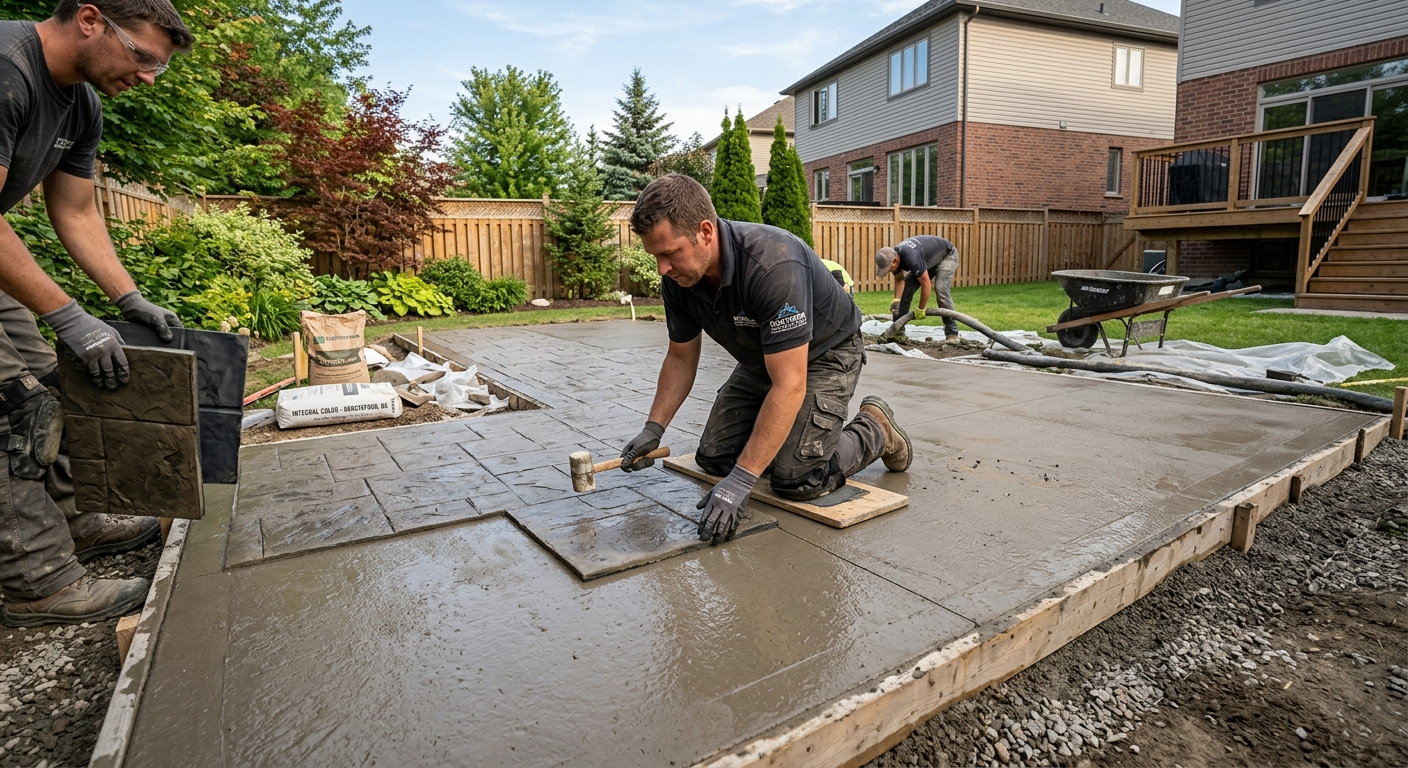
Concrete work options and costs in Midland
In Midland, concrete work is a common upgrade for homeowners—especially in neighbourhoods like Perkinsfield, where driveways and walkways see heavy seasonal use. With 65.0% of local dwellings being single-detached houses, most concrete quotes you’ll receive are for exterior flatwork such as driveways, patios, and walkways. Midland’s housing stock is also older, with 61.6% of homes built before 1981 (Statistics Canada, 2021 Census), and that matters because older lots often have established drainage patterns, mature trees, and less-understood subgrade conditions—meaning more prep and sometimes more excavation before the first truck arrives.
In the Kitchener–Waterloo–Barrie economic region, pricing is shaped by cold, high freeze-thaw conditions. Frost depth in this part of Ontario is commonly around 1.0–1.2 m (3–4 ft), and structural concrete like footings must be set below frost to prevent heave and cracking. That same freeze-thaw stress also drives specifications for air-entrained concrete for exterior slabs. Labour and equipment costs tend to be higher here than in milder climates because the effective pour season is shorter and curing/protection in cold wet weather can add real time on site.
When you compare bids, the “same” job can land at different numbers because of base depth, reinforcement, concrete mix design, and how many control joints are planned to manage movement. Use the table below to benchmark typical scopes—then we’ll break down what moves the final price in your project.
| Application |
Typical Size |
Key Spec |
Finish Option |
Price Range |
| Concrete driveway (standard broom finish) |
16 ft × 24 ft (384 sq ft) |
Air-entrained exterior mix; compacted granular base; control joints |
Broom finish |
$15,000–$25,000 |
| Exposed aggregate driveway |
16 ft × 24 ft (384 sq ft) |
Air-entrained mix; proper curing to support finishing; sealing recommended |
Exposed aggregate (wash/sandblasted look) |
$18,000–$30,000 |
| Stamped concrete driveway or patio |
12 ft × 20 ft (240 sq ft) |
Air-entrained mix; integral colour (or top colour); joint layout |
Stamped pattern (wood/stone/brick look) |
$10,000–$18,000 |
| Plain concrete patio or walkway |
10 ft × 16 ft (160 sq ft) |
Air-entrained mix; compacted base; formed edges and joints |
Plain trowel/broom hybrid |
$2,500–$4,000 |
| Garage floor (interior slab) |
22 ft × 24 ft (528 sq ft) |
Vapour barrier where needed; typical reinforcement; minimum thickness per design |
Broom finish |
$11,000–$18,000 |
| Foundation footings (structural, below frost) |
Typical new extension/run of footings |
Engineered/permit-required; excavate to design frost depth; proper concrete strength |
Structural concrete placement |
$6,000–$14,000 |
Prices are estimates only and vary by project scope, site access and material selection.
What affects the price of concrete work in Midland
In Midland, two contractors can price the “same” concrete surface 30–50% apart because the real work is in what’s underneath and how it’s built for Ontario’s climate. In the broader Kitchener–Waterloo–Barrie market, crews often account for frost-related excavation depth, the cost of air-entrained mixes, and time spent protecting and curing concrete during shoulder-season weather. In milder parts of Canada, fewer curing precautions and less frost depth can reduce labour and equipment time; in cold regions like ours, that same scope becomes more labour-intensive and less forgiving.
Every exterior slab in Ontario should be built to survive freeze-thaw cycles. Frost depth commonly sits around 1.0–1.2 m (3–4 ft) here, so footings (and anything structurally tied to them) must be placed below frost to prevent heave. Exterior concrete also needs air-entrainment—typically about 5–7% air content—so water inside the slab can freeze without destroying the paste. In Midland, the shorter pour season and cold-weather curing precautions (insulating blankets, temperature monitoring, sometimes temporary heating) can add cost even if the square footage is identical. De-icing salt can accelerate surface spalling, which is why sealing is often bundled as a smart durability step, particularly for driveways that see winter traffic.
Local site conditions swing pricing quickly. For example, older lots (61.6% built before 1981) often have uneven grades and mature drainage patterns that require more excavation and base re-build. If your driveway ties into an older foundation or there are utility conflicts, excavation and re-routing can add hours—and those hours directly influence your total. On the other hand, a simple, well-accessed patio with stable subgrade might land near the lower end of the patio/walkway band (around $14–$22 per sq ft), while a stamped job with colour and extra finishing time typically tracks higher (often $22–$35 per sq ft for stamped & decorative concrete). For structural footings, the difference between “shallow guess” and “right depth below frost line” is where budgets can jump by thousands.
| Price Factor |
Why It Matters |
Cost Impact |
| Frost line depth |
Determines footing depth and form height below design frost to prevent heave. |
More excavation and concrete; can add material and labour—especially where access is tight. |
| Site preparation |
Excavation, grading, and compacted granular base control settlement and surface cracking. |
Heavier costs where soil is poor, wet, or needs over-excavation and haul-away. |
| Reinforcement |
Rebar or wire mesh improves crack control and load performance. |
Adds steel and placement labour; varies by slab thickness and design needs. |
| Mix design |
Air-entrainment and compressive strength spec improve freeze-thaw durability. |
Air-entrained exterior mixes and higher-strength specs can increase concrete unit costs. |
| Finish type |
Broom vs. stamped vs. exposed aggregate affects finishing time, materials, and labour skill. |
Stamped/exposed typically cost more due to forms, colour, stamps, and longer finishing. |
| Pour size and concrete truck access to site |
Access affects pumping vs. placement distance, labour hours, and scheduling. |
Poor access can raise costs through additional labour, equipment, or pump charges. |
| Cold-weather curing precautions |
Heating/blankets protect early strength gain and reduce cracking risk. |
Can add daily setup and labour time near freezing or during wet cold snaps. |
| Control joint pattern and sealing cost |
Joint spacing guides cracking and sealing improves durability against salt and moisture. |
More joints add forming/sealing time; sealing is an extra line item but reduces spalling risk. |
Permits & regulations in Ontario
In Ontario, structural concrete work generally needs a building permit and, in many cases, engineered drawings reviewed by the municipality. That includes footings, foundation walls, and grade beams—anything that supports the building structure. Concrete flatwork like patios, walkways, and most driveways usually does not require a permit on its own, unless the work changes lot grading, affects municipal impervious surface limits, or impacts drainage toward a right-of-way. Even when a permit isn’t typical for the slab itself, you should still confirm requirements with the local authority before breaking ground—especially if you’re changing elevations, lowering the grade, or tying into existing foundation drainage.
Before you hire a contractor in Midland, verify three essentials: liability insurance, WSIB/WCB coverage, and proper Ontario registrations/licensing (as applicable to the scope). Step-by-step, ask for:
- Certificate of Insurance: confirm general liability limits are current and match the project address.
- WSIB/WCB clearance letter (or proof of coverage): request the document and verify it applies to the time period of the job.
- Ontario registration/licence details: confirm the company is properly registered for the work they’re claiming (ask the contractor to provide their business information and any applicable documentation).
- References: look for similar-scale concrete projects in Southern Ontario, not just masonry or landscaping.
Finally, get everything in writing: who pulls permits if required, what’s excluded, and how changes are handled—because in freeze-thaw season, small site discoveries can quickly become additional scope.
Getting concrete right in Midland's freeze-thaw climate
Concrete failures in Midland usually come from the same set of issues: poor base preparation, wrong mix, weak early curing, or joints that don’t manage movement. Ontario’s freeze-thaw cycles place the slab and any structural concrete under repeated stress as moisture expands and contracts in the pores and along the subgrade. If the base isn’t compacted to the right depth (and aligned to the local frost conditions), the slab can settle unevenly and crack. If the mix isn’t air-entrained, freezing water can damage the paste, leading to surface scaling and spalling—often visible after the first harsh winter.
To spec a job correctly, insist on five core items. First, base prep: a compacted granular sub-base to the design depth and a well-draining section that limits pumping and frost heave. Second, mix design: for exterior flatwork, target air-entrainment around 5–7% and a minimum 32 MPa compressive strength (or higher if engineered). Third, control joints: plan the joint pattern and spacing to limit random cracking, not just “where it’s convenient.” Fourth, curing: plan for minimum 7-day curing under appropriate conditions; in cold snaps, blankets or membranes can be essential to prevent early freezing. Fifth, sealing: apply a penetrating sealer after the concrete has cured—commonly around 28 days—to reduce salt and moisture intrusion.
Here’s the practical cost perspective. A stamped driveway typically costs more than broom-finish because of colour, stamp labour, and finish time; you may see stamped options land in the $22–$35 per sq ft band, while broom-finished driveway work often tracks closer to the $15–$25 per sq ft backbone. The higher option is usually justified for aesthetics, but the freeze-thaw durability requirements shouldn’t change—air-entrainment and joint design still matter the same, regardless of pattern.
| Spec |
Why It Matters in Midland |
What to Ask For |
Impact if Skipped |
| Compacted granular base (depth?) |
Controls settlement and helps prevent frost-driven movement under exterior slabs. |
State the granular base depth and compaction method; confirm subgrade assessment and drainage plan. |
Uneven settlement, early cracking, and water pooling that worsens freeze-thaw damage. |
| Air-entrained concrete mix (target air %?) |
Air pockets relieve freeze pressure in exterior concrete under winter cycling. |
Request exterior air-entrainment target around 5–7% for flatwork and confirm “air-entrained” on the ticket/spec. |
Spalling/scaling and premature surface deterioration. |
| Compressive strength (MPa rating) |
Strength gain supports durability and reduces cracking risk under load. |
Ask for minimum 32 MPa (or engineered requirement) and expected curing conditions. |
Lower performance, higher risk of cracking and damage under winter traffic. |
| Control joints (spacing per ACI guidelines) |
Directs cracking to predictable lines and reduces random fracture. |
Get joint spacing and layout plan before pour; confirm how joints align with edges and features. |
Random cracking patterns that look worse and can allow moisture intrusion. |
| Minimum 7-day curing period |
Cold nights and wet conditions can interrupt strength gain early. |
Confirm protection plan and minimum curing window; ask about blankets/membranes when temperatures drop. |
Weak early strength leading to surface damage and increased cracking risk. |
| Penetrating sealer (when applied after cure) |
Repels salt and moisture that drive freeze-thaw deterioration. |
Ask for a penetrating sealer after full cure (commonly ~28 days) and confirm the product and coverage rate. |
Faster salt-related spalling and staining, especially on driveways. |
How to choose a concrete work contractor in Midland
Choosing the right concrete contractor in Midland is less about the lowest number and more about verifying they’ll build to the specs that protect your slab through winter. Start with coverage. Ask for a current certificate of liability insurance and confirm the coverage is active for the project period. Then request a WSIB/WCB clearance letter (or proof of coverage) so you know the contractor can legally and safely employ crews on your site.
Next, insist on 2–3 itemised written quotes with a breakdown of labour and materials, not a single lump sum. A good quote will separate excavation/base work, forms/finishing, concrete supply/mix spec, reinforcement (if required), joints, and cleanup/disposal. Ask whether permits are included (if structural work requires them) and whether removal of excavated material is part of the price—unexpected disposal is a common budget surprise on older lots.
Warranty matters too. Look for a workmanship warranty length and what exactly it covers (for example, cracking that’s not due to subgrade failure). Confirm whether the warranty transfers to future homeowners if you sell. For payment, never pay more than about 10–15% upfront; hold back a portion until the job is complete, cleaned, and final protection/sealing steps are done. Finally, get the start date and completion estimate in writing, including what happens if cold weather slows curing.
- Ask to see similar project photos from Midland or nearby areas, not just marketing albums.
- Confirm the concrete mix will be air-entrained for exterior work.
- Require base prep details: base depth, compaction, and drainage plan.
- Get reinforcement scope in writing (where mesh/rebar is needed, not “maybe”).
- Review the control joint layout and spacing before the pour.
- Ask how they protect curing concrete in cold snaps (blankets/membranes, temperature checks).
- Confirm sealing is included or excluded—and when it will be applied (after cure).
- Check if disposal/haul-away of excavated soil is included.
- Verify access constraints: pump charges, distance to placement, and truck access.
- Make sure the quote lists materials grades and thicknesses (not just “concrete slab”).
- Confirm start/completion dates and concrete scheduling responsibilities.
- Request a clear change-order process if site conditions differ from assumptions.
Concrete red flags in Midland include: quotes that don’t mention air-entrainment, no written joint plan, cutting corners on base depth/compaction, vague curing/protection promises in shoulder-season weather, and contractors asking for large upfront deposits without a schedule or warranty in writing.
Frequently asked questions — concrete work in Midland
How much does concrete work cost in Midland?
Concrete pricing in Midland depends mainly on square footage, base prep, finish level, and how much cold-weather protection is needed during curing. As a benchmark, exterior driveways often land in the $15–$25 per sq ft range for broom-finish, while patios and walkways typically sit around $14–$22 per sq ft. Stamped & decorative concrete commonly runs higher, often $22–$35 per sq ft, because of integral colour, stamp labour, and extra finishing steps. For example, a straightforward patio might price near the lower band if the base is simple, while a stamped patio will be higher even if the dimensions are the same. Always treat “per sq ft” as an estimate—site access, excavation depth, reinforcement, and drainage work can move the total significantly in Midland’s freeze-thaw conditions (Statistics Canada, 2021 Census for local housing context).
How deep must footings be for Midland's frost line?
In Midland (and across Southern Ontario), footings are designed to extend below the local frost depth to prevent frost heave. In the Kitchener–Waterloo–Barrie context you’ll typically see frost depth commonly around 1.0–1.2 m (3–4 ft), but the required depth for your specific building is ultimately determined by the engineering design and soil conditions for the project. That’s why foundation work should not be priced off a “typical number” alone—excavation depth drives labour and material costs. If you’re comparing quotes, ask for the engineered footing size, required embedment, and whether the contractor allows for conditions like poor subgrade or excess moisture. Structural concrete work (footings and foundation walls) also usually needs permits and engineered drawings in Ontario, so depth should come from design, not guesswork.
Why does concrete crack in Midland and how is it prevented?
Concrete can crack in Midland due to movement: seasonal freeze-thaw cycles, moisture expansion, and minor settling in the subgrade. The most preventable causes are weak or poorly prepared base, missing or incorrectly spaced control joints, and inadequate concrete durability for winter exposure. For exterior work, air-entrainment (commonly about 5–7% air for flatwork) is a key spec to reduce spalling from freezing water inside the concrete paste. Control joints manage where cracking occurs by limiting random fractures across large slabs. Base prep—compacted granular sub-base to the right depth—reduces settlement and pumping. Finally, curing matters: if concrete is exposed to freezing temperatures early or dries too fast, it can underperform. A properly detailed driveway with joint spacing and curing/protection plan is much more likely to stay stable through Ontario winters.
Stamped vs broom-finish concrete — cost difference?
Stamped concrete costs more than broom-finish mainly due to the added materials and labour. Stamping requires moulds, careful curing timing, release agents, and more intensive finishing to keep crisp lines and consistent texture. In Midland pricing terms, stamped & decorative concrete often sits in the $22–$35 per sq ft range, while standard broom-finish driveways typically trend closer to the $15–$25 per sq ft backbone. That gap is justified if you want upgraded curb appeal or a stone/brick/wood look without a full masonry budget. But durability specs should still be the same: air-entrainment for exterior freeze-thaw resistance, a proper granular base, and a joint layout that prevents random cracking. If you’re only choosing for appearance, ask the contractor to explain what’s included (colour, sealant, disposal, and joint pattern) so you’re comparing apples to apples.
When is the best time to pour concrete in Midland?
The “best time” is when temperatures stay consistently warm enough to allow proper placement and curing without aggressive cold-weather measures. In Midland’s cold freeze-thaw climate, crews typically aim for spring through early fall, when the risk of freezing early strength gain is lower and curing can be done under more predictable conditions. If you must pour later in the year, reputable contractors plan cold-weather protection: insulating blankets or curing membranes, temperature monitoring, and careful scheduling to avoid placing when freezing is expected within the critical early window. Ask your contractor what the plan is if night temperatures drop, and confirm they’ll meet curing requirements (not just “we’ll pour and hope”). Since 61.6% of homes in Midland were built before 1981 (Statistics Canada, 2021 Census), many projects also involve older drainage and soil conditions—so site prep time matters, and delays can push pours into colder weather. Planning helps avoid cost increases and durability issues.
How long does concrete take to cure?
Concrete curing has two practical timelines: early strength gain and longer-term durability. Most quality specifications require minimum curing of about 7 days under proper conditions for placement stability, finishing, and early performance. However, for best long-term durability—especially for exterior slabs exposed to Ontario salt and moisture—sealers are commonly applied after full cure, often around 28 days post-pour. In Midland’s freeze-thaw climate, curing is even more important because moisture and temperature cycling can damage concrete if it’s not protected early. If cold weather arrives, a contractor should use curing blankets/membranes and temperature management so the concrete doesn’t freeze before it gains adequate strength. Ask for the curing plan in writing, including what protection is used during nights and how they’ll control drying in wet conditions.