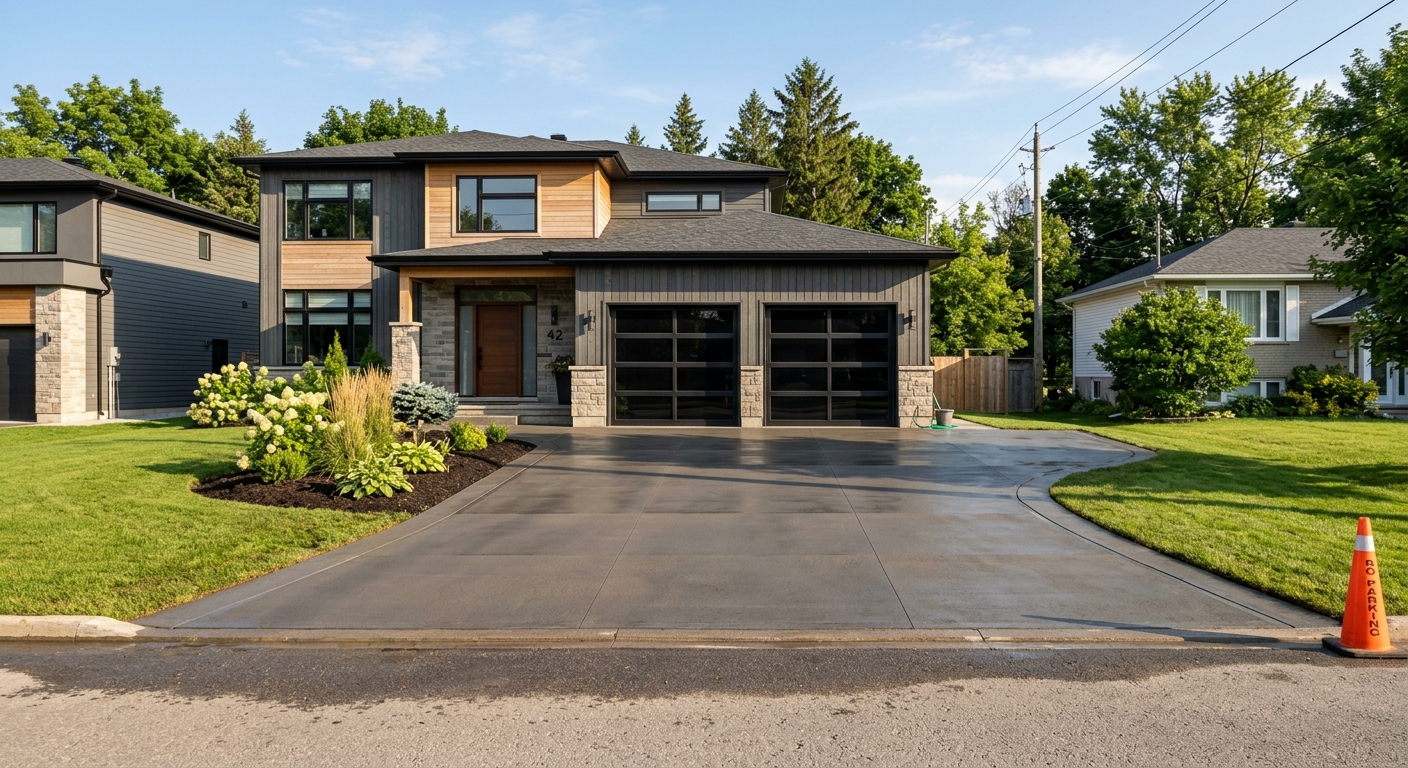
Concrete work options and costs in Englehart
Englehart concrete work is mostly built on the backs of homeowners—because 67.6% of local households own their homes, and about 73.5% of dwellings are single-detached houses, you’ll commonly see requests for new driveways, patios and walkways as families improve curb appeal and resale value. (Statistics Canada, 2021 Census). In older housing stock—84.6% of homes were built before 1981—there’s also frequent replacement of tired slabs, settled approaches and cracked porch pads where roots, water and freeze–thaw damage have done their work over decades.
In Northern Ontario’s winter-ready reality, concrete in Englehart costs more when the job needs deeper excavation, better drainage and longer, protected curing. Quotes can shift depending on how the site drains, whether the existing base must be removed, and how tight your access is for a concrete truck. Even when the calendar season feels “busy enough,” the schedule still gets compressed around workable temperatures—so contractors prioritize projects that are ready (accurate measurements, clear disposal path, and confirmed sub-base specifications).
Trade demand is especially strong around the residential core near Downtown and along the main approaches where driveways are short but snowbanks and winter maintenance are constant. If you’re in that area planning a driveway or patio upgrade, this table will help you compare typical specs and price ranges before you ask for itemized quotes.
| Application |
Typical Size |
Key Spec |
Finish Option |
Price Range |
| Concrete driveway (standard broom finish) |
16 ft x 30 ft (480 sq ft) |
Air-entrained exterior mix; control joints |
Broom finish |
$18,000 – $28,000 |
| Exposed aggregate driveway |
16 ft x 30 ft (480 sq ft) |
Air-entrained mix; aggregate retarder process |
Exposed aggregate |
$22,000 – $34,000 |
| Stamped concrete driveway or patio |
12 ft x 24 ft (288 sq ft) |
Air-entrained mix; release agent & sealer system |
Stamped pattern |
$10,000 – $18,000 |
| Plain concrete patio or walkway |
10 ft x 16 ft (160 sq ft) |
Air-entrained mix; broom finish |
Plain finish |
$2,400 – $4,000 |
| Garage floor (interior slab) |
20 ft x 22 ft (440 sq ft) |
Vapour barrier; reinforcement if required |
Float finish |
$6,600 – $11,000 |
| Foundation footings (structural, below frost) |
Per linear foot equivalent |
Excavate & form below frost; rebar; structural concrete |
Structural finish |
$55 – $90 |
Prices are estimates only and vary by project scope, site access and material selection.
What affects the price of concrete work in Englehart
In Englehart, you can see the same “concrete driveway” advertised at two very different numbers because contractors price the hidden work—not just the concrete. Across Ontario and the Northeast supply chain, it’s common for bids to vary by 30–50% when excavation depth, drainage work, reinforcement type, and curing protections change. The material per yard is a smaller part of the total than most homeowners expect; labour, equipment, disposal, and time are what move the needle.
Two items drive most of that spread. First is frost depth and freeze–thaw performance: exterior flatwork and footings must be designed so they don’t lift or crack from freezing moisture. Footings and structural concrete are commonly engineered to extend below frost depth; every additional step (deeper excavation, higher forms, extra backfill, and compaction testing) adds cost. Second is cold-weather curing and surface protection. When nights drop, contractors may need insulated curing blankets or temporary heating to keep concrete from freezing early. That’s why a basic broom-finished driveway often lands near the lower driveway band, but better-prepped sites and protected curing push you toward the upper end—similar to how stamped & decorative options (often $25,000 – $40,000 in the higher finish tier when expanded to a full driveway) justify their labour and materials.
Here are practical Englehart examples: if your driveway base is failing and needs full-depth removal down to a new compacted granular base, the price shifts more than a change from broom to exposed aggregate. If the home sits on older fill or has drainage issues near the foundation, adding perimeter drainage and proper grading may be a “must” to reduce rework. With 84.6% of homes built before 1981, it’s also common to find older sub-drains, shifting soils or undersized approach slopes that increase excavation and grading costs—sometimes by hundreds to thousands of dollars depending on how far you need to chase the problem.
| Price Factor |
Why It Matters |
Cost Impact |
| Frost line depth |
Footings must sit below frost to prevent heave and cracking. |
Often adds formwork, excavation and backfill; can push structural work toward the upper $55 – $90 per linear foot band. |
| Site preparation |
Grading and compacted granular base control settlement and water movement. |
More removal/disposal and more base material; can add a major portion of the total driveway price. |
| Reinforcement |
Rebar or mesh controls cracking from curling and loads. |
Material cost plus labour for chairs/tie-in; higher for thicker slabs and larger reinforcement layouts. |
| Mix design |
Air-entrainment and strength specs improve freeze–thaw durability. |
Air-entrained exterior mixes and higher strength can increase concrete cost but reduce early failure risk. |
| Finish type |
Broom vs stamped vs exposed aggregate changes labour and curing/sealer needs. |
Decorative work usually shifts you from standard driveway pricing up toward the decorative band (commonly $25 – $40 per sq ft for finishes). |
| Pour size and concrete truck access to site |
Smaller pours can cost more per sq ft due to setup; poor access can require smaller loads or multiple trips. |
Extra mobilization and multiple deliveries can add several thousand dollars on larger slabs. |
| Cold-weather curing precautions |
Protecting set and early curing prevents weak surfaces and spalling. |
Heating blankets/insulation, additional labour hours, and timing constraints add cost during shoulder season. |
| Control joint pattern and sealing cost |
Joints manage cracking; sealing helps protect against salt and moisture intrusion. |
Proper joint cutting and a later sealer application add both labour and scheduled material costs. |
Permits & regulations in Ontario
In Ontario, concrete that becomes part of a structure typically requires a building permit. That includes footings, foundation walls, and grade beams, especially when the foundation is engineered. Municipalities often require engineered drawings for load-bearing concrete elements and may review details like rebar placement, elevations, and drainage requirements.
Concrete flatwork—driveways, patios and walkways—usually does not require a permit by itself, unless it affects lot grading, stormwater/overland flow, or falls near a municipal right-of-way where approvals may be needed. Even then, it’s more about compliance with surface drainage and impervious surface rules than the concrete material.
For a homeowner in Englehart, verify a contractor the practical way, step-by-step:
- Ask for a current certificate of insurance showing liability coverage (and confirm limits are appropriate for excavation and concrete work).
- Check WSIB/WCB coverage (Ontario work must be covered; a clearance letter is often provided by the contractor).
- For contractor licensing: check the appropriate Ontario registries for the business identity and make sure the firm matches the quote and invoice name.
- Confirm they carry insurance before mobilizing—don’t rely on “we’re insured” without documentation.
- Request references on similar-scale local pours (driveway replacements and footing scopes are different jobs).
When in doubt, call the municipality before breaking ground—especially if you’re changing grades near a foundation or adding a new approach that changes how water flows.
Getting concrete right in Englehart's freeze-thaw climate
Concrete failures in Englehart usually come from water management and early-age protection. The most common pattern is spalling (surface scaling) and cracking when freeze–thaw cycles move moisture through the slab and the concrete doesn’t have the right air content or curing. To spec the job correctly, start with a proper base: a compacted granular sub-base sized to support the slab and achieve stable thickness under winter loads. On many Englehart soils, that means excavating to remove soft or frost-susceptible material and replacing it with well-compacted granular base so the slab can’t pump with freeze.
Next is mix design. For exterior flatwork, ask for air-entrained concrete with a target air content around 5–7% and a minimum 32 MPa compressive strength. Air entrainment is what gives concrete the “room” to expand safely when water freezes. Then set up control joints intentionally to reduce random cracking; they should be cut quickly after finishing to keep cracks aligned.
Curing matters as much as the pour. Even in Ontario, don’t treat curing as optional: plan for at least 7 days of curing under appropriate conditions, and in cold snaps, expect cold-weather precautions like insulation blankets or controlled heating to keep concrete from freezing early. Finally, apply a penetrating sealer after curing—typically around 28 days post-pour—to help repel de-icing salts.
To see where price differences are justified: switching from a plain broom finish driveway to a stamped concrete driveway can cost more upfront, but if the stamped job is also done with the same correct base, joints, and air-entrained mix, the higher price is buying better appearance and a durable system. If, however, a contractor tries to “save money” by skipping proper base prep or air entrainment, the cheaper option usually becomes the expensive one after one or two winters.
| Spec |
Why It Matters in Englehart |
What to Ask For |
Impact if Skipped |
| Compacted granular base (depth?) |
Prevents settlement and reduces frost heave by stabilizing subgrade moisture. |
Confirm excavation depth and granular base thickness plus compaction requirements. |
Early cracking, uneven surfaces, and frequent patching. |
| Air-entrained concrete mix (target air %?) |
Freeze–thaw durability depends on correct air void system. |
Target exterior air content about 5–7% and verify it’s air-entrained. |
Higher risk of spalling, scaling and surface deterioration. |
| Compressive strength (MPa rating) |
Ensures the concrete achieves required strength for durability and loads. |
Minimum 32 MPa (or project-specified strength). |
Weak concrete can crack more and wear faster under snow-clearing. |
| Control joints (spacing per ACI guidelines) |
Controls where cracks occur and limits random cracking. |
Ask for joint layout/spacing plan and cutting timing. |
Random cracking that’s harder to repair neatly. |
| Minimum 7-day curing period |
Early-age curing prevents strength loss and surface damage from cold nights. |
At least 7 days curing, plus cold-weather protections if needed. |
Surface scaling and reduced long-term performance. |
| Penetrating sealer (when applied after cure) |
Repels salt and water pathways that trigger freeze–thaw damage. |
Penetrating sealer after cure, typically about 28 days post-pour. |
Faster deterioration under winter de-icing. |
How to choose a concrete work contractor in Englehart
Choosing a contractor is less about slogans and more about proof. For Ontario work, verify three things before you sign: (1) proper licensing/registration for the business, (2) liability insurance, and (3) WSIB/WCB coverage. How to check: ask for a current certificate of insurance (make sure the name on the certificate matches the quote/invoice company), then ask for WSIB/WCB clearance documentation or equivalent evidence of coverage. If they can’t provide it, that’s a stop sign.
Next, get 2–3 itemised written quotes. Avoid “all-in lump sum” unless they clearly list quantities and specs. Ask for a labour + materials breakdown, including excavation/removal, granular base, reinforcement, concrete supply, finishing, joint cutting, and any sealing allowance. Confirm what’s excluded: permit pulling, disposal/dump fees, existing concrete removal, regrading, or making good landscaping around the slab.
Pay attention to warranty. A workmanship warranty should be clearly stated (how many years and what it covers). Also ask whether the product/manufacturer warranty is provided and whether it’s transferable to you after completion.
On payment schedule, don’t accept terms that ask for too much upfront. A solid approach is paying only 10–15% as a deposit, then holding back the remainder until the job is complete and cleanup is verified. Finally, insist on a start date and estimated completion timeline in writing—concrete schedules slip quickly when curing or temperature protection is required.
- Quote includes air-entrained exterior mix and joint plan for freeze–thaw durability.
- Base prep is described (depth, removal of unsuitable soil, compaction method/standard).
- Reinforcement scope is specific (mesh size, rebar spacing, support chairs/ties).
- Finishing method is named (broom vs stamped vs exposed aggregate process).
- Protection and cold-weather curing steps are listed if work falls near freezing.
- Sealer timing is included (and cost/allowance if you want it applied later).
- Cutting schedule for control joints is stated (timing after placement).
- Disposal and debris handling are clarified in writing.
- Concrete truck access plan is noted for your approach width/turn radius.
- Insurance certificate is current and shows adequate liability limits.
- WSIB/WCB clearance or proof of coverage is provided before mobilization.
- Warranty terms and exclusions are in writing, not only mentioned verbally.
Concrete red flags in Englehart: skipping air-entrainment “to save money,” vague base-prep language (no depth or compaction details), no written joint layout, quoting without explaining curing and temperature protection, and pushing for large upfront payments before forms and base work are verified.
Frequently asked questions — concrete work in Englehart
What is air-entrained concrete and why does it matter here?
Air-entrained concrete is mixed with a controlled amount of microscopic air bubbles. Those tiny air voids help the concrete handle water freezing inside the slab during Englehart winters, reducing the risk of scaling and spalling. In Ontario’s freeze–thaw conditions, exterior slabs (driveways, patios, walkways) need air-entrainment so they don’t “pump” moisture through the surface. When contractors follow the right spec (commonly around 5–7% air for exterior flatwork) and finish/curing is done properly, you get a tougher surface that lasts through repeated cold cycles. If you’re comparing quotes for a driveway—often in the $18,000 – $28,000 band—make sure the cheaper option isn’t using the wrong mix.
How do I prepare the base for a concrete slab?
Base preparation is where most durability is won or lost. Start with excavation to remove unsuitable topsoil and any frost-susceptible material, then place and compact a granular base to the required depth for your soil and slab thickness. The goal is stable support and proper drainage so water can’t sit under the slab and freeze. In Englehart, you should expect proof of compaction (not just “we tamped it”). Ask your contractor to explain what’s being removed, what material is being brought in, and how they achieve compaction before pouring. If your site has drainage concerns near an older home foundation (and with many homes built pre-1981, that’s common), you may also need regrading or added drainage to protect the slab long term. This is often a major driver of pricing differences.
How do I compare concrete quotes?
To compare concrete quotes fairly in Englehart, match the specs, not just the total price. First, check what’s included: excavation depth, removal and disposal of existing concrete, granular base depth, reinforcement type (mesh vs rebar), concrete mix design (air-entrained exterior), and joint cutting plan. Next, compare finish scope: broom finish versus stamped or exposed aggregate. Stamped and decorative finishes typically move you into a higher finish tier—commonly referenced around $25 – $40 per sq ft for decorative systems—so you can’t compare those apples-to-oranges against a standard broom driveway. Also ask about curing precautions if the pour is close to freezing, and whether sealer is included or scheduled. Finally, request itemized quantities and labour/material breakdowns so you can see what’s actually being done.
Can concrete be poured in cold weather in Englehart?
Concrete can be poured in cold weather, but it’s not “pour and hope.” In Ontario, once temperatures drop near or below freezing, early-age concrete can freeze before it gains sufficient strength. That can lead to weak surfaces, cracking, and higher risk of spalling later. A competent Englehart contractor will protect the pour: using cold-weather admixtures where appropriate, insulating blankets, wind protection, and occasionally temporary heating to keep the concrete within a safe temperature range during set and early curing. Ask how they plan to cure for at least 7 days under proper conditions. If you’re seeing “too-good-to-be-true” pricing during the shoulder season, it may mean they’re skipping those protections—often a bigger risk than choosing between a standard broom finish in the $18,000 – $28,000 range and a higher finish option.
How do I maintain concrete in Englehart's freeze-thaw climate?
Maintenance is about keeping water and salts away from the surface. Start with a good sealing plan: penetrating sealer is typically applied after the concrete cures (commonly around 28 days post-pour). Sealer helps repel moisture and de-icing salts, which reduces scaling and surface breakdown during freeze–thaw cycles. During winter, remove snow using plastic shovels or careful plowing to avoid gouging. Use de-icing products responsibly—some salts are harsher on concrete surfaces, especially if the slab isn’t sealed. In spring, wash away salt residue so water doesn’t stay trapped in pores. Also watch joints: if control joints are sealed or left for movement as designed, don’t let debris fill them. For stamped or decorative surfaces, follow the manufacturer’s care instructions to keep colour and texture looking right.
What causes concrete to spall in Englehart winters?
Spalling usually happens when water penetrates the concrete and then freezes repeatedly, expanding and breaking off the surface layer. The biggest causes are inadequate air entrainment, poor curing, and moisture pathways from weak base prep or drainage problems. If the mix isn’t air-entrained or if finishing and curing allowed the surface to freeze too early, the concrete is more vulnerable to damage from Ontario’s repeated freeze–thaw cycles. Another common trigger is salt exposure without adequate sealing—salt accelerates deterioration of the surface paste. Englehart’s housing stock includes many older homes, and where drainage has shifted over time, slabs can stay wetter than they should. If you’re troubleshooting spalling, ask what the original air content, curing conditions, and joint/sealing plan were before you repair; otherwise you can “fix” the surface while leaving the cause untouched.