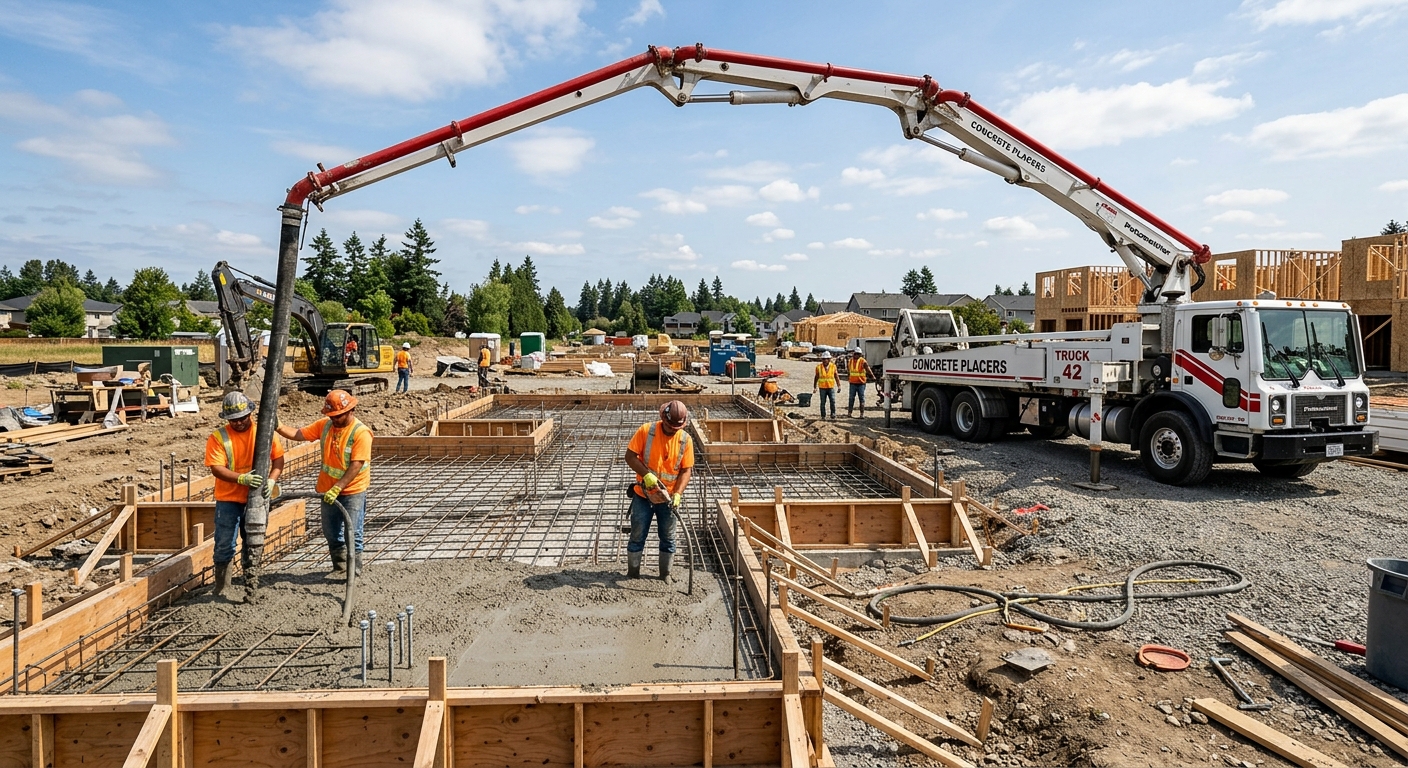
Concrete work options and costs in Agincourt North
In Agincourt North, Ontario, most homeowners start thinking about concrete the moment the snow melts and schedules open up for the warmer pour season. With a population of 29,113 (Statistics Canada, 2021 Census), demand stays steady year to year—especially for driveways, patios, and walkway repairs that keep houses looking sharp on side streets and crescents. In this GTA corridor, concrete contractors are often in high demand around mature neighbourhood pockets in Markham-adjacent areas (close to shopping and main arterials), where lots tend to be tight and access matters.
Toronto-area pricing is shaped by frost depth and freeze–thaw cycles. Local specs typically require structural footings to extend to at least about 1.2 m below grade to reduce frost heave and movement. For exterior flatwork, contractors generally use air-entrained concrete and plan for control joints—because repeated wetting, de-icing salts, and winter temperature swings can punish a weak mix or an underbuilt base. When temperatures drop toward 10 °C or lower, curing becomes harder, so many GTA crews schedule pours in warmer windows and use extra protection, which affects labour and materials.
If you’re comparing options, it helps to start with the typical per-project ranges below, then match the finish to how much appearance you want versus how much maintenance you’re willing to do. Use the table to benchmark a driveway or patio budget, and then read the factors that can move a quote up or down by 30–50% across the Toronto region.
| Application |
Typical Size |
Key Spec |
Finish Option |
Price Range |
| Concrete driveway (standard broom finish) |
10 ft x 20 ft (200 sq ft) |
Air-entrained exterior mix; control joints |
Broom finish |
$3,600–$5,600 |
| Exposed aggregate driveway |
10 ft x 20 ft (200 sq ft) |
Air-entrained mix; proper surface cure |
Exposed aggregate finish |
$4,400–$6,800 |
| Stamped concrete driveway or patio |
10 ft x 20 ft (200 sq ft) |
Air-entrained mix; base prep + joints |
Stamped + sealant-ready surface |
$4,800–$8,000 |
| Plain concrete patio or walkway |
10 ft x 12 ft (120 sq ft) |
Air-entrained; compacted base; joints |
Float/score or broom-light finish |
$1,900–$3,100 |
| Garage floor (interior slab) |
20 ft x 22 ft (440 sq ft) |
Vapour barrier/ground prep as needed; smooth finish |
Power-trowel or broom-smooth |
$6,200–$10,800 |
| Foundation footings (structural, below frost) |
Per linear ft (typical wall) |
Engineered footing size; below-frost depth |
Form and place (reinforced) |
$180–$300 |
Prices are estimates only and vary by project scope, site access and material selection.
What affects the price of concrete work in Agincourt North
Even for the “same” driveway size, concrete quotes in Agincourt North can swing by 30–50% because the low number is often built on assumptions that later show up as change orders: base depth, reinforcement details, concrete mix requirements, disposal, and how carefully the contractor plans joints and curing. In the Toronto economic region, pricing also reflects tighter competition and scheduling for exterior work—crews prefer the warmer months to protect curing quality when nights cool down.
Frost depth and freeze–thaw cycles dictate nearly every spec. Footings must extend below the design frost depth (Ontario commonly about 1.5–2.4 m depending on site conditions) to prevent frost heave and differential movement. Exterior slabs also need an air-entrained mix to survive repeated freeze–thaw. Then there’s the de-icing salt problem: salts can accelerate surface damage and spalling if the mix and finishing aren’t right and if sealing is skipped.
Practical examples in Agincourt North: (1) A driveway replacement on compacted clay with poor drainage often costs more because excavation goes deeper and the granular base has to be rebuilt and regraded. (2) A smaller patio with easy truck access may land closer to the lower end of plain patio/walkway budgets (for example, $16–$26 per square foot typical band) because labour and trucking are efficient. (3) Upgrading to stamped concrete is justified when you want appearance that lasts, but the finish complexity drives the range closer to the $24–$40 decorative band, especially with extra base prep and sealing considerations.
Housing age in the GTA matters too. Older neighbourhood lots often have uneven drainage or previous repairs, so contractors spend more time on demo, hauling, and rebuilding the base—turning “simple” repairs into full rebuild scopes that protect the concrete through winter.
| Price Factor |
Why It Matters |
Cost Impact |
| Frost line depth — determines footing depth and form height |
Below-grade depth reduces frost heave and differential movement |
Can add major excavation and formwork labour |
| Site preparation — excavation, grading, compacted granular base |
Proper base prevents settlement and premature cracking |
Often the biggest driver behind quote differences |
| Reinforcement — rebar or wire mesh requirement |
Controls cracking and strengthens slabs/footings |
Costs increase with heavier steel and correct placement time |
| Mix design — air-entrainment and compressive strength spec |
Air helps manage freeze–thaw; strength affects durability |
More expensive mix and quality control may be needed |
| Finish type — broom vs. stamped vs. exposed aggregate |
Finish systems require specialized labour and timing |
Stamped/exposed typically adds material and labour |
| Pour size and concrete truck access to site |
Short access routes reduce delays; larger pours need coordination |
Long carries, waiting, or extra equipment increases cost |
| Cold-weather curing precautions — heating and blankets |
Protects strength gain when temperatures drop |
Heaters/blankets add rental and labour hours |
| Control joint pattern and sealing cost |
Joints direct cracking; sealing repels salt-related damage |
Skipping either can lower upfront cost but increases failure risk |
Permits & regulations in Ontario
In Ontario, structural concrete work such as footings, foundation walls, and grade beams typically requires a building permit, and many projects also involve engineered drawings reviewed as part of the permitting process. For concrete flatwork (patios, walkways, driveways), a permit is often not required by default—but it can be required when the work affects lot grading, drainage, or impervious surface/municipal surface rules, or when it touches municipal right-of-way conditions. Because details vary by site plan and municipality, confirm with your local authority before a crew breaks ground.
For contractor qualification in Agincourt North, ask for proof of liability insurance and WSIB coverage (or the applicable WCB registration). Then verify whether the contractor is properly licensed for the work they’re performing and for the scope that involves excavation and concrete placement. Step-by-step, you can: (1) request the Certificate of Insurance showing active coverage and matching project address; (2) ask for WSIB/WCB clearance information—don’t accept an expired letter; (3) check online licensing/registration details through provincial or appropriate public registries; (4) confirm they have references for similar-scale foundation and flatwork jobs, not just decorative projects.
Bottom line: structural pours need tighter oversight than driveways and patios, and a reputable Toronto-area contractor should guide you through what your project needs—without pressuring you to start before permitting is sorted.
Getting concrete right in Agincourt North's freeze-thaw climate
In Agincourt North’s Toronto-area freeze–thaw climate, concrete most commonly fails when one of the basics is skipped: weak base prep, poor mix design, random cracking that’s not controlled, inadequate curing, or no protection against salt. Freeze–thaw works like a slow “pumping” effect. If water gets into the surface or microcracks, it freezes, expands, and can break surface paste—showing up as spalling and scaling.
To spec the job correctly, start with base preparation: compacted granular sub-base to the required depth for your soil and frost conditions, with proper drainage so the subgrade stays stable through wet springs. Next, insist on the right mix design for exterior exposure: air-entrainment typically targets 5–7% air content for exterior flatwork, paired with a minimum 32 MPa compressive strength so the concrete reaches durability goals. Then, control joints: plan joint spacing to limit random cracking and reduce where water can infiltrate.
For curing, ask for minimum 7-day curing under proper conditions. In cooler stretches near or below about 10 °C, the contractor should plan curing protection (insulation blankets and, if needed, temporary heating) to help strength develop. Finally, sealing: a penetrating sealer is commonly applied after the concrete has cured—often around 28 days post-pour—so de-icing salts and moisture have less direct contact with the surface.
Here’s where price difference is justified: a standard broom driveway might land around the lower end of the $18–$28 driveway band, while stamped concrete generally costs more (often in the $24–$40 decorative band). If the higher price includes correct air-entrainment, deeper base prep, proper jointing, and sealing plan, it’s worth it—because those items reduce winter damage that cheap finishes can’t cover up.
| Spec |
Why It Matters in Agincourt North |
What to Ask For |
Impact if Skipped |
| Compacted granular base (depth?) |
Prevents settlement and helps drainage under freeze–thaw |
Base depth for your lot/subgrade + compaction method |
More cracking, uneven surface, premature failures |
| Air-entrained concrete mix (target air %?) |
Reduces damage from repeated freeze–thaw |
Air content target (typically 5–7% for exterior flatwork) |
Higher risk of spalling and scaling in winter |
| Compressive strength (MPa rating) |
Strength gain supports durability and surface resistance |
Minimum 32 MPa for exterior structural exposure (project-specific) |
Weak surface, faster deterioration with de-icing salts |
| Control joints (spacing per ACI guidelines) |
Directs shrinkage/cracking to predictable lines |
Joint layout plan and saw-cut timing |
Random cracks that let water in—then freeze damage accelerates |
| Minimum 7-day curing period |
Strength develops properly for winter exposure readiness |
How long protected curing will be provided |
Surface weakness; increased scaling and texture breakdown |
| Penetrating sealer (when applied after cure) |
Repels moisture and slows salt-related surface breakdown |
Sealer type and application timing (commonly ~28 days after pour) |
Faster salt damage and more winter maintenance |
How to choose a concrete work contractor in Agincourt North
Start by verifying the contractor’s Ontario eligibility and protection. Request their liability insurance certificate showing coverage amounts and the project address. Then confirm WSIB/WCB status by asking for current clearance information (not an outdated document). For licensing, use the appropriate Ontario public registry/lookup tools to confirm they’re authorized for the type of work they’ll carry out. A contractor who can’t explain how they’re insured and registered usually costs you later through delays or incomplete paperwork.
Next, get 2–3 written, itemised quotes (labour + materials + any sitework lines). Ask whether the quote includes base excavation and disposal, permit handling (if applicable), and protection for curing in cool weather. A lump sum without details is where hidden costs appear. For payment, avoid paying more than about 10–15% upfront; use a holdback until finishing items are complete (sealing, joint finishing, cleanup). Also ask for a workmanship warranty—what length, what’s covered, and whether it’s transferable if you sell the home.
Finally, insist on schedule clarity. The best GTA crews will give you a start date and an estimated completion timeline in writing, plus weather/cure contingencies. In Agincourt North, timing matters because exterior pours are most reliable when temperatures support curing, and because rework after freeze–thaw is expensive.
- Ask for proof of liability insurance (active certificate) before any materials are ordered.
- Confirm WSIB/WCB clearance and request it as part of the contract package.
- Use itemised quotes: line items for excavation, granular base, reinforcement, concrete supply, finishing, and sealing.
- Ask whether permits apply to your scope and who pulls them (when required).
- Verify concrete specs: air-entrainment, minimum strength (MPa), and exterior exposure suitability.
- Request reinforcement details: where mesh/rebar sits (and correct chairs/spacers).
- Confirm base depth and compaction method (including how they verify compaction).
- Ask about joint pattern and saw-cut timing.
- Ask how they protect curing in cooler evenings (blankets/heating if needed).
- Confirm sealing: product type and when it’s applied after cure (often around 28 days).
- Review warranty terms in writing and confirm what happens if repairs are needed.
- Set payment milestones: keep upfront to 10–15% and hold back until full cleanup and finishing.
Concrete red flags in Agincourt North: contractors who refuse to discuss air-entrainment for exterior work; quotes that omit base depth/compaction; promises to pour in cold conditions without curing protection; payments demanding most money upfront; and contracts that don’t include jointing, sealing (when specified), and a clear warranty for workmanship.
Frequently asked questions — concrete work in Agincourt North
What causes concrete to spall in Agincourt North winters?
Spalling (flaking or scaling of the surface) in Agincourt North is usually a freeze–thaw problem plus moisture exposure. Water enters the surface through microcracks or porous paste, freezes, expands, and breaks down the top layer—especially when de-icing salts are present. The biggest preventable causes are inadequate air-entrainment (often the reason the surface can’t handle repeated cycling), poor curing that leaves the concrete weaker than intended, and insufficient sealing that allows salt and moisture to keep attacking the paste. If the base is also underbuilt or drainage is poor, settlement can open up cracks sooner. A contractor should specify air content for exterior flatwork and talk joints, curing protection, and sealing—because those items are what protect you through Toronto-area winters.
What is rebar and when is it required in Ontario?
Rebar is short for reinforcing steel bars. In Ontario concrete work, whether rebar is required depends on the structural design and the type of concrete element. For structural members like foundation footings, walls, grade beams, and many engineered slabs, reinforcement is commonly required to control cracking and to meet load and durability requirements set by the design. For some exterior flatwork, reinforcement may be specified based on slab thickness, sub-base conditions, and loading (like a driveway supporting vehicles). In Agincourt North, the contractor should follow the project’s engineered drawings (when applicable) or recommended specs for exterior slabs that account for frost and freeze–thaw. When you ask for a quote, request where reinforcement sits within the slab (not just “we used mesh”) and confirm it’s installed on supports so it isn’t buried at the bottom.
How long does a concrete project take in Agincourt North?
The timeline in Agincourt North depends on scope and weather. Demo and base prep for a driveway or patio can take a day or two, while forming and reinforcing can add more time for structural work. The actual pour is often fast—sometimes just hours—but curing and finishing govern when you can use the area safely. As a rule of thumb, exterior flatwork commonly requires at least several days before light use, and full performance comes after curing and, for many jobs, after sealing readiness around the 28-day mark. Cold nights and cool weather slow strength gain, which can extend the schedule when crews need extra protection blankets. If you’re budgeting, remember that a driveway spec in the $18–$28 band can still take longer if the contractor builds a deeper, better-prepped base and protects curing properly—those steps reduce winter repair risk.
What is a concrete overlay and is it suited to Agincourt North?
A concrete overlay is a new concrete layer placed on top of an existing slab to improve appearance or level out minor defects without full removal. It can be suited to Agincourt North when the existing concrete is structurally sound, properly prepared (cleaned, chipped/scarified, and bonded), and the drainage and jointing are in reasonable shape. Overlays are often used to restore driveways or paths that have surface wear, but they’re not a cure-all if the original slab is moving due to settlement or frost-related heaving—overlaying over active movement usually leads to cracking that telegraphs through. Because freeze–thaw and de-icing salts can worsen bond failures, the prep quality matters as much as the overlay mix and curing. If you’re considering an overlay, ask whether they’ll assess base/subgrade stability and how they’ll handle existing cracks and drainage.
How do I seal concrete to protect it in Agincourt North?
Sealing helps repel moisture and can slow salt-related surface deterioration, which matters in Agincourt North where winter cycling is relentless. The key is timing: concrete should cure first, and many contractors apply penetrating sealer after sufficient cure—commonly around 28 days post-pour for exterior work, assuming proper weather conditions. Before sealing, the surface needs to be clean, dry, and free of dust or curing compounds that block penetration. Choose a penetrating sealer made for exterior freeze–thaw exposure rather than a temporary surface coating if you want long-term protection. Ask your contractor what product they use, how many coats (if any), and whether they’ll specify an application date in the schedule. If your estimate is in the $24–$40 stamped/decorative band, sealing should be part of the plan, not an optional add-on.
What is the difference between concrete and cement?
Cement is an ingredient, while concrete is the full mixture. Cement (often Portland cement) is the binder that reacts with water to create strength. Concrete includes cement plus water and aggregates (sand and gravel/crushed stone), and for exterior work in Ontario it typically includes performance additives such as air-entrainment to handle freeze–thaw. So, when a quote says “air-entrained concrete,” it’s referring to the entire concrete mix design—not just the cement. In Agincourt North, the cement content alone isn’t what protects your driveway; it’s the overall mix properties, placement, curing, and sealing. That’s why reputable contractors discuss air-entrainment targets, curing duration, and jointing, rather than focusing only on “cement brand.”