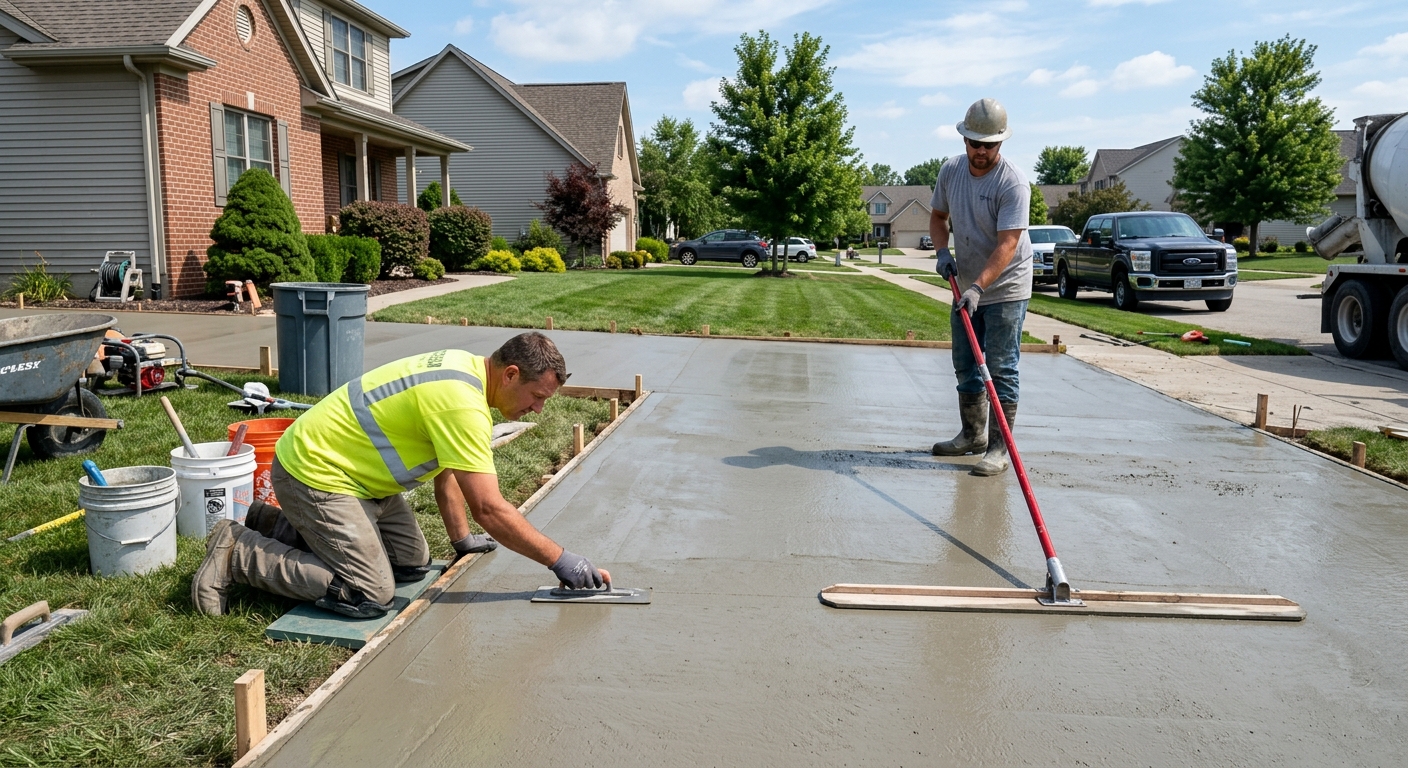
Concrete work options and costs in Emo
Emo, Ontario is a small community (population 1,204 per Statistics Canada’s 2021 Census) where most homeowners are busy with practical upgrades—like driveways, patios, walkways and foundation work. With 89.5% of dwellings being single-detached houses, concrete flatwork is especially in demand, particularly around places like downtown Emo and the main Hwy 11 corridor where curb access and winter traction matter. About 355 homeowner households (75.5% of households own) also means steady work for masonry and concrete crews, but schedules still tighten around the short pour season.
In Northwestern Ontario, the biggest driver of cost isn’t just labour—it’s the climate. Long winters with repeated freeze–thaw cycles force exterior slabs and foundations to be built for movement: air-entrained concrete, compacted granular base with drainage, correct control joints, and curing that can’t be rushed when temperatures drop. Excavations can be deeper too, because frost penetration can approach or exceed 5–6 ft in some areas, and footings for residential work are commonly set below the design frost zone (often roughly 4–6 ft below grade) to reduce heave. Add in de-icing salts near driveways and garages, and you’ll see why contractor availability and materials logistics can push prices up compared to southern Ontario.
Below is a realistic comparison of common options homeowners ask for in Emo, so you can line up expectations before you request quotes.
| Application |
Typical Size |
Key Spec |
Finish Option |
Price Range |
| Concrete driveway (standard broom finish) |
24 ft x 10 ft (240 sq ft) |
Air-entrained mix for exterior durability |
Broom finish, control joints |
$14,000–$22,000 |
| Exposed aggregate driveway |
24 ft x 10 ft (240 sq ft) |
Proper base drainage and consistent concrete mix |
Exposed aggregate for texture |
$18,000–$28,000 |
| Stamped concrete driveway or patio |
16 ft x 12 ft (192 sq ft) |
Air-entrained mix with colour hardener/sealer |
Stamped pattern + release + sealer |
$20,000–$32,000 |
| Plain concrete patio or walkway |
12 ft x 10 ft (120 sq ft) |
Graded base with joints as needed |
Broom or smooth finish |
$6,500–$10,500 |
| Garage floor (interior slab) |
22 ft x 20 ft (440 sq ft) |
Vapour barrier and reinforced slab as required |
Power trowel + light broom (if desired) |
$9,500–$17,500 |
| Foundation footings (structural, below frost) |
Typical 2-storey residential plan |
Below frost depth, reinforced and engineered |
Structural concrete; formwork included |
$180,000–$260,000 |
Prices are estimates only and vary by project scope, site access and material selection.
What affects the price of concrete work in Emo
In Emo (and across Northwestern Ontario), two quotes for what looks like the same concrete job can easily swing by 30–50%. A lot of that difference comes from how each contractor designs for the freeze–thaw reality, not just how fast they can place concrete. In northern climates, frost penetration can approach or exceed 5–6 ft in some locations, so footings and exterior slab support often need to go deeper and be built on a well-drained granular base. That means more excavation, more formwork, more granular material, and more time—especially when the ground is wet or firming up after spring thaw.
There’s also the mix and finishing cost. Exterior work needs air-entrained concrete so the surface resists scaling and spalling from repeated freezing and de-icing salt exposure. If a contractor cuts corners on air content or timing, the slab may crack sooner, and you pay twice. The short pour season (late spring through early fall in the Thunder Bay–Kenora–Dryden corridor) can compress schedules, and cold, wet, or windy weather can slow strength gain—so contractors may need heated blankets or insulated enclosures to cure properly.
In Emo, a driveway poured in May with good access and solid base can land closer to the lower end of the $14,000–$22,000 band (based on typical sizes), while a similar driveway that requires extra excavation for drainage and thicker base can push higher. A plain patio may stay near $6,500–$10,500, but stamped concrete work jumps because of colour materials and labour-intensive finishing (that’s why stamped & decorative projects track around the $20,000–$32,000 tier). Finally, housing stock matters: many homes in the area were built before 1981 (54.3% of dwellings per Statistics Canada, 2021 Census), so you’ll sometimes deal with older grading, thicker soil, or existing settlement—adding prep work before the new slab goes in.
| Price Factor |
Why It Matters |
Cost Impact |
| Frost line depth |
Determines footing depth and form height to reduce heave |
Higher depth means more excavation and concrete |
| Site preparation |
Excavation, grading, compacted granular base, and drainage |
More trucking and longer machine time |
| Reinforcement |
Rebar or wire mesh helps control cracking under load |
Material + labour increases, especially for large slabs |
| Mix design |
Air-entrainment and specified strength for durability |
Higher-spec mixes can raise material cost |
| Finish type |
Broom vs. stamped vs. exposed aggregate affects labour and materials |
Stamped and exposed options cost more |
| Pour size and concrete truck access to site |
Narrow access, long carry distances, or tight turning increases time |
May require extra crew or pump/short-load planning |
| Cold-weather curing precautions |
Heating, blankets, and insulation protect strength gain |
Extra equipment and labour during shoulder months |
| Control joint pattern and sealing cost |
Joints manage shrinkage cracks; sealing helps resist salts |
Correct layout prevents early failure; sealing is an add-on |
Permits & regulations in Ontario
In Ontario, the permit and documentation requirements depend on what you’re building with concrete. Structural concrete work—like footings, foundation walls, and grade beams—typically requires a building permit, and engineered drawings are often reviewed by the municipality before concrete can be poured. If you’re doing a foundation repair, underpinning, or any structural change, plan on permit involvement and inspections.
Concrete flatwork such as patios, walkways, and driveways often does not require a building permit by default. That said, you still may need municipal approval if the work affects lot grading, drainage, or triggers limits on impervious surface coverage, or if the driveway ties into the municipal right-of-way. In all cases, confirm with the local authority before breaking ground, especially if you’re changing slope, lowering grade, or moving swales.
To verify a contractor in Emo, I recommend doing three checks in order: (1) confirm their Ontario licence/registration where applicable through the relevant online registry; (2) request a current certificate of insurance showing liability coverage (you want to see dates and project/location listed or coverage clearly tied to the work); and (3) verify WSIB/WCB coverage if they employ workers—ask for clearance documentation. Then ask for references on similar-scale foundation or exterior flatwork jobs, including freeze–thaw climates like ours.
Getting concrete right in Emo's freeze-thaw climate
Concrete fails in Emo winters for a few predictable reasons: water gets into the surface or shallow cracks, then freeze–thaw cycles expand it. If the slab or foundation doesn’t have enough air entrainment, it can scale (the surface flakes) and spall (chunks break off), especially where de-icing salts sit. The way to prevent that is to spec the job correctly and build it on a stable base.
First, base preparation: you need a compacted granular sub-base to the right depth and a drainage plan that matches site soil and frost conditions. In Northwestern Ontario, the frost-active zone is deep, so the exterior slab and supporting layers must be able to resist movement—otherwise you’ll see heave and wide cracks. Second, mix design: exterior flatwork should use air-entrainment—typically targeting about 5–7% air content—and a minimum compressive strength (commonly 32 MPa for residential exterior work depending on design requirements). Third, control joints: don’t “wing it.” Joint spacing and timing matter because they manage shrinkage cracking before it turns into uncontrolled paths for water.
Fourth, curing: plan on at least 7 days under proper curing conditions, and in shoulder-season weather you may need blankets or heating to avoid early damage. Fifth, sealing: apply a penetrating sealer after the slab has cured—often around 28 days—to repel salts and slow water absorption.
Here’s a real-money example: a stamped driveway can land in the $20,000–$32,000 band, but it’s only “worth it” if the base, air content, joints, and curing are done properly. Otherwise, the look won’t survive our winters. A well-built broom-finished driveway in the $14,000–$22,000 band is often the better value long-term because durability is doing the heavy lifting.
| Spec |
Why It Matters in Emo |
What to Ask For |
Impact if Skipped |
| Compacted granular base (depth?) |
Reduces settlement and movement during freeze–thaw |
Granular type + compaction method; base thickness to match design |
Heave, cracking, and premature joint failure |
| Air-entrained concrete mix (target air %?) |
Resists scaling/spalling from winter freezing and salt exposure |
Air content target (typically 5–7% for exterior flatwork) noted on ticket/spec |
Surface deterioration and flaking within a few winters |
| Compressive strength (MPa rating) |
Ensures adequate strength gain in cold weather conditions |
Minimum 32 MPa (or higher if engineered); confirm mix design |
Weak surface, increased cracking, poor long-term durability |
| Control joints (spacing per ACI guidelines) |
Controls where shrinkage cracks form |
Planned joint spacing, saw-cut timing, and crack isolation details |
Random cracking and pathways for water entry |
| Minimum 7-day curing period |
Builds strength before the slab is exposed to freeze cycles |
Confirm curing plan; blankets/heating if cold temps occur |
Low strength development and higher risk of surface damage |
| Penetrating sealer (when applied after cure) |
Helps repel de-icing salts and reduces moisture absorption |
Sealer type; application timing (after full cure—commonly around 28 days) |
Faster scaling and more frequent maintenance |
How to choose a concrete work contractor in Emo
Choosing the right contractor in Ontario starts with verification. Ask for their business details, then check licensing/registration where applicable through the province’s online resources, and request a current certificate of liability insurance (verify it’s active and covers your project scope). Next, confirm WSIB/WCB coverage if they employ workers—ask for clearance documentation rather than a verbal promise. A reputable crew will share these documents quickly because they work with municipalities and inspections.
Then get 2–3 itemised written quotes instead of one lump number. I want to see line items that separate labour, concrete supply, excavation/grading, rebar or mesh, formwork, curing controls (blankets/heaters if needed), finishing (broom vs stamped vs exposed aggregate), and any sealing. Also note exclusions: is site protection included, disposal of surplus soil, saw-cut joints, or permit handling (if structural work is required)? Make sure any permit application or inspection coordination—where applicable—is clearly stated.
On warranty, push for two parts: a workmanship warranty (how many months/years for labour issues) and confirmation of any product/manufacturer warranty for additives, sealers, or specialized materials. Ask whether the warranty is transferable to you as homeowner. For payment, never agree to more than 10–15% upfront; hold back the final amount until the job is complete and cleaned up. Finally, require the timeline in writing with a start date estimate and completion target.
- Provide licence/registration details (and confirm it’s current)
- Show certificate of liability insurance with coverage dates
- Verify WSIB/WCB clearance for workers
- Use itemised quotes (labour, materials, base work, reinforcement, finishing)
- Confirm whether excavation haul/disposal is included
- Ask who supplies and places air-entrained concrete (and request mix specs)
- Get joint layout: spacing and saw-cut timing
- Confirm curing plan (including cold-weather blankets/heaters if required)
- Clarify rebar/mesh requirements (and tie them to your slab type)
- Verify truck access/pumping plan and how they’ll avoid driving over base
- Ask for schedule flexibility if weather delays occur in Emo
- Require final walkthrough and written punch list before release of holdback
Concrete red flags in Emo: quoting without discussing air entrainment or joints; “one price fits all” without a base-prep breakdown; refusing to provide insurance/WSIB/WCB documentation; starting without a curing plan for cold nights; and no mention of sealing timing or maintenance for salt exposure.
Frequently asked questions — concrete work in Emo
What causes concrete to spall in Emo winters?
Spalling is the breaking or flaking of the concrete surface, and in Emo it usually comes from moisture + freeze–thaw. Water gets into the surface pores or along tiny cracks, then expands when it freezes. After enough cycles, the near-surface material deteriorates and chunks fall off. De-icing salt makes this worse because it accelerates surface scaling and can concentrate water at the surface. The biggest spec-related cause is inadequate air entrainment—exterior slabs generally need proper air content to handle freezing pressure. Other contributors are poor base drainage (water sits under or beside the slab) and rushed curing in cool conditions, which can reduce early strength. When homeowners compare quotes, it’s worth asking what air-entrained mix they’re using and when saw cuts/joints are done, not just the broom-finish look.
What is rebar and when is it required in Ontario?
Rebar is steel reinforcement bars used inside concrete to help control cracking and improve structural performance under bending and load. Whether it’s required depends on the structural design (for foundations, beams, slabs-on-grade) and the type/size of the concrete element—not just the homeowner’s preference. For many residential slabs and exterior flatwork, reinforcement may be used (or may be reduced) based on thickness, sub-base conditions, and engineering requirements. In Ontario, structural concrete work like footings and foundation elements typically requires engineered drawings and permits where applicable, and those documents will specify reinforcement. For flatwork, reinforcement is often included when slabs are larger, thicker, or expected to carry heavier loads (like portions of driveways). In practice, a solid contractor will explain why they’re using rebar or mesh in your situation and tie it to your slab thickness and base prep.
How long does a concrete project take in Emo?
Timing in Emo is mostly about weather, curing conditions, and access. For a typical small exterior job like a driveway pour (for example, around 240 sq ft), the actual placement day might be one working day, but you should plan for additional time for excavation/grading, formwork, reinforcement setup, and finishing. Concrete needs proper curing; a minimum cure period is often at least 7 days under suitable conditions, and cold nights can extend the effective protection time if blankets or heaters are required. In our Northwest freeze–thaw climate, shoulder-season pours may take longer because crews slow down to protect strength gain. If there’s existing concrete removal, uneven base, or drainage corrections, add time for that work too. On the budget side, keeping an efficient schedule matters—contractors may price higher during late-spring windows when availability is limited.
What is a concrete overlay and is it suited to Emo?
A concrete overlay is a new concrete layer installed over an existing slab (after preparing the surface, removing weak material, and often applying a bonding method). It can be a cost-effective way to improve appearance and renew a driveway or walkway, but it’s only suited to Emo when the underlying slab is still structurally sound and well-drained. If the base is failing, the old slab has major settlement, or there’s extensive cracking and water infiltration, an overlay can reflect the same issues and fail sooner under freeze–thaw and salt exposure. The key is proper prep: grinding, patching, and creating a profile for bonding. If your driveway is just cosmetically rough and the base is stable, overlays can make sense—often cheaper than a full replacement that lands around the $14,000–$22,000 typical driveway band for many Emo projects. But if the concrete is actively moving, replacement is usually the more durable choice in Northwestern Ontario’s deep frost conditions.
How do I seal concrete to protect it in Emo?
In Emo, sealing is mainly about reducing water absorption from rain/snowmelt and helping protect against de-icing salts that drive freeze–thaw damage. The practical timing is important: sealing is typically applied after the concrete has fully cured—often around 28 days—so you don’t trap moisture in the slab. Use a penetrating sealer (commonly used for exterior concrete) that soaks into the surface rather than just forming a surface film. Before sealing, the slab should be clean and dry—no curing compounds, dirt, or salt residue. Ask your contractor what sealer they recommend and whether it’s appropriate for exterior exposure and snow removal. Also know sealing isn’t “set and forget”: you’ll likely need reapplication on a schedule depending on wear from ploughing and vehicle traffic. Sealing works best when the slab already has proper air entrainment, correct joints, and good base drainage—sealer can’t fix an inadequately built slab.
What is the difference between concrete and cement?
Concrete is the final building material you see and walk on. It’s made from several components: cement plus water plus aggregates (sand and gravel/crushed stone), and often admixtures that control air, set time, and durability. Cement is one ingredient inside concrete. Homeowners sometimes hear the terms used interchangeably, but in concrete work for Emo driveways, patios, and foundations, the mix design (including air-entrainment and strength targets) is what determines performance in freeze–thaw cycles. That’s why you’ll hear “air-entrained concrete” rather than “air-entrained cement.” The cement type can matter, but it’s only part of the outcome. In Northwestern Ontario, air entrainment and curing matter as much as the cement itself because they control how the slab withstands winter moisture freezing and thawing. If you’re comparing quotes, ask for the concrete mix spec and whether the contractor is meeting exterior air and strength requirements.