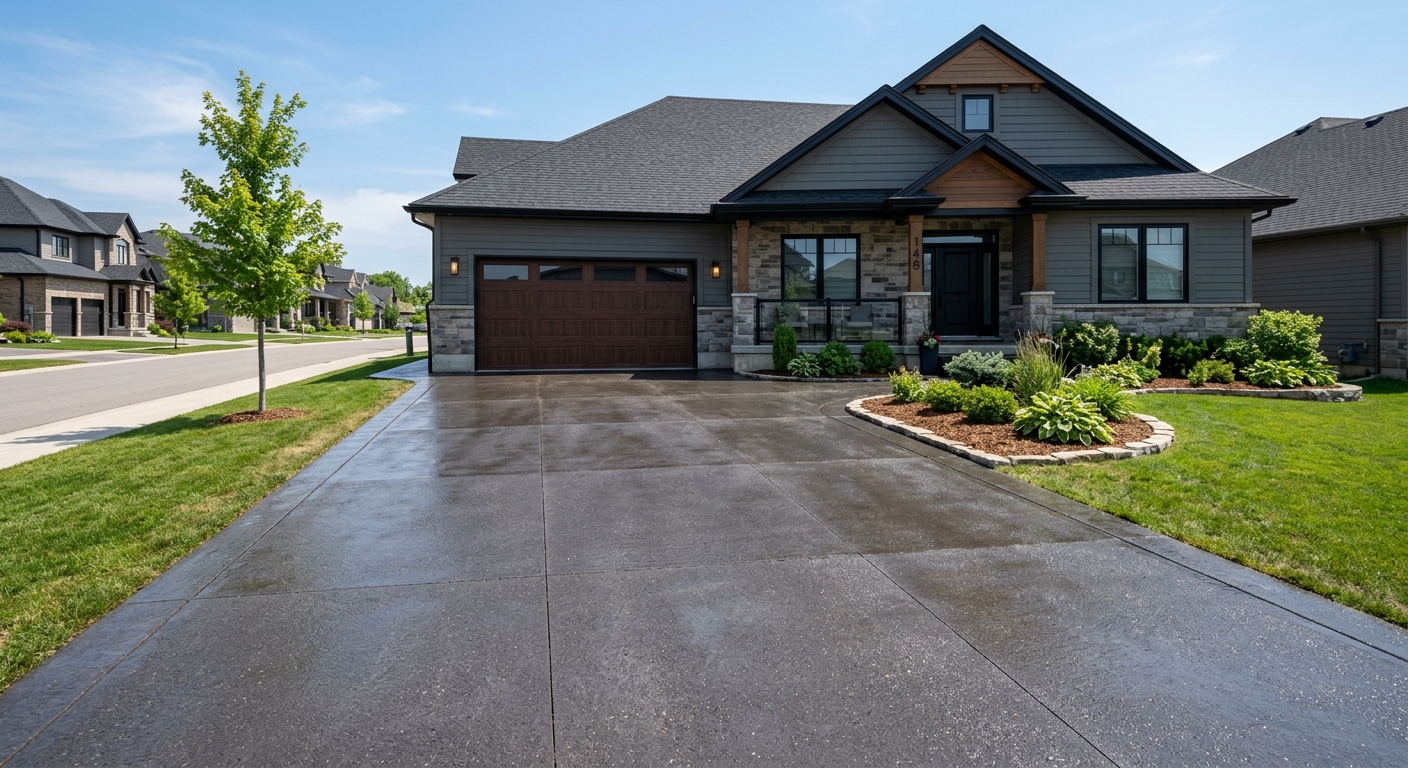
Concrete work options and costs in Acton
In Acton, choosing concrete work is a year-round decision, but the actual construction window is largely driven by Ontario’s freeze–thaw cycles. With a population of 9,377 (Statistics Canada, 2021 Census), Acton’s housing demand is steady, and most concrete flatwork is tied to long-term family homes that see heavy seasonal traffic—driveways for winter boots and salt, and patios for spring entertaining. In the Toronto economic region, concrete contractors typically plan around deeper frost protection and the need for air-entrained mixes for exterior slabs, which affects both scheduling and pricing. The Acton-area housing stock also tends to rely on exterior concrete for curb appeal and practical maintenance; that makes driveway and walkway work a frequent “first call” after landscaping updates or home additions.
Costs aren’t just about concrete volume. In the GTA, the same project can come in meaningfully higher or lower depending on soil conditions, truck access, and how much base excavation and compaction the job requires before a pour. The colder shoulder seasons (when temperatures can dip toward 10 °C) also change cure management—contractors may need additional protection to protect strength gain and surface durability. If you’re working near the busy commuter corridors around Acton’s town centre and connections toward Highway 401, plan for tighter access and scheduling coordination, which can add labour time.
Below is a practical comparison of common options so you can map your needs to a realistic budget, then we’ll break down what drives the variation in quotes.
| Application |
Typical Size |
Key Spec |
Finish Option |
Price Range |
| Concrete driveway (standard broom finish) |
400–600 sq. ft. |
Air-entrained mix; compacted granular base; control joints |
Broom finish |
$18,000–$28,000 |
| Exposed aggregate driveway |
400–600 sq. ft. |
Air-entrained mix; consistent aggregate grading; proper base and drainage |
Exposed aggregate |
$22,000–$32,000 |
| Stamped concrete driveway or patio |
250–500 sq. ft. |
Air-entrained mix; thicker sections where required; release agent and sealing plan |
Stamped pattern |
$24,000–$40,000 |
| Plain concrete patio or walkway |
200–400 sq. ft. |
Compacted base; slope for drainage; joints to manage shrinkage |
Float/smooth with broom edge |
$16,000–$26,000 |
| Garage floor (interior slab) |
300–500 sq. ft. |
Vapour barrier (as needed); reinforcement where specified; curing control |
Power-trowel or broom (depending on use) |
$18,000–$30,000 |
| Foundation footings (structural, below frost) |
Varies by foundation design |
Engineered footing size; pour below design frost depth (typically 1.2 m or more) |
Structural concrete |
$180,000–$300,000 |
Prices are estimates only and vary by project scope, site access and material selection.
What affects the price of concrete work in Acton
If you’ve received multiple quotes for “the same” concrete job in Acton, it’s normal to see meaningful spread—often 30–50%—because concrete work is labour-and-prep heavy, not just material heavy. In the Toronto economic region, labour availability and scheduling around warmer pour windows influences cost, especially when contractors must protect curing and manage risk when temperatures trend down toward 10 °C. Concrete also responds differently depending on soil moisture and how well the granular base is compacted; a driveway that looks flat can still require extra excavation if the subgrade is soft.
The biggest technical driver is frost depth and freeze–thaw cycles. Ontario Building Code expectations generally require most structural footings to extend at least 1.2 m (about 4 ft) below grade to reduce frost heave and differential movement. That depth (plus formwork height, excavation, and rebar/set costs) can swing totals. For exterior slabs like driveways, contractors commonly use air-entrained mixes so the concrete survives repeated freeze–thaw. When conditions are colder, cold-weather curing precautions—insulating blankets or temporary heat—can add cost, and if de-icing salt is used early, surface spalling risk rises, making sealing a sensible durability step.
In Acton specifically, costs can rise where you need deeper base replacement because of high-water or clay-heavy soil, or where access limits truck parking and increases labour time. Costs can also be lower when your site is straightforward (clean grading, good drainage, and easy equipment access) and you’re choosing a simpler broom finish instead of stamped or exposed aggregate—often a practical gap when comparing, for example, an $18–$28 driveway budget versus stamped work in the $24–$40 band.
| Price Factor |
Why It Matters |
Cost Impact |
| Frost line depth — determines footing depth and form height |
Footings must extend below design frost depth to prevent heave and movement. |
Can add significant excavation, rebar, and formwork labour. |
| Site preparation — excavation, grading, compacted granular base |
Subgrade problems and poor compaction lead to settlement and cracking. |
Extra base replacement typically increases material and labour. |
| Reinforcement — rebar or wire mesh requirement |
Helps control cracking and improves load capacity for driveways and slabs. |
More steel and time spent on placement and chairs/spacing. |
| Mix design — air-entrainment and compressive strength spec |
Air entrainment improves freeze–thaw durability for exterior work. |
Better spec mixes may slightly increase material cost but reduce failures. |
| Finish type — broom vs. stamped vs. exposed aggregate |
Texture and process affect labour time, materials, and curing/handling. |
Stamped/exposed typically costs more than standard broom finishes. |
| Pour size and concrete truck access to site |
Limited access can mean smaller placements or longer setups. |
Delays, extra labour, and possible re-planning of pour sequence. |
| Cold-weather curing precautions — heating and blankets |
Temperature affects strength gain; protection helps keep curing on track. |
Insulation/heat adds costs and may affect scheduling. |
| Control joint pattern and sealing cost |
Joints manage shrinkage cracking; sealing helps resist salt damage. |
Proper jointing and sealing can add line items, but reduce long-term issues. |
Permits & regulations in Ontario
In Ontario, many structural concrete tasks require a permit because they’re part of the building’s engineered load path. As a homeowner in Acton, the work that DOES typically require a building permit includes: foundation footings, foundation walls, grade beams, and other structural elements connected to the primary structure. In practice, municipalities often expect engineered drawings for structural concrete so the city can confirm sizes, reinforcement, and load considerations before anything is poured.
Concrete flatwork (driveways, patios, walkways) often does not require a permit, as long as it doesn’t significantly alter lot grading, interfere with stormwater/lot drainage, or conflict with municipal impervious surface coverage and right-of-way requirements. That said, even “simple” flatwork can trigger a review if it changes drainage patterns or impacts how water leaves your property.
Step-by-step verification you can do before you sign:
- Confirm the contractor’s Ontario business details and that they perform the work they’re quoting.
- Request a certificate of liability insurance (ask for the expiry date and limits).
- Ask for WSIB/WCB clearance (or confirmation of coverage status). If they won’t provide it, treat that as a major red flag.
- Verify references for similar-size flatwork or footing jobs, ideally in the GTA/Acton area.
- Confirm whether a permit is needed for drainage/grade changes and who pulls it.
When in doubt, ask the municipality—pushing paper up front is usually cheaper than delays after excavation.
Getting concrete right in Acton's freeze-thaw climate
Acton’s winter-to-spring freeze–thaw cycle is what punishes “just pour it” work. The most common failure mode on exterior flatwork is spalling and surface deterioration, usually linked to insufficient air entrainment, poor base preparation, or inadequate curing/protection. Another frequent issue is cracking—often from shrinkage and temperature movement—when control joints aren’t placed early or aren’t spaced appropriately.
To spec the job correctly in Ontario’s Toronto region conditions, focus on five fundamentals. First, base prep: concrete lasts longer when it sits on compacted granular sub-base sized to your soil and frost considerations. Second, mix design: exterior slabs should use air-entrained concrete (commonly targeted in the 5–7% air range) and meet a minimum compressive strength requirement (often 32 MPa for typical exterior concrete specs, depending on design). Third, control joints: joints should be planned so they guide cracking into predictable locations rather than letting cracks wander. Fourth, curing: plan for at least 7 days of curing under appropriate conditions; in colder weather, contractors may need blankets or controlled heat so strength gain doesn’t stall. Fifth, sealing: penetrating sealer applied after proper cure (commonly around 28 days post-pour) helps repel de-icing salts and moisture that can drive deterioration.
Here’s a practical pricing example: if your choice is between a standard broom-finish driveway in the $18–$28 band versus a stamped driveway in the $24–$40 band, the premium can be justified when the site is high-visibility and you’re also getting the same robust base, air entrainment, and joint/sealing plan. If a quote “saves money” by cutting corners on base thickness or air content, that’s where the cheaper option becomes expensive within a few winters.
| Spec |
Why It Matters in Acton |
What to Ask For |
Impact if Skipped |
| Compacted granular base (depth?) |
Reduces settlement and limits moisture movement that fuels freeze–thaw damage. |
Documented base depth and compaction method, plus slope/drainage plan. |
Uneven settling, cracking, and premature surface breakdown. |
| Air-entrained concrete mix (target air %?) |
Air voids help concrete survive repeated freezing and thawing outdoors. |
Air entrainment range (typically 5–7% for exterior flatwork) on the ticket/spec. |
Higher spalling risk, rough pitting, and early deterioration. |
| Compressive strength (MPa rating) |
Strength gain affects durability, abrasion resistance, and long-term performance. |
Minimum 32 MPa (or project-specific rating) stated in writing. |
Weaker concrete can crack more easily under loading and temperature cycles. |
| Control joints (spacing per ACI guidelines) |
Joints manage shrinkage so cracks don’t form randomly. |
Planned joint layout and spacing, plus saw-cut timing. |
Random cracking that can collect water and worsen deterioration. |
| Minimum 7-day curing period |
Proper curing improves strength and reduces early-life cracking. |
How they protect the slab, especially when temps drop near 10 °C. |
Lower strength gain, surface weakness, and poor long-term performance. |
| Penetrating sealer (when applied after cure) |
Repels salt and moisture, slowing surface deterioration in winter. |
Confirm sealer type and schedule (typically after full cure, ~28 days). |
Faster spalling/etching and higher maintenance costs. |
How to choose a concrete work contractor in Acton
Choosing the right concrete contractor in Acton is mostly about verification and clarity. Start with Ontario compliance: ask for proof of liability insurance (certificate of insurance with limits and expiry) and confirm WSIB/WCB coverage or clearance. If they can’t show documentation up front, you’re taking on unnecessary risk. Next, request 2–3 itemised written quotes rather than a single lump sum. You want labour and material line items so you can compare the base prep depth, reinforcement, concrete mix spec (including air entrainment), and finishing steps like broom texture, trowel sequence, and sealing.
Read the scope carefully: what is excluded (e.g., removing old concrete, disposal, curb cutting, landscaping reinstatement, topsoil restoration)? Is the permit pull included if drainage/grade changes require it? Who coordinates with the site for truck access and where will washout be handled? A good contractor will also provide a clear warranty—workmanship warranty length is important, and you should ask whether any product/manufacturer warranty applies and whether it’s transferable to you.
Payment schedule matters: never pay more than 10–15% upfront. Hold back a portion until the final inspection and cleanup are complete. Finally, lock the timeline in writing: get a start date and completion estimate, and ask what happens if weather affects curing or if the pour must be postponed.
- Verify liability insurance and WSIB/WCB status before any work begins.
- Confirm they’ve done similar driveway/patio or footing work in the GTA region.
- Ask for an itemised quote (base prep, reinforcement, mix design, finishing, sealing).
- Ensure the quote states air-entrained concrete for exterior slabs.
- Ask when saw-cut control joints will be done and for joint spacing plan.
- Confirm curing protection expectations for colder days.
- Clarify disposal: demolition hauling, dump fees, and site restoration.
- Check truck access and laydown area—limited access increases labour time.
- Require workmanship warranty terms in writing.
- Use a payment schedule with 10–15% max upfront and holdback until completion.
- Get start date and completion estimate in the contract.
- Request references with photos from finished projects.
Concrete contractor red flags in Acton: promises of “no joints needed,” vague mix descriptions (no air entrainment), refusal to provide insurance/WSIB paperwork, quotes that don’t include base prep and compaction detail, and starting work without confirming permit requirements when grading/drainage changes are involved.
Frequently asked questions — concrete work in Acton
How do I seal concrete to protect it in Acton?
In Acton and the broader Toronto region, sealing is mainly about resisting moisture and de-icing salts that can accelerate surface spalling. The key is timing: most penetrating sealers should be applied after the concrete has properly cured, commonly around 28 days post-pour (or when your contractor confirms the slab moisture condition). For exterior flatwork, ask for a penetrating sealer designed for freeze–thaw exposure, and confirm the surface is cleaned and dry before application. If you’re budgeting, sealing is often a smart add-on even when you’re targeting the lower end of the patio/walkway bands (for example, planning within the $16–$26 range), because it can extend appearance and reduce maintenance after multiple winters. (Statistics Canada, 2021 Census) shows Acton’s scale supports steady local contractor availability, but proper prep still determines results.
What is the difference between concrete and cement?
In everyday terms, people say “concrete” when they really mean the finished slab, driveway, or wall. Cement is one component inside concrete. Concrete is the full mix: cement plus water, sand (fine aggregate), gravel or stone (coarse aggregate), and often admixtures. In Ontario’s freeze–thaw conditions, exterior concrete typically also includes air-entrainment admixtures so the hardened paste has microscopic air voids to handle expansion during freezing. That’s why you’ll hear contractors talk about “air-entrained concrete”—they’re specifying the full concrete recipe, not just cement. For homeowners comparing quotes in Acton, the useful question is whether the ticket/spec confirms air content and strength rating for your exposure (driveway vs interior garage slab).
How much does concrete work cost in Acton?
Concrete costs in Acton usually track the typical bands for the Toronto economic region, but your final price depends heavily on excavation/base prep, reinforcement, finish complexity, and access. As a quick benchmark, a standard broom-finish driveway often lands in the $18–$28 range for typical project sizes, while stamped concrete driveway or patio work commonly falls into the $24–$40 range due to additional finishing labour and materials. Plain patios and walkways commonly fall into the $16–$26 band, while structural foundation footings can be much higher because of engineered design, excavation depth and labour intensity. If you’re comparing quotes, don’t just compare the bottom line—ask each contractor what’s included for base depth, air-entrained mix, and sealing. With Acton’s smaller but stable population of 9,377 (Statistics Canada, 2021 Census), scheduling is usually manageable, but winter curing protection can change costs.
How deep must footings be for Acton's frost line?
For most structural foundation footings in Ontario, the expectation is that footings extend below the design frost depth to reduce frost heave and differential movement. Practically, contractors and engineers often plan for at least about 1.2 m (roughly 4 ft) below grade in Ontario residential designs, though the exact required depth can vary by location, soil, and engineering design. In the Toronto region’s freeze–thaw environment, that depth impacts formwork height, excavation, and rebar placement—so it directly influences price. For Acton homeowners, the best step is to rely on the engineered drawing for your foundation system; then ask your contractor to confirm the footing locations and excavation depth match the drawings. If a quote suggests shallower footings “to save money,” that’s a durability and risk concern.
Why does concrete crack in Acton and how is it prevented?
Concrete can crack in Acton mainly because of shrinkage as it cures and temperature-related movement over Ontario winters. Exterior flatwork also experiences freeze–thaw stresses, especially if water gets into the slab or base. Cracking doesn’t always mean the slab is failing, but uncontrolled cracking can lead to water ingress and surface damage (spalling). Prevention starts with correct base prep—adequate compacted granular base and good drainage—plus air-entrained concrete for exterior durability. Control joints are also crucial: they’re designed to “direct” cracks into predictable lines. A proper curing plan matters too; freezing or cold-weather curing shortcuts can reduce strength gain. Finally, sealing helps protect surfaces from salt and moisture. When you compare quotes, ask about air entrainment, joint spacing, saw-cut timing, and the curing/blanket plan if pour temperatures trend down.
Stamped vs broom-finish concrete — cost difference?
Stamped concrete typically costs more than broom-finish because the finish process is labour-intensive: pattern mats, release agents, careful timing, and often more detailed curing and surface finishing. In the Toronto region, that’s why stamped driveways or patios commonly land in the $24–$40 band, while standard broom-finish driveways are often estimated around $18–$28 for comparable sizes. The important part for Acton homeowners is that the “premium” only makes sense when the contractor still builds the same durable foundation: compacted base, air-entrained mix, reinforcement when required, and proper control joints. If a contractor can’t clearly explain those specs, the cheaper broom option can become the better value—because durability problems erase the appearance benefits quickly after freeze–thaw exposure.