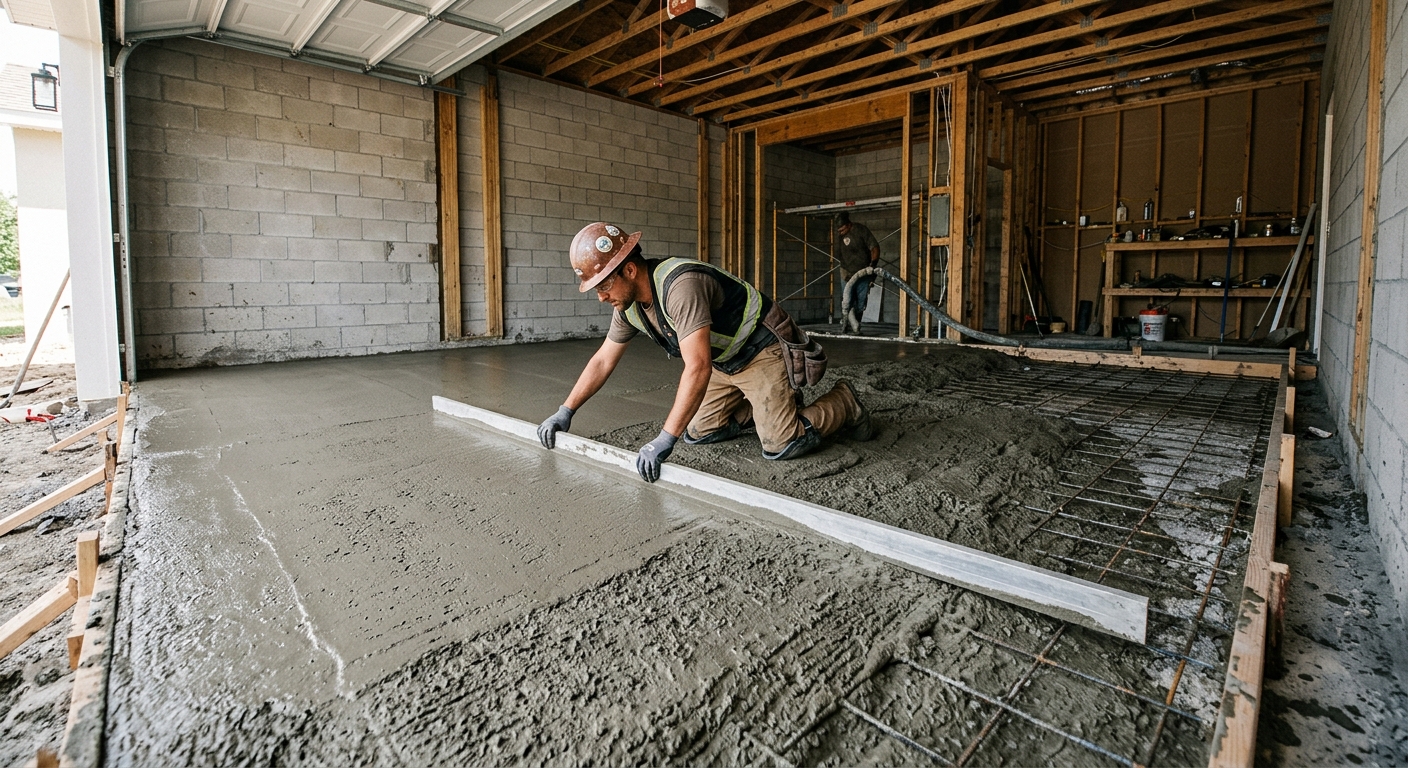
Concrete work options and costs in Port Colborne
Concrete work is a big part of home improvement in Port Colborne, especially when you consider the local housing profile. About 70.6% of area dwellings are single-detached homes, and many of those were built before 1981 (80.5%), which means driveways and patios often need replacement or major repairs rather than “minor upgrades.” With 6,335 homeowner households (72.7% of households own) in the area, there’s steady demand for practical concrete like driveways, walkway renewals, and garage slabs.
In the Hamilton–Niagara Peninsula’s cold, wet Great Lakes corridor, concrete costs aren’t just about materials—they’re driven by frost depth, freeze-thaw stress, and moisture exposure. Tradespeople plan footings to extend below frost, and exterior flatwork is typically done with air-entrained mixes, proper drainage, and tighter control joint spacing to manage shrinkage and thermal movement. Because the effective pour season is shorter (most exterior work is targeted roughly May–October), shoulder-season projects often require hoarding, heat, insulating blankets, and cold-weather admixtures, which add to installed pricing. That also affects contractor availability, so bookings can be tighter when multiple neighbours are scheduling the same window.
In Port Colborne, this work is especially in demand around the newer growth pockets near the Lake Erie shoreline and the established residential streets close to downtown, where older driveways are showing spalling, settlement, and scaling.
Use the table below to compare typical options and what most homeowners in Port Colborne budget for before you call for quotes.
| Application |
Typical Size |
Key Spec |
Finish Option |
Price Range |
| Concrete driveway (standard broom finish) |
480 sq. ft. (24’ x 20’) |
Air-entrained mix, compacted granular base, control joints |
Broom finish |
$8,500–$10,500 |
| Exposed aggregate driveway |
480 sq. ft. (24’ x 20’) |
Air-entrained mix, stone selection, retarder/cleaning process |
Exposed aggregate |
$10,000–$13,000 |
| Stamped concrete driveway or patio |
400 sq. ft. (20’ x 20’) |
Air-entrained mix, densifier/sealer system, tighter joint layout |
Stamp + colour |
$10,000–$14,000 |
| Plain concrete patio or walkway |
300 sq. ft. (15’ x 20’) |
Air-entrained mix, compacted base, broom float |
Plain/slight texture |
$3,800–$6,000 |
| Garage floor (interior slab) |
520 sq. ft. (20’ x 26’) |
Vapour management if needed, compacted base, fibre or mesh if specified |
Trowel finish + sealer (optional) |
$9,000–$12,500 |
| Foundation footings (structural, below frost) |
~120 linear ft. (varies by footing size/wall plan) |
Below-frost depth, reinforcement, forming and inspection readiness |
Structural grade concrete |
$7,200–$14,000 |
Prices are estimates only and vary by project scope, site access and material selection.
What affects the price of concrete work in Port Colborne
Two quotes for the “same” concrete job in Port Colborne can differ by 30–50% across the Hamilton–Niagara Peninsula and Ontario because the scope details are never truly identical. Small changes—like footing depth, drainage work, rebar amount, truck access, or whether the contractor includes cold-weather protection—can add major cost even when the finished square footage looks the same. In this region, a deeper, better-built foundation package is the norm: frost lines typically require footings to go below frost to reduce heave and cracking. Meanwhile, exterior slabs and flatwork need air-entrained mixes to handle repeated freeze-thaw cycles from Lake Ontario/Lake Erie moisture and temperature swings.
When the weather window narrows, the pour season also shrinks. If you’re scheduling outside the more common May–October period, contractors may add heating, insulating blankets, and sometimes accelerators—plus extra labour time for protection and curing. That’s why an exterior patio might land closer to the lower band when scheduled early in the season, then drift upward as conditions get colder and cure protection is needed. Similarly, driveway projects can move from around the $14–$22 per sq. ft. range toward the higher end if the contractor needs heavier prep, reinforcement, and additional drainage work.
Here are a few local examples that typically change costs in Port Colborne:
- An older driveway with settlement and failed base may require full removal and regrading—base replacement increases costs even if the new slab size stays the same.
- If drainage is redirected toward the slab during spring melt, contractors often add granular underdrainage and improve slope to protect the new concrete.
- Stamped or exposed aggregate finishes cost more (often in the $22–$35 range per sq. ft.) because the process needs specialty materials, stricter timing, and more careful finishing to avoid surface defects.
Lastly, housing age matters. With 80.5% of homes built before 1981, many sites already have older service lines, established grades, and existing concrete edges that require more sawcutting, disposal, and sometimes curb/transition modifications—so labour increases quickly. For homeowners budgeting, the most reliable approach is to ask what’s included in prep and curing, not just the final colour or broom finish.
| Price Factor |
Why It Matters |
Cost Impact |
| Frost line depth — determines footing depth and form height |
Below-frost placement prevents heave in repeated freeze-thaw cycles |
Higher excavation and forming can add significant labour and material costs |
| Site preparation — excavation, grading, compacted granular base |
Weak or wet subgrade leads to settlement and early cracking |
Removal/disposal and additional base can move a job toward the upper price band |
| Reinforcement — rebar or wire mesh requirement |
Supports slab capacity and reduces crack width (when detailed correctly) |
Extra materials + labour to place reinforcement increases cost |
| Mix design — air-entrainment and compressive strength spec |
Air-entrainment helps concrete survive freeze-thaw cycles; strength supports durability |
Premium mix designs and stricter batching add a measurable increase |
| Finish type — broom vs. stamped vs. exposed aggregate |
Technique and timing affect appearance and long-term surface durability |
Stamped/exposed typically costs more than plain broom-finished concrete |
| Pour size and concrete truck access to site |
Access affects placement speed, labour time, and equipment needs |
More labour or a smaller pour rate can raise installed pricing |
| Cold-weather curing precautions — heating and blankets |
Protects strength development and prevents surface scaling |
Heaters/blankets and time in protection can add cost during shoulder season |
| Control joint pattern and sealing cost |
Joints manage shrinkage cracking; sealing helps repel de-icing salt intrusion |
More sawing, joint layout, and sealer line items add to the final total |
Permits & regulations in Ontario
In Ontario, it’s usually the building work involving structure and load paths that triggers permits—not every slab you see in the driveway. In Port Colborne, structural concrete work such as footings, foundation walls, and grade beams typically requires a building permit, and municipalities often expect engineered drawings for review. For concrete flatwork like patios, walkways, and driveways, permits are commonly not required unless the work affects lot grading, drainage, impervious surface coverage limits, or the municipal right-of-way (for example, if you’re changing driveway access or altering curb/sidewalk interfaces). Before you break ground, confirm requirements with the local authority.
Also verify your contractor is set up for the job. Ask for proof of liability insurance and evidence of WSIB/WCB coverage (coverage requirements can depend on the contractor structure and how labour is handled). Request references for similar-scale concrete in Ontario and make sure the contractor understands your schedule and site constraints.
Step-by-step for homeowners (Port Colborne):
- Check the contractor’s business name and address on an Ontario trade/business registry (where applicable) and confirm it matches the proposal.
- Ask for an insurance certificate (COI). The COI should show current coverage and the jobsite/operation type.
- Ask for WSIB or WCB clearance documentation (or proof of coverage). If they can’t provide it, treat it as a red flag.
- Confirm permit responsibility in writing: whether the contractor will pull permits (when required) or the homeowner will.
- Verify the contractor’s references include concrete work in similar frost/freezing conditions.
Getting concrete right in Port Colborne's freeze-thaw climate
Concrete fails in Port Colborne most often when it’s built for “average” conditions rather than for our cold, wet Great Lakes freeze-thaw cycles. The biggest causes of problems like spalling, scaling, and early cracking are inadequate base preparation, poor drainage, insufficient air-entrainment, weak curing protection, and sloppy control joint detailing. To spec correctly, start with the base. Use a compacted granular sub-base to the right depth for local soil conditions and frost considerations—this is what keeps the slab from pumping with water during freeze-thaw.
Next, the mix design: exterior flatwork should be air-entrained (commonly 5–7% target air for many exterior placements) and meet minimum 32 MPa compressive strength. Air content is especially important in Port Colborne; without it, water inside the concrete can expand during freezing and break the surface, leading to spalling (often accelerated by de-icing salts). Then plan control joints early: spacing needs to limit random cracking into manageable lines, and joints should be sealed after curing to prevent salt water from migrating into the concrete.
Curing matters as much as the pour. Plan for at least 7 days of curing under appropriate conditions, and if you’re in shoulder season, you’ll likely need blankets/heat to avoid rapid temperature swings. After full cure, apply a penetrating sealer about 28 days post-pour to repel moisture and de-icing salts.
Here’s a practical dollar example: if you’re choosing between a plain broom driveway and stamped concrete, stamped work typically costs more—often landing near the $22–$35 per sq. ft. decorative band. That premium is justified when you also pay for the right air-entrained mix, proper base, and a tight joint plan. Skipping those “invisible” specs to save money usually costs more in repairs within a few winters.
| Spec |
Why It Matters in Port Colborne |
What to Ask For |
Impact if Skipped |
| Compacted granular base (depth?) |
Helps prevent settlement and frost-related movement in wet winters |
Granular base thickness to suit your soil and local frost considerations; proof of compaction testing |
Cracking, uneven settling, and early surface failure |
| Air-entrained concrete mix (target air %?) |
Reduces freeze-thaw damage and helps prevent spalling |
Confirm target air content (commonly 5–7% for exterior flatwork) and air tests |
Spalling/scaling, especially with de-icing salt exposure |
| Compressive strength (MPa rating) |
Strength supports durability and long-term load performance |
Minimum 32 MPa mix design and documentation from the supplier |
Surface wear, faster deterioration, and reduced reliability |
| Control joints (spacing per ACI guidelines) |
Manages shrinkage/thermal movement during Port Colborne’s temperature swings |
Joint layout and spacing plan for your slab dimensions |
Random cracking, wider cracks, and easier water intrusion |
| Minimum 7-day curing period |
Strength gain is temperature-sensitive in the cold, wet corridor |
How curing will be protected (blankets/heat) if pour temperatures are cool |
Surface scaling, weak top layer, and reduced durability |
| Penetrating sealer (when applied after cure) |
Helps repel moisture and de-icing salts common in Ontario driveways |
Penetrating sealer applied about 28 days post-pour (after curing) |
More moisture/salt penetration and faster freeze-thaw deterioration |
How to choose a concrete work contractor in Port Colborne
Choosing a contractor is where homeowners can win or lose years of service life. Start with Ontario compliance. Ask for proof of liability insurance and WSIB/WCB coverage before signing. For insurance, request a current certificate of insurance (COI) naming their insured entity and showing coverage that matches concrete contracting operations. For WSIB/WCB, ask for clearance documentation or proof of coverage; if they can’t provide it, don’t proceed—this is one of the clearest ways to protect yourself in Ontario.
Next, collect 2–3 itemised written quotes. Look for a labour + materials breakdown, not just a lump sum. A good quote will spell out excavation and removal, granular base thickness, reinforcement (if required), concrete mix specs (including air-entrainment), finishing steps, curing/blanket plan, joint cutting pattern, and whether sealing is included (and when). It should also address disposal and whether permit handling is included for work that needs it.
Warranty matters too. Confirm the workmanship warranty length and whether it covers cracking/spalling related to installation errors. Ask if the product/manufacturer warranty applies separately to the sealer, admixtures, or coatings used, and whether it’s transferable to you as the homeowner.
On payment terms, keep it controlled: never pay more than 10–15% upfront; negotiate a holdback until completion and cleanup. Demand a written timeline with a start date target and completion estimate, especially because Port Colborne projects are strongly influenced by freeze-thaw season timing and curing temperatures.
- Verify contractor identity on the quote matches the insurance certificate holder.
- Confirm liability insurance and request a COI before any work starts.
- Ask for WSIB/WCB proof/clearance documentation in writing.
- Require an itemised scope: prep, base, reinforcement, mix design, finishing, joints, curing, sealing.
- Clarify what’s excluded (existing concrete removal, disposal, sidewalk/curb modifications).
- Ask how they manage curing if temperatures drop—blankets/heaters line item.
- Check whether the quote includes control joint saw-cutting timing and sealing for joints.
- Get rebar/wire mesh details if your slab is on a grade or subject to vehicle loads.
- Request proof of past local work (photos of driveways/patios that survived multiple winters).
- Confirm warranty terms for workmanship and any sealer/coating manufacturer warranty.
- Use a payment schedule with a holdback until the final sealer/joints/cleanup are done.
- Get all timelines in writing, including weather-related postponement rules.
Concrete contractor red flags in Port Colborne include: quoting without specifying air-entrained mix or air testing, skipping base depth/compaction details, refusing to discuss joint spacing or sealing, providing non-itemised “one number” pricing, or asking for large upfront payments with no holdback until curing/sealing is complete.
Frequently asked questions — concrete work in Port Colborne
How do I prepare the base for a concrete slab?
In Port Colborne, base prep is usually the difference between a slab that lasts and one that cracks or settles after winter. A proper base starts with excavation to the designed depth, removing topsoil/organic material, then grading to slope away from structures. Contractors should place compacted granular sub-base (often in lifts) and compact to the required density so water can’t pump under the slab during freeze-thaw cycles. Ask your contractor what base depth they’re proposing for your soil and frost considerations, and whether they will document compaction. If the site is wet or soft, you may need additional granular drainage work. Quotes can swing—especially because deeper prep can push a job toward the upper end of the driveway or patio bands (for example, exterior concrete often ranges around the $14–$22 per sq. ft. driveway band depending on prep and mix).
How do I compare concrete quotes?
When comparing quotes in Ontario (Port Colborne included), don’t compare only the final dollar total—compare what’s inside the scope. Ask each contractor to itemise excavation, disposal, granular base thickness, reinforcement (if required), concrete mix specs (including air-entrainment for exterior work), finishing steps, curing protection plan, joint layout, and whether joint sealing/sealer is included. Make sure they’re quoting the same finish—for example, broom-finished concrete vs stamped or exposed aggregate—because decorative work typically lands higher than plain flatwork. If one quote is near the low end of the patio band (closer to $12 per sq. ft.) but doesn’t mention air-entrainment, cure blankets, or joint details, it’s likely not truly comparable. A thorough quote protects you from “change orders” after the concrete is already scheduled for the seasonal window.
Can concrete be poured in cold weather in Port Colborne?
Yes, concrete can be poured in cold weather in Port Colborne, but it should be done with a plan. The key is protecting curing concrete from rapid temperature swings and making sure the mix strength develops properly. Contractors may use hoarding, temporary heat, insulating blankets, and cold-weather admixtures so the slab reaches adequate early strength before exposure to freezing. Ask how they’ll monitor temperatures and for how long they’ll maintain heat/protection. Without cold-weather precautions, you risk surface scaling and weaker top layers—especially on exterior slabs exposed to de-icing salts. In Ontario, the effective exterior pour season is often roughly May–October, so winter work usually costs more due to labour, materials (blankets/heaters), and schedule impacts. If a contractor offers winter pours at summer pricing, ask hard questions about their curing methodology.
How do I maintain concrete in Port Colborne's freeze-thaw climate?
Maintenance in Port Colborne is mostly about limiting moisture and salt intrusion. After your slab cures and sealer is applied (commonly about 28 days post-pour for a penetrating sealer), keep de-icing salt use reasonable—salt accelerates surface spalling when moisture cycles through the concrete. Use non-abrasive methods for clearing snow and avoid throwing heavy ice chunks that can chip edges or corners. Check joints after the first winter; joints should stay serviceable to control cracking and keep water from migrating into the slab. If you have a driveway with visible hairline cracking, don’t panic—cracks often follow the joint pattern when installed correctly—but sealing and targeted touch-ups (approved for your product system) may be needed. Proper curing and sealing at installation are what reduce ongoing repairs. Expect better durability when your contractor specifies air-entrained concrete and a joint/seal plan.
What causes concrete to spall in Port Colborne winters?
Spalling is commonly caused by freeze-thaw damage combined with moisture and de-icing salt exposure. In Port Colborne’s Great Lakes freeze-thaw environment, water enters the concrete through cracks, joints, or surface pores. When temperatures drop, water expands; if the concrete isn’t air-entrained correctly, that expansion can break the surface and pop off small pieces (scaling/spalling). Inadequate curing or cold-weather protection can also weaken the surface layer, making it more vulnerable. Another contributor is poor base prep and drainage that lets water sit under or near the slab edges, intensifying water movement during thaw and refreeze cycles. To reduce risk, ask for air-entrained mix (often 5–7% target air for exterior flatwork), a minimum 32 MPa strength spec, correct control joint spacing, and a penetrating sealer applied after full cure.
What is rebar and when is it required in Ontario?
Rebar is steel reinforcement bars used to help concrete resist tensile stresses and to control cracking. In Ontario, whether rebar is required depends on the engineered design and the type of concrete work—not just the homeowner’s preference. Structural elements like foundation footings, foundation walls, and grade beams typically include reinforcement per drawings and engineering requirements. For exterior flatwork like driveways and patios, some projects use wire mesh or fibre reinforcement, while others use rebar—especially if the slab is designed for heavier loads, has a weak subgrade, or the engineer specifies it. In Port Colborne, where freeze-thaw movement can stress slabs, it’s important that reinforcement decisions are tied to base prep and slab design, not guesswork. Ask your contractor to explain what they’ll install (rebar vs mesh vs fibre), where it will sit (cover depth), and whether the plan matches the expected loads and any permit/engineering requirements.