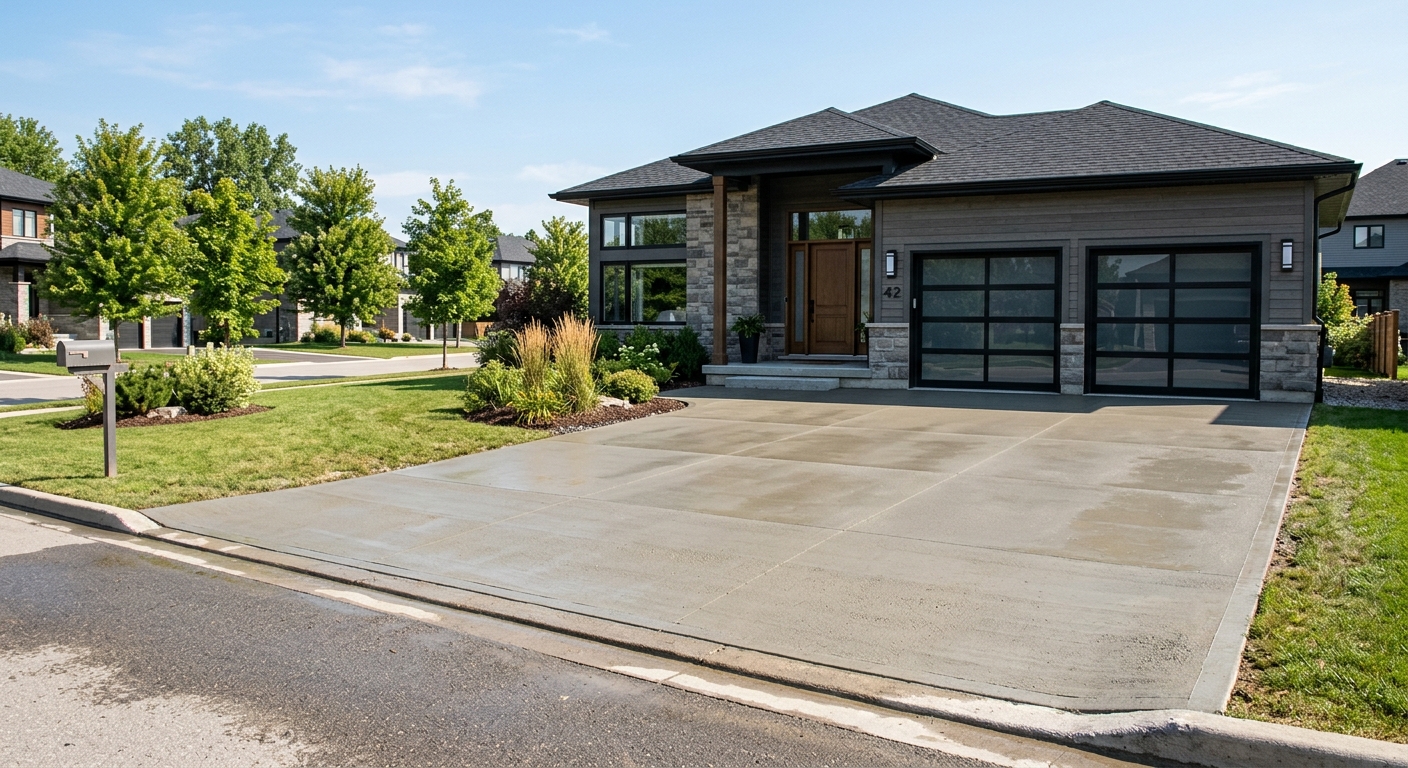
Concrete work options and costs in North St.James Town
North St.James Town, Ontario sits in the Toronto economic region, where concrete pricing is driven as much by winter conditions as by job size. With a population of 18,615 (Statistics Canada, 2021 Census), this neighbourhood sees steady demand for home improvements—especially exterior flatwork that takes daily wear. A large share of Toronto-area households are in detached and semi-detached neighbourhood housing patterns, and that typically translates into regular requests for driveways, patios, and walkways (Statistics Canada, 2021 Census).
In the GTA, freeze–thaw cycles and frost depth shape almost every design choice: footings generally need to extend well below grade, exterior slabs typically use air-entrained concrete, and control joints must be planned to manage cracking. Concrete crews also concentrate pours in warmer months to protect curing when temperatures drop toward 10 °C or below. Even if your project is small, site prep (grading, compacted granular base, drainage) and access for concrete trucks can add or reduce cost significantly—often more than the choice of finish.
On the ground, trade demand is especially consistent around busy residential corridors and side streets close to transit connections where older homes are being renovated and front entries are upgraded. If you’re comparing options, the table below lays out typical sizes, key specs, finish choices, and realistic price ranges for North St.James Town homeowners, including the items most affected by Toronto’s climate and labour availability.
| Application |
Typical Size |
Key Spec |
Finish Option |
Price Range |
| Concrete driveway (standard broom finish) |
10 ft x 20 ft (200 sq ft) |
Air-entrained exterior mix; compacted base; control joints |
Broom finish + edge rounding |
$18,000–$28,000 |
| Exposed aggregate driveway |
10 ft x 20 ft (200 sq ft) |
Air-entrained mix; proper curing & wash exposure |
Exposed aggregate (surface retarder/wash) |
$22,000–$35,000 |
| Stamped concrete driveway or patio |
10 ft x 20 ft driveway or 12 ft x 16 ft patio (240 sq ft) |
Air-entrained mix; thicker slab for pattern durability |
Stamp pattern + optional integral colour |
$24,000–$40,000 |
| Plain concrete patio or walkway |
12 ft x 16 ft patio (192 sq ft) or 3 ft x 20 ft walkway (60 sq ft) |
Compacted granular base; control joints; drainage slope |
Steel trowel edges/straightedge; light broom texture |
$16,000–$26,000 |
| Garage floor (interior slab) |
20 ft x 20 ft (400 sq ft) |
Vapour barrier (as required); fibre or mesh; proper base |
Power trowel + curing compound (where specified) |
$12,000–$22,000 |
| Foundation footings (structural, below frost) |
Typical house footing package (varies by design) |
Below frost depth, rebar placement, engineered dimensions |
Structural concrete (not aesthetic) |
$180–$300 |
Prices are estimates only and vary by project scope, site access and material selection.
What affects the price of concrete work in North St.James Town
If you get multiple quotes for “the same” concrete job in Toronto, it’s common to see total pricing swing by 30–50%. The difference usually isn’t the concrete itself—it’s what’s under it. Contractors may include different levels of site prep (excavation depth, granular base thickness, drainage work), reinforcement (wire mesh vs. rebar), and protection during curing. In North St.James Town, older lots can also have variable soil conditions and tight access, which increases time for excavation, forming, and concrete placement.
Toronto’s frost depth and repeated freeze–thaw cycles dictate key specs. Exterior slabs and walkways perform best when they’re built over well-compacted granular base and made with air-entrained concrete. Even for a plain patio, crews typically plan for control joints to limit random cracking. When pours are scheduled late in the season, heating blankets and longer curing protection may be needed if temperatures trend toward 10 °C or below, which adds labour and rental costs. De-icing salt in winter accelerates surface wear, so sealing after cure becomes part of a durability plan—especially for driveway edges and slopes.
Cost can go up or down quickly with local conditions. For example: a driveway that requires more demo and deeper base to fix drainage will cost closer to the higher end of the typical concrete driveway band (often aligning with the $18–$28 range). A stamped patio that stays within the same footprint can still be justified—stamps and finishing add complexity and labour, typically aligning closer to the stamped range ($24–$40). As a rough homeowner anchor, if you replace a failing small slab, you’re usually paying to rebuild the base correctly first—often a larger portion of cost than people expect in Toronto’s climate where saturated soils can shift and crack older flatwork.
| Price Factor |
Why It Matters |
Cost Impact |
| Frost line depth — determines footing depth and form height |
Footings must extend below design frost to prevent frost heave |
Higher excavation and forming; can add significant labour on foundation work |
| Site preparation — excavation, grading, compacted granular base |
Bad base leads to settlement and cracking, especially in wet spring/fall |
Often the biggest swing factor between “cheap” and “durable” bids |
| Reinforcement — rebar or wire mesh requirement |
Controls cracking and improves slab performance under loads |
Costs more in materials and labour; scope varies by thickness and use |
| Mix design — air-entrainment and compressive strength spec |
Air-entrainment helps concrete survive freeze–thaw cycles |
Small material cost increase for big durability benefit |
| Finish type — broom vs. stamped vs. exposed aggregate |
Finishing complexity and time; aesthetics affect labour |
Stamped/exposed usually add labour and sometimes specialized materials |
| Pour size and concrete truck access to site |
Limited access may require pumping, extra crew, or shorter deliveries |
Can add equipment and time, raising total cost |
| Cold-weather curing precautions — heating and blankets |
Protects early strength gain when temperatures drop |
Extra rentals and labour; commonly increases costs in shoulder season |
| Control joint pattern and sealing cost |
Proper joints limit random cracking; sealing helps resist salt damage |
Lower failures later; adds a modest up-front cost |
Permits & regulations in Ontario
In Ontario, structural concrete work—footings, foundation walls, and grade beams—typically requires a building permit and often engineered drawings that the municipality reviews. Concrete flatwork like patios, walkways, and standard driveways usually does not require a permit on its own, unless it affects lot grading, impervious surface coverage limits, or municipal right-of-way conditions (for example, drainage changes near the curb). For projects on older Toronto lots, I always recommend confirming whether your specific scope triggers any grading or drainage review before you break ground.
Step-by-step, here’s how a North St.James Town homeowner can verify a contractor is properly set up in Ontario. First, confirm liability insurance: ask for a current certificate of insurance that names you as the certificate holder where appropriate. Second, check worker coverage: request proof of WSIB/WCB (coverage for the contractor and their workers). If you see “cash-only,” vague paperwork, or expired clearance letters, that’s a red flag.
Next, ask if the permit process is included in the quote for structural work, and ensure the contractor’s scope matches what drawings/permits require. Finally, verify references on similar-scale pours (not just decorative work). For the trade, reliability matters as much as compliance—especially in Toronto’s freeze–thaw climate where curing and base preparation drive performance.
Getting concrete right in North St.James Town's freeze-thaw climate
Concrete failures in North St.James Town usually trace back to one of five areas: insufficient base preparation, poor drainage, incorrect mix design, inadequate curing, and skipped protection after the pour. In Toronto’s humid winters, freeze–thaw cycles stress the surface and paste. If the concrete isn’t air-entrained, or if the air content is too low, the freeze–thaw damage accelerates and you can see spalling and scaling within a few seasons—especially on driveway edges where de-icing salt is used.
To spec the job correctly, focus on build-up and timing. (1) Base preparation: place and compact the granular sub-base to the right depth for the soil and frost conditions, then give the slab a proper drainage slope. (2) Mix design: specify air-entrainment for exterior flatwork (commonly 5–7% air content) and a minimum 32 MPa compressive strength. (3) Control joints: cut or form joints early enough and with a pattern that limits random cracking. (4) Curing: plan for a minimum of 7 days of proper curing; in cooler weather, curing protection matters even more. (5) Sealing: apply a penetrating sealer after the concrete has cured (often after 28 days) to repel salt and moisture.
As a practical cost example, homeowners sometimes choose plain broom-finished concrete to stay within the $16–$26 patio/walkway band, then try to “upgrade later.” In Toronto, that often isn’t ideal. If you’re already paying for excavation and base rebuild, adding a higher-finish option like stamped concrete can be justified—typically aligning with the $24–$40 band—because the critical foundation work is the same and you’re paying mainly for finishing labour and colour/pattern systems. The real value is that correct specs reduce callbacks, which is where savings actually show up.
| Spec |
Why It Matters in North St.James Town |
What to Ask For |
Impact if Skipped |
| Compacted granular base (depth?) |
Stable base prevents settlement and cracking during wet/frozen cycles |
Base depth, grading slope, and compaction test/approach |
Uneven settling, edge cracking, early failure |
| Air-entrained concrete mix (target air %?) |
Air-entrainment helps resist freeze–thaw scaling/spalling |
Target air content (commonly 5–7%) and air-entrained designation |
Spalling, scaling, and costly resurfacing |
| Compressive strength (MPa rating) |
Strength supports loads and improves durability over cycles |
Minimum 32 MPa specified on the pour ticket/scope |
Premature wear and cracking under normal use |
| Control joints (spacing per ACI guidelines) |
Joints control where cracks form in freeze–thaw conditions |
Joint spacing plan and timing for cutting |
Random cracking and rough surfaces |
| Minimum 7-day curing period |
Early strength gain reduces surface damage from cold nights/rain |
Curing method (protection, coverings if needed) |
Weak surface, surface defects, reduced long-term performance |
| Penetrating sealer (when applied after cure) |
Salt and moisture exposure in Toronto increases deterioration without sealing |
Type of sealer and timing after cure (often after 28 days) |
Faster surface breakdown from de-icing salts |
How to choose a concrete work contractor in North St.James Town
Choosing the right contractor matters in North St.James Town because Toronto’s freeze–thaw cycle punishes shortcuts. Start with Ontario licensing and work eligibility. Ask the contractor for their Ontario documentation and current certificate of insurance. For liability coverage, request a certificate and verify the policy is active for the project period. Next, confirm worker coverage: ask for proof of WSIB/WCB (or equivalent clearance documentation where applicable) and ensure it’s current.
Then, get 2–3 itemised written quotes. I recommend a breakdown that shows labour, materials, excavation and formwork, reinforcement, concrete placement, finishing, and any sealing. Avoid lump-sum-only bids that don’t explain what’s included. Ask whether the quote includes permit pull (if required for structural work), disposal/dump fees, and whether concrete truck access/pumping is priced or treated as an allowance.
Read the scope line-by-line for exclusions—especially curing protection in cooler weather and joint cutting/granular base compaction. Warranty should be explicit: workmanship warranty length, what is covered (cracking due to improper curing vs. impact damage), and whether it includes repair labour. Product/manufacturer warranty depends on the sealant or admixtures used and whether coverage is transferable. Finally, use a responsible payment schedule: never pay more than 10–15% upfront, and hold back a portion until completion and final walk-through. Ask for an estimated start date and completion timeline in writing so you can plan around Toronto’s seasonal pour window.
- Provide a written scope with concrete thickness, base build-up, and joint plan
- Confirm air-entrained exterior mix and target air content (for outdoor flatwork)
- Ask for minimum compressive strength (MPa) stated in the scope
- Verify liability insurance is active and project-specific (certificate of insurance)
- Confirm WSIB/WCB coverage with current documentation
- Get an itemised quote showing excavation, granular base, reinforcement, and finishing
- Ask if permitting is included for structural concrete work
- Clarify whether disposal and haul-away of demo material is included
- Ask how truck access/pumping is handled given tight Toronto backyards
- Confirm curing plan for cool nights and rainy periods
- Request examples/photos of similar freeze–thaw durability projects
- Use a payment schedule with a holdback until the final completion inspection
Concrete red flags in North St.James Town: quotes that don’t discuss base depth or compaction, no mention of air-entrainment for exterior flatwork, “one-size-fits-all” joint spacing, missing or expired insurance/WSIB documentation, and contractors who dismiss curing protection when temperatures drop toward 10 °C or below.
Frequently asked questions — concrete work in North St.James Town
When is the best time to pour concrete in North St.James Town?
The best time to pour in North St.James Town is typically late spring through early fall, when daytime temperatures stay comfortably above freezing and you can maintain steady curing. In the Toronto area, contractors plan pours around the freeze–thaw cycle, and cold nights can slow strength gain and make finishing harder. If you must schedule during shoulder season, expect added curing precautions (heating, insulated blankets, and tighter timing) to protect the first week—because Toronto weather can flip quickly. That’s why you’ll often see exterior flatwork scheduled when contractors can control curing conditions. It also affects pricing: “late” pours can push costs toward the upper end of typical ranges like the $18–$28 for driveways, depending on protection needs.
How long does concrete take to cure?
Concrete curing has two timelines: initial set/strength gain and full strength development. For most residential pours, you should plan for a minimum of 7 days of proper curing conditions before you expect normal traffic, and longer for significant strength. In practical Toronto terms, even though concrete starts gaining strength immediately, the freeze–thaw season will punish weak early concrete if it’s exposed too soon. For long-term durability—especially for driveways and patios exposed to de-icing salt—many contractors plan work so the slab cures properly for at least the first week, then sealers are applied after the concrete has cured more fully (often after 28 days). If you’re comparing bids, ask how they protect curing when temperatures fall near 10 °C.
Do I need a permit for concrete work in Ontario?
In Ontario, structural concrete work such as footings, foundation walls, and grade beams typically requires a building permit and may need engineered drawings reviewed by the municipality. Regular concrete flatwork—patios, walkways, and standard driveways—often does not require a permit by default, but it can if your project affects lot grading, impervious surface coverage limits, or drainage/right-of-way conditions near the curb. The safest approach in North St.James Town is to confirm before starting: ask the contractor whether a permit is required for your scope and whether they will handle the paperwork (when applicable). As a homeowner, also verify the contractor carries liability insurance and has WSIB/WCB coverage before work begins.
Concrete vs pavers for a patio in North St.James Town?
Concrete and pavers can both work well in Toronto’s freeze–thaw conditions, but the durability comes from the foundation. For concrete, air-entrained mix, proper compaction, correct thickness, and control joints are key. For pavers, the bedding and edge restraints matter just as much; if water is trapped under pavers, you can still get shifting and uneven surfaces. Cost-wise, a simple broom-finished patio often lands around the plain concrete patio/walkway band (for example, roughly $16–$26 depending on size and site prep). Stamped concrete adds labour and finishing and can run closer to the $24–$40 band. If you want a “set it and maintain it” approach with fewer individual pieces to move, concrete is often the lower-maintenance choice—provided it’s built correctly for Toronto weather.
How long does a concrete driveway last?
A well-built concrete driveway in Ontario can last decades, but it depends on how it’s constructed for freeze–thaw and salt exposure. The big drivers are base preparation (compacted granular base and proper slope), air-entrained concrete for exterior performance, reinforcement where required, and a good joint plan to control cracking. Sealing after cure can help reduce moisture and de-icing salt penetration, which slows surface deterioration. In North St.James Town, driveways also see heavier edge exposure where snowmelt and salt accumulate, so proper finishing and edges matter. If a contractor cuts corners on base depth or air content, you can see scaling or spalling much sooner. That’s why “cheapest” bids may cost more over time even if they’re below the typical $18–$28 driveway band.
What is air-entrained concrete and why does it matter here?
Air-entrained concrete is mixed with tiny, evenly distributed air bubbles designed to relieve internal pressure when water in the paste freezes. In Ontario—especially the Toronto area where freeze–thaw cycles repeat every winter—this is one of the most important ingredients for resisting scaling and spalling. Without adequate air entrainment, the concrete can deteriorate at the surface even if it looks fine at first. For exterior flatwork in North St.James Town, many contractors specify air-entrained concrete with an air content target commonly in the 5–7% range and a minimum compressive strength (often at least 32 MPa) for durability. If you’re comparing quotes, ask for confirmation of air-entrainment in the scope and the mix design for your driveway/patio.