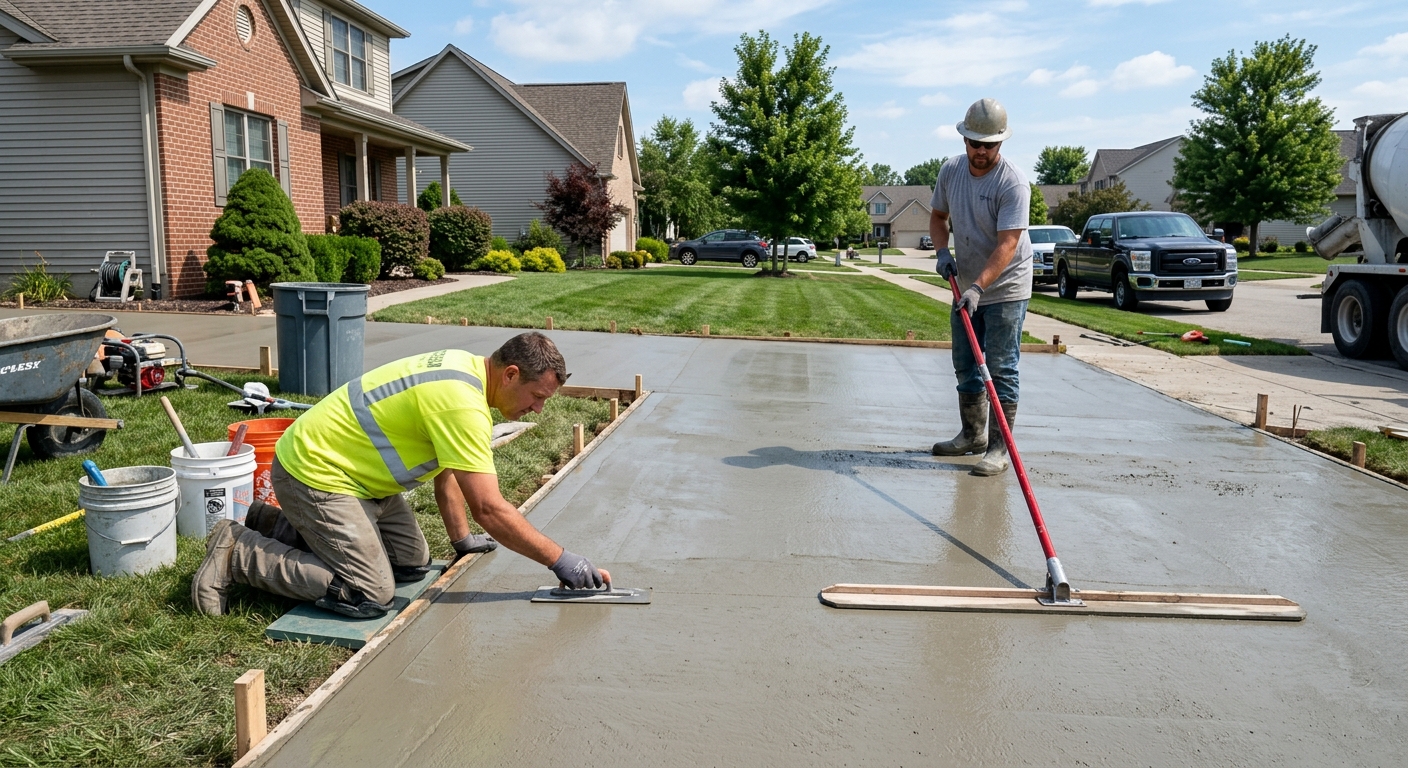
Concrete work options and costs in South Parkdale
Concrete work in South Parkdale is all about getting the base right and planning for Toronto’s freeze–thaw season. With a 2021 population of 21,849 in the area (Statistics Canada, 2021 Census), there’s steady demand for driveways, walkways, patios and repair work—especially in established pockets close to Queen Street West and the King/Queen area where many homes are older and lots are tighter. In South Parkdale, many homeowners are working on single-family properties where new or resurfaced concrete flatwork can materially improve curb appeal and daily function.
Toronto pricing can land in noticeably different places for the “same” job because climate impacts every spec: frost depth, air-entrainment, thickness, and joint layout. In the Toronto economic region, exterior pours are typically scheduled for the warmer months to manage curing—concrete needs more protection when temperatures trend down near 10 °C or below. At the same time, labour availability can tighten as the season gets busy, which is one reason two quotes for similar scopes may vary.
Below is a practical comparison of common options in South Parkdale. Use it as a baseline for budgeting, then build your exact price around site access, demolition, reinforcement, drainage, and finish details. For many homeowners, the best value comes from pairing a durable base and correct mix with the finish that fits how the area will be used.
| Application |
Typical Size |
Key Spec |
Finish Option |
Price Range |
| Concrete driveway (standard broom finish) |
300–500 sq. ft. |
Air-entrained concrete, compacted granular base, control joints |
Broom finish |
$18,000–$28,000 |
| Exposed aggregate driveway |
300–500 sq. ft. |
Air-entrained mix, proper base drainage, surface retard & washing |
Exposed aggregate |
$22,000–$34,000 |
| Stamped concrete driveway or patio |
250–400 sq. ft. |
Air-entrained mix, integral colour, release agent, sealing |
Stamped patterns |
$24,000–$42,000 |
| Plain concrete patio or walkway |
150–300 sq. ft. |
Compacted base, air-entrainment, slope to drainage |
Broom or smooth trowel |
$16,000–$26,000 |
| Garage floor (interior slab) |
400–650 sq. ft. |
Vapour barrier, mesh/rebar as required, flatness for vehicle use |
Plain trowel or broom |
$10,000–$20,000 |
| Foundation footings (structural, below frost) |
Per project (varies by house/engineer) |
Footings typically extend at least ~1.2 m below grade; engineered rebar |
Structural concrete |
$180,000–$300,000 |
Prices are estimates only and vary by project scope, site access and material selection.
What affects the price of concrete work in South Parkdale
In Toronto and across Ontario, it’s not unusual for quotes for the “same” concrete job to vary by 30–50%. The difference usually isn’t the concrete itself—it’s what happens around it: excavation depth, drainage correction, reinforcement, the air-entrained mix design, waste disposal, and how well the contractor controls curing and cracking. In a city with dense neighbourhoods like South Parkdale, access constraints can also change labour time and equipment needs.
The Toronto economic region’s frost and freeze–thaw cycles drive the biggest technical differences. Exterior footings must extend below the design frost depth (commonly about 1.2 m in Ontario for many structural applications) to prevent frost heave and differential movement. For flatwork, air-entrained concrete is typically specified so the slab survives repeated freeze–thaw. When pours fall into cooler periods, contractors often add cold-weather protection—heating, insulating blankets, and longer protected curing—because below-ideal temperatures slow strength gain. And because de-icing salt is used in winter here, sealing and a durable surface matter to reduce spalling and surface wear. That’s why sealing and proper joints can be “small line items” that protect the larger investment.
In South Parkdale specifically, older lots and tight drive approaches can raise excavation and grading costs before a contractor even pours. If your base has to be rebuilt with proper compacted granular material, that often pushes driveway work toward the higher end of the price band (for example, concrete driveway budgets commonly land around $18,000–$28,000 depending on prep and finish). If you choose stamped concrete, the labour and materials typically justify a higher band as well—often $24,000–$42,000—because colour, patterning and finishing steps are more labour-intensive than broom-finish flatwork.
| Price Factor |
Why It Matters |
Cost Impact |
| Frost line depth — determines footing depth and form height |
Deeper footings reduce frost heave risk |
Higher excavation and forming can add substantial cost |
| Site preparation — excavation, grading, compacted granular base |
Controls settlement and slab movement |
Soil removal/replacement can push quotes up 10–25% |
| Reinforcement — rebar or wire mesh requirement |
Improves load capacity and reduces cracking under stress |
Materials and labour typically add 5–15% |
| Mix design — air-entrainment and compressive strength spec |
Air voids help manage freeze–thaw expansion |
More expensive mix specs can add a noticeable amount |
| Finish type — broom vs. stamped vs. exposed aggregate |
Finish steps affect labour time and consumables |
Stamped/exposed can add material and production time |
| Pour size and concrete truck access to site |
Short access increases labour and may limit concrete flow |
Constrained access can increase labour cost significantly |
| Cold-weather curing precautions — heating and blankets |
Protects strength gain when temperatures drop |
Can add cost during shoulder seasons |
| Control joint pattern and sealing cost |
Joints control crack location; sealer reduces salt damage |
Skimping can lower upfront cost but increases long-term failure risk |
Permits & regulations in Ontario
In Ontario, the rule of thumb is that structural concrete work typically needs municipal oversight, while most exterior flatwork may not—unless it impacts grading, drainage, or lot coverage. For South Parkdale homeowners, concrete that affects foundations is the category most likely to require permits. That includes: footings, foundation walls, grade beams, underpinning, and other structural elements that support the building. These projects usually require a building permit and, in many cases, engineered drawings reviewed by the municipality.
Concrete flatwork—such as driveways, patios, walkways, and sidewalks on private property—often does not require a permit. However, permits or approvals can come into play if the work changes site grading, alters drainage, or affects impervious surface coverage limits. It can also involve municipal right-of-way conditions depending on where the concrete ties in. Always confirm with the local authority before breaking ground, especially if you’re changing slopes for water management or expanding coverage.
Before signing in Ontario, verify three things step-by-step. First, check contractor licensing status through Ontario’s relevant online registry tools. Second, request a certificate of insurance (liability) and confirm it’s current, including coverage limits suitable for concrete work. Third, ask for WSIB/WCB coverage proof—then check for clearance/coverage status documents your contractor provides. For added peace of mind, ask for references on similar South Parkdale-sized projects (tight access, older homes) and confirm the quote includes removal/disposal where applicable.
Getting concrete right in South Parkdale's freeze-thaw climate
Concrete failures in South Parkdale are usually preventable, but they happen when the job is treated like a “pour and go” task. The most common issues I see are surface spalling and scaling from winter salt use, plus random cracking from moisture movement and freezing expansion. The Ontario Building Code approach and local contractor practices both point to one theme: control frost movement through proper footing depth, and manage freeze–thaw in flatwork through air-entrained concrete, correct thickness, and well-planned joints.
Spec the job starting with base preparation: a compacted granular sub-base at the right depth for your soil conditions and local frost considerations. Next is mix design. For exterior flatwork, ask for air-entrained concrete with a target air content typically in the 5–7% range and a minimum compressive strength of 32 MPa for many common applications. Then plan control joints early—spacing should limit random cracking and guide where cracks occur. Curing matters just as much: aim for at least 7 days of protected curing under suitable conditions, and if the weather turns colder, request cold-weather curing precautions (insulating blankets/heating as needed). Finally, sealing should be scheduled after curing—often 28 days post-pour—so penetrating sealer can repel de-icing salts and reduce scaling.
Where does the money make sense? If you’re choosing between a standard broom-finish patio and a stamped patio, the price difference can be justified by additional labour and materials. For example, a broom-finished patio may fit around $16,000–$26,000, while stamped work often runs higher around $24,000–$42,000. The key is that neither option protects you if air-entrainment, base prep, joints and curing are skipped—those are the real drivers of long-term durability in Toronto’s freeze–thaw climate.
| Spec |
Why It Matters in South Parkdale |
What to Ask For |
Impact if Skipped |
| Compacted granular base (depth?) |
Stable support prevents settlement and reduces cracking |
Documented base depth and compaction testing/acceptance |
Premature cracking, uneven slab, drainage failure |
| Air-entrained concrete mix (target air %?) |
Air voids manage freeze–thaw expansion |
Target air content (commonly 5–7% for exterior flatwork) |
Spalling/scaling and rapid surface deterioration |
| Compressive strength (MPa rating) |
Strength gain supports loading and durability |
Minimum 32 MPa (confirm project-specific design) |
Lower performance and higher cracking risk |
| Control joints (spacing per ACI guidelines) |
Controls where cracks happen |
Joint layout plan and spacing consistent with ACI guidance |
Random cracking and expensive patching |
| Minimum 7-day curing period |
Curing affects strength and resistance to damage |
Minimum 7 days of protected curing, especially in cool weather |
Weak surface, scaling, reduced service life |
| Penetrating sealer (when applied after cure) |
Helps repel salts and water ingress |
Penetrating sealer applied after cure (often around 28 days) |
Faster wear, staining, and salt-related damage |
How to choose a concrete work contractor in South Parkdale
Start with verification. In Ontario, ask your contractor for their current Ontario licence details (as applicable), a current certificate of liability insurance, and WSIB/WCB coverage evidence. The practical way to check is to: (1) confirm the licence/registration information they provide matches the online registry listing; (2) request a certificate of insurance and verify the coverage dates, insured name, and limits; and (3) obtain WSIB/WCB proof (often a clearance letter or coverage document) and confirm it’s active for the dates of your project. If anything doesn’t match or they can’t provide documentation, treat it as a red flag.
Next, insist on 2–3 itemised written quotes. Concrete quotes should break down labour and materials rather than a single lump sum so you can compare apples-to-apples: demolition and disposal, excavation depth, granular base, reinforcement, concrete supply, finishing, and sealing. Read the scope for exclusions—such as permit pulls (if required), protection of adjacent surfaces, trucking/line pumping, and whether removals are included. For warranty, ask for workmanship warranty length in writing and clarify product/manufacturer warranty terms; also confirm whether any warranty is transferable if you sell your home.
Payment schedule matters. In Ontario, avoid paying much more than 10–15% upfront. Use a holdback until the job is complete and any punch-list items are addressed. Finally, get a written start date and completion estimate. In the Toronto area, schedules often tighten during the pour season, and having dates in writing helps reduce delays that can impact curing and final appearance.
- Verify Ontario licence/registration details before work starts.
- Request a certificate of liability insurance and confirm it’s current.
- Confirm WSIB/WCB coverage (ask for a clearance/coverage document).
- Get 2–3 itemised quotes (labour + materials + disposal).
- Check whether excavation, hauling and disposal are included.
- Confirm reinforcement plans (mesh vs rebar) and placement.
- Ask for the air-entrained mix spec and target air content for exterior work.
- Review joint layout: spacing and how they’ll control cracking.
- Confirm curing approach for cool days (blankets/heating if needed).
- Ask when sealing will be applied (often after full cure).
- Use a deposit capped around 10–15%, with holdback until completion.
- Get a written timeline: start date, pour date, and substantial completion.
Concrete red flags I watch for in South Parkdale include: vague scope that doesn’t mention base depth or drainage, no discussion of air-entrainment for exterior flatwork, quotes that ignore joints and curing protection, contractors asking for large deposits up front, and workmanship that’s rushed without a plan for protection during Ontario’s temperature swings.
Frequently asked questions — concrete work in South Parkdale
Why does concrete crack in South Parkdale and how is it prevented?
Cracking in South Parkdale is usually caused by a combination of movement and restraint. Toronto’s freeze–thaw cycles pull moisture in and out of the slab and soil, which can stress the concrete—especially if the base wasn’t properly compacted or drainage wasn’t corrected. Cracks also happen when slabs shrink as they cure and when there aren’t enough control joints (or the joints aren’t laid out with the slab’s dimensions in mind). The prevention steps are very technical but practical: specify air-entrained concrete for exterior work, build a compacted granular base, plan joint placement, and protect curing so the slab gains strength properly. If you’re budgeting for a driveway, think in the range of $18,000–$28,000; the lower end typically assumes fewer prep surprises and a simpler finish.
Stamped vs broom-finish concrete — cost difference?
Stamped concrete costs more because it adds colour, pattern application, texture detailing, and extra labour steps compared with a broom-finish. A broom finish is straightforward: it’s typically about creating a uniform slip-resistant texture while timing the surface properly after finishing. Stamped work also usually includes release agents, careful curing timing, and sealing to lock in the look and improve stain/water resistance. In the South Parkdale market, homeowners often see broom-finish flatwork around the driveway band of $18,000–$28,000, while stamped driveway or patio work commonly lands higher, around $24,000–$42,000 depending on size and site access. The right approach is to compare quotes that both include base prep, air-entrainment, joints, and sealing—otherwise the cheaper “stamped” quote may just be skipping durability fundamentals.
When is the best time to pour concrete in South Parkdale?
The best time to pour in South Parkdale is typically late spring through summer, when temperatures support reliable curing and the contractor can protect the slab through the early strength-gain period. In the Toronto economic region, exterior pours are commonly scheduled in warmer months because concrete needs time to reach adequate strength—especially when you want full durability against freeze–thaw and salt exposure. If you do have to pour near cooler weather, reputable contractors plan cold-weather curing precautions such as insulating blankets and, in some cases, temporary heating. That’s why one quote can be more expensive: the contractor may include weather protection measures and longer protected curing time. For homeowners, ask your contractor to show the intended pour timing and how they’ll protect the concrete if the forecast dips toward 10 °C or below.
How long does concrete take to cure?
Concrete curing is a staged process. You’ll often see concrete “set” within hours, but the strength and durability that matter for freeze–thaw resistance take longer. A good standard for many residential exterior pours is to protect and cure the slab for at least 7 days under suitable conditions so it can gain meaningful strength. For tasks like sealing, many contractors schedule penetrating sealer after the full cure period—commonly around 28 days—so the concrete has released moisture and can accept the sealer properly. In Ontario’s climate, rushing curing or exposing fresh concrete to cold snaps and early de-icing can increase the risk of surface scaling. If you’re comparing quotes for a patio or driveway, ask for the curing plan (what they’ll do on cool nights, weekends, and how they’ll protect the surface).
Do I need a permit for concrete work in Ontario?
In Ontario, structural concrete work usually requires a building permit and often engineered drawings reviewed by the municipality—especially for footings, foundation walls, grade beams, underpinning, and other load-bearing elements. For typical concrete flatwork like patios, walkways, and driveways on private property, permits are often not required, but there are important exceptions: if the work changes lot grading, impacts drainage, affects impervious surface coverage limits, or ties into conditions near the municipal right-of-way, approvals may be required. For South Parkdale homeowners, the safest approach is to confirm with the local authority before work begins. Also ask whether the contractor includes permit handling in the quote (if applicable). Proper documentation protects you and helps ensure the finished concrete meets the expectations tied to how your lot handles water.
Concrete vs pavers for a patio in South Parkdale?
Concrete and pavers can both work well in South Parkdale, but they solve the freeze–thaw problem differently. Concrete flatwork relies on air-entrained mix, correct base compaction, control joints, and curing to manage movement. Pavers rely on a different system: an interlocking surface with bedding sand and often geotextile layers. In Toronto’s freeze–thaw and salt environment, poorly built paver bases can settle or heave, causing uneven surfaces and weed growth, while poorly built concrete can crack or scale if air-entrainment, base prep, and joints aren’t done properly. Cost-wise, plain concrete patios often fit around $16,000–$26,000 (depending on size and site prep). Pavers can sometimes be similar or higher once excavation, bedding, and edging are included. The best choice usually comes down to how you want the patio to be repaired: concrete is typically repaired by patching or resurfacing, while pavers can be lifted and replaced section-by-section.