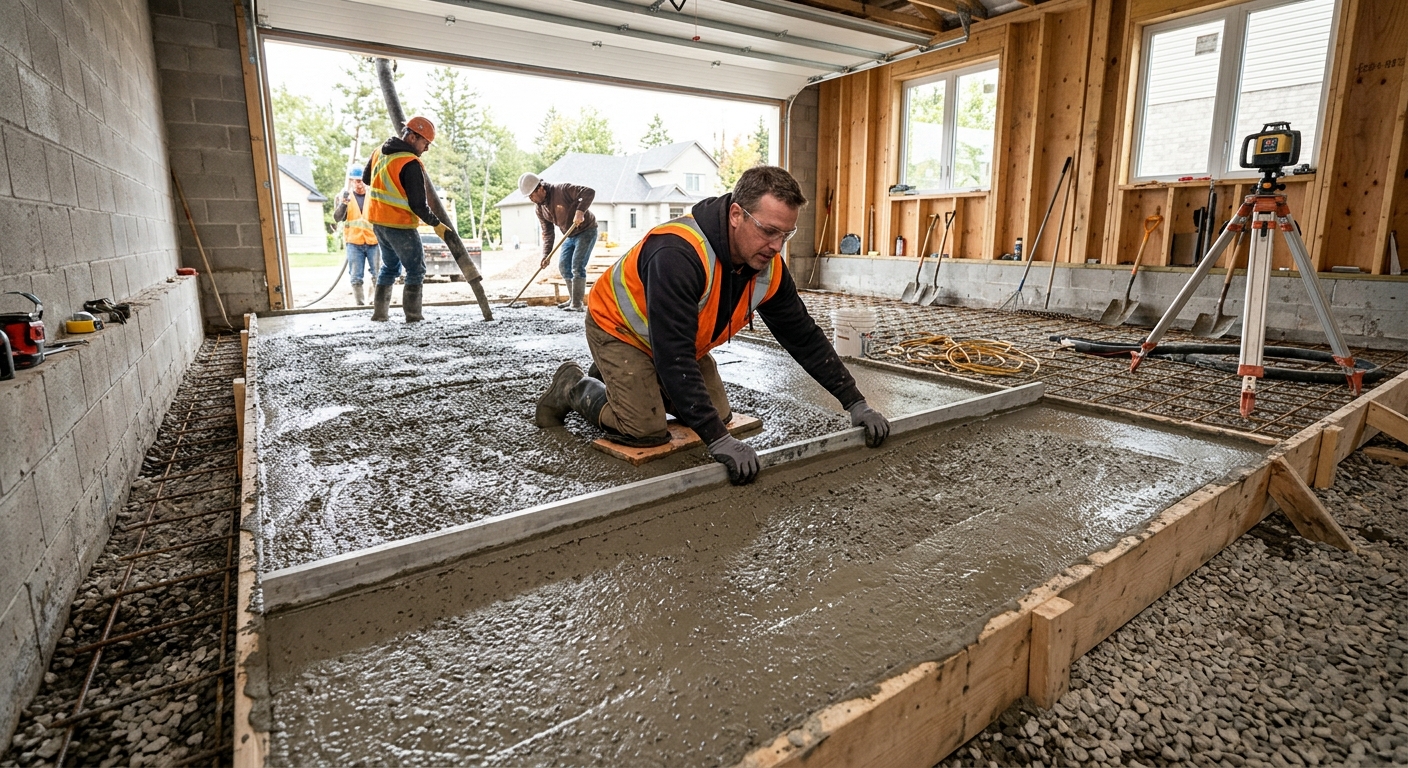
Concrete work options and costs in College Park
Concrete work in College Park typically starts with a driveway, a patio, or a walkway—because that’s where homeowners feel the biggest day-to-day improvement. College Park has 4,072 residents (Statistics Canada, 2021 Census), and the surrounding Toronto economic region is dominated by suburban lots where exterior concrete flatwork is a regular upgrade. In practice, most residential concrete projects cluster around the same property types you see throughout the Toronto corridor, where driveways, front steps, and backyard walkways are common. If you’re near established pockets like the College Park/Westwood area, you’ll also notice strong contractor availability for seasonal exterior pours, especially in spring and early summer.
Pricing in the Toronto region is influenced by frost depth and freeze–thaw cycles, which affect everything from footing depth to air-entrainment and control-joint layout. Local building departments and the Ontario Building Code generally push structural footings below grade to reduce frost heave and differential movement, and that requirement alone can swing budgets. Exterior flatwork also needs the right mix and protection during curing; when temperatures dip toward 10 °C or below, contractors often add blankets, plan longer cure windows, and schedule pours to reduce early-age damage. That’s why you may see quote differences of 30–50% for seemingly “similar” work—especially when one contractor includes proper granular base prep, jointing, and sealing, and another doesn’t.
Below is a realistic comparison of common options homeowners ask for, so you can connect the quote you receive to the finish and scope you’re actually getting.
| Application |
Typical Size |
Key Spec |
Finish Option |
Price Range |
| Concrete driveway (standard broom finish) |
12 ft × 20 ft (240 sq ft) |
Air-entrained exterior mix, compacted granular base, control joints |
Broom finish |
$4,320 – $6,720 |
| Exposed aggregate driveway |
12 ft × 20 ft (240 sq ft) |
Air-entrained mix, proper curing and wash timing |
Exposed aggregate |
$5,520 – $8,640 |
| Stamped concrete driveway or patio |
10 ft × 18 ft (180 sq ft) |
Air-entrained mix, integral colour options, release agent |
Stamped pattern |
$4,320 – $7,200 |
| Plain concrete patio or walkway |
10 ft × 12 ft (120 sq ft) |
Compacted base, rebar/wire mesh as required, air-entrained mix |
Broom or smooth trowel look |
$1,920 – $3,120 |
| Garage floor (interior slab) |
20 ft × 22 ft (440 sq ft) |
Interior slab mix, vapour control as specified, minimal joints |
Plain trowel finish |
$8,800 – $13,200 |
| Foundation footings (structural, below frost) |
Typical house footing package |
Engineered depth below frost, rebar cage, concrete pours below grade |
Structural concrete |
$180 – $300 |
Prices are estimates only and vary by project scope, site access and material selection.
What affects the price of concrete work in College Park
In College Park and the broader Toronto region, quotes for the same “type” of concrete can land 30–50% apart because the real cost drivers aren’t visible at first glance. Two contractors can both say “240 sq ft driveway,” but one includes the correct granular base depth, proper compaction, air-entrained mix, reinforcement, jointing, and sealing plan—while another trims those items to hit a lower number. Labour availability also matters: exterior work is concentrated in the warmer months, and when multiple crews are booked at once, scheduling and protection materials (especially for curing) can change the price quickly.
Freeze–thaw is the other big reason spec details change the bill. Frost depth and movement cycles dictate how deep structural footings must go and how exterior slabs are supported. In Ontario, structural footings are typically required to extend below the design frost depth (often about 1.5–2.4 m depending on conditions), to prevent frost heave and differential settlement. Exterior flatwork is almost always air-entrained to survive freeze–thaw, and on colder pours contractors commonly add cold-weather curing precautions—heating, insulating blankets, and protected curing time—if temperatures fall. De-icing salt also accelerates surface deterioration, so sealing is a practical durability add-on for long-lived driveways and walkways.
Here are a few examples of how local conditions raise or lower cost in College Park: (1) Poor drainage or clay-rich subgrade can force deeper excavation and more imported granular base, pushing a standard driveway toward the upper band (around $18–$28 per sq ft). (2) If you choose stamped or exposed aggregate, the added materials and labour can move the project closer to $24–$40 per sq ft for decorative work. (3) Tight access for a concrete truck can extend setup time and sometimes require alternative placement methods, which increases labour. In an area with an older housing stock and frequent homeowner renovations, replacing damaged approaches and adjusting levels at steps can also add concrete, base, and forming costs—sometimes hundreds to a couple thousand dollars depending on removal scope.
| Price Factor |
Why It Matters |
Cost Impact |
| Frost line depth — determines footing depth and form height |
Deeper footings resist frost heave and movement |
Higher depth/formwork and excavation increases cost materially |
| Site preparation — excavation, grading, compacted granular base |
Correct base support prevents settling and cracking |
More removal/import and compaction can add significant labour and materials |
| Reinforcement — rebar or wire mesh requirement |
Helps control cracking and improves structural behaviour |
Extra steel and placement time increases price, but may prevent future failures |
| Mix design — air-entrainment and compressive strength spec |
Air-entrained concrete improves freeze–thaw durability |
Proper mix can cost more than basic mixes, especially for exterior specs |
| Finish type — broom vs. stamped vs. exposed aggregate |
Finish requires different labour, timing, and materials |
Decorative work typically costs more than plain broom finish |
| Pour size and concrete truck access to site |
Placement speed affects workability and finish quality |
Tight access can add labour and increase placement complexity |
| Cold-weather curing precautions — heating and blankets |
Prevents early-age damage when temperatures drop |
Adds materials and crew time; avoids costly callbacks |
| Control joint pattern and sealing cost |
Joints manage cracking; sealing repels salt and water |
Sealer and joint layout time raise the upfront total, but improve longevity |
Permits & regulations in Ontario
In Ontario, structural concrete work generally requires a building permit, particularly when it affects the stability of the structure. That means things like foundation walls, grade beams, and structural footings typically fall under permitted and inspected work, and engineered drawings may be reviewed by the municipality before construction. Concrete flatwork—driveways, patios, and walkways—usually doesn’t require a permit by itself, unless it triggers changes to lot grading, impacts stormwater management, or violates impervious surface/municipal requirements. Because every site is different, you should always confirm requirements with your local authority before breaking ground.
For a homeowner in College Park, verify your contractor in a practical order: first, confirm the contractor carries appropriate liability insurance (request a current certificate of insurance). Next, check workers’ compensation coverage (WSIB/WCB coverage documentation) so you’re not exposed if a worker is injured on site. Then confirm licensing and standing using Ontario’s public contractor/licensing resources (or the company’s verified business profile) and ask for references that match your scope—ideally exterior flatwork in similar freeze–thaw conditions.
Ask your contractor for three documents before the work starts: (1) certificate of insurance, (2) WSIB/WCB clearance or coverage proof, and (3) their written scope that clearly states what is included (excavation, base compaction, joints, curing, sealing, disposal). That paperwork-heavy approach is what protects you in Ontario.
Getting concrete right in College Park's freeze-thaw climate
Concrete fails in College Park most often for preventable reasons: inadequate support under the slab, poor mix for freeze–thaw, weak early-age curing, and cracking that isn’t managed with a proper joint plan. The fix is to spec the whole system—not just the visible surface—so water can’t get under the slab and then expand in winter. Start with base preparation: excavate to the right depth for your local soil and frost conditions, then place and compact a properly sized granular sub-base in lifts. Next, specify an air-entrained exterior mix. For many exterior flatwork applications, an air content target in the range of about 5% to 7% is common, paired with a minimum 32 MPa compressive strength requirement.
Third, control cracking with a planned joint pattern. In practice, joints should be spaced to reduce random cracking and be installed at the right time so they work as intended. Fourth is curing. Give concrete proper protection and allow a minimum 7-day curing period under suitable conditions—this matters even more when spring or fall temperatures hover and then drop toward the low teens. Fifth, sealing: use a penetrating sealer after the concrete has cured (commonly applied after 28 days) to help repel de-icing salts and reduce surface deterioration.
To illustrate why the spec matters: a sealed, properly air-entrained broom-finish driveway may stay within the plain driveway band of about $18–$28 per sq ft. If a contractor cuts back on base prep or joints to “save money,” you often end up paying again sooner—sometimes within a few seasons—through patching and rework, which costs far more than the modest addition of correct mix, joints, and sealing in the first place.
| Spec |
Why It Matters in College Park |
What to Ask For |
Impact if Skipped |
| Compacted granular base (depth?) |
Prevents settling and frost-related movement |
Confirm excavation depth, granular type/gradation, compaction method |
Uneven support leads to cracking, rocking, and premature failures |
| Air-entrained concrete mix (target air %?) |
Improves durability through freeze–thaw |
Ask for air content target and mix design for exterior exposure |
Higher risk of freeze–thaw spalling and scaling |
| Compressive strength (MPa rating) |
Supports long-term structural performance |
Request minimum MPa rating (commonly 32 MPa for many exterior specs) |
Lower strength increases cracking and surface damage risk |
| Control joints (spacing per ACI guidelines) |
Controls where cracks form |
Joint spacing plan and whether joints are saw-cut or formed |
Random cracking reduces lifespan and can allow water ingress |
| Minimum 7-day curing period |
Builds early strength before winter cycles |
Confirm curing approach and protection if temperatures drop |
Early-age damage and reduced durability |
| Penetrating sealer (when applied after cure) |
Helps resist de-icing salts and moisture |
Confirm sealer type and application timing (often after 28 days) |
Faster surface deterioration and more frequent patching |
How to choose a concrete work contractor in College Park
Choosing the right concrete contractor in College Park starts with verification and documentation. In Ontario, you want a contractor who can prove liability insurance (request a current certificate of insurance), has WSIB/WCB coverage (ask for coverage proof/clearance documentation), and can explain their licensing/registration status clearly. Don’t accept “we’re covered” without paperwork—ask for the documents before work begins and keep copies.
Next, get 2–3 itemised written quotes rather than a single lump sum. A good quote separates labour and materials and breaks down key items: excavation, removal, granular base supply and compaction, reinforcement, concrete supply and mix spec, forming, finish work, curing/protection, joints, and disposal. Confirm whether permits are included if the scope touches structural elements. Also ask what happens if conditions change—e.g., unexpected soft soils or drainage improvements required for proper base support.
Warranty matters too. Ask for (1) a workmanship warranty length and what it covers, (2) any product/manufacturer warranty if coloured/stamped or sealing products are involved, and (3) whether the warranty is transferable to future owners. For payment, avoid paying more than 10–15% upfront; hold back payment until the job is complete and broom-clean and meets finish expectations. Finally, timeline: get a start date and completion estimate in writing, including curing/protection time. In the Toronto area, scheduling around temperature drops is part of the job—ask how they protect concrete when the weather turns cool.
- Request certificate of insurance and confirm active coverage before any excavation.
- Provide WSIB/WCB proof; verify it matches the scope (exterior flatwork and/or structural work).
- Get itemised quotes (labour + materials) instead of one number.
- Confirm granular base depth and compaction method, not just “base prep included.”
- Ask for the concrete mix design spec (air-entrainment for exterior and required MPa strength).
- Confirm reinforcement plan (wire mesh/rebar type and placement) where applicable.
- Ensure control joints are included (spacing plan, saw-cut vs. formed timing).
- Ask how they handle curing in cool weather (protection, blankets/heating if needed).
- For driveways and patios, confirm whether penetrating sealer is included and the timing (often after cure).
- Clarify disposal/haul-away (old concrete removal, debris handling, and site restoration).
- Review warranty details in writing—workmanship and product coverage separately.
- Use a payment schedule with a holdback until final inspection and touch-ups are complete.
Concrete contractor red flags in College Park include: (1) quotes that omit base preparation depth and compaction details, (2) vague language like “standard concrete” without air-entrainment or strength specs for exterior work, (3) no plan for control joints and curing protection in shoulder seasons, (4) asking for large deposits (beyond 10–15%) before any work starts, and (5) refusing to provide insurance/WSIB paperwork or written scope and timeline.
Frequently asked questions — concrete work in College Park
How much does concrete work cost in College Park?
In College Park, most homeowners budget based on the finish and the amount of prep included. For a standard broom-finish driveway, pricing often falls around $18–$28 per sq ft depending on removal, granular base preparation, and access. A simple patio or walkway commonly lands around $16–$26 per sq ft when the scope includes proper base and drainage. If you want decorative work like stamped concrete, costs typically rise into the $24–$40 per sq ft range because of labour, colour system choices, and finishing time. Foundation footings are usually quoted differently (per package or per linear/area basis), and structural concrete work often starts around $180–$300 per unit depending on excavation depth and engineering.
How deep must footings be for College Park's frost line?
For College Park and the wider Ontario region, structural footings generally need to extend below the design frost depth to limit frost heave and movement. That requirement often means footings in the range of about 1.5–2.4 m below grade depending on soil conditions and the specific design criteria used for your site. The exact depth is not a guess—it should come from the engineered foundation design (or the applicable design approach for your structure), and it may be influenced by local soils, groundwater, and bearing conditions. When you’re comparing quotes, the contractor should be able to tell you the footing depth used on the drawings and explain excavation and forming logistics based on that depth.
Why does concrete crack in College Park and how is it prevented?
Concrete cracks in College Park mainly because it moves: it shrinks as it cures, and it expands and contracts with moisture changes and freeze–thaw cycles. When control joints aren’t placed early enough or at the right spacing, cracking can turn random instead of planned. Poor base preparation can also allow settlement, which stresses the slab and accelerates cracking. The prevention approach is a combination: compacted granular base, correct air-entrained exterior mix for freeze–thaw durability, reinforcement when required, and a joint pattern that directs cracking. Proper curing time matters too—especially if temperatures dip toward cooler overnight conditions. Sealing later helps reduce moisture and de-icing salt exposure, which supports durability.
Stamped vs broom-finish concrete — cost difference?
Stamped concrete costs more than broom-finish because it requires additional materials and higher finishing labour. A broom-finish driveway or patio typically sits in the driveway band of about $18–$28 per sq ft, assuming proper base prep and exterior durability specifications. Stamped concrete tends to land in the decorative range of about $24–$40 per sq ft because contractors add colour systems, release agents, stamping labour, and careful finishing and curing coordination. If a quote for stamped work is close to broom pricing, ask what’s different—mix design, thickness, and joint plan should still meet exterior durability requirements. The best value often comes from paying for the correct base and joint layout, because that determines longevity as much as the look.
When is the best time to pour concrete in College Park?
The best time to pour concrete in College Park is during the warmer, more stable part of the year—typically late spring through early fall—so concrete can cure without temperature swings. In the Toronto area, contractors pay close attention when daytime temperatures drop and nights cool; when temperatures approach the low teens and closer to about 10 °C or below, early-age curing becomes more challenging. That’s why exterior pours are often scheduled in warmer months: it reduces the need for heavier cold-weather protection and lowers the risk of early-age damage. That said, reputable contractors can pour in cooler shoulder conditions if they plan cold-weather curing precautions (insulating blankets, heating where needed, and strict curing control). Your quote should explain their protection plan rather than assuming weather cooperates.
How long does concrete take to cure?
Concrete “sets” quickly, but it needs curing time to reach durability. For most exterior flatwork in Ontario, plan for a minimum 7-day curing period under proper conditions, with additional protection if temperatures drop. Full strength development continues beyond that, and that’s why sealing is commonly done later—often around 28 days post-pour—so the concrete can repel moisture and de-icing salts effectively. If you rush traffic, snow clearing, or heavy loads before adequate curing, you can create surface damage or weaken the slab’s long-term performance. When reviewing your contractor’s plan, ask what temperature and curing protection procedures they use and whether the schedule allows for curing and the recommended sealing timing.