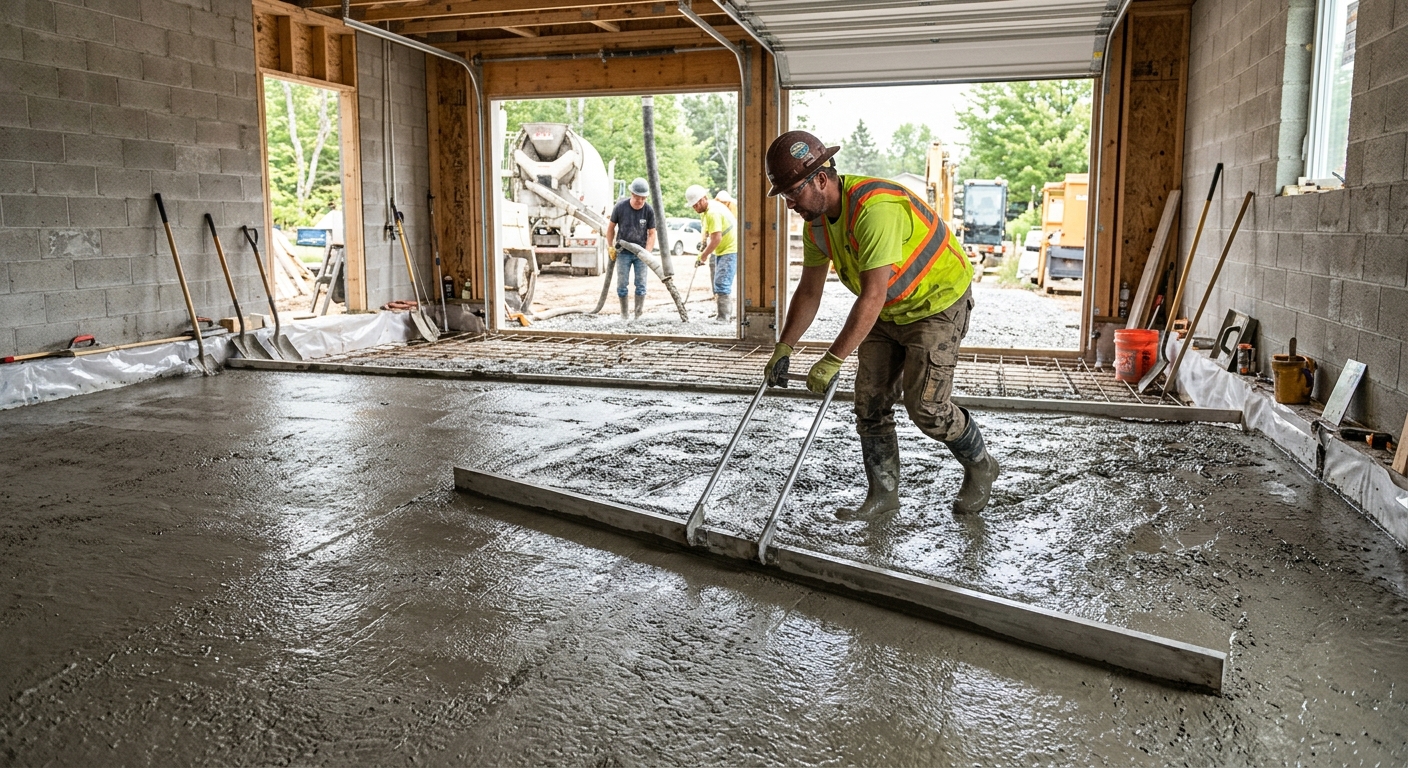
Concrete work options and costs in Preston Centre
Preston Centre, Ontario is a classic neighbourhood where concrete flatwork gets real daily use—driveways for vehicles, walkways for year-round foot traffic, and patios for summer entertaining. With a population of 10,441 (Statistics Canada, 2021 Census), demand is steady, especially around the Preston Centre/Highway 7 corridor where homeowners commonly upgrade entries and backyard access. Concrete also fits the housing mix here: many properties are single-family homes, and that typically means regular replacement or expansion of driveways, steps, and patio slabs.
In the Toronto economic region, pricing is heavily influenced by frost depth and freeze–thaw cycles. Footings for structural work are generally required to extend at least 1.2 m (about 4 ft) below grade to reduce frost heave and differential settlement. For exterior slabs like driveways and patios, crews usually specify air-entrained mixes, proper drainage, and control joints to manage cracking as Ontario winter cycling stresses the concrete surface. That means your quote can change noticeably depending on soil condition, how thick the slab is, and what finish system is chosen.
Contractor availability can also affect timing. In the GTA, exterior pours are concentrated in the warmer months so concrete can cure properly; when temperatures fall toward 10 °C or below, protection and longer cure management add cost. If you’re comparing options, the table below shows typical Preston Centre price bands for common concrete projects.
| Application |
Typical Size |
Key Spec |
Finish Option |
Price Range |
| Concrete driveway (standard broom finish) |
16 ft x 20 ft (320 sq. ft.) |
Air-entrained mix, compacted granular base, control joints |
Broom finish |
$5,760 – $8,960 |
| Exposed aggregate driveway |
16 ft x 20 ft (320 sq. ft.) |
Air-entrained mix, proper finishing + curing, joint layout |
Exposed aggregate (washed stone) |
$7,040 – $11,200 |
| Stamped concrete driveway or patio |
16 ft x 18 ft (288 sq. ft.) |
Air-entrained mix, thicker slab for durability, sealer |
Stamped pattern + colour hardener/release |
$6,912 – $11,520 |
| Plain concrete patio or walkway |
10 ft x 16 ft (160 sq. ft.) |
Compacted base, drainage slope, control joints |
Float + broom (light texture) |
$2,560 – $4,160 |
| Garage floor (interior slab) |
20 ft x 22 ft (440 sq. ft.) |
Vapour barrier, proper reinforcement, curing plan |
Standard broom / smooth finish (per spec) |
$7,920 – $12,320 |
| Foundation footings (structural, below frost) |
Per linear ft equivalent |
Excavation + engineered footing depth, reinforced concrete |
Structural concrete |
$180 – $300 |
Prices are estimates only and vary by project scope, site access and material selection.
What affects the price of concrete work in Preston Centre
In Preston Centre and across the Toronto economic region, it’s common to see 30–50% differences in quotes for what looks like the “same” concrete job. The reason isn’t usually the concrete itself—it’s the total system: excavation depth, base preparation, reinforcement, mix design, finishing method, and how crews handle curing during the GTA’s humid shoulder seasons. Even small changes—like going deeper on footings, improving granular base, or adjusting slab thickness—can shift labour time, equipment needs, and material usage, which changes the final number.
Frost depth and freeze–thaw cycles dictate the specs here. Structural footings generally must extend below the design frost depth (Ontario commonly falls in the 1.2 m minimum region, and design can push deeper depending on soil and exposure), and exterior slabs need air-entrained concrete to survive winter cycling. GTA contractors also plan pours for the warmer months to ensure proper curing; if temperatures drop toward 10 °C or below, cold-weather protection (insulating blankets, heating, longer cure control) adds cost.
Concrete can also cost less or more based on conditions. For example, if your driveway subgrade is soft or has poor drainage, the contractor may need extra granular base and regrading—pushing you toward the higher end of the driveway band (often closer to $18–$28 per sq. ft.). Conversely, a straightforward patio on stable soil with good access can stay closer to the lower patio band ($16–$26 per sq. ft.). In older Preston Centre homes, legacy drainage patterns sometimes require added slope work to prevent water from sitting against the slab and accelerating spalling.
| Price Factor |
Why It Matters |
Cost Impact |
| Frost line depth — determines footing depth and form height |
Deeper footings resist frost heave and reduce settlement |
Higher excavation and concrete volume; often moves foundation pricing toward the upper band |
| Site preparation — excavation, grading, compacted granular base |
Saturated soils expand/contract and can undermine slabs |
More base and labour when soils are unstable; can increase total by 10–25% on exterior work |
| Reinforcement — rebar or wire mesh requirement |
Controls cracking and improves slab durability |
Material + labour line item; affects thicker or larger slabs most |
| Mix design — air-entrainment and compressive strength spec |
Air-entrainment improves freeze–thaw resistance |
Small per-yard material increase, but protects against costly rework |
| Finish type — broom vs. stamped vs. exposed aggregate |
Finish systems require different labour time and materials |
Stamped/exposed typically pushes you toward higher driveway/patio bands |
| Pour size and concrete truck access to site |
Access affects placement speed and labour staging |
Limited access can add labour hours and pumping/extra equipment |
| Cold-weather curing precautions — heating and blankets |
Curing needs stable temps; prevents weak surface performance |
Additional equipment and time; more likely when pours run into cooler weeks |
| Control joint pattern and sealing cost |
Joints manage cracking; sealing helps repel de-icing salts |
Better joint layout and sealing can add a modest line item but reduces failure risk |
Permits & regulations in Ontario
In Ontario, structural concrete work typically requires a building permit and often engineered drawings reviewed by the municipality. This includes concrete used for foundation walls, grade beams, and structural footings—because these elements carry loads and interact directly with the building’s safety design. If you’re planning excavation and new foundation concrete in Preston Centre, treat it as a permit-level project from the start.
Concrete flatwork—such as patios, walkways, driveways, and garage slab work—usually does not require a permit on its own. The common exceptions are when the work changes lot grading, affects required drainage, or triggers municipal concerns around impervious surface coverage or any work near a municipal right-of-way. Your contractor should be able to tell you whether your scope is expected to need a permit based on the municipality’s rules, but you should still confirm directly before breaking ground.
To verify a contractor in Ontario, start with their liability insurance certificate (make sure it’s current and lists the jobsite address) and check WSIB/WCB coverage. Then, ask for a clearance letter or account verification if they’re operating through WSIB. For licence-related items, look up the contractor in the applicable Ontario registry and confirm any required designation for the type of work they’re performing. Finally, request references from similar Preston Centre projects—especially driveways and any structural foundation work—so you can confirm quality and compliance.
Getting concrete right in Preston Centre's freeze-thaw climate
Concrete failures in Preston Centre usually come from one of five weak links: poor base prep, incorrect mix design, insufficient thickness, inadequate jointing, or curing/sealing shortcuts. The Toronto area’s freeze–thaw cycling is particularly hard on exterior concrete because water migrates into the surface and expands as it freezes. That’s why air-entrained concrete and drainage-compatible base prep are non-negotiable for driveways, patios, and walkways.
To spec the job correctly, contractors should start with (1) compacted granular sub-base at the right depth for your soil and frost considerations, with the right slope so water doesn’t pond. Next comes (2) mix design: for exterior flatwork, aim for air-entrainment in the 5–7% range and a minimum 32 MPa compressive strength spec (per the project requirements). Then plan (3) control joints to limit random cracking—especially at transitions like steps, edges, and door openings. For (4) curing, insist on a minimum 7-day curing period under proper conditions; cold pours need protection and longer management when temperatures drop. Finally, (5) sealing matters: apply a penetrating sealer about 28 days after the pour so de-icing salts and moisture are less likely to attack the surface.
If you’re comparing options, the most cost-effective “upgrade” is often not fancy finishing—it’s the base + air-entrainment package. For example, a broom-finished driveway may fall closer to the $18–$28 band, but trying to cut corners on the mix or air content can lead to surface scaling/spalling that costs far more than the difference between finishes like exposed aggregate versus standard broom. Ask for the air content and joint layout in writing—those details are what keep your slab performing through another winter in Ontario.
| Spec |
Why It Matters in Preston Centre |
What to Ask For |
Impact if Skipped |
| Compacted granular base (depth?) |
Supports the slab and prevents moisture-driven movement during freeze–thaw cycles |
Base depth tied to your soil; compaction method and proof (e.g., density testing if available) |
Uneven settlement, cracking, and premature spalling |
| Air-entrained concrete mix (target air %?) |
Air voids help concrete resist repeated freezing and thawing |
Target air content of 5–7% for exterior flatwork in typical GTA conditions |
High risk of scaling and spalling from de-icing salts and moisture |
| Compressive strength (MPa rating) |
Strength influences durability and resistance to wear |
Minimum 32 MPa compressive strength in the mix spec (confirm on paperwork) |
Surface may degrade faster under traffic and winter salt exposure |
| Control joints (spacing per ACI guidelines) |
Controls where cracks form, reducing random “ugly” cracking |
Joint spacing plan and alignment on edges/transitions |
Wider random cracking and costly cosmetic repairs |
| Minimum 7-day curing period |
Cold snaps and humidity fluctuations can leave concrete underdeveloped if rushed |
Confirmation of cure time and protection plan if pouring near cooler weeks |
Lower durability and increased risk of early surface failure |
| Penetrating sealer (when applied after cure) |
Reduces moisture and salt penetration into the concrete surface |
Penetrating sealer application after cure (commonly around 28 days) |
More scaling from de-icing salt and faster deterioration |
How to choose a concrete work contractor in Preston Centre
Choosing the right concrete contractor in Preston Centre starts with proof—not promises. First verify Ontario compliance: request a current certificate of liability insurance and confirm WSIB/WCB coverage (ask for a clearance letter if they provide it through their account). If they can’t produce the paperwork quickly, that’s a red flag for scheduling and jobsite professionalism. Next, get 2–3 itemised written quotes rather than a single lump sum. A good quote breaks labour and materials separately so you can compare like-for-like: excavation/base prep, reinforcement, concrete supply (including air-entrainment and strength), finishing, joints, sealing, and disposal.
Read the scope carefully. Ask whether a permit is included where required, whether demolition and hauling are part of the price, and what’s excluded (topsoil replacement, landscaping restoration, snow removal during protection, or electrical saw cutting and dust control). For warranty, request workmanship warranty length in writing, plus any product/manufacturer warranties—then confirm whether they transfer if you sell the home. Payment scheduling matters too: never agree to pay more than about 10–15% upfront, and hold back a portion until the job is complete and protected for the full cure period.
Finally, insist on a timeline in writing: start date, curing/protection window, and completion estimate. In the Toronto freeze–thaw market, rushing curing or trying to extend work into cold weeks without protection is where durability risks increase.
- Confirm liability insurance is active and matches the jobsite
- Verify WSIB/WCB coverage (and request proof/clearance letter)
- Ask for 3 itemised quotes: labour, materials, and site prep
- Require mix paperwork info: air-entrainment and 32 MPa minimum strength spec
- Get the joint plan: spacing and where control joints will be placed
- Confirm slab thickness and reinforcement type (mesh vs rebar) for your use case
- Ensure excavation and granular base depth are included, not “allowance” only
- Ask if disposal/dump fees are included
- Clarify sealing scope (penetrating sealer) and expected timing after cure
- Request protection plan if temperatures drop (blankets/heating as needed)
- Use a payment schedule with a 10–15% upfront cap and a completion holdback
- Confirm warranty details: workmanship coverage and any transferability
Concrete contractor red flags in Preston Centre: quotes that don’t mention air-entrainment, no written cure/protection plan for cold nights, vague “we’ll decide the base later” language, no proof of WSIB/WCB coverage, and skipping control joints or sealing while planning to use de-icing salt in winter.
Frequently asked questions — concrete work in Preston Centre
Concrete vs pavers for a patio in Preston Centre?
For most homeowners in Preston Centre, both concrete and pavers can work well, but they fail differently. Concrete patios are typically more rigid and, when done with proper base prep and control joints, they settle less than many improvised paver bases. Pavers are modular, so individual stones can be lifted and replaced after problems, which can be helpful if utilities are near the patio or if drainage is tricky. In Ontario’s freeze–thaw climate, paver problems usually show up as movement at edges when the sand bedding or base isn’t compacted properly; concrete problems more often come from inadequate air-entrainment or poor curing. Pricing is also different: plain patios often land around $2,560 – $4,160 for a typical size, while decorative stamped options can be higher. If you expect heavy salt exposure and want a continuous surface, ask for air-entrained concrete and a penetrating sealer timing (about 28 days after pour). If you value easy future repairs, pavers can be a strong option.
How long does a concrete driveway last?
A well-built concrete driveway in Ontario commonly lasts 20 to 30 years, and sometimes longer, but “lifetime” depends on what’s underneath and how it’s protected. In Preston Centre, the biggest drivers are base compaction, drainage (so water doesn’t sit under the slab), correct air-entrainment for freeze–thaw, and a joint layout that controls where cracks happen. If crews rush curing or don’t plan for cold nights, durability drops. If you use lots of de-icing salt without sealing, scaling/spalling risk increases—especially on sun-wet surfaces. Typical driveway pricing in the Toronto region is often $5,760 – $8,960 for a standard broom-finished driveway, and you may see higher costs for exposed aggregate or better base packages. The best way to predict lifespan is to ask for the mix spec (air + 32 MPa minimum) and the base depth plan, not just the finish. A contractor should also confirm sealing and ongoing maintenance expectations.
What is air-entrained concrete and why does it matter here?
Air-entrained concrete is mixed with microscopic air bubbles designed to give freezing water places to expand without breaking the concrete. In Preston Centre, Ontario’s freeze–thaw cycles and humid winter conditions mean moisture can get into the surface and repeatedly freeze. Without correct air-entrainment, that expansion leads to surface damage like scaling and spalling—often within a few winters on exterior flatwork exposed to de-icing salts. That’s why Toronto-area contractors typically specify air-entrained mixes for driveways, patios, and walkways, and why it’s a key cost driver even if the visible finish looks similar. When you compare quotes, don’t just compare the total price—ask for target air content (commonly 5–7% for exterior flatwork) and confirm the mix strength spec (often a 32 MPa minimum). You can also ask how they’ll cure the slab in variable temperatures and whether they’ll apply a penetrating sealer after cure. Skipping air-entrainment is one of the fastest ways to turn a standard driveway into an early repair.
How do I prepare the base for a concrete slab?
Base prep is where concrete success starts in Preston Centre. The goal is a stable, well-draining, compacted granular base to the right depth for your soil and the frost considerations for exterior work. Typically, the contractor excavates to sound material, removes topsoil and any organic material, then installs compacted granular layers (often crushed stone) and compacts each lift. They should also grade the area with the right slope so water doesn’t pond near the slab edges, because trapped moisture accelerates deterioration during freeze–thaw cycles. For homeowners, the practical step is to make sure your quote includes base excavation and compaction (not just “concrete supply”). Ask what base depth is planned and whether they will include drainage measures if the site is prone to saturation. For exterior slabs, insist on air-entrainment and proper reinforcement where required. A small example: moving from a minimal base to a full compacted base plan can push your driveway toward the higher end of the $18 – $28 per sq. ft. range—but it’s usually far cheaper than redoing a cracked, settled slab.
How do I compare concrete quotes?
To compare concrete quotes in Preston Centre, you need side-by-side scope comparison, not just total dollars. Start by requesting itemised breakdowns: excavation and disposal, granular base depth and compaction, reinforcement type, concrete mix details (air-entrainment and compressive strength), formwork and finishing, control joints, sealing (for exterior), and protection/curing plan. Ensure the quotes include the same schedule and assumptions: slab thickness, whether a permit is required (structural foundation work usually is), and concrete truck access or pumping needs. Look for hidden differences like “allowance” pricing for reinforcement, or a quote that mentions a finish but not air-entrainment or joints. Price bands can help you sanity-check: for example, driveway work commonly sits around $18 – $28 per sq. ft. for standard to premium exterior driveways, while plain patio/ walkway work often sits around $16 – $26 per sq. ft. If one quote is far lower, ask what spec was reduced—often it’s base preparation or curing protection. Finally, confirm workmanship warranty terms and payment schedules.
Can concrete be poured in cold weather in Preston Centre?
Concrete can be poured in cold weather in Preston Centre, but it requires planning and protection—otherwise the slab won’t develop adequate strength or durability. Ontario’s winter swings and damp conditions mean temperatures may dip near or below ranges that slow curing, and crews must control early-age temperature and moisture. A reliable contractor will use cold-weather practices such as insulating blankets and, when needed, heating methods and curing protection. The key is that the contractor should provide a written cold-weather plan and discuss how long protection will stay in place. It’s also why GTA pours are often concentrated in warmer months: crews want stable conditions for proper curing and finishing. If your pour date falls into cooler periods, your quote may increase due to heating/protection labour and longer cure management, and that can be the difference between getting a driveway that scales in two winters versus one that holds up for years. If the quote doesn’t mention curing protection or cold-weather procedures, treat it as incomplete and ask directly before signing.