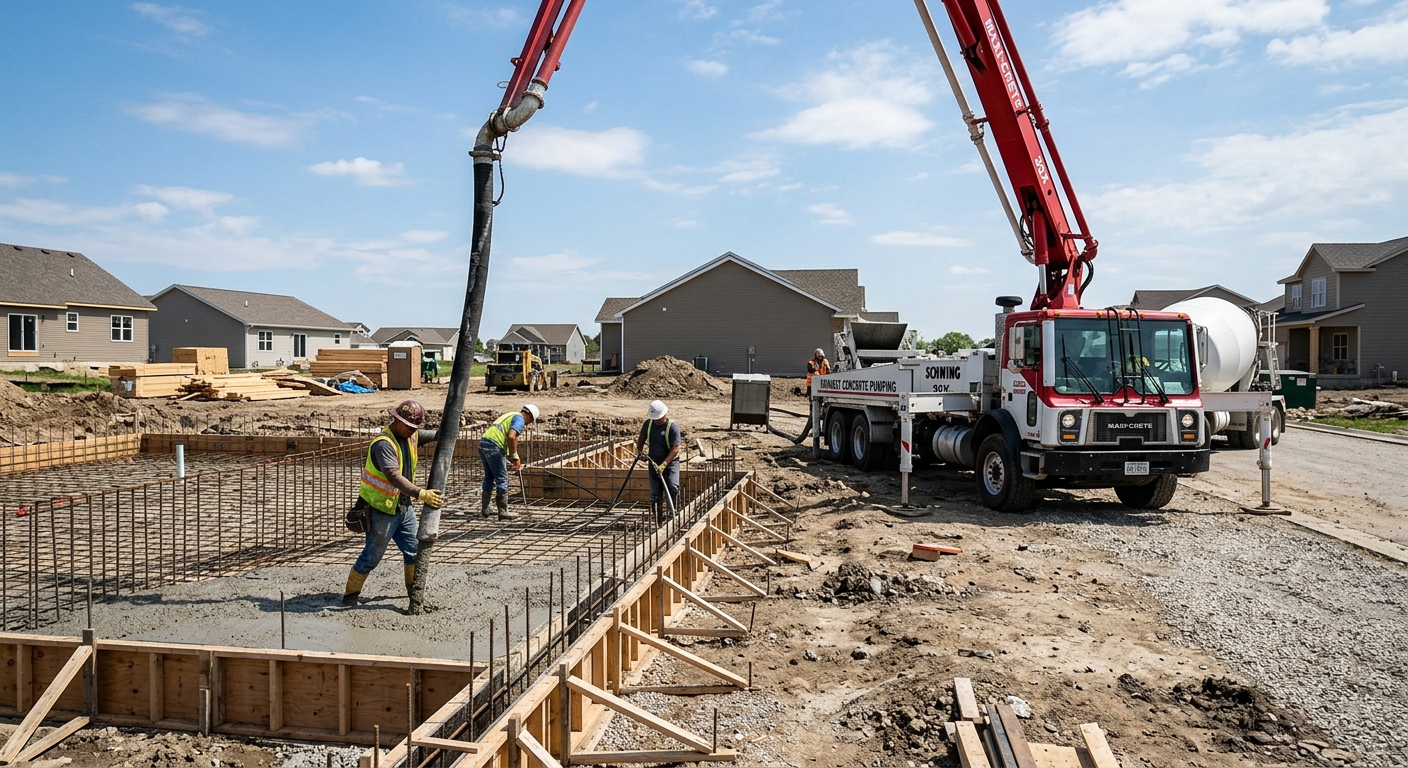
Concrete work options and costs in Ionview
Ionview homeowners usually start concrete conversations with three main projects: a driveway, a patio/walkway, and sometimes foundation work. With a population of 13,641 (Statistics Canada, 2021 Census), the area draws steady demand from owner-occupied households and ongoing home improvements. In a Toronto-area market where many properties are single-family homes—commonly with attached or detached garages—flatwork is one of the most visible upgrades, especially in neighbourhood pockets like the greener, family-oriented streets around the Ionview core.
In the Toronto economic region, pricing is shaped less by “concrete itself” and more by how much prep, depth, and protection the freeze–thaw cycle requires. Local building practice typically drives most structural footings to extend to at least about 1.2 m below grade (to reduce frost heave and differential movement). For exterior slabs, crews usually specify air-entrained concrete, adequate thickness, and correctly spaced control joints to manage cracking. Then there’s curing and protection: pours often shift to the warmer months to ensure the concrete reaches strength under damp, shoulder-season conditions. When temperatures trend toward 10 °C or below, contractors may add cold-weather measures (insulating blankets and/or temporary heating), which is a real cost driver.
Because contractors in the GTA are busiest during the reliable pour season, last-minute scheduling can also affect labour rates and availability. Below is a practical comparison of typical options and what you can expect to pay, before the final quote is adjusted for site access, removal/disposal, drainage work, and finish level.
| Application |
Typical Size |
Key Spec |
Finish Option |
Price Range |
| Concrete driveway (standard broom finish) |
10×20 ft (200 sq ft) |
4 in slab, compacted granular base, 1.2 m minimum footing depth when required by design |
Broom finish, light edge saw cuts/control joints |
$3,600–$5,600 |
| Exposed aggregate driveway |
10×20 ft (200 sq ft) |
Air-entrained mix, higher paste quality, proper cure and wash |
Exposed aggregate with consistent texture |
$4,500–$7,000 |
| Stamped concrete driveway or patio |
10×18 ft (180 sq ft) |
Air-entrained exterior mix, thicker sections for stamping durability |
Stamp + release, optional colour hardener |
$4,300–$7,200 |
| Plain concrete patio or walkway |
10×12 ft (120 sq ft) |
Compacted sub-base, proper drainage slope, air-entrainment for exterior |
Broom finish or hand-trowelled with light texture |
$1,900–$3,100 |
| Garage floor (interior slab) |
20×20 ft (400 sq ft) |
Concrete thickness and subgrade prep, vapour/ground moisture control as needed |
Light broom finish or steel trowel (if specified) |
$6,000–$10,000 |
| Foundation footings (structural, below frost) |
Approx. 40 linear ft (varies) |
Below-frost depth, formwork, rebar as required by engineer |
Structural concrete with engineered reinforcement |
$7,200–$12,000 |
Prices are estimates only and vary by project scope, site access and material selection.
What affects the price of concrete work in Ionview
In Ionview and across the Toronto economic region, two quotes for the “same” driveway can easily differ by 30% to 50% because contractors price the details that aren’t visible in a quick walk-through—site grading, drainage, removal, base thickness, reinforcement, concrete mix requirements, and how the crew protects curing in cold snaps. In Toronto’s housing market, labour and truck scheduling also follow the pour season; when crews are fully booked, timelines can change and costs can shift.
Everything starts with frost and freeze–thaw. Local specs generally require exterior slabs and structural elements to accommodate Ontario frost depth—footings must extend below the design frost depth (often cited around 1.5–2.4 m in Ontario depending on soils and design) to help prevent frost heave and movement. For flatwork that gets saturated and salted in winter, air-entrained concrete is typically expected so the freeze–thaw cycle doesn’t destroy the surface. When temperatures drop toward 10 °C or below, contractors add cold-weather curing precautions (insulating blankets, heaters, or longer protection), which increases labour and materials. De-icing salt can also accelerate spalling if the mix or finishing isn’t right—so sealing becomes more than “nice to have.”
Here are a few Ionview examples that move the number: (1) If your driveway area has poor drainage and needs re-grading plus a thicker granular base, your cost climbs—often aligning with the higher end of the $18–$28 per sq ft band for driveways when added prep is required. (2) If you want stamped or exposed finishes, you’re paying for additional finishing labour and materials; that’s why stamped work often lands in the $24–$40 decorative band instead of broom-finish pricing. (3) Older lots may have unstable fill—extra excavation and haul-off can add thousands, even if the final slab size is the same.
| Price Factor |
Why It Matters |
Cost Impact |
| Frost line depth — determines footing depth and form height |
Deeper footings reduce frost heave and settlement risk in freeze–thaw cycles |
Can add significant excavation/formwork cost; frequently a major driver for structural work |
| Site preparation — excavation, grading, compacted granular base |
Subgrade failure leads to settlement and cracking even with good concrete |
Heavy impact when soils are wet/soft, or when regrading and haul-off are needed |
| Reinforcement — rebar or wire mesh requirement |
Controls cracking and improves load performance where specified |
Moderate-to-high impact depending on quantity, tying labour, and support chairs |
| Mix design — air-entrainment and compressive strength spec |
Air entrainment is critical for exterior freeze–thaw durability |
Often modest per yard, but can be a meaningful cost multiplier when specialty mixes are required |
| Finish type — broom vs. stamped vs. exposed aggregate |
Complex finishing requires more labour, materials, and careful curing timing |
Higher end of the driveway/patio bands for decorative finishes |
| Pour size and concrete truck access to site |
Truck distance and access affect labour for pumping/hoses and staging |
Can noticeably raise cost on tight lots or long carry distances |
| Cold-weather curing precautions — heating and blankets |
Protects early-age strength gain when temperatures drop |
Higher labour and equipment rental; cost increases if pour extends into cooler periods |
| Control joint pattern and sealing cost |
Proper jointing reduces random cracking; sealing helps repel salts and moisture |
Usually a smaller line item individually, but skipping it can lead to premature deterioration |
Permits & regulations in Ontario
In Ontario, structural concrete work typically needs a building permit and is often tied to engineered drawings reviewed by the municipality. That includes concrete foundations such as footings, foundation walls, grade beams, and any structural slabs that form part of the load-bearing system. If your scope involves demolition and rebuilding of foundation elements, assume permits and inspections are part of the process.
Concrete flatwork—like patios, walkways, driveways, and garage slabs—usually does not require a permit by default. However, you should expect permit checks if the work affects lot grading, changes drainage patterns, impacts impervious surface coverage limits, or encroaches on municipal right-of-way (for example, work near the curb or sidewalk area). The safest approach is to confirm requirements with the local authority before breaking ground, especially if you’re changing elevations or adding new drainage features.
For contractor verification in Ionview, Ontario, don’t just ask for a licence number—verify it and confirm insurance documents are current. Step-by-step: (1) Request the contractor’s business details and proof of liability insurance; review the certificate of insurance for limits and effective dates. (2) Ask for WSIB/WCB clearance (or equivalent proof of coverage) and verify it’s active and matches the legal entity doing the work. (3) Confirm they can produce relevant documentation for the specific scope (structural vs flatwork), including their permit responsibilities when required. (4) Ask for references on similar-scale projects with comparable access and finishes.
If anything can’t be provided quickly and clearly, it’s a red flag—concrete failures are expensive, and documentation matters when there’s an issue.
Getting concrete right in Ionview's freeze-thaw climate
The biggest concrete failures in Ionview come from water and freeze–thaw working together: weak or poorly prepared bases allow settlement, inadequate air-entrainment leaves the concrete vulnerable, and poor curing can stop strength gain before winter conditions stress the surface. In practice, the right spec is a chain—base prep, correct mix, joints, curing, and sealing—because skipping one link can lead to surface scaling, spalling, and random cracking.
Start with base preparation: the sub-base needs to be compacted granular material to the right depth for your soil and intended load, with drainage slopes that keep water moving away from the slab. Next is the mix design. For exterior flatwork in Ontario, air-entrainment is typically targeted at about 5–7% air content to survive freeze–thaw cycling, paired with a minimum 32 MPa compressive strength spec for good performance. Then control joints: they should be laid out to limit random cracking—don’t leave it to “whatever looks good.” After the pour, curing matters. Plan for at least 7 days of curing under proper conditions; in cooler weather, protection (blankets/heating) helps prevent early-age damage.
Finally, sealing: use a penetrating sealer applied after the concrete cure window (commonly 28 days post-pour for best results) to repel moisture and reduce the impact of de-icing salt. When homeowners ask, “Do I really need sealing on a new driveway?” the answer is usually yes for Ionview winters.
On cost: choosing decorative finishes can be justified, but pay attention to what you’re not compromising. For example, moving from a standard broom driveway toward stamped concrete can add cost within the $24–$40 decorative band—worth it for look and value—but the base and air-entrained mix should stay the same. If a quote cuts corners on air entrainment to “fit the budget,” you may spend again sooner than expected.
| Spec |
Why It Matters in Ionview |
What to Ask For |
Impact if Skipped |
| Compacted granular base (depth?) |
Prevents settlement and pumping during wet spring/fall freeze–thaw cycles |
Specify base depth by load and soil, and confirm compaction testing where applicable |
Cracking, edge failure, and uneven surface |
| Air-entrained concrete mix (target air %?) |
Helps resist freeze–thaw damage and reduces risk of spalling |
Ask for air content target of about 5–7% for exterior flatwork |
Scaling/spalling during winter weather |
| Compressive strength (MPa rating) |
Ensures durability and adequate early/long-term performance |
Confirm minimum 32 MPa rating (and test method if discussed) |
Reduced strength gain and faster surface wear |
| Control joints (spacing per ACI guidelines) |
Controls where cracks form instead of random cracking |
Ask for joint layout/spacing plan and sawcut timing |
Random cracking and appearance failures |
| Minimum 7-day curing period |
Protects early-age strength in humid and cooler periods |
Confirm curing plan, protection method, and temperature expectations |
Surface weakness, curling, and early deterioration |
| Penetrating sealer (when applied after cure) |
Repels moisture and helps manage de-icing salt exposure |
Ask about penetrating sealer and application timing (commonly after full cure, e.g., around 28 days) |
Faster water uptake and salt-related surface damage |
How to choose a concrete work contractor in Ionview
Choosing a contractor in Ionview is mostly about verifying proof, then comparing scopes line-by-line. First, confirm Ontario licensing where applicable for the work type (especially for structural/permit-driven scopes). Next, verify liability insurance: request a current certificate of insurance and make sure it names the correct legal entity and covers the work activities. Then check WSIB/WCB coverage—ask for a clearance letter or proof that matches the contractor’s business. If the contractor can’t provide these documents promptly, it’s not a “small delay” issue; it’s a risk issue.
Get 2–3 itemised written quotes rather than lump sums. You want labour and materials separated: concrete supply, aggregate/base materials, rebar/wire mesh, formwork, sawcut/jointing work, sealing, protection, and disposal/removal. Ask whether a permit pull (if required) is included, and whether haul-away and dump fees are included for demolition. For warranties, ask for the workmanship warranty length in writing, plus the manufacturer/product warranty details where relevant (for sealers, additives, and decorative systems). Clarify whether warranties are transferable if you sell the home.
For payments, avoid large upfront deposits: keep deposits around 10–15% and use a holdback until completion and cleanup. Get a start date and realistic completion estimate in writing, including contingencies for weather and curing protection—crucial in Ontario’s shoulder seasons.
- Provide scope as a written plan: slab sizes, thickness, base depth, drainage slopes.
- Confirm the mix spec: air-entrainment and minimum compressive strength.
- Ask for reinforcement details: rebar/wire mesh, tie spacing, and supports/chairs.
- Require a joint plan: layout, spacing, and sawcut timing.
- Confirm curing and protection approach for cooler nights and wet conditions.
- Clarify sealing: product type and when it’s applied after cure.
- Include removal/disposal: old concrete breaking, haul-away, and grading restoration.
- State site access assumptions: whether pumping/hoses are included.
- Use itemised pricing for decorative finishes (stamped/exposed aggregate) versus standard broom.
- Check insurance and WSIB/WCB clearance before signing.
- Request references on similar projects near the Toronto market (flatwork and/or structural).
- Get timeline and weather contingency terms in writing.
Concrete contractor red flags in Ionview: vague scope (“we’ll pour what fits”), no air-entrainment confirmation for exterior work, unclear joint and sealing plans, refusal to provide insurance/WSIB documentation, and quotes that jump straight to decorative finishes without addressing base depth and drainage.
Frequently asked questions — concrete work in Ionview
How do I compare concrete quotes?
To compare concrete quotes in Ionview, ask for the same scope details in writing: slab thickness, compacted base depth, drainage slope, reinforcement (if any), concrete mix spec (air-entrainment for exterior), joint layout, curing protection plan, and whether sealing is included. A driveway quote can look “close” until you notice one contractor assumed poor subgrade repair or didn’t include haul-away/disposal. Also check finish inclusions: stamped/exposed aggregate should specify colour hardener/release and curing/sealing timing. If you’re seeing big gaps, remember Toronto-area freeze–thaw drives requirements; cutting corners on base prep or using the wrong mix is a common way quotes get cheaper. For reference, broom-finish driveways typically land around $18–$28, while stamped decorative work often sits higher within the $24–$40 decorative band.
Can concrete be poured in cold weather in Ionview?
Yes, concrete can be poured in cold weather in Ontario, but it’s not “pour whenever.” In the Ionview/Toronto area, crews generally avoid long exposure to temperatures near freezing during the early cure stage unless they add cold-weather protection. That typically means insulating blankets and/or temporary heating to keep the concrete warm enough for strength gain, plus a tighter plan for cure time and protection duration. The key is early-age temperature control: if the concrete is stressed before it reaches adequate strength, you can see surface scaling, weakened durability, and higher risk of cracking. If the job is close to winter, ask your contractor what temperature range they will protect against and how long they will maintain curing conditions.
How do I maintain concrete in Ionview's freeze-thaw climate?
Maintenance in Ionview is mostly about controlling water and managing salt. Keep surfaces clean so grit and debris don’t hold moisture against the concrete. Use de-icing methods carefully: while salt is common, excessive or constant application can worsen spalling if the concrete wasn’t correctly air-entrained and sealed. That’s why a penetrating sealer applied after full cure (commonly around 28 days) is valuable for exterior flatwork. Recheck expansion/control joint areas: if joints start to separate or lose sealant, water can migrate underneath and undermine the slab. Plan for simple resealing cycles based on the product and local exposure, and address small cracks early so freeze–thaw doesn’t widen them.
What causes concrete to spall in Ionview winters?
Spalling in Ionview winters usually comes from a combination of water ingress and freeze–thaw stress—plus the wrong mix or insufficient curing. The big technical culprit is inadequate air-entrainment. Without the proper air void system (often targeted around 5–7% for exterior flatwork), water that enters the paste can freeze and expand, breaking the surface during repeat cold cycles. Base and drainage issues contribute too: if water pools against the slab due to poor slope or inadequate granular base, freeze–thaw damage accelerates. De-icing salt can amplify surface deterioration. Finally, rushing early curing—especially when temperatures drop toward 10 °C or below—reduces durability. That’s why you should insist on air-entrained mix and a proper curing/protection plan in your quote.
What is rebar and when is it required in Ontario?
Rebar is reinforcing steel bars placed inside concrete to improve strength and reduce cracking under load and movement. In Ontario, whether rebar is required depends on the structural design, the load conditions, and what an engineered drawing specifies—especially for structural foundations and grade beams. For typical exterior flatwork like driveways and patios, some designs use wire mesh or rebar while others rely on thickness, joints, and base prep; the decision is influenced by soil conditions and expected vehicle loads. The important homeowner takeaway is to ask your contractor to state the reinforcement strategy in the written scope, including rebar size/spacing or mesh type, and to explain whether it’s required by engineering. If it’s a permit/engineered foundation scope, assume reinforcement is not optional.
How long does a concrete project take in Ionview?
Timelines in Ionview are usually driven by curing and weather windows more than by “casting time.” A small patio or walkway can take a couple of days on site (demolition/removal, base prep, pour, finishing), but it won’t be fully “usable” immediately. Many contractors schedule handover after finishing and initial curing, while proper durability depends on the concrete reaching strength over time—especially around colder periods. Driveways generally take longer due to base/grading, potential reinforcement, and full finishing/sealing steps. If you’re pouring in a cooler stretch, curing protection might extend the effective work window because blankets/heating may be needed for at least 7 days or as specified by conditions and mix requirements. For planning, ask for a start date and completion estimate in writing, including weather contingencies.