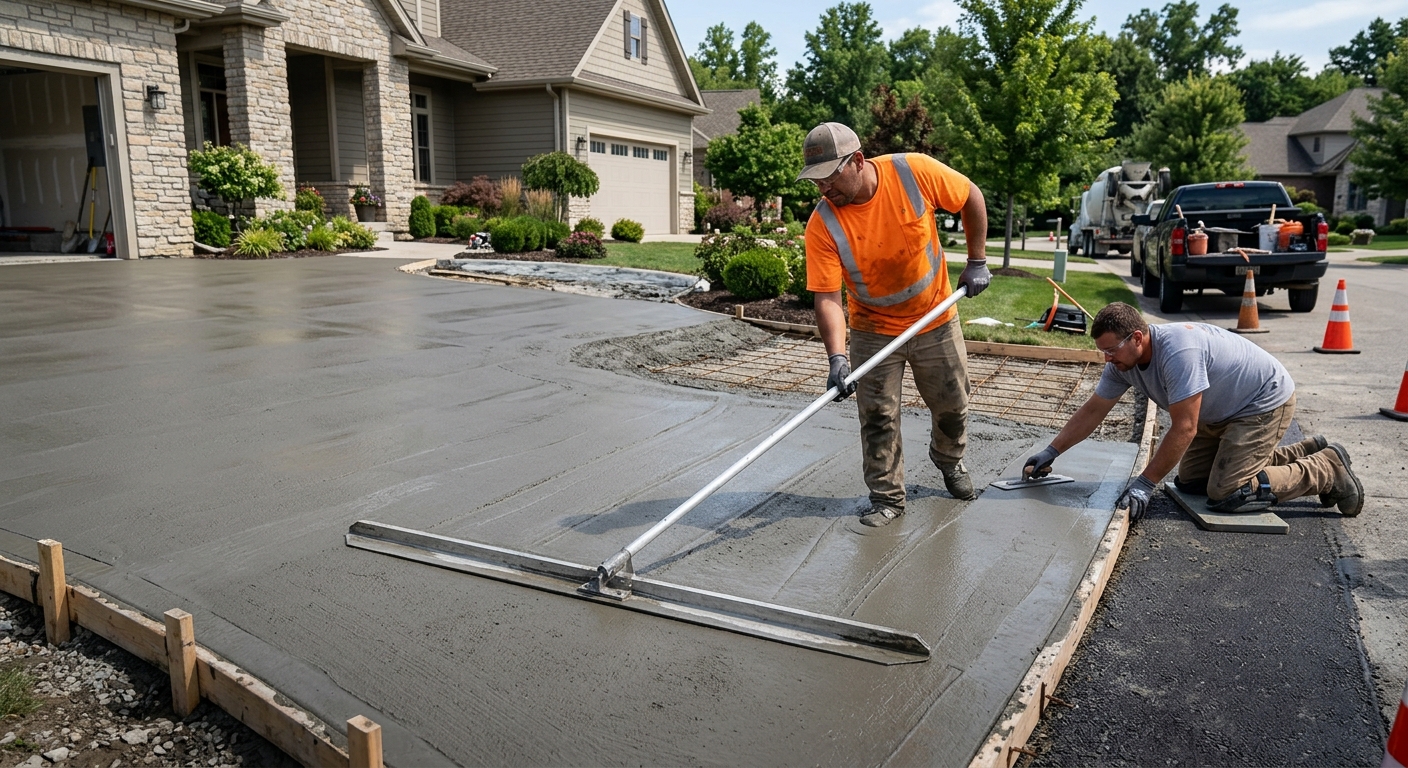
Concrete work options and costs in Vaughan
Concrete contractors in Vaughan are busy year-round, and the options range from simple broom-finished driveways to higher-end decorative work. Vaughan’s housing mix matters: single-detached homes make up about 62.5% of dwellings, so exterior concrete flatwork—driveways, patios, walkways, and stoops—is a constant demand. With 89,290 homeowner households (85.9% of households owning), many projects are part upgrades and part “refresh,” especially for older properties where concrete renewal is common (7.6% of homes were built before 1981).
In the Toronto economic region, concrete pricing is strongly influenced by frost depth, freeze–thaw cycles, and how well the contractor manages curing. Local specs typically call for structural footings to extend at least about 1.2 m below grade to limit frost heave and differential movement. On exterior slabs, contractors usually use air-entrained concrete, adequate thickness, and properly spaced control joints because GTA winters can be brutal on poorly detailed flatwork. Pours are also concentrated in the warmer months to maintain curing performance—when temperatures drop toward 10 °C or below, protection and longer cure management add cost and coordination time. This is why two quotes for the “same size driveway” can differ, especially if one contractor is planning for deeper base, reinforcement, or cold-weather protection.
In Vaughan, areas like Maple (near major commuter routes) and the Patterson–Vaughan corridor often see higher demand because of frequent rebuilds, landscaping refreshes, and garage/basement updates that tie into new exterior flatwork. Below is a practical comparison table to help you line up budget expectations before you request itemised quotes.
| Application |
Typical Size |
Key Spec |
Finish Option |
Price Range |
| Concrete driveway (standard broom finish) |
400–600 sq. ft. |
Typical 4 in. slab + compacted granular base |
Broom finish, perimeter forms |
$8,000–$13,500 |
| Exposed aggregate driveway |
400–600 sq. ft. |
Well-graded base + controlled surface wash |
Exposed aggregate finish |
$12,000–$18,000 |
| Stamped concrete driveway or patio |
300–500 sq. ft. |
Air-entrained exterior mix + proper jointing |
Stamped pattern with sealer |
$9,000–$20,000 |
| Plain concrete patio or walkway |
150–300 sq. ft. |
Minimum 4 in. thickness on compacted base |
Broom/float finish |
$2,500–$7,500 |
| Garage floor (interior slab) |
300–600 sq. ft. |
Vapour barrier + proper sub-base compacting |
Float finish |
$7,500–$16,500 |
| Foundation footings (structural, below frost) |
Varies (typically per linear ft.) |
Below frost depth; forms, rebar, inspection-ready |
Structural concrete |
$180–$300 |
Prices are estimates only and vary by project scope, site access and material selection.
What affects the price of concrete work in Vaughan
In Vaughan and across the Toronto economic region, the same “driveway size” can land 30–50% apart between bids. The difference is usually not the concrete itself—it’s the foundation work beneath it, the mix spec, and how the contractor schedules and protects curing. Because Vaughan sits in a freeze–thaw climate, frost depth and winter temperature swings dictate structural details. Exterior slabs and walkways are expected to be built on well-compacted granular base and to use air-entrained concrete to manage expansion/contraction through repeated freeze–thaw cycles. Structural footings must extend below the design frost depth (Ontario commonly requires at least 1.2 m), otherwise you risk frost heave and uneven settlement that shows up as cracks, misaligned edges, and drainage issues.
Contractor availability also affects cost: the reliable pour season is shorter when temperatures approach 10 °C or below, and cold-weather curing precautions (insulating blankets, heating where needed, extended protection) add labour, equipment, and scheduling time. De-icing salt accelerates surface wear and can contribute to spalling if the mix and finishing aren’t suited to winter exposure—so sealing and correct curing timing become part of a durable long-term spec.
Here are a few real Vaughan examples where costs move up or down. If your existing driveway needs full removal and haul-away, you’ll typically pay more in excavation and disposal than a simple overlay. Homes built before 1981 are more likely to have older grading patterns or drainage issues that force rework of base depth and slopes, which can change your final number. If you choose stamped or exposed aggregate, the finish package adds forms, labour time, and material for colouring and sealing—often pushing you from “standard driveway” pricing closer to the stamped & decorative band (for example, stamped projects commonly sit around $24–$40 per sq. ft. in this market). On the other hand, a straightforward broom-finished patio on stable soil with easy truck access can stay nearer the plain concrete band.
| Price Factor |
Why It Matters |
Cost Impact |
| Frost line depth — determines footing depth and form height |
Deeper excavation increases labour, shoring considerations and concrete volume |
High (can add significant form and excavation time) |
| Site preparation — excavation, grading, compacted granular base |
Base quality controls settlement and prevents water from undermining slabs |
High to medium (varies with soil and access) |
| Reinforcement — rebar or wire mesh requirement |
Helps control cracking on flatwork and structural elements |
Medium (material + labour) |
| Mix design — air-entrainment and compressive strength spec |
Exterior freeze–thaw survival depends on air content and strength |
Medium (higher spec mix can cost more) |
| Finish type — broom vs. stamped vs. exposed aggregate |
Decorative work adds colour hardener, stamping/washing, labour and sealing |
Medium to high |
| Pour size and concrete truck access to site |
Shorter runs and easier access reduce waiting time, pump costs and labour |
Medium (can swing quickly) |
| Cold-weather curing precautions — heating and blankets |
Cold pours need protection for proper hydration and strength gain |
Low to high depending on timing |
| Control joint pattern and sealing cost |
Joints manage cracking; sealing protects from salt and moisture intrusion |
Low to medium |
Permits & regulations in Ontario
In Ontario, most structural concrete work needs a building permit and often engineered drawings that the municipality reviews. That includes foundation walls, grade beams, and other load-bearing elements such as footings where structural capacity matters. For Vaughan homeowners, the key point is that if the concrete is part of the house’s structure or affects the load path, plan on permits and inspections.
Concrete flatwork—patios, walkways, driveways—often does not require a permit. However, it can require review if the work changes lot grading, modifies drainage in a way that impacts neighbours or municipal requirements, or increases impervious surface coverage beyond what your lot conditions allow. If your project involves moving downspouts, altering slopes toward a protected area, or connecting to existing drainage infrastructure, confirm with the local authority before you break ground.
Before the first pour, verify the contractor carries proper liability insurance and has WSIB/WCB coverage (or the equivalent clearance documentation, depending on their operating structure). Then ask for references on similar-scale concrete work in Vaughan—ideally projects with air-entrained exterior flatwork and documented curing/sealing practices.
Step-by-step verification you can do:
- Check the contractor’s Ontario licence/registration status through provincial resources (availability depends on business type).
- Ask for a current certificate of insurance naming you as the certificate holder (if offered) or at least showing active coverage.
- Request WSIB/WCB clearance (or proof) and confirm it matches the company you’re hiring.
- Verify the scope matches the quote—especially footing depth, base thickness, reinforcement, and sealing timing.
- Confirm permit responsibility in the written contract (who pulls it and what’s included).
Getting concrete right in Vaughan's freeze-thaw climate
Concrete fails in Vaughan when the slab or footing isn’t detailed for moisture and freeze–thaw movement. The most common problems are premature cracking, edge deterioration, and spalling—usually tied to inadequate base preparation, poor drainage, and (most importantly) insufficient air-entrainment. To spec the job correctly, start with the base. For exterior slabs, it’s not enough to “pour over whatever is there.” You need properly excavated and graded sub-base and compaction to the right depth for your soil and the local freeze environment.
Next is the mix. Exterior work should use air-entrained concrete—typically targeting about 5–7% air content for freeze–thaw exposure—and a minimum 32 MPa compressive strength so the slab can perform through winter loads and thermal cycling. Then control cracking with a proper joint layout. Control joints are placed to encourage cracking in the right locations rather than randomly. Curing matters just as much: plan for at least 7 days of proper curing under favourable conditions, and use cold-weather protection if temperatures drop. Finally, sealing is your winter shield. A penetrating sealer is generally applied after the concrete has cured (commonly after 28 days) to repel de-icing salt and reduce water uptake.
Ask pointed questions to avoid spalling. For example: “What air content are you targeting for this exterior pour?” and “How are you protecting the slab during cure if night temperatures fall?”
Price-wise, some options are worth paying for. If you’re comparing a standard driveway to stamped concrete, the premium often pays for extra finishing labour and materials plus better sealing expectations. But if the base prep is cut to save money, even a decorative finish won’t last. One practical example: a plain patio in the market may land in the $16–$26 per sq. ft. band, while stamped work can move into the $24–$40 per sq. ft. range—however, the extra cost is only justified if reinforcement, jointing, and sealing are also specified and executed correctly.
| Spec |
Why It Matters in Vaughan |
What to Ask For |
Impact if Skipped |
| Compacted granular base (depth?) |
Prevents settlement and reduces water saturation before freeze–thaw |
Confirm excavation depth, granular type, and compaction requirements |
Early cracking, pumping, sinking edges |
| Air-entrained concrete mix (target air %?) |
Reduces damage risk from freeze–thaw cycling |
Ask for target air content (commonly 5–7% for exterior flatwork) |
Spalling and surface scaling in winter |
| Compressive strength (MPa rating) |
Ensures durability and strength gain for service life |
Confirm minimum 32 MPa for the mix used |
Soft surface, wear-through, reduced structural performance |
| Control joints (spacing per ACI guidelines) |
Controls where cracks form during temperature changes |
Ask for joint spacing plan and contraction joint depth |
Random cracking and cosmetically uneven slabs |
| Minimum 7-day curing period |
Hydration and strength development depend on cure conditions |
Clarify curing method and any cold-weather protection plan |
Reduced strength, surface weakness, scaling |
| Penetrating sealer (when applied after cure) |
Improves salt and moisture resistance during winters |
Confirm sealer type and timing (commonly after 28 days) |
Faster deterioration from de-icing salts and water ingress |
How to choose a concrete work contractor in Vaughan
Choosing the right Vaughan contractor starts with verification. First, confirm licensing/registration status for Ontario for the legal entity doing the work. Next, ask for proof of liability insurance (active coverage for property damage and bodily injury) and ensure the policy amount is reasonable for concrete projects. Then request WSIB/WCB clearance or proof of coverage. If a contractor can’t supply these documents quickly, treat that as a red flag—concrete incidents are expensive, and you don’t want the risk on your homeowners’ insurance.
From there, get 2–3 written, itemised quotes rather than lump sums. A good quote breaks down labour and materials (excavation, base, forms, reinforcement, concrete supply, pump if required, finishing, joints, and sealing). Review what’s excluded: disposal/haul-away, concrete grinding, saw-cutting, permit assistance, traffic control, protection during curing, and any site restoration like sod replacement.
Warranty is part of the “spec,” not an afterthought. Ask for a workmanship warranty length and whether it’s tied to the finish and sealing plan you’re paying for. Also ask about manufacturer/product warranty and whether it’s transferable if you sell the home.
Payment schedule matters. Avoid paying more than 10–15% upfront. Use a holdback until the final items—especially sealing and any patching/cleanup—are complete. Get a start date and completion estimate in writing, plus what happens if weather forces a reschedule; in Vaughan, curing protection can change timelines.
- Provide a detailed scope with footing/slab thickness, base thickness, and compaction expectations.
- Include concrete mix details: air-entrainment and minimum strength spec (e.g., 32 MPa).
- Show the reinforcement plan (rebar/mesh location and coverage) for slabs that need it.
- Confirm control joint layout and saw-cut timing.
- Clarify curing method and protection plan if nights are cold.
- List whether sealing is included and the application timing (often after cure, around 28 days).
- State disposal/haul-away included or billed separately.
- Note any restoration allowances (topsoil, sod, stone, edging).
- Check for clear site access and equipment plan (truck/pump/boom details).
- Ask about barricades, cleanup, and protection of landscaping and windows.
- Verify insurance and WSIB/WCB documents before signing.
- Request references for freeze–thaw exterior flatwork done in the past 12–24 months.
Concrete red flags in Vaughan: contractors who won’t specify air-entrainment, who skip or downplay control joints, who cut base prep to “save time,” who quote only in a per-sq-ft number without thickness/base details, and who ask for large upfront payments (beyond ~10–15%).
Frequently asked questions — concrete work in Vaughan
How do I prepare the base for a concrete slab?
For Vaughan patios, walkways, and driveways, base preparation is where durability starts. A proper base usually means removing topsoil/soft material, grading to slope requirements, then installing compacted granular sub-base to the design depth for your soil and intended load. Because of Ontario’s freeze–thaw cycles, the goal is to keep the foundation stable and prevent water from saturating underneath the slab. Ask your contractor to explain compaction testing (or at least compaction procedures), granular type, and how they plan drainage around the edges. If your property has older drainage patterns (common in housing stock built before 1981), base and grading rework can be the difference between a slab that lasts and one that cracks early. A driveway replacement commonly ends up in the $18–$28 per sq. ft. market expectation when base and thickness are done properly.
How do I compare concrete quotes?
When comparing quotes in Vaughan, don’t compare only the total price or only a per-sq-ft number. For exterior concrete, the “same” job can differ in slab thickness, base depth, reinforcement, air-entrainment, and finishing details. Ask each contractor to list: concrete mix spec (including air-entrainment for freeze–thaw), minimum compressive strength (commonly 32 MPa), base and compaction, control joint spacing and timing, and whether sealing is included (often applied after the concrete cures, around 28 days). Also confirm inclusions: excavation limits, disposal/haul-away, saw-cutting, and protection during curing if nights are cold. If one contractor’s quote is materially cheaper, look for missing items like proper joints or reduced base prep. Decorative choices matter too—stamped work typically costs more and can fall in the $24–$40 per sq. ft. range, but only if the underlying specs match.
Can concrete be poured in cold weather in Vaughan?
Yes, concrete can be poured in cold weather in Vaughan, but it must be managed correctly. The risk isn’t just the day of the pour—it’s curing performance when temperatures drop toward 10 °C or below. Contractors typically use cold-weather protection such as insulated blankets, heaters, and wind protection to maintain temperature long enough for proper hydration and strength gain. Ask for the contractor’s written cold-weather plan: how they monitor slab temperature, how long protection will be provided, and whether materials and curing meet the mix requirements. If protection isn’t planned, you can end up with weak surfaces that scale or crack sooner, especially after Ontario’s winters and de-icing salt exposure.
How do I maintain concrete in Vaughan's freeze-thaw climate?
Maintenance is mostly about keeping water and salt from attacking the surface. In Vaughan, sweep off debris regularly to prevent trapped moisture. After winter, clean with gentle methods—avoid harsh chemical treatments that could damage sealers. The single best step homeowners can take is sealing: many contractors apply a penetrating sealer after the concrete has cured (often around 28 days) to repel de-icing salts and reduce water uptake. Re-check high-traffic and high-salt zones (driveway edges, steps, and entry walkways) every couple of years and plan resealing when water stops beading. If you have early staining around joints, don’t ignore it—joint lines are where moisture tends to collect, and that can feed freeze–thaw stresses. Well-maintained flatwork built with air-entrained mixes and proper joints tends to hold up far better through Ontario winters.
What causes concrete to spall in Vaughan winters?
Spalling—surface scaling or flaking—usually comes from freeze–thaw damage and moisture intrusion, and in Vaughan the most common root cause is insufficient air-entrainment for exterior exposure. Air-entrained concrete creates microscopic space in the mix to let freezing water expand safely. If the contractor uses a mix without the right air content or skips proper cold-weather practices, water gets into pores and freezes, weakening the surface. Another frequent contributor is poor base drainage or saturated sub-base, which keeps moisture working under the slab. De-icing salts then accelerate surface wear, especially when sealing and curing timing aren’t handled correctly. That’s why a “cheap” exterior mix or missing spec detail can show up as spalling after one or two winters. If you’re replacing a driveway, it’s normal to budget for air-entrained exterior concrete and sealing; in this market, even plain exterior pours often sit around the $16–$26 per sq. ft. band depending on scope.
What is rebar and when is it required in Ontario?
Rebar is steel reinforcement placed inside concrete to help resist tensile stresses and control cracking. In Ontario, whether rebar is required depends on the engineered design and the type of concrete element. For structural concrete like foundation footings and grade beams, reinforcement is typically part of the engineered system. For exterior slabs and garage floors, reinforcement may be required based on slab thickness, soil conditions, and whether the slab is designed to carry point loads (like vehicle traffic). Even when wire mesh is used, the placement, coverage, and bar spacing matter—just “tossing mesh on the ground” won’t perform. In Vaughan’s freeze–thaw environment, reinforcement works with control joints and a proper air-entrained mix to manage cracking patterns so the slab can survive winter movement. Always ask for the reinforcement plan in writing so you know whether you’re getting rebar, mesh, or both.