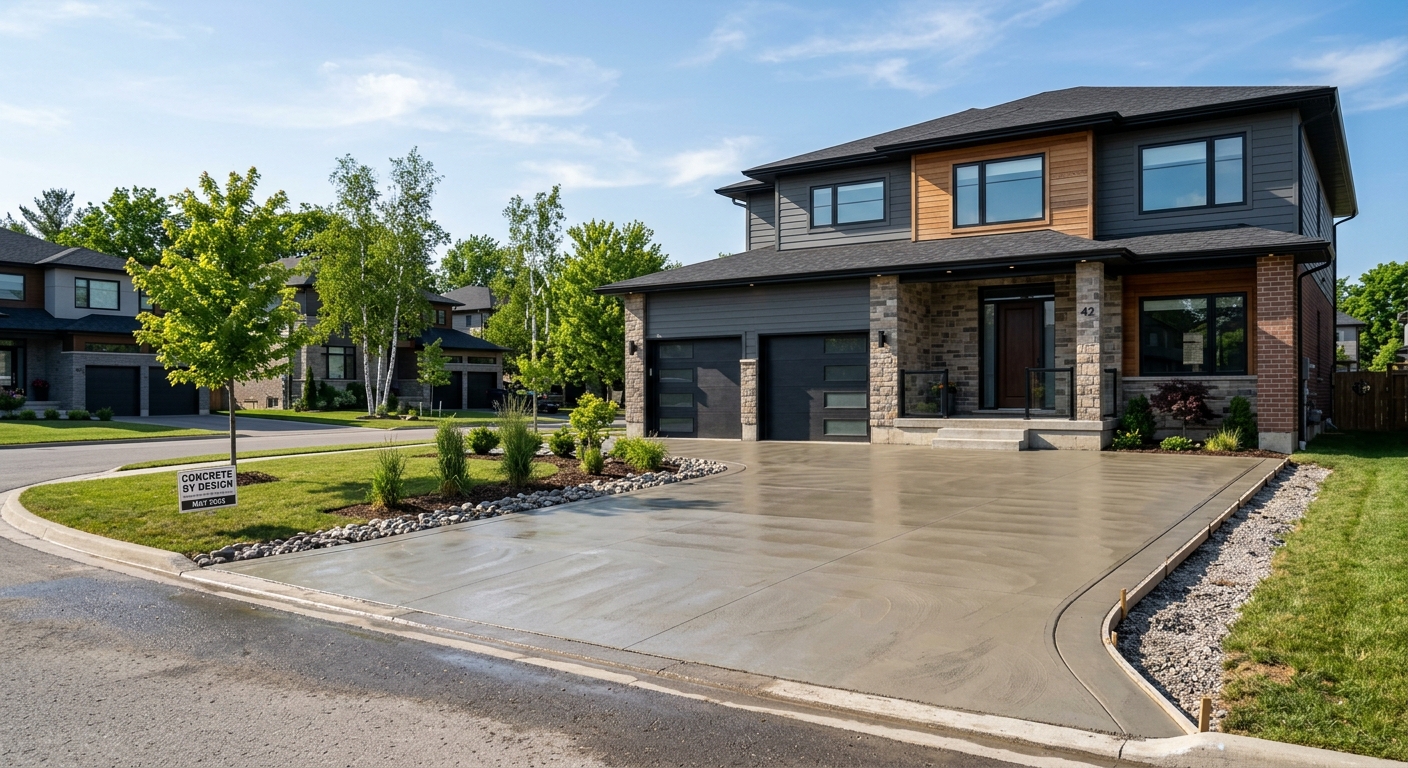
Concrete work options and costs in Timmins
Timmins homeowners rely on concrete year-round, from winter-ready driveways to low-maintenance patios and stable garage floors. In 2021, Timmins had 41,145 residents and 11,975 homeowner households, and about 67.0% of households own their homes (Statistics Canada, 2021 Census). That matters because single-detached housing makes up 65.1% of dwellings—this is the primary market for concrete flatwork like driveways, walkways, garage slabs, and patios.
Concrete pricing in Timmins is shaped by Northeast Ontario’s harsh freeze–thaw conditions. Even though Timmins isn’t as deep-freeze as parts of Northeast British Columbia, the recurring winter temperature swings still demand proper base prep, air-entrained mixes, and a tight plan for curing protection. Concrete also has a short “good-weather” window for outdoor flatwork, so labour scheduling can tighten in spring and early summer. On top of that, most work is done on older lots—71.7% of homes in Timmins were built before 1981 (Statistics Canada, 2021 Census)—which often means mature landscaping, limited access for concrete trucks, and more excavation around existing steps, sidewalks, or aged drainage.
In town, demand tends to run steady in established neighbourhoods like Haileybury Road and the older central areas where driveway replacements and small patio work are frequent. With those realities in mind, the table below gives a realistic look at typical sizes and cost ranges so you can compare apples to apples before you request quotes.
| Application |
Typical Size |
Key Spec |
Finish Option |
Price Range |
| Concrete driveway (standard broom finish) |
400–600 sq. ft. |
4 in. slab, 6 mil poly vapour barrier where appropriate, air-entrained mix |
Broom finish |
$7,200 – $13,500 |
| Exposed aggregate driveway |
400–600 sq. ft. |
Air-entrained concrete; approved aggregate exposure timing |
Exposed aggregate |
$9,000 – $16,000 |
| Stamped concrete driveway or patio |
250–500 sq. ft. |
Air-entrained mix, colour hardener, release agent, seal-ready surface |
Stamped pattern (2-colour typical) |
$7,000 – $18,000 |
| Plain concrete patio or walkway |
200–450 sq. ft. |
4 in. slab, granular base, air-entrained concrete |
Smooth or light broom |
$3,000 – $9,000 |
| Garage floor (interior slab) |
500–700 sq. ft. |
4–5 in. slab, vapour barrier, wire mesh or rebar where required |
Float and trowel, light broom |
$5,500 – $12,500 |
| Foundation footings (structural, below frost) |
Typical new build/major repair |
Engineered structural concrete, reinforced footings below design frost depth |
Structural finish (no decorative finish) |
$6,000 – $22,000 |
Prices are estimates only and vary by project scope, site access and material selection.
What affects the price of concrete work in Timmins
Even when two contractors look at the same driveway footprint, quotes in the Northeast Ontario/Timmins area can vary by 30–50% because concrete isn’t “just pouring.” The biggest swing is usually what’s included in the foundation/base system, reinforcement, and the cold-weather handling plan—specs that directly affect how long the slab holds up through repeated winter cycles. For homeowners, the end result is that one quote may assume easier excavation and minimal drainage work, while another includes more base depth, better sub-drainage, and thicker/reinforced sections.
Frost and freeze–thaw drive every key decision: exterior slabs must be built on a properly prepared granular base and, where applicable, footings must extend below the design frost depth to prevent frost heave and slab movement. Concrete also needs an air-entrained mix for the freeze–thaw exposure. Cold-weather precautions matter too—protecting curing surfaces and controlling set time can add material and labour, especially if you’re scheduling outside the most favourable pour season. In Timmins, de-icing salt is another reality for driveways; without a durable surface and later sealing, spalling can accelerate.
Here are a few concrete examples that raise or lower cost in Timmins: (1) If your driveway ties into an older culvert or drains poorly, we often add granular base and improve drainage, which can push costs toward the higher end—around the mid-to-high band for standard broom work (for example, $18–$28 per sq. ft. is a common planning range). (2) Stamped and decorative work is usually priced higher than plain flatwork—your best comparison point is often the stamped band (commonly $25–$40 per sq. ft. depending on complexity), which is justified when the pattern, colour, and sealing system are all included. (3) If you have easy access for a concrete truck, you reduce labour and logistics costs; if you’re working around steep grades, narrow gates, or mature shrubs, expect more time for concrete handling.
| Price Factor |
Why It Matters |
Cost Impact |
| Frost line depth — determines footing depth and form height |
Deeper, frost-protected construction prevents heaving and cracking |
Higher excavation and concrete volume; typically shifts footing jobs to the upper band |
| Site preparation — excavation, grading, compacted granular base |
Bad base leads to settlement and edge failures |
Can add or reduce several thousand dollars depending on soil and access |
| Reinforcement — rebar or wire mesh requirement |
Controls cracking and improves slab/beam performance |
Material plus labour tie-in; small cost on paper, big value in durability |
| Mix design — air-entrainment and compressive strength spec |
Air voids and strength target reduce freeze–thaw damage |
May increase per-m³ concrete cost, but prevents premature scaling/spalling |
| Finish type — broom vs. stamped vs. exposed aggregate |
Surface method affects appearance and adds crew time |
Stamped/exposed typically moves you from driveway “standard” into decorative pricing |
| Pour size and concrete truck access to site |
Short pours may require more logistics; tight access increases handling time |
Limited access often adds labour and can increase concrete placement inefficiency |
| Cold-weather curing precautions — heating and blankets |
Early freezing weakens concrete and can ruin surface integrity |
Adds cost for insulation/blankets, monitoring, and sometimes admixtures |
| Control joint pattern and sealing cost |
Joints steer cracking and sealing protects against salt and moisture |
Sealing is often quoted separately; skipping it increases risk of early scaling |
Permits & regulations in Ontario
In Ontario, most structural concrete work needs the right approvals before you break ground. In Timmins, building permit requirements typically apply to structural elements such as foundation footings, foundation walls, and grade beams, especially where there are engineered design drawings that the municipality must review. Those components are part of the building’s structural system and can affect safety, drainage interfaces, and load paths.
Concrete flatwork—patios, walkways, and standard driveways—often does not require a permit by default. However, permits can be triggered if the work affects lot grading, changes stormwater/servicing flow, or conflicts with municipal requirements tied to impervious surface coverage, drainage, or right-of-way constraints. If you’re changing elevations, relocating steps, altering an entrance, or tying into existing municipal features, confirm first.
To protect yourself as a homeowner in Timmins, verify the contractor’s insurance and compliance in a simple sequence. Step 1: ask for a certificate of insurance showing general liability coverage; Step 2: confirm WSIB (Workplace Safety and Insurance Board) clearance; Step 3: if the contractor uses subcontractors, ask for evidence they’re covered too. Step 4: check the contractor’s licence/registration details using Ontario’s publicly available business registry and the contractor’s stated legal name matching the quote.
Finally, request references for similar-scale projects (especially cold-season exterior work) and ensure the quote clearly states what’s included in excavation, disposal, and curing protection so you’re not surprised later.
Getting concrete right in Timmins's freeze-thaw climate
In Timmins, concrete typically fails for predictable reasons: water gets in, freeze–thaw cycles expand it, and the slab starts scaling or cracking. To spec the job correctly, start at the bottom of the system. First, base preparation: use a compacted granular sub-base to the right depth for your soil and drainage conditions so the slab doesn’t settle. If the base is too thin or poorly compacted, control joints won’t save the slab—movement will telegraph through the surface.
Second, mix design: exterior flatwork should use air-entrained concrete (commonly 5–7% air content for freeze–thaw exposure) and meet a minimum compressive strength target (often 32 MPa for typical exterior work, depending on drawings/spec). Third, control joints: install them with the right spacing so cracking happens at planned locations instead of randomly. Fourth, curing: plan for at least 7 days of proper curing under suitable conditions; if it’s cold, protection (insulation blankets and/or heating) is critical because early freezing can severely weaken the concrete. Fifth, sealing: apply a penetrating sealer after the concrete has cured (commonly around 28 days) to help repel de-icing salts and reduce moisture uptake.
Here’s a dollar example tied to real choice: upgrading from a basic broom-finish to a stamped driveway can add roughly $25–$40 per sq. ft. compared with standard driveway work in the $18–$28 per sq. ft. range. That higher price is justified when the contractor also increases quality control—proper air content, joint layout, and correct curing—because that’s what actually keeps the decorative surface from failing early.
| Spec |
Why It Matters in Timmins |
What to Ask For |
Impact if Skipped |
| Compacted granular base (depth?) |
Prevents settlement and frost-related movement |
Granular base depth and compaction method documented |
Cracking at edges, uneven slab, early repairs |
| Air-entrained concrete mix (target air %?) |
Protects against freeze–thaw scaling/spalling |
5–7% target air for exterior flatwork, with mix delivery notes |
Surface scaling, flaking, shorter service life |
| Compressive strength (MPa rating) |
Ensures durability and load capacity |
Minimum 32 MPa (or engineered spec) and documented test records |
Soft concrete, abrasion wear, premature failure |
| Control joints (spacing per ACI guidelines) |
Directs shrinkage cracking in cold climates |
Joint layout plan, saw-cut timing, and required sealant system |
Random cracking and moisture infiltration into base |
| Minimum 7-day curing period |
Builds strength before exposure to winter stress |
Type of curing (water cure/curing compound/blankets when needed) |
Reduced strength, surface weakness, higher spalling risk |
| Penetrating sealer (when applied after cure) |
Helps resist de-icing salt and moisture uptake |
Penetrating sealer after cure (commonly around 28 days) |
Faster salt damage and more frequent patching |
How to choose a concrete work contractor in Timmins
Choosing the right contractor for concrete in Timmins starts with verification. In Ontario, confirm the contractor carries general liability insurance (ask for a current certificate) and has WSIB clearance where applicable. You can verify WSIB status using the provider’s WSIB number and a clearance letter they should provide on request. For licensing/registration, make sure the legal business name on the quote matches the name on Ontario business registry listings, and ask for any trade registration references they rely on for structural work. If subcontractors are used, require proof they’re covered too.
Next, get 2–3 itemised written quotes, not just a lump sum. Ask for a breakdown that shows excavation and disposal, granular base depth, reinforcement placement, concrete mix/air-entrainment spec, finishing method, and curing/blankets plan for the scheduled pour date. Also request whether permits are included where needed (structural elements typically require them) and whether engineering drawings are supplied/handled.
Warranty matters: ask for workmanship warranty length and what it covers (cracks at joints, spalling, delamination, settlement). Clarify whether it’s transferrable if you sell the home. For payment, don’t pay more than 10–15% upfront; hold back an agreed portion until forms are removed, curing is complete, cleanup is done, and key items pass inspection. Finally, insist on a written start date and estimated completion timeline.
- Itemised quote with unit pricing for concrete, excavation, and base prep
- Specific mix details: air-entrainment target and compressive strength
- Documented granular base depth and compaction requirements
- Reinforcement plan stated (mesh vs. rebar, and where it sits)
- Clear finish spec (broom, exposed aggregate method, or stamped pattern/colour system)
- Cold-weather curing plan if temperatures drop during the pour window
- Joint spacing plan and whether joints are saw-cut and sealed
- Sealer included or excluded (and what product type)
- Disposal and haul-off included, with estimated tonnage or minimum allowance
- Permit responsibility clarified for structural vs. flatwork scope
- Insurance certificate and WSIB clearance letter provided before work starts
- Defined warranty terms and exclusions in writing
Concrete red flags I watch for in Timmins: quotes that don’t mention air-entrainment or curing protection; promises of “cheap” work without a granular base depth and compaction plan; no written joint layout (or claiming joints are optional); vague warranties (“guaranteed” but no length or coverage); and contractors asking for large upfront payments (beyond about 10–15%) without a clear schedule.
Frequently asked questions — concrete work in Timmins
Concrete vs pavers for a patio in Timmins?
In Timmins, both pavers and concrete can perform well, but they fail differently under freeze–thaw. Concrete patios (plain or broom-finished) are usually faster to install and provide a continuous surface that sheds water well when drainage is correct; typical patio pricing often aligns with the $15–$25 per sq. ft. band, depending on thickness and base prep. Pavers can be easier to repair—individual stones can be swapped—but they depend heavily on joint sand maintenance and correct sub-base compaction. If your site gets splashback from winter road salt and frequent thaw cycles, a concrete system with air-entrainment, correct joints, and sealing after full cure is a strong, low-maintenance choice.
How long does a concrete driveway last?
A properly built concrete driveway in Timmins commonly lasts 25–40 years, but “expected life” depends on how it’s built for freeze–thaw and de-icing salt. The two biggest drivers are base prep/compaction and the concrete mix. If the contractor uses an air-entrained mix and controls joints correctly, the slab is much more resistant to scaling and spalling. If your driveway is in the $18–$28 per sq. ft. range for standard broom-finish work, that price should reflect proper base depth, air content, and curing protection—cut those corners and you may see surface deterioration within a much shorter period. Sealing after curing (commonly around 28 days) can also extend service life by helping repel moisture and salt.
What is air-entrained concrete and why does it matter here?
Air-entrained concrete is formulated with tiny, evenly distributed air bubbles that provide space for water to expand as it freezes. In Timmins and across Ontario, freeze–thaw cycles are hard on exterior surfaces, especially when de-icing salts keep the surface wet. Without air entrainment, water expands inside the concrete and the surface can scale or spall. That’s why a quote should explicitly reference air-entrainment and exterior freeze–thaw durability specs. If you’re comparing quotes for driveway work priced around $18–$28 per sq. ft., ask whether the mix is air-entrained to the proper target and whether the crew will protect curing if it’s cold during the pour window.
How do I prepare the base for a concrete slab?
For homeowners, the key is ensuring the contractor plans base prep rather than just “adding concrete.” Base prep typically includes excavating to the planned depth, placing a compacted granular sub-base, grading for drainage, and compacting in lifts to reach the required density. In Timmins, base failures often show up as edge cracking or uneven settlement, which is why you should ask for granular base depth and compaction method in writing. If there are existing soils that hold moisture or unsuitable backfill, the price can shift upward due to additional excavation and replacement. A good contractor will also discuss whether vapour barrier is needed (more common in interior slabs like garages) and how they’ll manage water pathways under the slab.
How do I compare concrete quotes?
Compare scope and specs, not just the total price. Ask each contractor to provide an itemised quote showing excavation/disposal, granular base depth, reinforcement (mesh vs. rebar, and placement), concrete mix details (air-entrainment and strength), finish type, joint layout, and curing/blankets if cold weather is possible. Confirm whether sealing is included (often applied after the concrete cures, commonly around 28 days). It’s also important to check exclusions: some bids omit disposal, assume unlimited truck access, or don’t include sealing/caulking at joints. If one driveway quote is near the $18–$28 per sq. ft. band and another is much lower, ask what’s being reduced—finish, base depth, or durability items. For decorative work, compare against the stamped band ($25–$40 per sq. ft. typical planning range) and ensure colour/release materials are included.
Can concrete be poured in cold weather in Timmins?
Concrete can be poured in cold weather in Timmins, but it must be managed correctly—early freezing can weaken concrete and ruin surface durability. A contractor should have a cold-weather curing plan that includes monitoring temperatures, protecting the pour with insulation blankets or other coverings, and sometimes using admixtures approved for the job. You should also expect extra time and labour for heating/protection if temperatures are near or below freezing overnight. The safest approach is to schedule outdoor flatwork during the warmer portion of the season, but if you’re working around a tight timeline, insist on a written procedure for curing protection and a clear start/finish schedule. If a quote doesn’t mention curing blankets/heating in cold conditions, that’s a major omission.