Concrete work options and costs in Downtown Cambridge
Concrete work in Downtown Cambridge, Ontario is typically busiest around older neighbourhood streets where people want durable driveways, tidy patios, and safer walkways through the front doors. With a small local population of 3,117 people (Statistics Canada, 2021 Census), there’s still plenty of replacement demand every year—especially because many surrounding homes are reaching the point where flatwork becomes uneven or cracks after repeated freeze-thaw cycles.
In the Kitchener–Waterloo–Barrie economic region, winter isn’t mild: frost commonly penetrates about 1.0–1.2 m, and that means exterior slabs need footings set below the frost line to avoid heave and random cracking. Costs also reflect what’s required here for durability—air-entrained concrete for exterior work, better granular base preparation, and control joints spaced to manage movement. That climate reality shortens the effective pour season and makes cold-weather curing planning a normal part of scheduling, which can affect labour and equipment availability.
In Downtown Cambridge, trade demand is especially high in established pockets near historic main routes (for example, around the downtown core and nearby residential streets) where homeowners often upgrade curb appeal with stamped or exposed aggregate driveways and patios. If you’re comparing options, use the ranges below as a practical starting point before you request an itemised quote.
Here are typical cost bands for common concrete projects, based on local material specifications and southern Ontario labour realities, including driveway and patio finishes that are popular in this area.
| Application |
Typical Size |
Key Spec |
Finish Option |
Price Range |
| Concrete driveway (standard broom finish) |
12 ft x 20 ft (240 sq ft) |
Exterior air-entrained mix; compacted granular base |
Broom finish with control joints |
$3,600–$6,000 |
| Exposed aggregate driveway |
12 ft x 20 ft (240 sq ft) |
Air-entrained mix; properly cured surface |
Exposed aggregate finish |
$5,200–$8,200 |
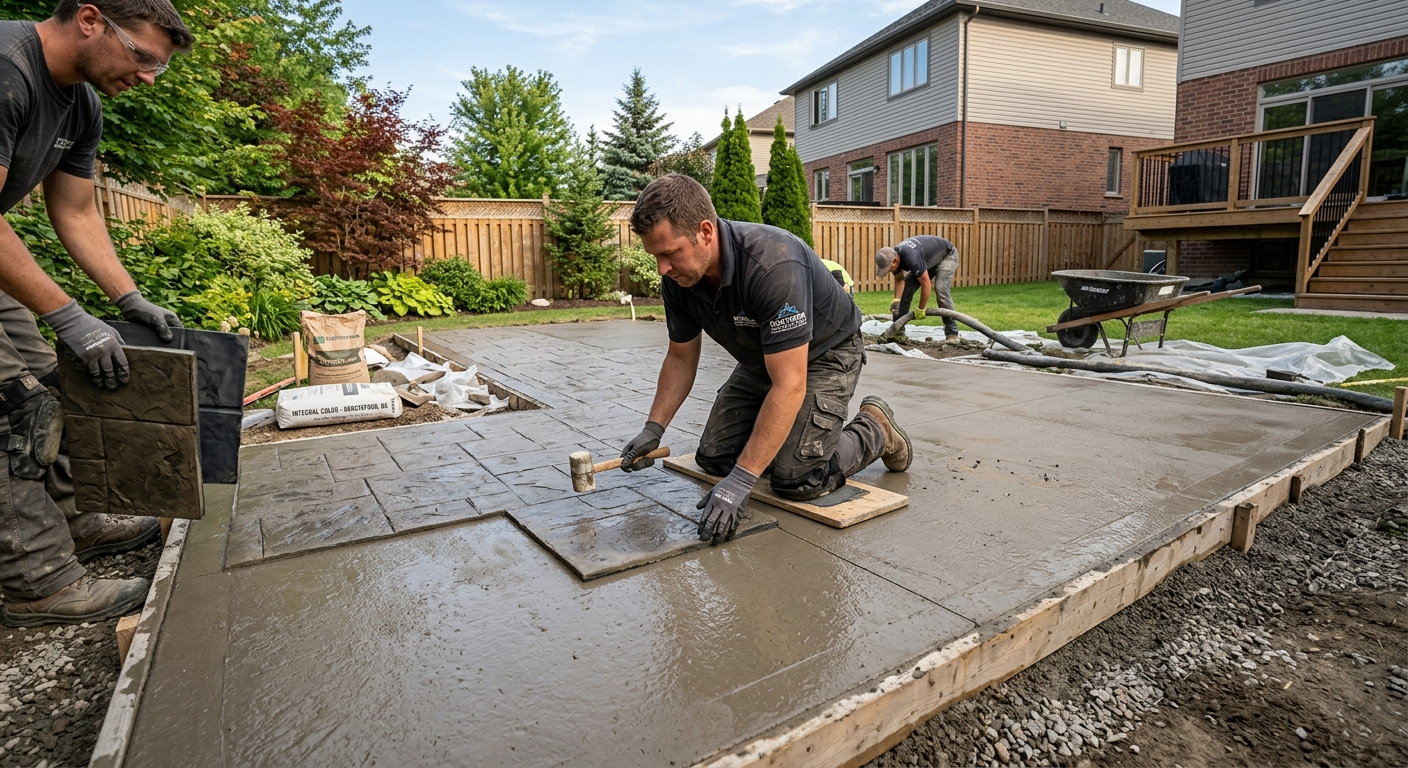
| Stamped concrete driveway or patio |
12 ft x 18 ft (216 sq ft) |
Air-entrained mix; integral colour |
Stamp pattern and release agent |
$4,800–$7,600 |
| Plain concrete patio or walkway |
10 ft x 15 ft (150 sq ft) |
Air-entrained mix; grade and drainage |
Steel-trowel or broom (as specified) |
$2,100–$3,300 |
| Garage floor (interior slab) |
18 ft x 20 ft (360 sq ft) |
Vapour barrier (if needed); flatness and reinforcement as required |
Float and broom (or smooth trowel) |
$4,500–$7,700 |
| Foundation footings (structural, below frost) |
Typical home footing set (varies by plan) |
Designed below frost line; concrete quality per engineer |
Structural concrete |
$6,500–$12,500 |
Prices are estimates only and vary by project scope, site access and material selection.
What affects the price of concrete work in Downtown Cambridge
In Downtown Cambridge and across the broader Kitchener–Waterloo–Barrie market, it’s common to see quote differences of 30–50% for what looks like the same concrete job on paper. The main reason is that “concrete” isn’t just the pour: it’s excavation depth, granular base, reinforcement detailing, mix design, curing protection, and finishing and sealing practices that protect the slab through years of freeze-thaw.
Frost line depth is the biggest driver. In Ontario, exterior structural work and footings must extend below the local design frost depth to prevent frost heave—if form height and excavation aren’t planned correctly, contractors either lose time or add costs later. Along with that, every exterior slab should be air-entrained so the freeze-thaw cycle is handled internally; without the proper air content, surfaces can deteriorate and spall faster. Cold-weather curing is also a cost factor here: in this region, the effective pour season is shorter, and crews may need insulated blankets, curing protection, or schedule adjustments to reach adequate strength.
Two common examples from Downtown Cambridge homeowners: (1) A simple broom-finish patio can land near the plain concrete patio/walkway band of $14–$22 per sq ft when drainage and base prep are straightforward; (2) The same footprint with poor drainage or deeper removal (to fix soft subgrade) can push costs toward the high end because excavation and granular replacement increase labour and material. Similarly, decorative options like stamped concrete fall into a wider finish band (commonly $22–$35 per sq ft), but that extra is often justified where homeowners want consistent patterning and proper colour curing—not just “stamp over old base.”
Finally, older home lots in and around the downtown core often have tighter access and more existing demolition, and that can change equipment needs and truck frequency—both are real money in southern Ontario.
| Price Factor |
Why It Matters |
Cost Impact |
| Frost line depth |
Determines footing depth and form height to resist heave |
Higher excavation and longer job days; can significantly increase foundation/footing scope |
| Site preparation |
Excavation, grading and compacted granular base control settlement |
Soft subgrade or added gravel often adds labour, haul-off, and compaction passes |
| Reinforcement |
Rebar or mesh helps control cracking and improves structural performance |
Material and labour increases, especially with dowels, chairs and tie-in details |
| Mix design |
Air-entrainment and strength targets improve freeze-thaw durability |
Specified exterior mixes can cost more and require careful placement and curing |
| Finish type |
Broom vs. stamped vs. exposed aggregate changes labour complexity and timing |
Decorative finishes typically cost more due to colour, stamping hardware and surface processes |
| Pour size and concrete truck access to site |
Small access can require additional crew time or alternate placement methods |
Staging and longer pour logistics can increase labour and equipment costs |
| Cold-weather curing precautions |
Protects early-age concrete from losing strength |
Heating blankets, membranes and extra monitoring can add line-item charges |
| Control joint pattern and sealing cost |
Controls shrinkage cracking and helps manage moisture intrusion |
Joint saw cuts, filler and later sealing can add cost but reduce long-term repairs |
Permits & regulations in Ontario
In Ontario, concrete isn’t automatically “permit-free.” In Downtown Cambridge, structural concrete work like footings, foundation walls, and grade beams typically requires a building permit and is often based on engineered drawings reviewed during the permitting process. That’s because these elements support the house and must meet design loads and frost considerations.
For concrete flatwork—driveways, patios, and walkways—a permit is often not required when it’s straightforward replacement on the same grade and doesn’t impact municipal requirements. However, you should confirm if your plan affects lot grading, stormwater flow, impervious surface coverage limits, or any work near a municipal right-of-way (for example, tie-ins at the boulevard or changes that could affect drainage toward the street). When in doubt, ask the municipality before breaking ground.
To verify a contractor in Ontario, start with the licence/registration using the contractor’s listing on the provincial and/or business registry sources they provide, then ask for a certificate of insurance and proof of WSIB/WCB coverage. Next, request a clearance letter if available and check expiry dates. Finally, review references for similar scope (driveways and exterior slabs in southern Ontario), because freeze-thaw durability and proper base prep are where most failures—or savings—show up. A credible contractor won’t mind giving you documents before a pour date.
Getting concrete right in Downtown Cambridge's freeze-thaw climate
Concrete failures in Downtown Cambridge usually come down to three things: movement (settlement or heave), water (poor drainage or trapped moisture), and early-age damage (inadequate curing in cold conditions). The region’s freeze-thaw cycles stress slabs, and when the concrete mix isn’t designed for durability or the base isn’t built correctly, surfaces can crack first and then spall as water works in and freezes.
To spec the job correctly, insist on five practical details tied to this climate. First, base preparation: the sub-base must be excavated to the right depth and replaced with properly graded, compacted granular material so the slab doesn’t settle. Second, mix design: for exterior work, use air-entrained concrete (commonly 5–7% air content for flatwork) and specify a minimum 32 MPa compressive strength so the slab reaches adequate performance. Third, control joints: joints need a deliberate pattern and spacing to limit random cracking. Fourth, curing: allow a minimum 7 days of proper curing conditions—cold weather often requires insulating blankets or curing protection so strength gain isn’t interrupted. Fifth, sealing: apply a penetrating sealer after cure (typically around 28 days) to help repel moisture and de-icing salts.
When you talk to contractors, ask direct questions that target the biggest risk: “What air-entrained mix are you using, and how will you protect the slab during curing?” A broom-finish driveway is usually the most cost-controlled option (within the $15–$25 per sq ft band), but if a contractor offers “cheap concrete” without specifying air content and curing, that low price often isn’t a bargain. Stamped concrete is typically higher (often within $22–$35 per sq ft), and the extra cost is justified when they’re doing correct base prep, curing, and consistent finishing—not just adding stamps.
| Spec |
Why It Matters in Downtown Cambridge |
What to Ask For |
Impact if Skipped |
| Compacted granular base (depth?) |
Reduces settlement and supports the slab against frost-related movement |
Confirm excavation depth, granular type, moisture conditioning, and compaction requirements |
Uneven surfaces, cracking, and early replacement |
| Air-entrained concrete mix (target air %?) |
Lets water/ice expansion relieve internally during freeze-thaw cycles |
Ask for exterior mix with 5–7% air content |
Spalling and surface scaling, especially after winter de-icing |
| Compressive strength (MPa rating) |
Ensures durability and strength gain for early-age and long-term performance |
Minimum 32 MPa specified and curing plan to achieve it |
Surface damage and reduced lifespan |
| Control joints (spacing per ACI guidelines) |
Limits random shrinkage cracking under Ontario temperature swings |
Joint spacing plan and saw-cut timing after initial set |
Uncontrolled cracks that allow moisture penetration |
| Minimum 7-day curing period |
Protects early strength development in cold or damp conditions |
Confirm curing method: blankets/membranes as needed and daily protection |
Weak surfaces that erode and crack sooner |
| Penetrating sealer (when applied after cure) |
Helps repel water and reduce damage from de-icing salts |
Apply after full cure (around 28 days) with correct surface prep |
Faster deterioration and higher freeze-thaw damage |
How to choose a concrete work contractor in Downtown Cambridge
Choosing the right contractor is the fastest way to protect your budget in Downtown Cambridge. Start by verifying Ontario business legitimacy and then confirm liability insurance and WSIB/WCB coverage. How to check: request a current certificate of insurance (with policy dates and coverage limits) and review it for the exact contractor listed on the quote; ask for proof of WSIB/WCB coverage and clearance letter details if they’re using subcontract labour. If anything is missing or expired, that’s a stop-sign—concrete mistakes are expensive, and you want the job backed by real coverage.
Next, get 2–3 itemised written quotes. The best quotes separate labour and materials and identify what’s included: excavation depth, granular base build, reinforcement type, concrete mix specification (including air-entrainment), finishing method, curing protection, joint saw cutting, and whether sealing is included or a later add-on. Avoid lump-sum quotes that don’t state what disposal or trucking includes, because haul-off, pump/boom needs, and access constraints can change the true cost.
Check warranty terms: workmanship warranty length matters, and product/manufacturer warranty should be stated clearly. Understand whether warranties are transferable if you sell your home. For payment schedule, never pay more than about 10–15% upfront; use a holdback until completion and final cleanup. Finally, get a written start date and completion estimate—freeze-thaw planning in this region means timing and curing protection are part of performance.
- Ask what exterior air content is used for driveway/patio work.
- Confirm footings/structural depths are below design frost requirements.
- Request an itemised breakdown for excavation, base, concrete, and reinforcement.
- Verify liability insurance and WSIB/WCB coverage dates before signing.
- Check whether joint saw-cut timing is included in the schedule.
- Ask about curing methods in cold or damp conditions (blankets/membranes).
- Confirm drainage approach: slopes and any tie-ins for runoff.
- Review how they handle disposal/haul-off and clean job sites.
- Get written confirmation on sealing: included, excluded, or date-later.
- Ask for sample finishing results for stamped/exposed aggregate work.
- Confirm protection of finished concrete from early de-icing and heavy loads.
- Use a payment schedule with a holdback until final inspection.
Concrete contractor red flags in Downtown Cambridge include: (1) no mention of air-entrained mix or curing protection, (2) skipping control joint planning, (3) promising stamped work without confirming base and drainage, (4) “cheap replacement” over soft or unverified subgrade, and (5) quotes that don’t state what’s included for haul-off, saw-cutting, or sealing.
Frequently asked questions — concrete work in Downtown Cambridge
What causes concrete to spall in Downtown Cambridge winters?
Spalling in Downtown Cambridge is most often tied to freeze-thaw stress plus water getting into the concrete surface. If the exterior slab wasn’t made with the correct air-entrainment (typical exterior target is about 5–7% air), water can’t relieve pressure as it freezes, so the surface flakes and scales. Poor drainage and missing or poorly planned control joints also allow water to track into cracks. Another common contributor is insufficient curing time in cold snaps; if the concrete doesn’t reach strength while protected, the surface stays more vulnerable. Finally, aggressive early de-icing salt before the slab is properly cured can accelerate surface damage. If you’re comparing quotes, make sure the air-entrainment and curing plan are spelled out—otherwise your driveway may start looking rough long before the expected lifespan.
What is rebar and when is it required in Ontario?
Rebar (reinforcing steel bars) is used to increase tensile capacity and help control cracking, especially in structural elements and in slabs where engineer or design requirements call for reinforcement. In Ontario, whether rebar is required isn’t based on “typical” alone—requirements come from building design and site conditions. For structural concrete like footings and foundation walls, reinforcement is commonly specified by engineering drawings that are reviewed through the building permit process. For exterior flatwork like driveways and patios, reinforcement (wire mesh, rebar, or fibre in specific systems) may be recommended depending on slab thickness, sub-base quality, and expected loads (like heavy vehicles). The right approach is to ask your contractor to state slab thickness and reinforcement type, and to match it to the project’s design and climate exposure in Downtown Cambridge.
How long does a concrete project take in Downtown Cambridge?
Timelines in Downtown Cambridge depend on weather, access, and what scope you’re doing—not just the pour day. Typical exterior flatwork includes excavation and forms first, then base prep and compaction, delivery and placement, finishing, and curing protection. The actual concrete pour is often one day, but curing and protection determine when the surface is safe for normal use. For many patios/walkways and standard broom-finish driveways, plan for about several days total, with full care guidance extending beyond that as concrete matures. Cold-weather scheduling can extend time if heating blankets or membranes are used to maintain strength gain. If the project involves demolition and haul-off, or if there’s structural work like footings (requiring deeper excavation below frost line), the timeline naturally increases. A good contractor will provide a written start/completion estimate and a curing plan aligned to the season.
What is a concrete overlay and is it suited to Downtown Cambridge?
A concrete overlay is a new concrete layer placed over an existing slab after preparation, usually to restore appearance and provide a new surface without full removal. It can be suited to Downtown Cambridge when the existing concrete is structurally sound (not heavily deteriorated, not undermined, and not suffering widespread base failure). The catch is that freeze-thaw climate can expose any weak points underneath, so proper prep is everything: cleaning, repair of spalls/cracks, bonding preparation, and correct thickness. If the old slab is failing due to base problems, an overlay can become a band-aid and lead to new cracking. Cost-wise, overlays can sometimes be less than full replacement, but you still need to factor prep labour and appropriate materials. When pricing, compare your overlay quote to standard driveway replacement bands like $15–$25 per sq ft so you can judge real value—not just a lower headline number.
How do I seal concrete to protect it in Downtown Cambridge?
Sealing helps protect concrete from moisture and de-icing salt effects, which is especially relevant in Ontario winters. For best results around Downtown Cambridge, wait until the slab has cured properly—commonly about 28 days—then clean thoroughly so the sealer can penetrate. Use a penetrating sealer (not just a film-forming surface coating) when the goal is moisture repellency through seasons of freeze-thaw cycling. Apply with the correct method and coverage rate recommended by the product. Also, avoid putting sealer over contaminated surfaces, construction debris, or chalky curing residue. After sealing, it’s still important to minimize aggressive de-icing practices and follow proper loading guidance. If your contractor includes sealing in the schedule, confirm whether they’re doing it after cure, because “sealing right after pour” can undermine performance.
What is the difference between concrete and cement?
In Ontario, people often use “cement” and “concrete” interchangeably, but they’re not the same. Cement is the binding ingredient inside concrete—typically Portland cement—used to react with water and form paste that hardens. Concrete is the overall composite: cement paste plus aggregates (sand and stone), water, and sometimes air-entraining admixtures for freeze-thaw durability. That air-entrainment is a big deal for Downtown Cambridge exterior slabs because it helps manage internal pressure as water freezes. So when you see a quote, don’t just ask “what cement do you use?” Ask about the exterior mix specification, including air content and compressive strength (often aiming for at least 32 MPa for durability on flatwork). If you want a reference point for budgeting, typical patios/walkways often fall around $14–$22 per sq ft depending on finish and site prep.