Concrete work options and costs in Dovercourt-Wallace Emerson-Junction
Dovercourt-Wallace Emerson-Junction, Ontario is a neighbourhood where concrete shows up everywhere—driveways, garden walkways, patios, and the basement slab-and-footing systems that many older homes rely on. With a population of 36,625 (Statistics Canada, 2021 Census), the Toronto economic region has enough steady demand that homeowners can usually get competitive scheduling, but winter-related constraints still affect timelines. In this part of Toronto, concrete flatwork is especially popular around pocket streets and service-lane areas where homeowners need durable access—places like Wallace Emerson-Junction and the routes feeding into the Dovercourt corridor see frequent repairs after settlement, drainage issues, or surface wear.
Toronto’s costs are shaped by freeze–thaw cycling and frost-depth requirements. In practice, that means structural footings typically need to sit below the design frost depth (Ontario minimums are commonly in the 1.2 m range), and exterior slabs should use air-entrained concrete plus drainage-friendly base prep. Pour seasons are shorter once temperatures start hovering near the low teens and curing becomes more sensitive—so labour and scheduling can tighten in fall and early spring.
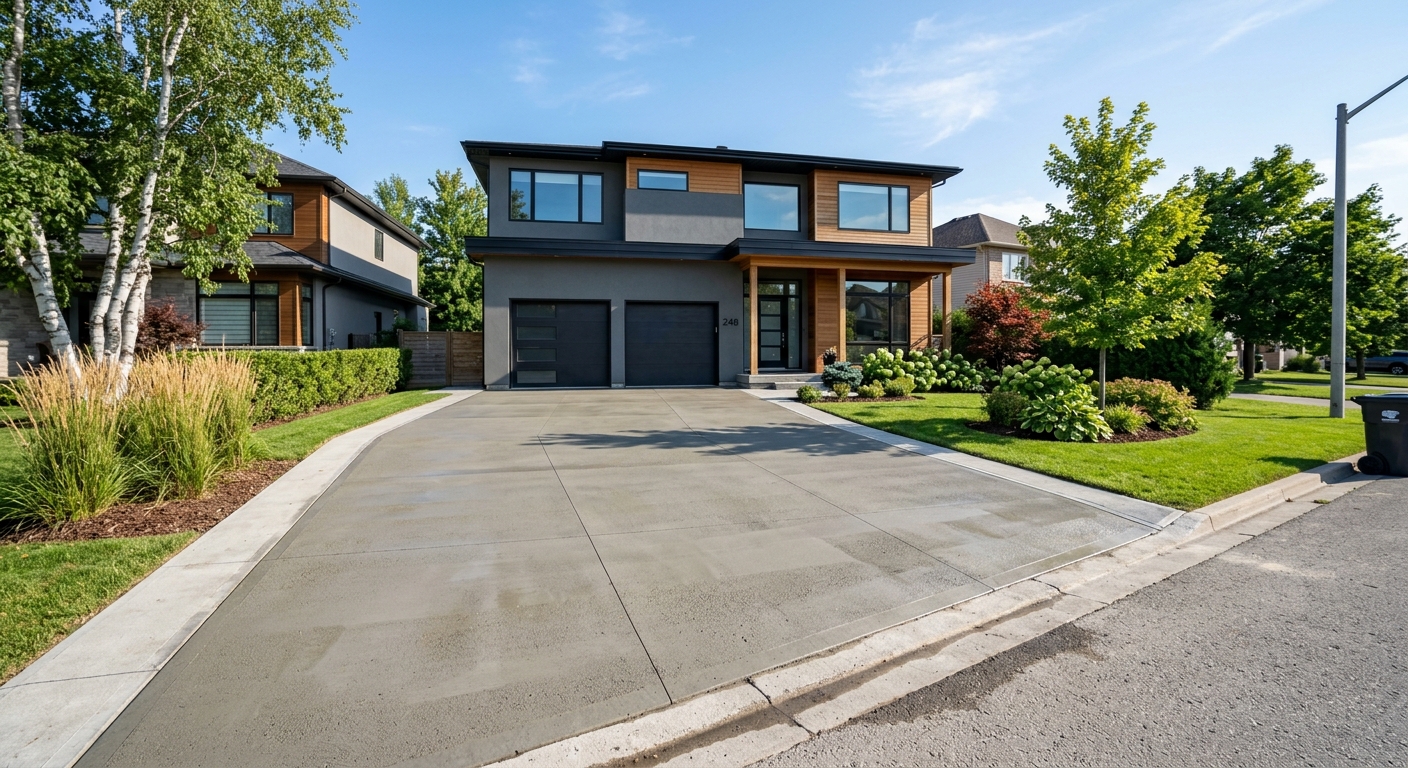
Finishes also matter. A plain broom-finished driveway tends to be the most budget-friendly, while exposed aggregate and stamped work cost more because of added surface processing and materials. If you’re comparing like-for-like, use the table below as a baseline for typical Dovercourt-Wallace Emerson-Junction projects, then we’ll fine-tune the spec based on soil, access, and drainage.
| Application |
Typical Size |
Key Spec |
Finish Option |
Price Range |
| Concrete driveway (standard broom finish) |
12 ft x 20 ft (240 sq ft) |
Air-entrained mix, compacted granular base, control joints |
Broom |
$4,320–$6,720 |
| Exposed aggregate driveway |
12 ft x 20 ft (240 sq ft) |
Air-entrained mix, base prep, delayed wash/chemical retarder |
Exposed aggregate |
$5,280–$8,160 |
| Stamped concrete driveway or patio |
12 ft x 16 ft (192 sq ft) |
Air-entrained mix, colour hardener, release agent, seal coat |
Stamped |
$4,800–$7,680 |
| Plain concrete patio or walkway |
10 ft x 12 ft (120 sq ft) |
Granular base, thickness spec, joints as required |
Float/trowel + light broom |
$1,920–$3,120 |
| Garage floor (interior slab) |
20 ft x 22 ft (440 sq ft) |
Vapour barrier, proper sub-base, fibre or mesh as specified |
Broom or light trowel finish |
$7,920–$12,320 |
| Foundation footings (structural, below frost) |
Typical small addition/underpin context |
Engineered rebar, excavation & formwork, below-frost depth |
Structural concrete |
$1,800–$3,000 |
Prices are estimates only and vary by project scope, site access and material selection.
What affects the price of concrete work in Dovercourt-Wallace Emerson-Junction
In the Toronto economic region, two homeowners can get very different quotes for what looks like the same concrete job—typically a 30–50% swing—because concrete pricing isn’t just “$ per square foot.” It’s driven by excavation depth, frost protection requirements, base preparation quality, reinforcement needs, finish complexity, and how well the contractor can schedule a proper pour and curing window. In a market with strong demand and busy crews, travel time and truck access also change the effective labour rate.
At the core, frost depth and freeze–thaw cycles dictate the spec. Structural footings must extend below design frost depth to prevent frost heave and differential settlement; for exterior slabs and patios, an air-entrained mix is essential to survive repeated freezing and thawing. That same exposure makes de-icing salt a durability factor—spalling risk rises if the air content or curing and sealing aren’t handled correctly. When temperatures trend toward 10 °C or below, cold-weather curing precautions (heating, insulating blankets, longer protection time) can add cost because the crew must maintain conditions longer before forms come off or the slab is considered safe to finish.
In Dovercourt-Wallace Emerson-Junction, costs often rise when older neighbourhood soils are poorly drained or when driveways connect to existing entrances with tight access—extra excavation, granular base, and sub-drain work increase the scope. Costs can also drop when the site is already well-graded, forms can be reused, and the pour is a simple broom-finished removal/replacement. For example, homeowners choosing a basic driveway in the $18–$28 per-square-foot band (typical) may save money compared with stamped work in the $24–$40 range, but the stamped option is often justified when you want the finish to match brick or stone and reduce surface patching over time.
| Price Factor |
Why It Matters |
Cost Impact |
| Frost line depth — determines footing depth and form height |
Deeper excavation/Formwork is needed to keep footings below frost heave risk |
Higher excavation and labour; can shift the project band significantly |
| Site preparation — excavation, grading, compacted granular base |
Controls settlement and prevents saturated soils from pumping against concrete |
Extra base and disposal add cost, especially on constrained lots |
| Reinforcement — rebar or wire mesh requirement |
Improves crack resistance and load capacity for driveways and slabs |
Materials plus labour for chairing and spacing |
| Mix design — air-entrainment and compressive strength spec |
Air entrainment helps resist freeze–thaw damage; strength supports durability |
Better-spec mix and batching can raise unit cost |
| Finish type — broom vs. stamped vs. exposed aggregate |
Complex finishes take more steps and skilled labour time |
Stamped/exposed typically add material and production time |
| Pour size and concrete truck access to site |
Smaller pours, multiple stages, or difficult access increases handling |
Extra charges for truck positioning or pump/transfer |
| Cold-weather curing precautions — heating and blankets |
Protects strength gain and reduces surface defects during cool snaps |
Heaters/insulation rentals and longer protection window |
| Control joint pattern and sealing cost |
Joints limit random cracking; sealing helps resist salt and moisture ingress |
More precision layout and materials; improves long-term performance |
Permits & regulations in Ontario
In Ontario, structural concrete work typically requires a building permit and may need engineered drawings reviewed by the municipality. This includes concrete foundations and structural elements such as footings, foundation walls, grade beams, underpinning, and other work that affects a home’s structural integrity. For many homeowners in Dovercourt-Wallace Emerson-Junction, that means any project involving new or repaired foundation support should start with a permit conversation before excavation begins.
Concrete flatwork (patios, walkways, sidewalks, and many driveways) usually does not require a permit unless it changes lot grading, impacts drainage patterns, or triggers municipal impervious surface coverage/right-of-way requirements. If the concrete work ties into or changes a driveway approach, affects stormwater flow, or creates a new drainage problem, you may need additional approvals—so confirm with the local authority.
To protect yourself, verify the contractor’s Ontario credentials and insurances before signing. Step-by-step: (1) ask for their certificate of liability insurance and confirm the policy is current and aligned with the job scope; (2) request WSIB/WCB clearance documentation and make sure it covers the workers who will be on-site; (3) verify their licensing/registration where applicable for the type of work; and (4) use references for similar-scale projects in your area and in comparable neighbourhood conditions. If anything feels vague—especially around permits or insurance—treat it as a red flag and get it clarified in writing before work starts.
Getting concrete right in Dovercourt-Wallace Emerson-Junction's freeze-thaw climate
Concrete fails in Dovercourt-Wallace Emerson-Junction mainly when moisture and freezing water expand where they shouldn’t. The biggest drivers are inadequate base preparation, poor drainage, and—most commonly—inadequate air entrainment, which can lead to surface spalling and premature scaling after de-icing salt hits a weakened surface. Your best defence is getting the spec right from the start so the slab behaves predictably through freeze–thaw cycles.
Start with (1) base preparation: excavate to the right depth for your local soil and compact a granular sub-base so it drains and doesn’t pump when saturated. Next, (2) mix design: for exterior flatwork, air-entrainment should generally target 5–7% air content, and the concrete should meet a minimum 32 MPa compressive strength spec so it achieves proper durability. (3) Control joints should be planned with a consistent pattern and sealed after appropriate cure time to control where cracking happens. (4) Curing: plan on a minimum 7-day cure under proper protection; in cool spells, protect the slab longer so strength gain isn’t interrupted. (5) Sealing: apply a penetrating sealer after cure—commonly at 28 days post-pour—to help repel moisture and reduce salt-driven deterioration.
Ask the contractor specific questions: What air content will you order? What base thickness and compaction standard will you use? How will you manage curing if temperatures drop? How will you seal, and when? For a dollar reality check, upgrading from a basic broom finish to exposed aggregate may cost more (often in the $18–$28 to $24–$40 driveway-style bands depending on scope), but the cost is sometimes justified when you’re also addressing drainage and air entrainment—because that’s what prevents failure, not just what looks nicer.
| Spec |
Why It Matters in Dovercourt-Wallace Emerson-Junction |
What to Ask For |
Impact if Skipped |
| Compacted granular base (depth?) |
Prevents water from trapping under the slab and limits frost-related movement |
Granular sub-base depth and compaction method (e.g., lift thickness and roller compaction) |
Settlement, rocking, and faster cracking/spalling |
| Air-entrained concrete mix (target air %?) |
Provides freeze–thaw resistance so water doesn’t damage the surface |
Target air content (commonly 5–7% for exterior flatwork) and confirmation on the ticket/mix design |
Surface scaling/spalling after winters and salt exposure |
| Compressive strength (MPa rating) |
Strength supports durability and reduces early wear |
Minimum 32 MPa (or higher if specified) and mix class that matches the exposure |
Higher risk of abrasion, cracking, and premature deterioration |
| Control joints (spacing per ACI guidelines) |
Controls crack locations during temperature and shrinkage changes |
Joint spacing plan and saw-cut timing |
Random cracking and wider repair costs |
| Minimum 7-day curing period |
Ensures proper strength gain before the first significant weather swings |
Protection plan for cooler temperatures (covers/heating if needed) |
Weaker surface, increased cracking and scaling risk |
| Penetrating sealer (when applied after cure) |
Reduces salt/moisture penetration in Toronto’s wet fall/spring cycles |
Sealer type and application timing (commonly ~28 days post-pour after cure) |
Faster moisture/salt intrusion and shorter service life |
How to choose a concrete work contractor in Dovercourt-Wallace Emerson-Junction
Choosing the right contractor in Dovercourt-Wallace Emerson-Junction starts with verifying that they can legally and safely do the work in Ontario. Ask for their proof of liability insurance (certificate of insurance) and WSIB/WCB coverage before the first shovel hits the ground. Then confirm the contractor’s Ontario licensing/registration as applicable to the type of concrete work being performed. If a contractor can’t provide clear documents—or tries to dodge details about insurance and clearance—pause the process and move on.
Next, get 2–3 itemised written quotes. You want labour and materials broken out (concrete supply, base/granular, reinforcement, forms, finishing, sealing, disposal, and any heating/blankets for cold-weather curing). Avoid a “lump sum” quote with vague scope—concrete problems are frequently scope gaps: “Is disposal included?” “Are saw cuts and joint sealing included?” “Is the permit pull included if needed?” “What thickness and base depth are you proposing?” A proper quote answers these directly.
Look for a workmanship warranty (length and what it covers) and clarify whether any product/manufacturer warranty is included and transferable to you. For payment scheduling, never pay more than 10–15% upfront; insist on holdback until completion and final inspection. Finally, require a written timeline: start date, pour date window, cure/protection period expectations, and completion estimate.
- Request COI (certificate of insurance) and confirm it matches the project address.
- Ask for WSIB/WCB clearance or equivalent coverage proof for the crew.
- Confirm whether permits are required and who pulls them (structural vs flatwork).
- Require itemised pricing: concrete, base, reinforcement, finishing, sealing, disposal.
- Check the proposed slab thickness and base depth in writing.
- Ask what air-entrained mix they’ll order for exterior flatwork.
- Get the joint plan: spacing, saw-cut timing, and whether joints are sealed.
- Ask how they’ll manage curing if temperatures drop below about 10 °C.
- Verify site access: truck placement, staging area, and whether a pump is included.
- Confirm if drainage corrections (grading/sub-drain) are included when needed.
- Review warranty terms: workmanship start date and covered failures.
- Use a payment schedule with a holdback until finish quality and sealing are done.
Concrete red flags to watch in Dovercourt-Wallace Emerson-Junction: (1) no discussion of air-entrainment or freeze–thaw protection; (2) “we’ll pour whenever” without a cold-weather curing plan; (3) base prep described vaguely (“we’ll level it”) without thickness/compaction details; (4) missing insurance/WSIB paperwork; and (5) a contract that treats sealing and control joints as optional add-ons after the slab is cured.
Frequently asked questions — concrete work in Dovercourt-Wallace Emerson-Junction
What is a concrete overlay and is it suited to Dovercourt-Wallace Emerson-Junction?
A concrete overlay is a new concrete layer installed over an existing concrete surface—often to improve appearance and cover minor cracking. In Dovercourt-Wallace Emerson-Junction, overlays can be a fit when the existing slab is still structurally sound, well-bonded, and not lifting due to major drainage or frost-related heave. If the base underneath is failing, an overlay can look good initially but still fail early because the movement continues. Before choosing an overlay, a contractor should inspect for hollow spots, delamination, settlement, and drainage problems, and discuss whether patching, full removal, or reconstruction is the right durability move. Cost-wise, a driveway replacement often sits in the $18–$28 per-square-foot band, while overlays can be competitive for cosmetic refresh—if the underlying conditions are truly stable.
How do I seal concrete to protect it in Dovercourt-Wallace Emerson-Junction?
Sealing is about controlling moisture and salt intrusion—important in Ontario where wet seasons and de-icing compounds accelerate surface deterioration. For best results, concrete should cure fully before sealing: a common approach is applying a penetrating sealer around 28 days post-pour (after adequate curing). The slab needs to be clean, dry, and properly prepared; sealed-over dust or curing residue can reduce performance. Ask your contractor what sealer type they use (penetrating vs film-forming), how they’ll test dryness, and whether they’ll include joint preparation and joint sealing (control joints matter for crack control). If you’re sealing an exterior driveway or patio near a garage entrance, prioritize sealing schedule consistency since freeze–thaw cycles can punish any missed areas.
What is the difference between concrete and cement?
Cement is one ingredient inside concrete. Concrete is the final building material made by mixing cement with water, aggregates (sand and stone), and often admixtures such as air-entrainment for freeze–thaw durability. In everyday conversation people use “cement” to mean the whole mix, but technically cement is the binder that reacts with water and helps the concrete set and gain strength. In Dovercourt-Wallace Emerson-Junction, the practical difference shows up in the mix design: for exterior flatwork exposed to Toronto’s freeze–thaw cycles and salt, contractors should order an air-entrained concrete with a proper strength spec (commonly minimum 32 MPa) rather than “whatever mix is on hand.” That’s how you avoid spalling, not by changing the word you call it.
How much does concrete work cost in Dovercourt-Wallace Emerson-Junction?
Pricing in Dovercourt-Wallace Emerson-Junction depends on finish type, thickness, base prep, access, and how the contractor plans for Ontario’s freeze–thaw climate. As a baseline, concrete driveways and slabs often fall around $18–$28 per square foot for standard work, while patios and walkways commonly price around $16–$26 per square foot. If you choose decorative finishes, stamped or high-end decorative driveway work typically runs in the $24–$40 per square foot range. Foundation/footing work is quoted differently (often per project scope, and structural depth matters) and commonly lands in the $180–$300 range in price band terms for the footing component. The safest way to budget is an itemised quote that includes base depth, reinforcement, and sealing—because those are usually the true drivers.
How deep must footings be for Dovercourt-Wallace Emerson-Junction's frost line?
In Ontario, structural footings are typically required to extend below the design frost depth to reduce the risk of frost heave and differential movement. In Toronto-area practice, that usually means a minimum around 1.2 m (about 4 ft) below grade for many structural footing situations, though the exact depth depends on soil conditions and engineering. Because the requirement is tied to the project’s design and exposure—not guesswork—your engineer or designer will specify the depth and reinforcement details. If you’re doing foundation work in Dovercourt-Wallace Emerson-Junction, insist that the quote reflects excavation to the specified below-frost depth and that the contractor accounts for disposal, shoring (if needed), and proper backfill. Cutting corners on footing depth is one of the costliest mistakes long-term.
Why does concrete crack in Dovercourt-Wallace Emerson-Junction and how is it prevented?
Concrete cracking is common in Ontario because concrete shrinks as it cures and expands/contracts with temperature changes, and exterior surfaces are hit by freeze–thaw cycling. In Dovercourt-Wallace Emerson-Junction, the biggest drivers of problematic cracking are poor base preparation, missing or poorly planned control joints, and inadequate mix design for the exposure. Prevention is about directing cracks and managing movement: properly compacted granular base, air-entrained exterior concrete, planned control joint spacing, and correct timing for saw cuts. Curing and sealing also matter for durability—especially where de-icing salt is used—because damaged surfaces can worsen over repeated winters. The key is to ask for the joint plan, confirm air-entrainment, and ensure curing protection if temperatures drop during the pour window (cold-weather curing precautions can be required).