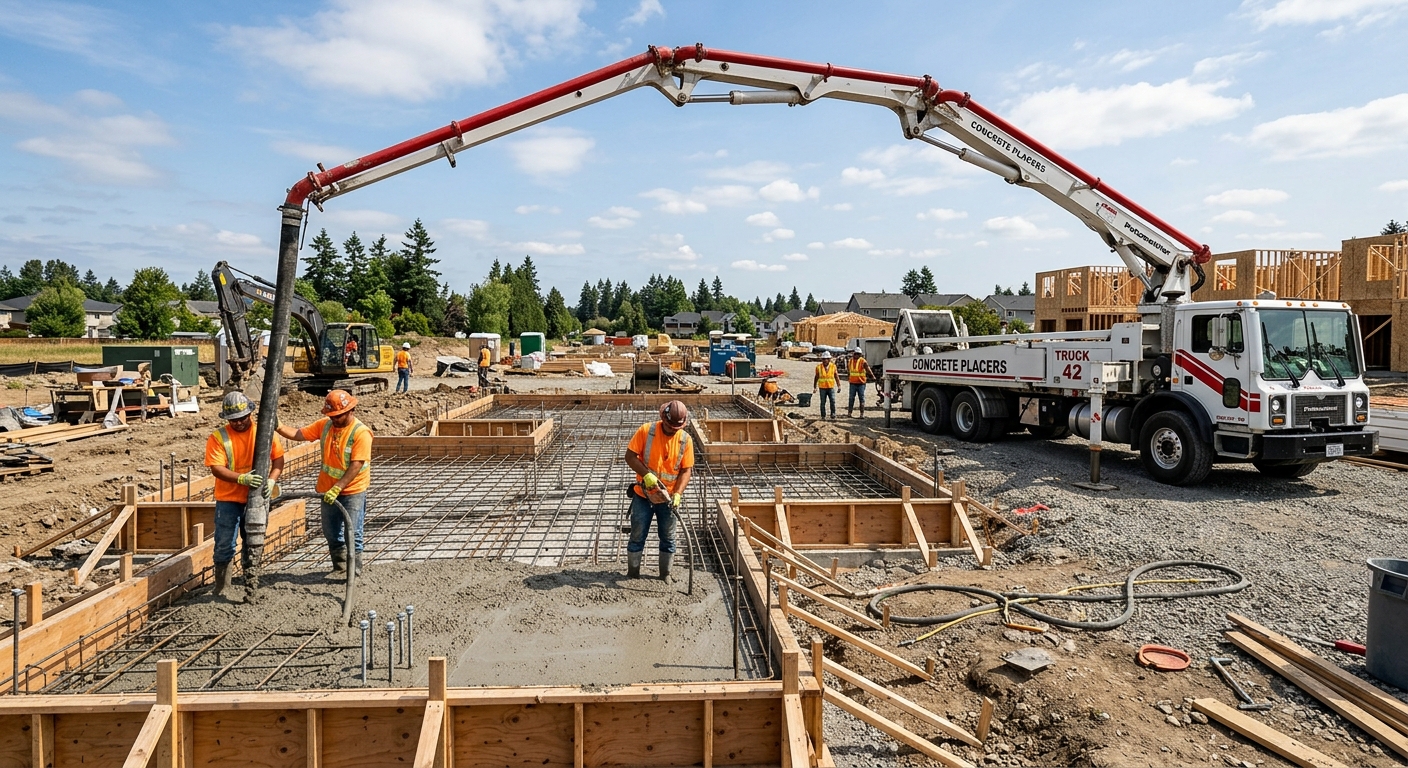
Concrete work options and costs in Deep River
Concrete work in Deep River is one of those “looks simple, costs for real” projects—especially for homeowners on the older housing stock. With 75.1% of dwellings in the area being single-detached homes (Statistics Canada, 2021 Census), most concrete demand here is for driveways, patios, walkway repairs, and foundation work that matches how properties were originally built. Deep River also has a lot of homes built before 1981 (84.5%), so it’s common to see re-lifts, drainage fixes, and slab patches tied to improving how water moves around the foundation.
In the Kingston–Pembroke region, your budget is driven less by the slab “type” and more by site conditions and weather windows. Freeze-thaw cycles mean exterior concrete needs the right base preparation and an air-entrained mix, and the pour season is shorter—so scheduling labour, protecting the pour during cool shoulder-season weather, and curing discipline add up. Contractors often get especially busy in neighbourhoods with more frequent driveway refresh demand such as the downtown core and residential streets near the riverfront, where access and drainage can be tricky.
Below is a practical comparison of typical sizes and specs you’ll see in Deep River bids, so you can sanity-check whether a quote is targeting the right scope before you compare finish upgrades. Use it as a baseline, then we’ll break down the cost drivers and what to ask your contractor for.
| Application |
Typical Size |
Key Spec |
Finish Option |
Price Range |
| Concrete driveway (standard broom finish) |
12 ft x 24 ft (288 sq. ft.) |
6 in (150 mm) slab, air-entrained mix, control joints |
Broom finish |
$3,000 – $5,100 |
| Exposed aggregate driveway |
12 ft x 24 ft (288 sq. ft.) |
Air-entrained mix, seeded aggregate exposure, proper curing |
Exposed aggregate |
$4,200 – $6,600 |
| Stamped concrete driveway or patio |
10 ft x 20 ft (200 sq. ft.) |
Air-entrained, integral colour, release agent, sealer plan |
Stamped pattern |
$4,000 – $7,000 |
| Plain concrete patio or walkway |
10 ft x 12 ft (120 sq. ft.) |
4 in (100 mm) slab, air-entrained where exterior |
Float & broom / light trowel |
$1,800 – $3,200 |
| Garage floor (interior slab) |
20 ft x 22 ft (440 sq. ft.) |
Interior mix, vapour control (as required), saw cuts |
Smooth or broom finish |
$5,500 – $9,000 |
| Foundation footings (structural, below frost) |
Typical single-bay footing wall run: 40 lin. ft. |
Engineered/required depth, rebar, formwork, drainage plan |
Structural concrete (no decorative finish) |
$7,200 – $12,800 |
Prices are estimates only and vary by project scope, site access and material selection.
What affects the price of concrete work in Deep River
In Deep River and across the Kingston–Pembroke region, two quotes for what looks like the same driveway can swing by 30–50% because the “real” work is underneath: excavation depth, granular base prep, reinforcement requirements, drainage details, and how the contractor schedules around cold nights and rain. Ontario’s broader market has similar pricing variability because contractors price risk differently—especially when weather protection and curing discipline are required to keep exterior slabs from surface scaling and premature cracking.
Here’s the biggest technical driver: frost line depth and freeze-thaw cycles dictate every spec. In Ontario, footings generally need to extend below design frost depth (often about 1.2 m below grade for common residential work, sometimes deeper depending on local conditions and engineering), and all exterior slabs require air-entrained concrete to survive repeated cycles. When the warm-weather pour window shrinks, contractors add cold-weather precautions (insulating blankets, heating as needed, and tighter curing monitoring), which increases labour and equipment costs. Also, de-icing salt accelerates surface spalling, so sealing is not just cosmetic—it’s often part of a realistic maintenance plan.
Concrete examples that change cost in Deep River: (1) a driveway replacing a failing base with poor drainage usually costs more because we excavate farther and rebuild the granular profile; (2) a small 200 sq. ft. stamped patio might land closer to the stamped band, while a simple 120 sq. ft. broom-finished walkway can stay near the patio range; and (3) long truck access routes or tight turns near older properties can add mobilization and delivery charges. Given many homes here were built before 1981 (84.5%), it’s common to find foundation drainage details that need upgrading, and even a few thousand dollars in base and drainage work can prevent bigger failures later—especially when salt and winter traffic meet.
| Price Factor |
Why It Matters |
Cost Impact |
| Frost line depth — determines footing depth and form height |
Controls how deep concrete must be to prevent frost heave |
Higher depth increases excavation, rebar, and formwork time |
| Site preparation — excavation, grading, compacted granular base |
Proper base prevents settlement and keeps the slab flat |
Unstable soils or poor drainage increase aggregate and labour |
| Reinforcement — rebar or wire mesh requirement |
Resists cracking from load and movement |
More steel and correct placement add material and labour |
| Mix design — air-entrainment and compressive strength spec |
Improves freeze-thaw durability and strength gain |
Stricter specs can raise material cost and scheduling needs |
| Finish type — broom vs. stamped vs. exposed aggregate |
Determines how labour-intensive finishing and sealing will be |
Stamped/exposed adds colour, tools, labour, and cure/sealer steps |
| Pour size and concrete truck access to site |
Impacts labour efficiency and delivery logistics |
Short access can increase placement labour or require extra pumps |
| Cold-weather curing precautions — heating and blankets |
Strength gain depends on curing temperature and time |
Adds equipment, monitoring, and materials |
| Control joint pattern and sealing cost |
Limits random cracking and reduces salt-driven scaling |
More joints and proper sealing add line-item cost but extend service life |
Permits & regulations in Ontario
In Ontario, structural concrete work generally needs the right approvals before anyone pours. That means permit requirements and engineered drawings are typical for footings, foundation walls, grade beams, and other below-grade structural elements. Concrete flatwork (driveways, patios, walkway slabs) often does not require a building permit on its own, but it can trigger requirements if it affects lot grading, drainage, or impervious surface coverage limits, or if work touches the municipal right-of-way. For Deep River homeowners, the safe approach is to confirm with the local authority before excavation begins—especially when you’re changing elevations near a foundation or altering how water drains off the property.
Before you hire, verify the contractor carries liability insurance and the appropriate workplace coverage (WSIB/WCB). Ask for proof and make sure it covers the kind of work being done (excavation, forming, reinforcement, and concrete placement). Then, request references on similar projects—driveways and small slabs are one thing, but foundation/footing work is a different risk profile and typically requires more documentation.
Step-by-step verification you can do right away:
- Check the Ontario business/contractor licensing information online (where applicable in your trade category) and confirm the company name matches the quote.
- Ask for a certificate of insurance dated within the last year; confirm coverage amount and that it includes general liability for the work.
- Confirm WSIB/WCB coverage status; request clearance documentation if provided by the contractor.
- Look at past projects in your area: similar freeze-thaw exposure, similar slab thickness, and similar drainage solutions.
If the scope includes structural concrete, insist the permit/engineering steps are clearly included—or clearly excluded—with responsibility assigned in writing.
Getting concrete right in Deep River's freeze-thaw climate
Deep River’s freeze-thaw climate punishes weak details. Concrete failures you’ll commonly see here are spalling at the surface edge, random cracking, and slab lift caused by inadequate base preparation or poor drainage. The fix is not “stronger concrete only”—it’s correct base, correct mix, and correct curing.
Start with base preparation: compacted granular sub-base to the right depth for the soil and frost protection needs. Even small exterior slabs need a properly graded and compacted foundation so the concrete doesn’t flex and crack. Next is mix design: for exterior flatwork, specify air-entrained concrete with a target air content in the 5–7% range and a minimum 32 MPa compressive strength, as typical for durable residential exterior work. Then plan control joints: spacing should limit random cracking into predictable lines that you can maintain. Curing is equally important—plan for at least 7 days under proper conditions, and in cool weather, the contractor should protect the pour with blankets or heating where needed so strength gain keeps on track. Finally, sealing: a penetrating sealer applied after curing (commonly around 28 days post-pour) helps repel de-icing salts and reduces scaling risk.
When you’re choosing between options, you should pay the price difference only when it’s tied to durability or site constraints. For example, upgrading from a plain broom-finished patio to stamped concrete can add roughly $160–$280 per sq. ft.-level equivalent work in decorative scopes (often aligning with the stamped & decorative band), and that cost is justified when you’re willing to maintain the sealer schedule and accept the tighter finishing tolerances. But if your base is weak, spending more on a decorative finish won’t save it—bad base is still bad base.
To avoid the most common failure—spalling—ask directly about air-entrainment and joint/curing discipline. In Deep River, that’s what keeps the surface intact through winters, not just the finish look.
| Spec |
Why It Matters in Deep River |
What to Ask For |
Impact if Skipped |
| Compacted granular base (depth?) |
Prevents settlement and supports freeze-thaw movement control |
Base thickness and compaction method (e.g., granular type, lifts, density target) |
Uneven settling, cracking, and early edge spalling |
| Air-entrained concrete mix (target air %?) |
Improves freeze-thaw durability in Ontario winters |
Specified target air content (typically 5–7% for exterior flatwork) |
Surface scaling/spalling after salt exposure and repeated freeze-thaw |
| Compressive strength (MPa rating) |
Ensures structural integrity and proper strength gain |
Minimum 32 MPa compressive strength spec and test/cylinder plan if required |
Higher risk of cracking and weak early-age performance |
| Control joints (spacing per ACI guidelines) |
Controls where cracks happen during contraction/expansion |
Planned joint spacing, timing (saw cut vs. formed), and joint depth |
Random cracking and loss of slab straightness |
| Minimum 7-day curing period |
Strength gain and durability depend on proper curing conditions |
Curing protection plan and when traffic is allowed |
Surface damage, scaling, and reduced long-term performance |
| Penetrating sealer (when applied after cure) |
Helps repel de-icing salts common in Deep River |
Application timing after cure (often ~28 days) and product type |
Accelerated spalling and harder-to-maintain surface |
How to choose a concrete work contractor in Deep River
Choosing the right concrete contractor in Deep River comes down to verification and clarity. First, confirm Ontario licensing/registration where applicable and make sure the contractor has liability insurance that matches the project risk—excavation and rebar work can be unforgiving. Ask for proof of insurance (a current certificate) and verify coverage limits. Next, confirm WSIB/WCB coverage: request documentation such as clearance status or proof that the contractor is registered and compliant for the work being done. If they can’t produce paperwork, treat that as a red flag.
Then get 2–3 itemised written quotes, not just a lump sum. A proper concrete bid breaks out excavation, granular base preparation, reinforcement, formwork, concrete supply/transport, finishing, saw cuts/control joints, curing protection, and sealing (if included). Ask what’s excluded—topsoil removal, disposal, tying into existing drainage, electrical saw cutting for tight access, and permit pulling if structural concrete is involved.
For warranty, ask for two things: a workmanship warranty length and what’s covered (often cracking lines due to curing/jointing issues) versus excluded issues (like soil movement). Also ask whether any product/manufacturer warranty is transferable. Payment schedule matters: don’t pay more than 10–15% upfront, and hold back a meaningful portion until the finish, joints, and cleanup are complete.
Finally, timeline should be written: a start date, estimated completion, and how they handle cool nights or rain. In Kingston–Pembroke, that weather discipline often separates a driveway that stays solid from one that starts scaling early.
- Confirm contractor identity: quote name matches the insured company.
- Request a current certificate of liability insurance.
- Confirm WSIB/WCB coverage and ask for clearance/proof documentation.
- Require an itemised quote with labour and materials breakdown.
- Ask about disposal: is excess soil/gravel haul-away included?
- Ask about base specs: granular type, lift depth, and compaction approach.
- Confirm concrete mix details: air-entrainment and minimum strength spec for exterior.
- Check joint plan: spacing, timing of saw cuts, and whether joints are sealed where required.
- Ask curing plan: blankets/heating in cool weather and when traffic is permitted.
- Get finish details in writing: broom vs. stamped vs. exposed aggregate, and sealer inclusion.
- Review warranty terms in plain language and confirm duration.
- Confirm payment schedule: keep upfront payment at 10–15% and hold back until final inspection.
Concrete contractor red flags in Deep River: vague scope (“we’ll handle the rest” without base or mix specs), no proof of insurance/coverage, missing joint/cure details in the quote, charging full payment upfront, and refusing to explain how they protect exterior pours during cool shoulder-season weather.
Frequently asked questions — concrete work in Deep River
How long does concrete take to cure?
In Deep River and across Ontario, concrete strength gain happens over time, but you’ll see practical timelines on most residential work. Most exterior slabs are planned so they receive proper protection and curing for at least 7 days before normal light use, with full strength developing over longer periods. That’s why a contractor should explain when they’ll cut joints (for control cracking) and when they allow traffic or heavy loads. If weather is cool or damp—common in the Kingston–Pembroke area—curing discipline matters even more, and opening the surface too early can lead to scaling or surface dusting. If you’re comparing bids, a patio or walkway near the $90–$150 per sq. ft. band should still include curing protection as part of the scope, not just “wait a week.”
Do I need a permit for concrete work in Ontario?
For Ontario, structural concrete generally requires a building permit and often engineering review—think footings, foundation walls, and grade beams. Concrete flatwork like patios, walkways, and driveways typically doesn’t need a permit by default, but it can if you’re changing lot grading, drainage, or affecting impervious surface limits, or working near the municipal right-of-way. For a Deep River homeowner, that usually means: if the project is only a driveway replacement or a broom-finished patio, you may not need a permit; if you’re excavating for drainage changes, changing elevations close to the foundation, or doing foundation/footing repair, plan on permitting steps. Always confirm with the local authority before breaking ground, and make sure your contractor clarifies whether permits are included in the quote.
Concrete vs pavers for a patio in Deep River?
Concrete and pavers can both look great, but freeze-thaw durability and maintenance choices differ. A plain concrete patio or walkway is usually straightforward: air-entrained exterior concrete, correct base compaction, and control joints. If you keep traffic and drainage in mind, a broom-finished concrete patio typically lands in the patio range (for example, around $90–$150 for the common per-square-foot equivalent scope). Pavers can be easier to repair locally if a section heaves, but they still require a properly prepared base and drainage. In Deep River winters, poor drainage under pavers can also cause movement, and resetting stones takes time. If you want lower long-term surface maintenance and fewer individual elements to shift, concrete is often the practical option. If you prefer a varied pattern and are okay with potential re-leveling, pavers can work well.
How long does a concrete driveway last?
A concrete driveway in Ontario often lasts decades when the base is built correctly and the mix and joints are planned for freeze-thaw conditions. The biggest threats to longevity in Deep River are inadequate base preparation, insufficient air-entrainment for exterior durability, poor drainage, and delayed sealing in salt-heavy winters. When those details are done right, many standard broom-finished driveways provide long service life before noticeable cracking or surface scaling. If you’re comparing costs, standard driveway work in the local band often falls around $120–$180 for the typical driveway/pad scope equivalent, while upgrades like exposed aggregate or stamped work cost more because of finishing and sealing requirements. Paying for air-entrainment, base compaction, and proper joint timing usually protects the investment more than paying for a decorative finish alone.
What is air-entrained concrete and why does it matter here?
Air-entrained concrete is mixed with tiny, evenly distributed air bubbles that act like pressure relief during freeze-thaw cycles. In Deep River, that matters because water in the concrete can freeze and expand, and without proper air entrainment the surface can scale or spall—especially where de-icing salts are used. Exterior concrete should be air-entrained to survive repeated winters, and your contractor should specify the target air content (commonly around 5–7% for exterior flatwork) and the minimum compressive strength (often 32 MPa for durable residential exterior work). If a bid doesn’t clearly mention air-entrainment and joint/curing discipline, you’re not really comparing apples-to-apples. This is one reason weather-window scheduling in the Kingston–Pembroke region affects cost and quality: the contractor must protect curing so the mix achieves the intended performance.
How do I prepare the base for a concrete slab?
Base preparation is the foundation of a long-lasting slab—driveways, patios, and walkways in Deep River all benefit from the same discipline. The contractor should excavate to the proper depth, remove organic material, and place compacted granular base in lifts so it’s stable and well-drained. Proper grading matters so water doesn’t pond near foundation walls or under edges (a common problem in older properties). The base depth depends on soil conditions, slab thickness, and frost protection needs, but what you should ask for is the granular type, the compaction approach, and the target for a stable, dense layer. Then specify exterior durability: air-entrained mix and a planned control joint pattern. If the base isn’t compacted correctly, even a better finish—like stamped concrete in the higher decorative band—won’t prevent early cracking or spalling.