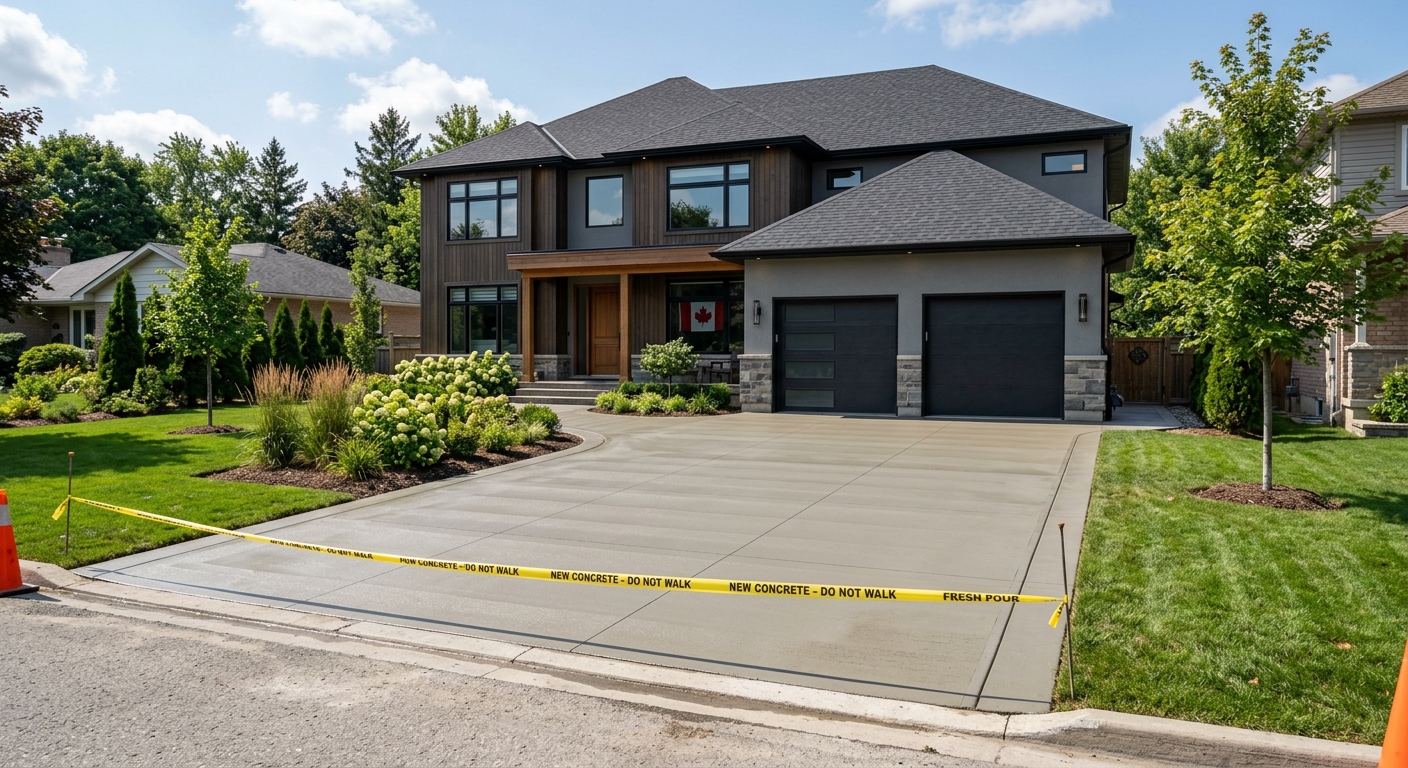
Concrete work options and costs in Don Valley Village
Don Valley Village, Ontario is a mature, mostly residential neighbourhood where concrete flatwork is a common upgrade—especially for homeowners replacing worn driveways, uneven walkways, or aging patio slabs. The local market includes a mix of housing types, and for perspective, Toronto’s population was 2,834,676 in 2021 (Statistics Canada, 2021 Census). In Don Valley Village specifically, there are 27,051 residents (Statistics Canada, 2021 Census), and that steady homeowner demand is why you’ll find reliable crews operating out of the GTA for driveway and patio work.
Pricing here is strongly influenced by freeze–thaw conditions and required frost depth performance. In the Toronto economic region, contractors typically design exterior work with footings and base prep that can handle Ontario’s winter movement, and they rely on air-entrained concrete mixes plus proper curing. Those details—plus the fact that the dependable pour season is shorter when temperatures drop toward 10 °C or below—mean that two “similar” projects can land in different price bands.
Demand is especially high around the commercial corridor near Don Mills Road and in established pockets close to transit routes, where properties often need driveway rework after settling or surface deterioration. If you’re budgeting, it helps to compare typical sizes and finishes side-by-side before you request quotes. Use the table below as a realistic starting point for driveway, patio, garage, and structural footing scopes—then match the spec to your soil, drainage, and access constraints.
| Application |
Typical Size |
Key Spec |
Finish Option |
Price Range |
| Concrete driveway (standard broom finish) |
16 ft x 20 ft (320 sq ft) |
Air-entrained mix, compacted granular base, control joints |
Broom finish + saw-cuts |
$5,760–$8,960 |
| Exposed aggregate driveway |
16 ft x 20 ft (320 sq ft) |
Air-entrained mix, decorative surface retarder, base drainage |
Exposed aggregate (light broom/brush) |
$7,680–$12,800 |
| Stamped concrete driveway or patio |
12 ft x 24 ft (288 sq ft) |
Air-entrained mix, stamped pattern plates, release agent |
Stamped pattern + sealer (where required) |
$6,912–$11,520 |
| Plain concrete patio or walkway |
10 ft x 16 ft (160 sq ft) |
Air-entrained mix, proper slope and jointing |
Float/trowel top + light broom |
$2,560–$4,160 |
| Garage floor (interior slab) |
20 ft x 20 ft (400 sq ft) |
Vapour barrier (if specified), minimum thickness, jointing |
Power trowel or broom finish |
$6,200–$10,400 |
| Foundation footings (structural, below frost) |
Typical 1,000–1,500 linear ft varies by design |
Excavate to frost depth, rebar placement, engineered dimensions |
Structural concrete (no decorative finish) |
$180–$300 |
Prices are estimates only and vary by project scope, site access and material selection.
What affects the price of concrete work in Don Valley Village
In Don Valley Village and across the broader Toronto area, quotes for the same “type” of concrete job can vary by 30–50% because the real cost drivers are usually hidden in the prep and specs—not the concrete itself. A driveway that looks the same from the street may require different excavation, different base thickness, extra reinforcement, or a larger granular base rebuild after removing unsuitable soils. Contractors also price risk differently: winter curing requirements, schedule availability, and disposal/haul-off can move a job up or down quickly.
Ontario’s frost requirements dictate every major exterior choice. Footings must extend below the design frost depth (often in the range of 1.5–2.4 m across Ontario) to prevent frost heave and differential movement. Because freeze–thaw cycling is relentless here, most exterior slabs (driveways, patios, walkways) need air-entrained concrete mixes and adequate thickness. If pours happen late in the season, cold-weather curing precautions—like insulating blankets and controlled heat—add labour and materials. Also, de-icing salt accelerates surface wear and can increase spalling risk on low-quality or under-air-entrained mixes, which is why sealing and surface protection show up in many Toronto bids.
Local conditions can raise costs in several predictable ways: (1) saturated or clay-heavy areas may need deeper, better-graded base and more hauling; (2) limited truck access near Don Mills Road can increase time on prep and reloading; and (3) complex drainage solutions (new weeping ties-in, regrading, or elevating edges) can add scope. On the flip side, a straightforward replacement with solid access and stable base may land near the lower end of the standard price bands—for example, standard driveway concrete commonly tracks the $18–$28 per sq ft band, while stamped decorative work can climb toward the $24–$40 per sq ft range when colour hardeners and finishing labour are included.
| Price Factor |
Why It Matters |
Cost Impact |
| Frost line depth |
Determines footing depth and form height |
More excavation and concrete volume; adds formwork and labour |
| Site preparation |
Excavation, grading, compacted granular base |
Unstable soils/extra haul-off push cost upward; good subgrade can reduce it |
| Reinforcement |
Rebar or wire mesh requirement |
Material and labour for tying/spacing; critical for garage slabs and larger spans |
| Mix design |
Air-entrainment and compressive strength spec |
Higher-spec air/strength and QC checks; usually worth it for exterior durability |
| Finish type |
Broom vs. stamped vs. exposed aggregate |
Decorative finishes add material and finishing time; can shift you into higher bands |
| Pour size and concrete truck access to site |
Logistics affect timing and placement method |
Long carries/chutes/limited access add labour and can limit scheduling windows |
| Cold-weather curing precautions |
Heating and blankets |
Extra equipment and labour; protects strength gain when temperatures fall |
| Control joint pattern and sealing cost |
Manages cracking and reduces salt/surface damage |
Better joint layout and quality sealers add small costs but reduce premature deterioration |
Permits & regulations in Ontario
In Ontario, structural concrete work—such as foundation footings, foundation walls, and grade beams—typically requires a building permit, and many projects also need engineered drawings that the municipality reviews. For concrete flatwork (driveways, patios, walkways), permits are often not required when it’s purely “like-for-like” replacement on the same footprint, but permits may be required if the work changes lot grading, impacts stormwater drainage, or affects impervious surface coverage and any related municipal constraints. Because rules can vary by situation, confirm with the local authority before breaking ground.
For homeowners in Don Valley Village, the practical checklist is straightforward. First, verify the scope: ask whether the contractor is pulling any permit for structural elements (footings/walls) and whether they’ll coordinate engineering if needed. Next, confirm the contractor carries liability insurance and has coverage for workers (WSIB). In most cases, contractors should also provide proof of coverage status through a clearance letter or current account documentation upon request.
Step-by-step, you can verify everything without guessing:
- Request their certificate of insurance and check that it names you/your property properly as required (or that it includes adequate liability limits).
- Ask for WSIB clearance (or proof of active account/coverage, as applicable).
- Ask for references on similar Ontario-scale concrete jobs (footings, exterior slabs, decorative work).
- For anything structural, ask whether engineered drawings and permit submission are included or handled by a stamped designer.
- Finally, confirm start dates and curing approach in writing—cold-weather protection is part of the “spec,” not optional.
Getting concrete right in Don Valley Village's freeze-thaw climate
Concrete failures in Don Valley Village are usually about water movement and freeze–thaw stress, not about “cheap concrete” alone. The most common issues are spalling (surface scaling), random cracking, and settled slabs—often caused by inadequate base preparation, insufficient air-entrainment, and poor jointing/sealing. To spec the job correctly for Toronto’s winter freeze–thaw cycle, homeowners should insist on five fundamentals: (1) base preparation with a compacted granular sub-base to the correct depth for local soil and frost performance; (2) an air-entrained exterior mix (typically 5–7% air content for durable flatwork) and a minimum compressive strength rating (commonly 32 MPa for structural or specified flatwork performance); (3) a control joint layout that limits random cracking; (4) curing with enough protected time—minimum 7-day curing under proper conditions—and extra protection when temperatures fall; and (5) penetrating sealer applied after cure (often after 28 days) to help repel de-icing salt and reduce surface breakdown.
Ask the contractor pointed questions: “What is your planned joint spacing and saw-cut timing?” and “How will you protect the slab during cold nights and meet curing targets?” When you get these right, you reduce the need for repeat repairs that cost far more than the difference between finish levels.
Here’s a practical dollar example: a stamped driveway or patio can be priced in the $24–$40 per sq ft band, while plain exterior concrete often sits in the lower $16–$26 per sq ft band for patios and walkways. Paying for decorative work is justified when you’re also getting premium base prep, proper drainage slope, correct air-entrainment, and sealed protection—otherwise you’ll simply “decorate” a slab that fails early.
| Spec |
Why It Matters in Don Valley Village |
What to Ask For |
Impact if Skipped |
| Compacted granular base (depth?) |
Proper drainage and frost stability depend on the right sub-base thickness and compaction |
Document base depth, material type (granular), and compaction method/test |
Settling, rocking, accelerated cracking from soil pumping and saturated base |
| Air-entrained concrete mix (target air %?) |
Freeze–thaw cycles in Toronto require microscopic air voids for durability |
Confirm target air content (typically 5–7% for exterior flatwork) |
Spalling/scaling, surface deterioration, and shorter service life |
| Compressive strength (MPa rating) |
Strength gain supports load resistance and long-term performance |
Specify minimum 32 MPa (or project-specific rating in writing) |
Wear, surface failure, and potential structural concerns on heavier-use slabs |
| Control joints (spacing per ACI guidelines) |
Controls where cracks happen, limiting water ingress at weak points |
Provide joint spacing plan, saw-cut timing, and joint sealant plan if applicable |
Random cracking, water getting into slab edges, and faster freeze–thaw damage |
| Minimum 7-day curing period |
Concrete needs protected time to reach usable strength before exposure cycles |
Confirm curing method and protection schedule, especially for late-season pours |
Reduced strength, surface weakness, and early cracking |
| Penetrating sealer (when applied after cure) |
Helps repel de-icing salts and limits water absorption at the surface |
Ask for “penetrating sealer after cure,” typically around 28 days post-pour |
Faster scaling and staining, with higher maintenance costs over time |
How to choose a concrete work contractor in Don Valley Village
Choosing a contractor in Don Valley Village is mostly about verification and clarity. Start with Ontario compliance. Ask for proof of liability insurance (certificate of insurance) and verify it covers concrete-related risks at an appropriate limit for your project. For worker coverage, request WSIB clearance or proof of active coverage status—contractors should be able to show documentation promptly. If the contractor won’t provide insurance/coverage paperwork, treat that as a serious warning sign.
Next, don’t shop only by the bottom line—shop by the details. Get 2–3 itemised written quotes that break costs into labour and materials, and that include scope items like excavation/haul-off, granular base type and depth, reinforcement (if required), control joint plan, finishing, curing protection, and sealing. Confirm whether permits are included (for structural work) and whether disposal is part of the price. A good quote will state exclusions explicitly, such as tree root removal, regrading beyond the slab footprint, or utility locates.
For warranty, ask for the workmanship warranty length and whether it’s tied to proper installation conditions. Also ask about product/manufacturer warranties for sealers or specialty materials—these are not always transferable. Finally, watch payment scheduling: never pay more than 10–15% upfront; require a reasonable holdback until the work is complete and cleaned up.
Concrete is schedule-sensitive here due to curing needs and freeze–thaw timing. Insist on a written start date and completion estimate, and ask how they’ll protect the pour if nights get cold.
- Ask for liability insurance certificate and confirm coverage limits.
- Request WSIB clearance/coverage proof before work begins.
- Get 2–3 itemised quotes (labour + materials) instead of a single lump sum.
- Ensure the quote states base thickness and granular type (not “standard base”).
- Confirm air-entrainment and strength spec in writing (especially for exterior).
- Ask who supplies and places reinforcement (mesh vs rebar, tied/positioned).
- Verify joint spacing and saw-cut timing are included.
- Ask about curing protection plan for any late-season pour.
- Confirm whether sealing is included (and when it will be applied after cure).
- Check disposal/haul-off is included for excavation waste.
- Use a payment schedule with no more than 10–15% upfront; keep a holdback.
- Get start date, pour date, and completion target in writing.
Concrete contractor red flags in Don Valley Village include: vague scopes (“standard concrete” with no air/strength details), refusal to provide insurance/WSIB proof, quotes that ignore base prep or assume “existing base is fine,” no plan for curing in cold nights, and workmanship warranties that are either missing or do not cover exterior freeze–thaw performance.
Frequently asked questions — concrete work in Don Valley Village
Concrete vs pavers for a patio in Don Valley Village?
For a patio in Don Valley Village, concrete is usually the better choice when you want one-piece, low-maintenance coverage and predictable performance through Toronto freeze–thaw cycles—especially if the contractor uses an air-entrained exterior mix, proper base prep, and control joints. Pavers can be excellent too, particularly if you like easier spot repairs later; however, pavers can shift over time if the granular base and edge restraints aren’t built to spec. Cost-wise, patio concrete is commonly in the $16–$26 per sq ft range, while pavers often end up competitive once you add excavation depth, bedding sand, edge restraints, and re-grading. If de-icing salt and winter moisture are a concern, ask both contractors how they manage drainage and whether concrete will be sealed after cure.
How long does a concrete driveway last?
A concrete driveway in Ontario can last 20–30 years when it’s built for the freeze–thaw environment: air-entrained mix, correct base depth and compaction, proper slope away from the garage, and a control joint pattern that limits random cracking. In Toronto’s climate, sealing and good drainage matter because saturated soils and salt exposure accelerate surface scaling. If you’re comparing options, contractors often position standard driveway concrete around the $18–$28 per sq ft band; the difference is usually the quality of prep (granular base), the mix spec (air content), and curing/finishing discipline—not just the price of concrete. If you see early surface scaling within a few winters, it’s often a sign the mix wasn’t sufficiently air-entrained or the curing/sealing steps were skipped.
What is air-entrained concrete and why does it matter here?
Air-entrained concrete has microscopic air bubbles intentionally included in the mix. In Don Valley Village, those air voids give water room to expand when it freezes, which helps prevent surface damage like spalling and scaling during repeated freeze–thaw cycles. This is why local GTA contractors strongly emphasize air-entrainment for exterior slabs—driveways, patios, and walkways—especially when homeowners use de-icing salt. For exterior flatwork, contractors typically target around 5–7% air content (project-dependent), and they pair it with the right thickness and control joints. When air-entrainment or curing is inadequate, you can get cracking and scaling that turns into a much more expensive replacement sooner. It’s also why “cheapest mix” quotes may look good initially but cost you later.
How do I prepare the base for a concrete slab?
Base prep is where most durability is won or lost. For Don Valley Village and the Toronto region, your contractor should remove unsuitable topsoil, excavate to the design depth, and then place a compacted granular base that supports drainage and frost stability. The base must be graded to achieve proper slope away from the house and compacted in lifts to reduce settlement. Ask for the granular type and target depth and whether they’ll confirm compaction (some contractors use test documentation). For exterior slabs, the base should be built so water can’t saturate underneath, because saturated soil expands and contracts with freezing seasons. If the base is wrong, even a high-end finish won’t last. When you request a quote, ensure the scope includes excavation/haul-off and the base build—not just “we pour concrete.”
How do I compare concrete quotes?
To compare concrete quotes fairly in Don Valley Village, insist on itemised scope and matching specs. Start by comparing: (1) concrete mix requirements (air-entrainment and minimum strength), (2) base thickness and material, (3) reinforcement type and positioning if needed, (4) finish method (broom vs stamped vs exposed aggregate), (5) control joint pattern and saw-cut timing, and (6) curing protection plan for cold nights. Then compare included allowances: disposal/haul-off, permit coordination (for structural work), and whether sealing is included (often after cure around 28 days). A “low” bid may omit base depth, reinforcement, or curing/blanket protection—items that directly affect freeze–thaw survival. As a reality check, standard patios/walkways tend to land in the $16–$26 per sq ft range, while stamped decorative work commonly sits in the $24–$40 per sq ft range.
Can concrete be poured in cold weather in Don Valley Village?
Yes, concrete can be poured when temperatures drop, but it’s not a simple “pour anyway” situation in Ontario. In Don Valley Village, once conditions are cold enough that proper curing slows, contractors need cold-weather precautions—typically curing protection such as insulating blankets and, in some cases, heating the work area—to help concrete reach the required strength gain before freeze exposure. A quality contractor will plan around temperature forecasts and protect the slab during the critical early days, which is why curing discipline is a key cost driver in the GTA. If your project timing pushes into colder periods, expect cost impacts related to blankets/equipment and extra labour. When reviewing quotes, ask for their cold-weather curing plan and what minimum 7-day curing approach they will follow. Without that protection, you increase the risk of weak surface performance and early cracking.