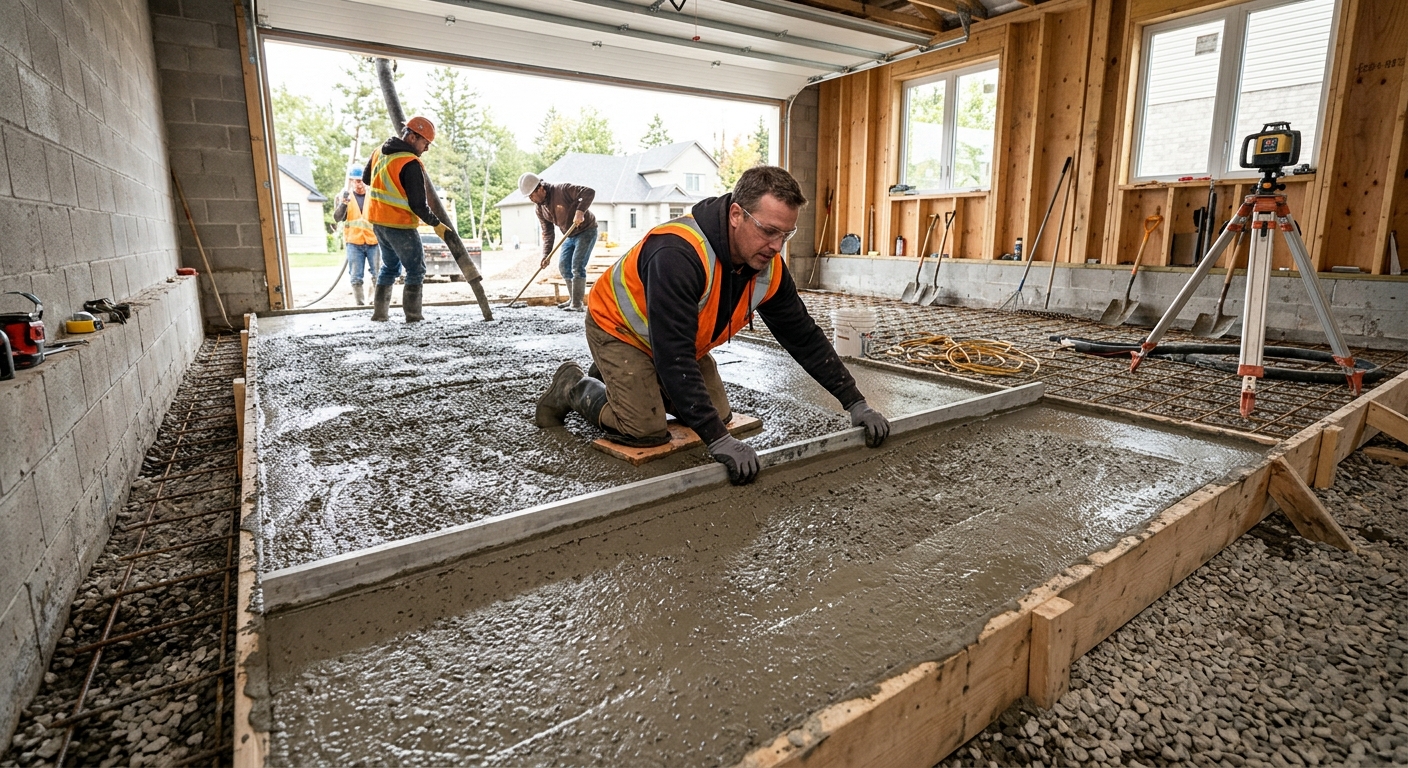
Concrete work options and costs in Oakville
Oakville homeowners usually start with three common concrete projects: driveways, patios/walkways, and foundation-related work. In a market where single-detached houses make up 58.6% of dwellings and about 77.5% of households own their homes (Statistics Canada, 2021 Census), there’s steady demand for exterior flatwork that looks good and performs through winter. It’s also why you’ll notice crews working in pockets like Trafalgar Village and north Oakville during peak season—those neighbourhoods tend to have a lot of older lots and established driveway/patio replacements.
Pricing in the Toronto economic region is shaped by frost depth, freeze–thaw cycles, and how long concrete can safely cure at workable temperatures. Ontario building practices typically require structural footings to extend at least 1.2 m below grade to reduce frost heave and differential movement. For exterior slabs, contractors often specify air-entrained mixes, adequate thickness, and proper drainage so saturated soils don’t expand and contract against the concrete each winter. Even when the scope is similar, one contractor’s protection plan for late-fall pours (blankets, insulated forms, and longer cure management near 10 °C or below) can be the difference between durable concrete and early surface scaling.
Because Oakville has a large homeowner base—median household income was $128,000 in 2020 (Statistics Canada, 2021 Census)—many owners also choose upgrades like stamped or exposed aggregate to improve curb appeal. Below is a practical comparison of typical sizes, specs, and realistic price bands so you can line up apples-to-apples when you request quotes.
| Application |
Typical Size |
Key Spec |
Finish Option |
Price Range |
| Concrete driveway (standard broom finish) |
400–600 sq. ft. |
Air-entrained mix, compacted granular base, control joints |
Broomed surface |
$18,000–$28,000 |
| Exposed aggregate driveway |
400–600 sq. ft. |
Air-entrained mix, proper base and curing plan |
Exposed aggregate finish |
$24,000–$34,000 |
| Stamped concrete driveway or patio |
250–500 sq. ft. |
Air-entrained mix, stamping, release agent, joint plan |
Stamped pattern |
$24,000–$40,000 |
| Plain concrete patio or walkway |
200–400 sq. ft. |
Drainage slope, compacted base, air-entrained mix |
Plain trowel/broom finish |
$16,000–$26,000 |
| Garage floor (interior slab) |
300–600 sq. ft. |
Vapour barrier (as applicable), wire mesh/rebar where required |
Steel trowel finish |
$18,000–$32,000 |
| Foundation footings (structural, below frost) |
Per linear foot / per engineered plan |
Excavation, reinforcement, engineered depth below frost |
Structural concrete only |
$180–$300 |
Prices are estimates only and vary by project scope, site access and material selection.
What affects the price of concrete work in Oakville
In the Toronto economic region, it’s common to see quotes for the same concrete scope vary by 30–50%. The biggest reasons aren’t just “who is cheaper”—they’re the details: base depth and compaction, reinforcement decisions, the air-entrained mix design, curing protection, and whether disposal and regrading are fully included. Contractors who build in proper freeze–thaw durability often cost more upfront, but they’re planning for the realities of Oakville’s winters.
Frost line depth and freeze–thaw cycles dictate nearly every spec here. Structural footings must extend below the design frost depth to prevent frost heave and differential movement, and that typically means deeper excavation, taller forms, and more concrete volume than owners expect. Exterior slabs and flatwork should use air-entrained concrete mixes to help resist freeze–thaw damage, and they need well-compacted granular base plus drainage so water doesn’t sit under the slab. Toronto-area pours are also heavily concentrated in the warmer months; when temperatures drop toward 10 °C or below, cold-weather curing precautions (insulation blankets, heated enclosures for critical pours, and adjusted scheduling) add labour and materials.
Two quick Oakville examples: (1) If your driveway ties into an existing curb or sidewalk and the contractor has to saw-cut, remove, and haul off thick old concrete, the excavation and disposal line item can push the driveway toward the upper end of the $18–$28 band. (2) If your patio area is shaded, drains poorly, or sits on a wetter subgrade, the contractor may need additional base and a more robust slope plan—often justifying a jump from plain flatwork pricing into the stamped or exposed aggregate band of $24–$40.
Finally, housing age plays a role: 27.0% of homes were built before 1981 (Statistics Canada, 2021 Census). Older driveways and patios frequently involve poorer subgrade conditions and buried services, which increases the chance of encountering utility adjustments during excavation—another reason quotes can differ significantly.
| Price Factor |
Why It Matters |
Cost Impact |
| Frost line depth — determines footing depth and form height |
Controls excavation volume and reduces frost heave risk |
Higher depth = more concrete + more labour; can shift structural costs materially |
| Site preparation — excavation, grading, compacted granular base |
Ensures stable support and drainage under exterior slabs |
More base depth and compaction time increases price, but reduces future settlement |
| Reinforcement — rebar or wire mesh requirement |
Improves slab performance over subgrade movement |
Materials and placement labour add cost; omission increases cracking/spalling risk |
| Mix design — air-entrainment and compressive strength spec |
Targets freeze–thaw durability for Oakville winters |
Better mix spec costs slightly more but avoids premature scaling |
| Finish type — broom vs. stamped vs. exposed aggregate |
Different labour, materials, and curing/finishing process |
Stamped/exposed aggregate typically adds significant labour and specialty finishing |
| Pour size and concrete truck access to site |
Manages logistics and avoids delays |
Limited access or long carry distances can add crew time |
| Cold-weather curing precautions — heating and blankets |
Protects early-age strength gain |
More equipment and labour when scheduling into shoulder season |
| Control joint pattern and sealing cost |
Reduces random cracking and limits water intrusion |
Proper jointing and sealing add scope but help long-term durability |
Permits & regulations in Ontario
In Ontario, structural concrete work—such as footings, foundation walls, and grade beams—almost always triggers a building permit, and municipalities often require engineered drawings for compliance and safety. For your Oakville project, the permit pathway matters because it affects how the design depth, reinforcement, and inspection schedule are handled before concrete is placed. If you’re doing a foundation repair or underpinning, expect reviews tied to load paths and frost-protected details.
Concrete flatwork (patios, walkways, and driveways) typically does not require a permit by default. That said, a permit may be needed if the work changes lot grading, alters drainage in a way that impacts neighbouring properties, involves impervious surface coverage thresholds, or affects the municipal right-of-way (for example, sidewalk/apron work). Before anyone breaks ground, confirm with the Town of Oakville—especially if you’re adjusting elevations, adding a new drain, or modifying connections to existing infrastructure.
Step-by-step for verifying a contractor in Ontario: (1) Ask for their certificate of insurance (liability) and confirm the coverage is current and includes concrete-related operations. (2) Request evidence of WSIB/WCB clearance for workers. (3) Use Ontario’s business registry resources to verify the legal entity name matches the quote and contract. (4) Review the “certificate of insurance” for limits and expiry dates—don’t accept expired documents. (5) If the job is structural, ensure the contractor is coordinating inspections and provides a clear engineered plan package for the work scope.
Getting concrete right in Oakville's freeze-thaw climate
Concrete failures in Oakville are usually a freeze–thaw story combined with water management and workmanship. The most common issues I see are spalling (flaking) from insufficient air-entrainment, scaling from poor curing in cool weather, and cracking linked to inadequate base prep or incorrect jointing. When you spec your project correctly, you prevent water from getting in, give the concrete proper support, and control where cracking should happen.
Start with base preparation: use a properly compacted granular sub-base and build the thickness to suit local soil and frost movement potential. Next, mix design: for exterior flatwork, you should expect air-entrained concrete with target air content in the 5–7% range, along with a minimum 32 MPa compressive strength spec. In Toronto-area freeze–thaw conditions, that air-void system is what helps concrete survive repeated winters.
Then manage cracks with control joints. Spacing should limit random cracking, and joints should be planned so they match slab geometry. Curing is critical: plan for at least 7 days of proper curing conditions, and in cooler shoulder-season weather, contractors should protect the pour with insulation and scheduling controls so strength develops before freeze risk. Finally, sealing matters for Oakville driveways and patios: apply a penetrating sealer after the concrete has cured—typically around 28 days post-pour—to repel de-icing salts and reduce surface water uptake.
As for cost justification: if a broom-finished driveway quote sits near the $18–$28 band, that usually reflects correct base, air-entrained mix, and jointing. Paying extra for stamped or exposed aggregate (often in the $24–$40 range) is justified when you want curb appeal and the contractor is still using the same durability-grade mix and curing plan—otherwise you’re just paying more for the same failure risk.
| Spec |
Why It Matters in Oakville |
What to Ask For |
Impact if Skipped |
| Compacted granular base (depth?) |
Prevents settlement and reduces water expansion/contraction effects |
“Show me base thickness and compaction method; what granular material is used?” |
Premature cracking, uneven surface, and poor drainage |
| Air-entrained concrete mix (target air %?) |
Helps concrete withstand Oakville freeze–thaw cycles |
“What is the target air content (5–7%) and mix design details?” |
Spalling and scaling during winters |
| Compressive strength (MPa rating) |
Ensures durability and adequate early-age strength gain |
“Is minimum 32 MPa specified, and is it tested per standard practice?” |
Surface wear, cracking, and reduced service life |
| Control joints (spacing per ACI guidelines) |
Controls where shrinkage cracking occurs |
“What joint spacing will you use, and where exactly will they be cut/sealed?” |
Random cracks and water intrusion into the slab |
| Minimum 7-day curing period |
Strength gain must progress before freeze risk and early traffic |
“How do you protect curing in cooler weather, and what’s the traffic restriction plan?” |
Weak surface, scaling, and curling/warping |
| Penetrating sealer (when applied after cure) |
Repels de-icing salts and reduces moisture uptake |
“Will you apply penetrating sealer around 28 days after pour, and which product?” |
Faster deterioration of the surface and more staining |
How to choose a concrete work contractor in Oakville
Choosing a concrete contractor in Oakville should be evidence-based, not based on the lowest number on a page. Start by verifying Ontario compliance: ask for a current certificate of insurance (liability), evidence of WSIB/WCB coverage for workers, and confirm the company’s legal name matches the contract. If the job is structural (footings/foundation work), ensure they understand permit timelines, engineered drawing requirements, and inspection sequencing.
Next, request 2–3 itemised written quotes that separate labour and materials instead of one lump sum. Good quotes clearly list excavation and disposal, base preparation and compaction, reinforcement (if needed), concrete quantity, finishing, and—if included—curing protection and sealing. Confirm whether a permit pull is included where required, and whether sidewalk/curb modifications fall under an approved scope. Also ask what’s excluded: landscaping reinstatement, snow cover protection, drain adjustments, or restoring grass sod.
Warranty matters. Ask for workmanship warranty length and what it covers (typically surface/installation issues, not normal wear). Understand whether product/manufacturer warranties are provided and if they’re transferable. On payment schedule, avoid large upfront deposits—many reputable contractors keep initial payment around 10–15% and hold back the remainder until the work is complete and documented.
Finally, timeline: get a written start date, concrete delivery day, and completion estimate. In our freeze–thaw climate, scheduling into shoulder season affects curing risk—experienced crews plan protection so the job doesn’t fail due to timing.
- Provide proof of current liability insurance (with expiry date) and WSIB/WCB clearance.
- Use itemised quotes with labour, materials, and disposal/grading listed separately.
- Confirm whether base thickness and compaction targets are included—not just “remove and pour.”
- Ask for the mix design: air-entrainment target and minimum compressive strength (e.g., 32 MPa).
- Require a written curing and cold-weather protection plan if the pour may run late in the season.
- Verify reinforcement approach (mesh vs. rebar) based on slab purpose and local conditions.
- Confirm control joint spacing and whether joints will be sealed if the design calls for it.
- Ask who supplies the concrete and whether delivery logistics/access are included in scheduling.
- Check whether sealing is included and when it will be applied (typically around 28 days post-pour).
- Get permit responsibility clear: what’s handled by the contractor vs. what the homeowner must arrange.
- Review warranty terms in writing, including exclusions and how claims are processed.
- Avoid paying more than 10–15% upfront; hold back until final inspection/cleanup is complete.
In Oakville, concrete red flags include: promises of “cheap concrete” without specifying air-entrainment; skipping or minimizing base depth and compaction; no plan for curing protection if temperatures drop; vague jointing (no spacing plan) paired with “no sealing needed”; and contractors asking for most payment upfront before any pour or prep is completed.
Frequently asked questions — concrete work in Oakville
What causes concrete to spall in Oakville winters?
Spalling—when surface concrete flakes or pops off—typically comes from freeze–thaw stress plus water getting into the slab. In Oakville and the broader Toronto region, repeated winter cycles stress concrete repeatedly, especially if the mix isn’t properly air-entrained or if the slab stays wet. De-icing salt can accelerate surface deterioration by increasing chemical exposure, which is why sealing matters. Another contributor is poor base prep or drainage: when water pools or sits beneath the slab, freeze–thaw can magnify movement. The fix isn’t just “patching”—it’s specifying air-entrainment and correct curing, then using a penetrating sealer after the concrete cures (often around 28 days). If you’re comparing quotes, don’t ignore the difference between a budget finish and a durability-focused spec.
What is rebar and when is it required in Ontario?
Rebar (reinforcing steel bars) are used to strengthen concrete against cracking and movement, especially where loads, shrinkage, or subgrade conditions make cracking more likely. In Ontario, whether rebar is required depends on the engineered design (for structural elements) and the slab’s intended use and thickness. For foundation-related work like footings, foundation walls, and grade beams, rebar requirements are typically defined by engineered drawings and permit inspections. For driveways and patios, it’s often a “design- and base-dependent” decision—some projects use wire mesh or rebar based on thickness, support conditions, and reinforcement needs. In Oakville’s freeze–thaw environment, the better contractors match reinforcement to the spec and don’t just “use extra steel” for no reason. Ask your contractor to explain their reinforcement plan in writing.
How long does a concrete project take in Oakville?
Timeline depends on size, access, and whether the scope includes excavation, base work, reinforcement, and finishing. A typical exterior flatwork project (for example, a patio or walkway) often takes about 2–4 days on site, including prep and finishing, with additional time for cure before full use. A driveway can take longer due to larger removal and more complex grading—often a few days for the active work, plus curing and protection. The weather and temperature during curing are crucial in Oakville: if pours occur near cooler periods, contractors may need insulated blankets and longer restrictions on traffic and vehicle loading to protect early-age strength. Even though concrete looks “dry” sooner, you should plan around curing time—minimum 7 days for basic strength development, and longer before stressing joints and finished surfaces.
What is a concrete overlay and is it suited to Oakville?
A concrete overlay is a new layer of concrete placed over an existing concrete slab—usually after preparation like cleaning, crack treatment, and sometimes bonding system installation. In Oakville, overlay can be suited when the underlying slab is structurally sound (not heavily heaved, extensively undermined, or failing at the base). If the original concrete is already moving because of poor drainage or subgrade, an overlay may fail sooner because freeze–thaw movement continues underneath. Overlays also need careful attention to joint strategy and proper drainage so water doesn’t get trapped. Cost-wise, overlays can sometimes be less expensive than full removal, but when the existing slab is deteriorated or the base is compromised, full replacement may be the safer route—often closer to the $18–$28 driveway band depending on size and site work. A contractor should assess the slab condition before recommending overlay.
How do I seal concrete to protect it in Oakville?
Sealing helps repel water and de-icing salt exposure, which is especially helpful in Oakville’s humid winters and freeze–thaw cycles. The key is timing and product type. Use a penetrating sealer, not a surface film, and apply it after the concrete has cured—commonly around 28 days post-pour—so you’re sealing a mature, stable slab. Before sealing, the surface must be clean and dry; residues or curing compounds can prevent proper absorption. After sealing, avoid washing the surface for a period recommended by the manufacturer and keep vehicles off until fully cured. Sealing cost is often part of a contractor’s quote only when explicitly included—so confirm if sealing is included for your project. If your quote lands in the mid-range, it may or may not include sealing depending on what the scope covers.
What is the difference between concrete and cement?
People often use the terms interchangeably, but they’re not the same thing. Cement is the binding ingredient—an industrial powder—used inside concrete. Concrete is the full engineered mixture: cement plus water, aggregates (sand and gravel/crushed stone), and sometimes admixtures like air-entrainment for durability in freeze–thaw climates. In Oakville exterior work, the air-entraining component is a critical part of the concrete mix design that helps manage freeze–thaw stress and reduces spalling risk. When contractors quote projects in bands like $16–$26 for a plain patio/walkway or $18–$28 for a driveway, the price differences aren’t just “cement cost”—they reflect the full mix, base preparation, thickness, finishing labour, and curing/protection decisions. So when comparing quotes, ask what the contractor is specifying for the complete concrete mix, not only the cement brand.