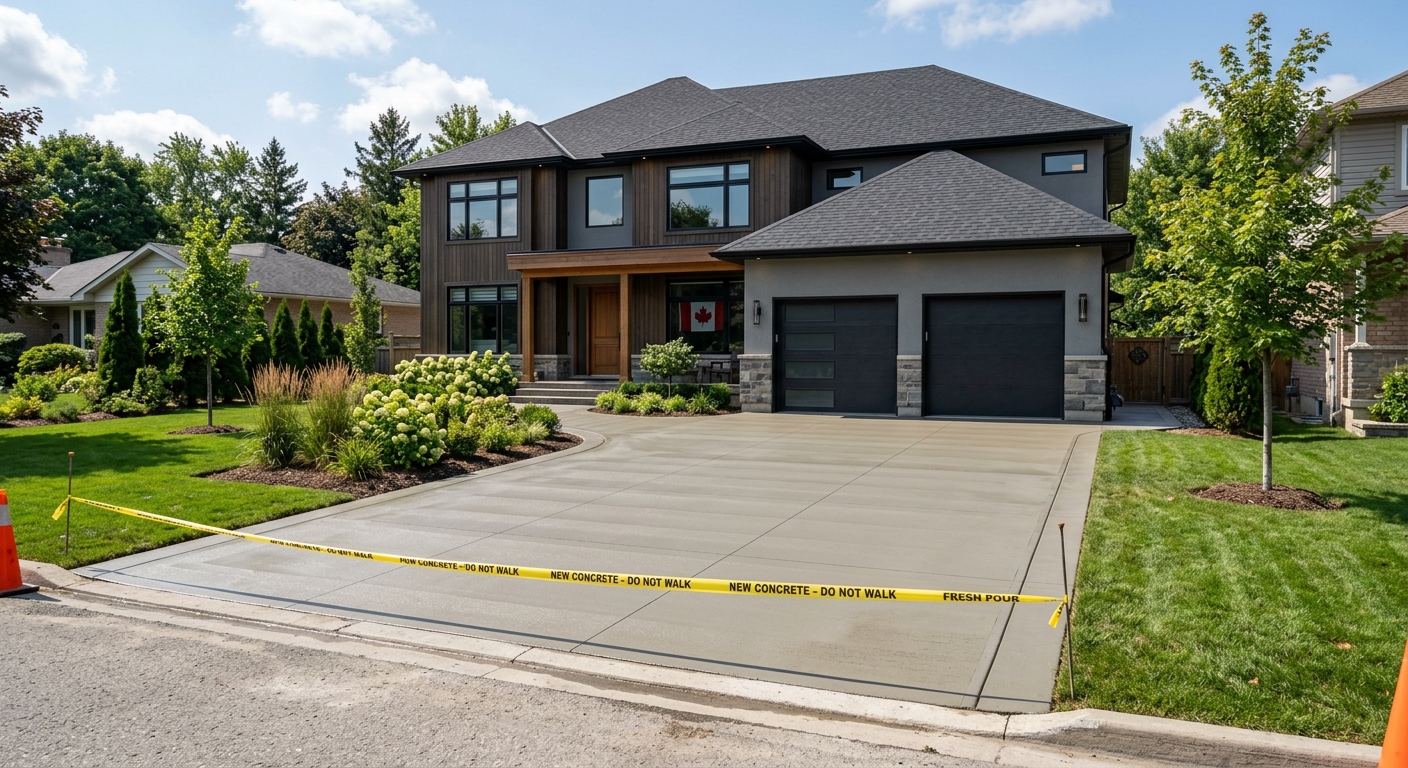
Concrete work options and costs in Sault Ste. Marie
Sault Ste. Marie homeowners typically choose concrete for driveways, patios, walkways and basement/garage slabs because it’s dependable and easy to maintain when it’s built for our freeze–thaw weather. In 2021, the city had 72,051 residents and 68.3% of households owned their homes (Statistics Canada, 2021 Census), which is a large part of why concrete flatwork demand is steady. Single-detached houses make up 65.0% of dwellings—exactly the housing type that receives routine driveway widening, garage slab upgrades and new steps in neighbourhoods like Northern Avenue and the west-end areas near the escarpment.
Concrete costs here don’t just reflect materials; Northeast winter conditions shape the whole job. Freeze–thaw cycles demand proper air-entrainment and drainage, while cold snaps require cold-weather curing protection so the slab reaches design strength before surface exposure. That means more time on prep, tighter control-joint planning and sometimes extra curing measures—cost drivers that can make the same “square footage” work price 10–25% higher than homeowners expect.
You’ll also see practical differences between finishes. Standard broom-finished driveways are usually the lowest-cost option in the $18–$28 band, while stamped and decorative work commonly lands in the $25–$40 range once forms, surface prep and release systems are included. Below are realistic per-project starting ranges, so you can compare contractor quotes apples-to-apples.
| Application |
Typical Size |
Key Spec |
Finish Option |
Price Range |
| Concrete driveway (standard broom finish) |
400 sq. ft. |
Air-entrained mix, wire mesh or rebar where required |
Broom texture + control joints |
$7,200–$11,200 |
| Exposed aggregate driveway |
400 sq. ft. |
Air-entrained mix, proper curing for clean exposure |
Exposed aggregate (washed surface) |
$10,400–$14,600 |
| Stamped concrete driveway or patio |
300 sq. ft. |
Air-entrained mix, stain/release system (as specified) |
Stamp pattern + color hardener/sealer |
$7,500–$12,000 |
| Plain concrete patio or walkway |
200 sq. ft. |
Compacted base + air-entrained concrete |
Float + broom edge (minimal decoration) |
$3,000–$5,000 |
| Garage floor (interior slab) |
480 sq. ft. |
Vapour barrier (if required) + reinforcement as specified |
Light broom or smooth trowel finish |
$9,600–$16,500 |
| Foundation footings (structural, below frost) |
Typical single house footprint |
Structural concrete to engineered section; below frost depth |
Reinforced concrete formwork + proper backfill |
$10,000–$18,000 |
Prices are estimates only and vary by project scope, site access and material selection.
What affects the price of concrete work in Sault Ste. Marie
In Sault Ste. Marie, it’s common to see the same concrete project range 30–50% between quotes—even when the square footage looks identical. That gap usually comes from differences in base preparation, reinforcement choices, mix design, and how contractors protect the pour in cold stretches. In the Northeast region’s winter-like conditions (freeze–thaw cycles and deeper frost concerns across Ontario climates), the “invisible” parts of the job matter as much as the finished surface.
First, frost and movement control drive cost. Footings must extend below the design frost depth to prevent frost heave and slab cracking; for exterior work, air-entrained concrete is essential to survive repeated freezing and thawing. Second, cold-weather operations shorten the effective pour season and can force more scheduling and labour to hit workable temperatures. Cold-weather curing precautions—insulation, curing blankets, and sometimes heating—add material and labour time. Third, de-icing salt exposure accelerates surface wear and spalling if the mix and finishing/sealing plan isn’t right, so sealing becomes a cost you may want to plan for.
Here are a few local examples of how pricing changes in Sault Ste. Marie: upgrading from broom to stamped concrete can move a driveway from the $18–$28 concrete driveway band into the $25–$40 stamped range because of colour systems and extra labour. Adding proper granular base depth and drainage can look “more expensive” upfront, but it avoids future settlement repairs that often cost several times the initial difference. And older housing stock—75.3% of homes built before 1981 (Statistics Canada, 2021 Census)—often means more foundation irregularities and heavier demo of existing steps, walks or slab sections.
| Price Factor |
Why It Matters |
Cost Impact |
| Frost line depth — determines footing depth and form height |
Controls frost heave risk and cracking by keeping structural elements below movement zones |
Can add significant excavation and formwork labour; largest cost swing on foundations |
| Site preparation — excavation, grading, compacted granular base |
Provides stable support so slabs don’t settle or pump under freeze–thaw cycling |
Higher when soil removal/replacement and haul-off are needed |
| Reinforcement — rebar or wire mesh requirement |
Helps control cracking from loads and temperature movement |
More material + labour time; cost varies with thickness and spans |
| Mix design — air-entrainment and compressive strength spec |
Air entrainment and strength targets are critical for freeze–thaw durability |
Usually modest per yard, but often the difference between “lasts” and “spalls” |
| Finish type — broom vs. stamped vs. exposed aggregate |
Decorative systems require extra prep, materials, curing attention and sealing |
Stamped/exposed typically increases total price versus broom-finish |
| Pour size and concrete truck access to site |
Access affects labour time, pump needs, and placement efficiency |
Hard access (stairs, narrow gates, long carry) can materially raise labour |
| Cold-weather curing precautions — heating and blankets |
Protects early-age concrete so it gains strength and resists surface damage |
Adds materials and time; often scheduled when temperatures dip |
| Control joint pattern and sealing cost |
Controls where cracks form and reduces salt/moisture penetration |
Proper joints plus sealer usually add line-item cost but reduce long-term repairs |
Permits & regulations in Ontario
In Ontario, the permitting and review requirements depend on whether your concrete work is considered structural and whether it impacts grading or stormwater. Structural concrete work—such as footings, foundation walls, grade beams, and other load-bearing foundation elements—typically requires a building permit, and municipalities often expect engineered drawings or stamp verification. For concrete flatwork (driveways, sidewalks, patios and walkways), a permit is often not required, unless the project affects lot grading, drainage patterns, or impervious surface coverage limits, or you’re working near or altering a municipal right-of-way (for example, driveway entrances).
Regardless of whether a permit is required, you should verify your contractor is properly insured and accountable. Step-by-step for Sault Ste. Marie homeowners:
- Check the contractor’s Ontario licensing and business details through the appropriate public registry sources available to you, then confirm the company name matches the quote and invoice.
- Request a current Certificate of Insurance (liability) and confirm it covers concrete work and jobsite operations.
- Ask for proof of WSIB/WCB coverage (or a clear exemption/coverage arrangement where applicable) so you aren’t exposed if a worker is injured.
- Look for references on similar projects (same type of pour, similar driveway thickness, similar site access), not just “finished photos.”
- If the scope includes any foundation modifications or drainage/grading changes, contact the municipality before excavation to confirm whether a permit or approvals are required.
This is the quickest way to reduce surprises and ensure your project is compliant and properly managed from day one.
Getting concrete right in Sault Ste. Marie's freeze-thaw climate
Concrete failures in Sault Ste. Marie are usually traceable to a handful of predictable issues: weak base support, inadequate air-entrainment, poor drainage, missing/incorrect control joints, and rushed curing during cold snaps. When freeze–thaw cycles hit moisture-saturated surfaces, inadequate air content can lead to spalling—tiny pops that become pits and scaling. The fix is to specify the right materials and build process, then verify workmanship milestones.
Start with base preparation: compacted granular sub-base to the correct thickness and to a stable grade. If the base isn’t compacted or drainage isn’t addressed, the slab can settle, crack, and pump fine material over time. Next, mix design matters: for exterior flatwork, use air-entrainment to target about 5–7% air content and specify a minimum 32 MPa compressive strength so the concrete can handle temperature swings. Third, control joints should be planned and cut on a schedule that limits random cracking—joints aren’t optional in a freeze–thaw climate; they’re the map that controls cracking.
Curing is where projects can succeed or fail. Plan for at least 7 days of proper curing under protective conditions, and be ready with curing blankets or insulation when cold weather threatens early-age set. Finally, apply a penetrating sealer after the cure period (commonly around 28 days post-pour). This helps repel de-icing salts and reduces moisture ingress.
Here’s a simple cost example: a standard broom-finish driveway in the $18–$28 band might cost $7,200–$11,200 for 400 sq. ft., while adding sealing and better base/drainage practices could nudge the total toward the upper end. It’s usually justified because it reduces the likelihood of early scaling repairs—which can quickly outpace the cost of doing drainage, joints, and sealing correctly the first time. For stamped concrete, the price rises into the $25–$40 range, and the same durability specs still apply under the decorative surface.
| Spec |
Why It Matters in Sault Ste. Marie |
What to Ask For |
Impact if Skipped |
| Compacted granular base (depth?) |
Prevents settlement and supports the slab through freeze–thaw expansion/contraction |
Confirm sub-base depth, compaction method, and whether drainage/gravel layer is included |
More cracking, rocking, and pumping of fines over winter |
| Air-entrained concrete mix (target air %?) |
Improves freeze–thaw durability by allowing expansion space for freezing water |
Target air content about 5–7% for exterior flatwork (as per spec) |
Higher risk of spalling and surface scaling |
| Compressive strength (MPa rating) |
Ensures the slab reaches sufficient strength for winter loading and early exposure |
Minimum 32 MPa (or higher if engineering calls for it) before allowing full exposure |
Weak early-age concrete leading to faster wear and cracking |
| Control joints (spacing per ACI guidelines) |
Directs shrinkage and movement cracking to predictable locations |
Joint layout and spacing plan; confirm timing of saw-cut or formed joints |
Random cracks that can open and trap moisture |
| Minimum 7-day curing period |
Protects early-age concrete so it gains strength before winter exposure |
Confirm curing method and what happens if temperatures drop at night |
Surface damage, dusting, and reduced long-term durability |
| Penetrating sealer (when applied after cure) |
Helps reduce salt and water penetration at the surface |
Ask for penetrating sealer and application timing after cure (commonly around 28 days) |
Faster scaling and spalling from de-icing salts |
How to choose a concrete work contractor in Sault Ste. Marie
Choosing the right contractor is the best “durability upgrade” you can buy in Ontario. Start by verifying three things: Ontario licensing/business legitimacy, liability insurance, and WSIB/WCB coverage. Ask for the Certificate of Insurance and confirm it’s current (and names the correct legal entity). For WSIB/WCB, request proof of coverage so you know the workers are protected and the company is set up to operate properly on worksites. If they can’t provide documentation quickly, that’s a major warning sign.
Next, get 2–3 itemised written quotes instead of lump sums. You want separate line items for excavation/site prep, granular base and compaction, reinforcement (rebar mesh size and placement), concrete mix (including air-entrainment/strength spec), forming, finishing, and sealing (if included). Also check what’s excluded: disposal/haul-off, saw cutting and joint materials, driveway approach removal, and any permit pull if required for structural work.
Warranty matters too. Ask for a workmanship warranty length and whether product/manufacturer warranties apply to admixtures, sealers, or decorative systems. Clarify whether the warranty is transferable if you sell your home. For payment, avoid paying more than 10–15% upfront. Hold back funds until the final walk-through and curing/sealer steps are complete. Finally, require a written timeline: start date, pour day window, and estimated completion date (including cure/return schedule).
- Provide a written scope with dimensions, thickness, and reinforcement details
- Confirm concrete thickness and whether it meets load needs (driveways vs patios)
- Ask for the concrete mix spec: air-entrainment and minimum compressive strength
- Require a joint plan (locations and timing of cuts)
- Ensure base prep includes granular depth and compaction method
- Get details on drainage where the slab meets the house or garage
- Confirm curing plan for cold nights (blankets/heating if needed)
- Clarify if saw cutting will be done by a specified time after pour
- Confirm whether sealing is included and when it will be applied
- Ask how they handle debris removal and disposal (and whether it’s included)
- Verify insurance certificate and WSIB/WCB coverage before work begins
- Request references for similar projects in Sault Ste. Marie, not just social media posts
Concrete red flags in Sault Ste. Marie: contractors who won’t provide mix/air content details, quotes that omit base prep depth, “we’ll cure it later” promises that ignore early-age temperatures, weak or missing joint layouts, and payment terms that demand large upfront deposits without a clear schedule and milestones.
Frequently asked questions — concrete work in Sault Ste. Marie
Why does concrete crack in Sault Ste. Marie and how is it prevented?
Cracking in Sault Ste. Marie is usually a normal consequence of concrete shrinkage plus movement during freeze–thaw cycles—especially when moisture and salt get into micro-cracks. The biggest prevention tools are a properly compacted granular base, the right air-entrained mix for exterior durability, and an intentional control joint pattern. When joints are cut/formed on schedule, cracks form where they’re designed instead of randomly. Finishing choices matter too: an overly rushed broom finish can trap bleed water. Also, older homes (75.3% built before 1981) often have uneven drainage near foundations, so correcting grading/drainage can reduce stress on the slab. If you’re budgeting, a standard broom driveway often sits around the $18–$28 range, but skipping joints or base prep is what typically leads to premature repair costs.
Stamped vs broom-finish concrete — cost difference?
Stamped concrete costs more because it requires extra steps: release agent, stamp mats, often colour hardener/stain, more careful finishing, and typically additional sealing to protect the decorative surface. In Sault Ste. Marie, you’ll usually see stamped driveway or patio pricing in the $25–$40 band, while broom-finish driveways more commonly fall in the $18–$28 range for similar sizes. The difference isn’t just labour—decorative work also needs tighter surface prep to avoid uneven tone. That said, don’t treat stamped work as “cosmetic only.” The durability specs still have to be correct: air-entrainment for freeze–thaw resistance and a proper joint layout. A contractor who offers “cheap stamping” but can’t explain the mix and joint plan is likely to trade durability for appearance.
When is the best time to pour concrete in Sault Ste. Marie?
The best time is during consistently workable weather when concrete can set and cure without early freezing. In Ontario, that generally means late spring through early fall, depending on nightly temperatures. Even if the daytime weather is mild, cold nights can slow strength gain and increase surface risk—especially for exterior slabs exposed to snowmelt and de-icing salt. A good contractor will discuss a pour-day temperature window and whether they need curing blankets/insulation if temperatures dip. If you’re planning work on a driveway or patio, scheduling earlier in the season can reduce the chance of cold-weather curing add-ons. For homeowners budgeting, those protection measures can push a job toward the upper end of the $18–$28 or $15–$25 bands depending on scope. Ask your contractor what the plan is if a cold snap hits.
How long does concrete take to cure?
Concrete curing is often misunderstood. For typical residential work in Ontario, you should plan for at least 7 days of proper curing before expecting significant early-age durability. However, design strength continues to develop beyond that. For many exposures, sealer application is planned after the concrete has sufficiently cured—often around the 28-day mark for penetrating sealers, especially for driveways where de-icing salts are used. If cold weather is involved, curing must be protected so the slab can gain strength steadily. That’s why reputable Sault Ste. Marie contractors build curing into their timeline rather than treating it as “wait time.” If you want a predictable result, ask for their curing method, what they do at night, and when you can safely return for sealing.
Do I need a permit for concrete work in Ontario?
Often, concrete flatwork like patios, walkways and driveways does not require a building permit, unless it affects grading, impervious surface rules, or a municipal right-of-way. Structural concrete work—like footings, foundation walls and grade beams—typically requires a building permit and often engineered drawings reviewed by the municipality. In Sault Ste. Marie, the practical approach is to confirm before excavation, especially if your work includes drainage changes, foundation alterations, or anything near the property lines that might impact municipal services. Regardless of permits, verify your contractor carries liability insurance and has WSIB/WCB coverage so you’re protected. If a contractor tells you “no permits ever,” ask them to clarify whether your specific scope impacts grading or structural elements.
Concrete vs pavers for a patio in Sault Ste. Marie?
Concrete and pavers can both work well, but they suit different homeowner priorities. Concrete patios are usually more cost-predictable and can be built with air-entrained concrete, a compacted base, controlled joints, and a sealer plan that helps resist freeze–thaw moisture and de-icing salt effects. Pricing for plain concrete patios/walkways typically sits around the $15–$25 band, depending on size and base requirements. Pavers can look great and make repairs easier if a section settles—yet labour often increases for layout precision, edge restraints, and base depth. In Sault Ste. Marie’s freeze–thaw climate, the real “make-or-break” factor is the sub-base and drainage for either choice. Ask each contractor to specify the base depth/compaction, drainage handling, and how they prevent movement at edges and where the patio meets the house.