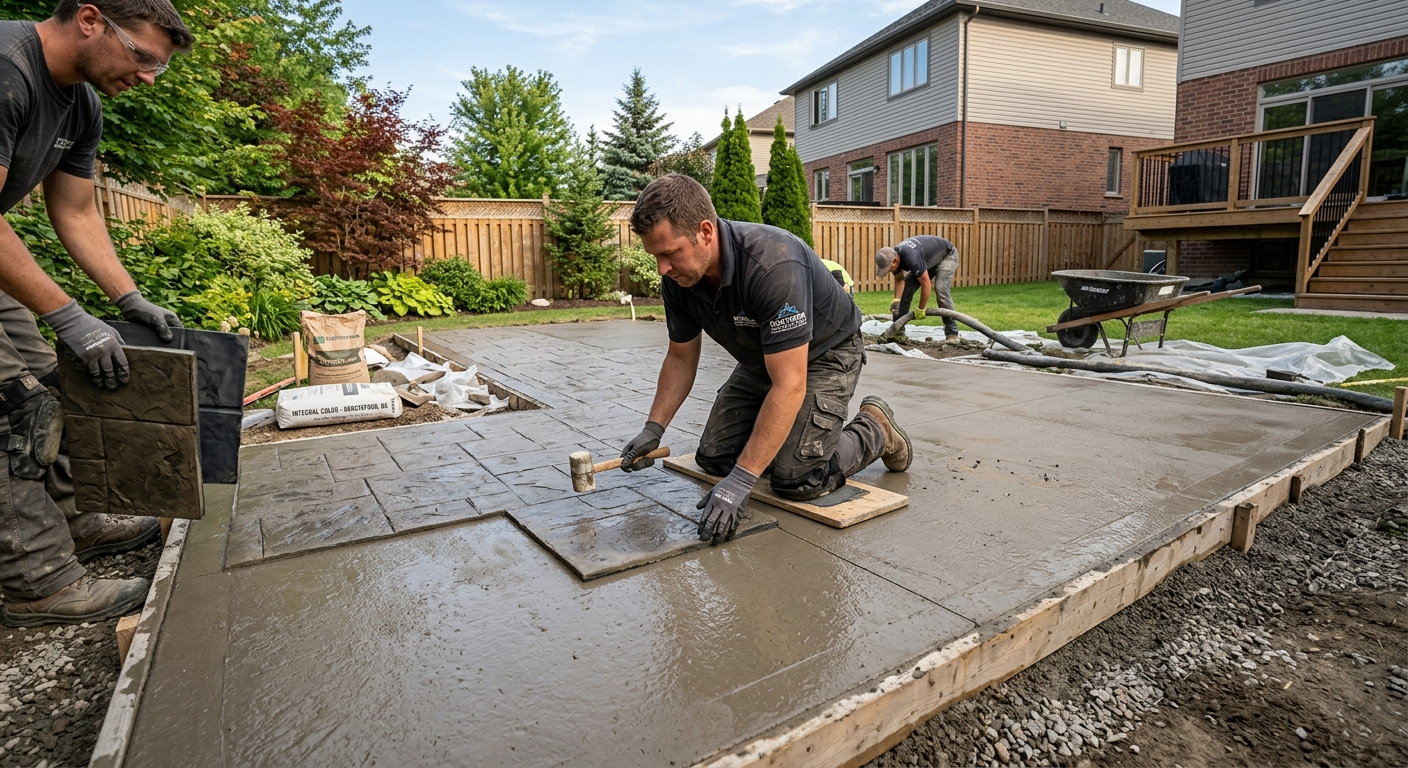
Concrete work options and costs in Markstay-Warren
Markstay-Warren is a tight-knit community in Ontario where concrete flatwork is a big part of keeping older homes functional and curb appeal looking sharp. With 90.1% of dwellings being single-detached houses (Statistics Canada, 2021 Census), most concrete work here is driveway, patio, walkway, and basement/structure-related. The housing stock also skews mature—66.2% of homes were built before 1981—so it’s common to see repairs, replacements, and upgrades to drainage and slab performance rather than brand-new pours only.
Concrete pricing in this area is influenced heavily by Northeast Ontario’s freeze–thaw exposure and how contractors manage frost protection, drainage, and curing. Even if your pour season feels “normal,” the risk of cold nights, fast surface drying, and freeze–thaw strain means crews often plan tighter schedules, stage materials early, and use cold-weather protection when temperatures dip. Jobsite access matters too: narrow driveways, soft shoulders, and longer hauling distances can add time for excavation, granular base prep, and concrete truck setup.
In Markstay-Warren, you’ll typically see the busiest demand around residential pockets where driveways and side walks are most exposed—especially in established lanes outside the core services. When homeowners compare options, broom-finish concrete generally stays the most budget-friendly, while stamped or exposed aggregate is priced higher because of finishing time, materials, and skill. Below is a practical comparison to help you line up scopes before you request quotes.
| Application |
Typical Size |
Key Spec |
Finish Option |
Price Range |
| Concrete driveway (standard broom finish) |
320–480 sq. ft. |
4 in. (100 mm) slab, granular base, air-entrained mix |
Broomed, saw-cut control joints |
$5,760–$13,440 |
| Exposed aggregate driveway |
320–480 sq. ft. |
4 in. (100 mm) slab, air-entrained mix, proper base drainage |
Exposed finish with sealer |
$7,680–$16,800 |
| Stamped concrete driveway or patio |
240–400 sq. ft. |
4 in. (100 mm) slab, air-entrained mix, release agent |
Stamp mats + colour hardener |
$6,000–$16,000 |
| Plain concrete patio or walkway |
120–240 sq. ft. |
4 in. (100 mm) slab, compacted base, air-entrained mix |
Saw-cut joints, broom or smooth float |
$1,800–$6,000 |
| Garage floor (interior slab) |
240–520 sq. ft. |
4–5 in. (100–125 mm), vapour considerations as needed |
Float finish with steel trowel if specified |
$4,800–$15,600 |
| Foundation footings (structural, below frost) |
Varies by design |
Engineered thickness/width, excavation and backfill, below frost |
Structural concrete with reinforcement as required |
$4,500–$18,000 |
Prices are estimates only and vary by project scope, site access and material selection.
What affects the price of concrete work in Markstay-Warren
In Markstay-Warren, it’s common to see quotes for the “same” concrete job vary by 30–50% once you price the details. The main reason isn’t the concrete itself—it’s everything around it: excavation depth, granular base thickness, reinforcement type and quantity, access for the truck, and whether the contractor can cure and protect the pour properly when the weather turns. Two driveways that both end up the same square footage can cost very differently if one requires deeper prep, more drainage work, or extra labour to protect the slab from early freezing.
Frost and freeze–thaw cycles dictate the specs in Ontario: footings must extend below the design frost depth to prevent frost heave and slab cracking. That requirement drives form height, excavation volume, and backfill costs. For exterior slabs and flatwork, we also rely on air-entrained concrete mixes to survive repeated freeze–thaw movement. Cold weather impacts the schedule too—Ontario’s shorter, riskier pour window often pushes crews to pour during safer stretches and use cold-weather curing precautions like insulation blankets or temporary heating on exposed/large pours. Finally, de-icing salt accelerates surface deterioration, so sealing is often a worthwhile line item to keep an exterior slab performing.
In practical terms around Markstay-Warren, deeper excavation for proper base prep can add thousands, while better site drainage can reduce long-term maintenance. An older lot that has settled at the edge of a driveway may require regrading and additional granular base, pushing you toward the higher end of typical driveway pricing (for example, $18–$28 per sq. ft.). Meanwhile, a straightforward patio with good access and minimal demo often stays nearer the lower end of walkway/patio pricing ($15–$25 per sq. ft.).
| Price Factor |
Why It Matters |
Cost Impact |
| Frost line depth — determines footing depth and form height |
Controls how deep excavation and concrete go to prevent frost heave |
Can raise foundation/footing costs materially (more excavation, more concrete, more labour) |
| Site preparation — excavation, grading, compacted granular base |
Improper base leads to settlement and cracking |
Typically the biggest swing factor on flatwork; add-ons like regrading raise cost |
| Reinforcement — rebar or wire mesh requirement |
Supports structural capacity and controls cracking |
Rebar-heavy specs and chairing add labour/materials |
| Mix design — air-entrainment and compressive strength spec |
Survives freeze–thaw and reaches intended strength |
Higher-spec air-entrainment and strength can increase material cost |
| Finish type — broom vs. stamped vs. exposed aggregate |
Finishing time and material complexity |
Stamped/exposed usually add labour and product cost versus broom-finish |
| Pour size and concrete truck access to site |
Changes labour hours and may require smaller/extra loads |
Poor access can increase handling time and truck charges |
| Cold-weather curing precautions — heating and blankets |
Protects early strength gain and surface durability |
Adds material and crew time; prevents premature freeze damage |
| Control joint pattern and sealing cost |
Limits random cracking and improves surface longevity |
Sealing adds a line item, but can reduce spalling and repairs |
Permits & regulations in Ontario
In Ontario, structural concrete work—typically footings, foundation walls, and grade beams—usually requires a building permit, and in many cases engineered drawings reviewed as part of the permit package. For concrete flatwork like patios, walkways, and driveways, a permit is often not required by default, unless your project affects lot grading, interferes with required drainage, triggers impervious surface coverage limits, or impacts a municipal right-of-way or driveway entrance. Even when a permit isn’t required, your local authority can still require conditions (like drainage plans) to protect adjacent properties and municipal infrastructure.
For homeowners in Markstay-Warren, the best approach is to confirm with your municipality before breaking ground and to treat the contractor’s paperwork as part of the scope. Start by verifying the contractor carries liability insurance (request a current Certificate of Insurance) and coverage for workplace injury protection (WSIB/WCB documentation). Then ask for references on similar-scale work—especially exterior flatwork exposed to freeze–thaw.
To verify Ontario compliance step-by-step, use three checks: (1) check the contractor’s licensing/registration information through appropriate provincial business/contractor lookup resources (as applicable for concrete forming/pouring contractors in Ontario), (2) review the Certificate of Insurance for the stated project address/coverage period, and (3) request a WSIB/WCB clearance letter or proof of account status. If they can’t provide documents promptly, that’s a red flag.
Getting concrete right in Markstay-Warren's freeze-thaw climate
Concrete in Markstay-Warren fails most often when one of the “five pillars” isn’t handled correctly: base prep, mix design, jointing, curing, and sealing. Freeze–thaw damage shows up as spalling (flaking), scaling, and cracking—often because the slab isn’t properly air-entrained or because it freezes before it gains sufficient early strength. Moisture must also have a way to drain, which is why compacted granular sub-base and correct grading are non-negotiable for driveways and walkways.
To spec the job correctly, begin with (1) base preparation: compacted granular sub-base to the right depth for local soil and frost protection, with drainage that doesn’t trap water under the slab. (2) mix design: for exterior flatwork, air-entrainment typically targets 5–7% air content, and you should ask for at least a 32 MPa minimum compressive strength specification to achieve durability. (3) control joints: plan saw-cut joints on a spacing that limits random cracking and coordinates with edges and re-entrant corners. (4) curing: plan for minimum 7 days of curing under proper conditions; when cold nights are expected, ask about curing blankets/insulation or other cold-weather protection. (5) sealing: apply a penetrating sealer 28 days after the pour (once fully cured) to repel de-icing salt and reduce scaling.
One quick “money where it matters” example: if a broom-finish driveway quote seems much cheaper than the next one, compare curing protection and base thickness. Cutting corners on curing can cost far more later. A difference of a few hundred dollars today (for better granular prep, correct mix, and sealing) can prevent early spalling repairs that can run into thousands.
| Spec |
Why It Matters in Markstay-Warren |
What to Ask For |
Impact if Skipped |
| Compacted granular base (depth?) |
Reduces settlement and helps frost protection perform as designed |
Base depth and compaction method; confirm drainage grading |
Uneven settling, cracking, and premature edge failure |
| Air-entrained concrete mix (target air %?) |
Protects against freeze–thaw scaling/spalling |
Target 5–7% air for exterior flatwork |
Higher risk of surface scaling and flaking within a few winters |
| Compressive strength (MPa rating) |
Ensures strength gain for durability and load capacity |
Minimum 32 MPa (or higher if specified by design) |
Soft slab, easier cracking, and reduced durability |
| Control joints (spacing per ACI guidelines) |
Controls where cracks form so they’re predictable |
Planned spacing, timing of saw cuts, and joint depth |
Random cracking across bays and edges |
| Minimum 7-day curing period |
Cold nights can stall strength gain and weaken the surface |
Curing schedule and cold-weather protection plan |
Reduced strength, surface damage, and early failure |
| Penetrating sealer (when applied after cure) |
Helps resist de-icing salt penetration and moisture cycling |
Apply penetrating sealer 28 days post-pour (or as recommended) |
Faster scaling/spalling and more frequent maintenance |
How to choose a concrete work contractor in Markstay-Warren
Choosing the right concrete contractor in Markstay-Warren starts with verifying credentials and then matching the quote to the technical scope. In Ontario, ask for proof of liability insurance and request current WSIB/WCB documentation (or clearance letter where applicable). How to check: (1) confirm the Certificate of Insurance is active and includes liability coverage amounts appropriate for the project; (2) make sure the named insured matches the contractor doing the work; and (3) request WSIB/WCB confirmation in writing before any work begins.
Next, don’t rely on a lump-sum number alone. Get 2–3 itemised written quotes with a labour + materials breakdown so you can compare base preparation, reinforcement, mix design, finishing, curing protection, and sealing. Read the scope line-by-line for what’s excluded: excavation limits, disposal of concrete, allowance for extra truck visits, any permit responsibilities (if required), and repair of adjacent landscaping.
For warranty, look for a workmanship warranty length stated clearly and understand whether it covers labour only or labour plus materials for repairs. Ask about any manufacturer product warranty (sealers/admixtures/finishes) and whether it’s transferable to you if you sell the home. On payment schedule, never agree to more than 10–15% upfront; hold back until the work is complete and surfaces are accepted. Finally, require a start date and a completion estimate in writing, and confirm how they handle cold nights—especially if the pour is near the shoulder season.
- Request itemised quotes (labour, materials, excavation, hauling, finishing, sealing).
- Confirm slab thickness and air-entrainment requirements in writing.
- Ask how they handle curing if temperatures drop at night.
- Verify reinforcement type (wire mesh vs rebar) and support/coupler details.
- Confirm base depth, compaction, and drainage grading.
- Ensure joint spacing and saw-cut timing are included.
- Clarify disposal: who hauls away demo and spoil material?
- Check permit responsibility: who pulls it if required?
- Confirm truck access plans (gate/drive width, turning radius, hose/pump notes).
- Get a written warranty for workmanship and what it covers.
- Review payment terms: keep retainage until final completion/acceptance.
- Ask for 2–3 recent references in similar freeze–thaw exposure conditions.
Concrete red flags I see in Markstay-Warren include: vague “standard mix” wording with no air-entrainment spec, quotes that omit base depth/compaction and then promise durability anyway, payment schedules requiring large upfront deposits, no plan for cold-weather curing protection, and finish work (stamping/exposed aggregate) priced without describing timing, release/colour systems, and sealer.
Frequently asked questions — concrete work in Markstay-Warren
How much does concrete work cost in Markstay-Warren?
Concrete pricing in Markstay-Warren depends on site prep, frost protection, and the finish system—not just the square footage. For typical exterior flatwork, many homeowners see driveway concrete in the broader range of $18–$28 per sq. ft., while patios/walkways often land around $15–$25 per sq. ft. The difference comes from base thickness, reinforcement needs, access for the concrete truck, and whether cold-weather curing protection and sealing are included. Stamped concrete usually costs more because of colour materials and finishing labour; exposed aggregate also adds steps. If your lot has older drainage issues (common in homes built before 1981), quotes can move up quickly once excavation and regrading are properly included. (Statistics Canada, 2021 Census)
How deep must footings be for Markstay-Warren's frost line?
Footings must be placed below the local design frost depth so the ground cannot lift the foundation during freeze–thaw cycles. In Ontario, that frost protection requirement is typically addressed in engineered footing designs and local requirements, so the exact depth can vary by soil conditions and the building design. Practically, this means excavation depth and form height are major cost drivers for structural concrete, even before reinforcement and concrete are poured. For homeowners, the key is to avoid guessing: your structural drawings should specify footing dimensions and depth, and your contractor should be building to those specs. When you review a quote, ask whether excavation is included to the required depth and how they handle backfill and compaction below and around the foundation.
Why does concrete crack in Markstay-Warren and how is it prevented?
Concrete cracks for predictable reasons in freeze–thaw climates like Markstay-Warren: moisture movement, temperature shrinkage, and restraint at edges. The most common prevention is proper base preparation so the slab doesn’t settle, plus a correct air-entrainment mix for exterior exposure. Jointing is another big one—control joints need to be planned and cut on schedule so cracking happens in the joints instead of randomly. Curing matters too: if concrete is exposed to early freezing or poor curing conditions, the surface can weaken and become more crack-prone. Finally, sealing helps reduce salt-driven surface deterioration. When you compare quotes, don’t just look at the final finish price—confirm air content, base depth, reinforcement approach, and joint spacing are in the written scope.
Stamped vs broom-finish concrete — cost difference?
Stamped concrete costs more than broom-finish because it requires extra materials and labour—typically colour hardener/release products, careful timing, and more detailed finishing. In Markstay-Warren, homeowners often pay roughly $25–$40 per sq. ft. for stamped and decorative concrete, while standard broom-finish driveway work tends to follow the simpler range of about $18–$28 per sq. ft. That price gap can be justified if you’re getting a consistent joint layout, proper base prep, and correct sealing for durability. If a “cheap” stamped quote sounds too good, ask what’s included for cure protection, sealer type, and how they control joint patterns. In Ontario’s climate, durability failures often come from mix/curing shortcuts more than from the stamp pattern itself.
When is the best time to pour concrete in Markstay-Warren?
The best time to pour concrete in Markstay-Warren is during stretches of stable, warmer weather when the contractor can place, finish, and cure without the risk of early freezing. Even in spring and early summer, cold nights and shoulder-season temperature swings can force extra protection like insulation blankets or curing heat—both of which should be in the plan and price if needed. For homeowners, the practical move is to book your pour window early, so the contractor can schedule around weather. Ask what temperature thresholds they follow and how they protect the slab overnight, especially for driveways and exposed patios that cool faster. If the forecast suggests cold snaps, a reputable contractor should recommend postponing or adding cold-weather curing precautions rather than rushing a weak surface.
How long does concrete take to cure?
Concrete curing has two timeframes: initial strength gain and full curing. For durability in Markstay-Warren’s freeze–thaw climate, the practical minimum is often a 7-day curing period under proper conditions to reach safer handling/early durability. Full cure is typically longer—commonly 28 days—after which the concrete has achieved most of its design strength and the surface is ready for long-term protection. That’s why many exterior projects apply a penetrating sealer only after full cure, often around 28 days post-pour, to better repel de-icing salt and moisture cycling. When you’re budgeting, make sure your contractor includes curing protection in the scope if weather is cool. Skipping proper curing can lead to scaling/spalling that shows up within a few winters.