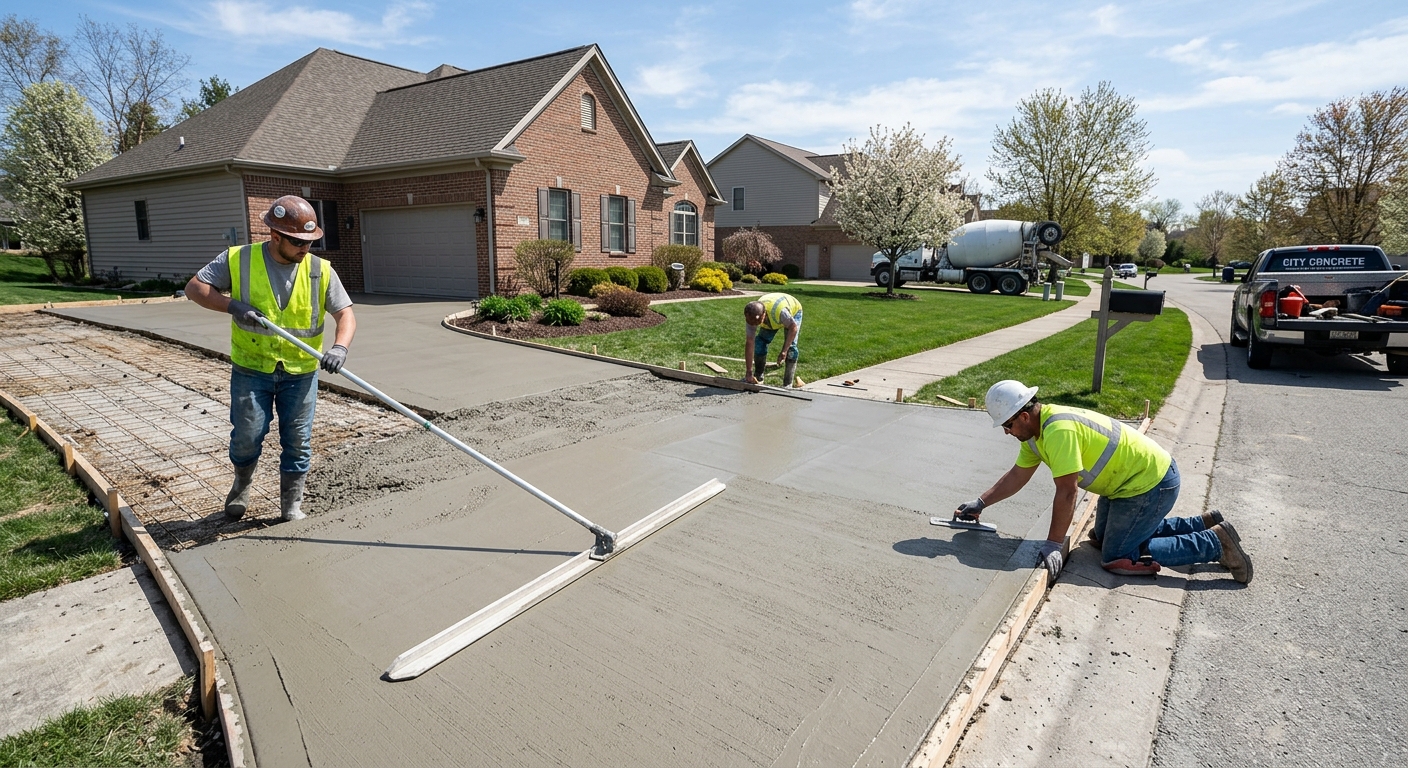
Concrete work options and costs in Chatham
Concrete work in Chatham, Ontario is especially popular for driveways, patios and walkways—flatwork that many homeowners want to handle heavy cars, de-icing salt and the area’s freeze–thaw swings. Chatham’s housing stock is strongly residential in nature, with single-detached dwellings making up a major share of homes (Statistics Canada, 2021 Census). With a population of 43,550 (Statistics Canada, 2021 Census), demand is steady year-round, but the concrete season really tightens when the ground gets saturated in shoulder months.
In the Windsor–Sarnia region, frost and moisture are the cost drivers. Footings and exterior slabs generally need to be engineered and built to withstand repeated freezing and thawing, which means air-entrained mixes, well-compacted granular bases, and tighter control of curing. Contractors also plan crack management carefully—control joints and/or saw-cutting have to be done on schedule. If the slab stays wet while temperatures swing, you can get surface scaling and spalling, so drainage and curing steps matter.
In Chatham, demand is often highest in established neighbourhoods with older lot grading and more rework needs, such as East Chatham and north-side residential areas. That mix of retrofits and new installs is part of why you’ll see wider price ranges than you might expect for “the same” concrete job. Below is a practical comparison table so you can line up what you’re actually getting before you review quotes.
| Application |
Typical Size |
Key Spec |
Finish Option |
Price Range |
| Concrete driveway (standard broom finish) |
10 m x 3 m (30 m²) |
Air-entrained mix, proper granular base, control joints |
Broom-finished |
$5,500 – $15,000 |
| Exposed aggregate driveway |
10 m x 3 m (30 m²) |
Air-entrained mix, base compaction, aggregate exposure process |
Exposed aggregate (sand-blast or wash) |
$7,000 – $18,000 |
| Stamped concrete driveway or patio |
8 m x 4 m (32 m²) |
Air-entrained mix, integral color, engineered joint pattern |
Stamped + textured sealer-ready finish |
$7,500 – $22,000 |
| Plain concrete patio or walkway |
6 m x 3 m (18 m²) |
Air-entrained mix, slope for drainage, joints as needed |
Float/finish with light broom |
$3,500 – $9,000 |
| Garage floor (interior slab) |
6 m x 6 m (36 m²) |
Minimum slab thickness, wire mesh or rebar as specified |
Float finish (option for hardener) |
$6,000 – $14,500 |
| Foundation footings (structural, below frost) |
Perimeter ~40 m (varies by plan) |
Below frost elevation, rebar, engineered formwork |
Structural concrete |
$12,000 – $35,000 |
Prices are estimates only and vary by project scope, site access and material selection.
What affects the price of concrete work in Chatham
In Chatham and across Southwestern Ontario’s Windsor–Sarnia region, quotes for the “same” concrete project can vary by 30–50% because the real cost sits in the details: how deep you must dig, how much reinforcement you need, what the soil and drainage are doing, and how cold-weather placement is managed. Even within Ontario, the region’s cold, lake-influenced climate pushes contractors to spend more up front on base preparation, air-entrainment, and curing—steps that prevent freeze–thaw damage later.
Footings must be built to extend below the design frost depth, and that drives excavations, form height, and concrete volume. Exterior slabs also need air-entrained mixes to survive freeze–thaw cycles and reduce the risk of scaling. When the pour season is effectively shorter, crews may need insulating blankets, temporary heat, or admixtures to keep the concrete developing strength—those cold-weather precautions can add meaningful labour and equipment costs. And because Chatham homes often use de-icing salt, sealing (especially for driveways and patios) becomes more than an aesthetic upgrade.
Here are practical examples of what changes the price in Chatham: a driveway replacement on a tight urban lot in older areas may cost more because access limits truck reach and requires tighter staging; a patio over poorly drained soils can require additional granular base and drainage, pushing the job closer to the $3,500–$9,000 band’s higher end; and stamped work is justified where you want a decorative finish that still needs a proper joint layout—often landing in the $7,500–$22,000 range. Finally, housing age matters: older properties frequently have altered lot grades and thinner existing bases, and fixing those deficiencies is where your “low quote” sometimes disappears.
| Price Factor |
Why It Matters |
Cost Impact |
| Frost line depth |
Determines footing depth and the excavation/form height required to prevent frost heave |
Can add major concrete and labour; often shifts foundation/footings pricing toward the upper band |
| Site preparation |
Excavation, grading, and installing a properly compacted granular base so the slab doesn’t settle |
Increases cost where soil is soft/wet or where hauling/disposing is needed |
| Reinforcement |
Rebar or wire mesh supports slabs and helps control cracking from movement |
More steel and tying labour; required more often for larger slabs and some garage/foundation work |
| Mix design |
Air-entrainment and compressive strength requirements for exterior freeze–thaw durability |
Better performance mix can raise material cost but reduces failure risk and callbacks |
| Finish type |
Broom vs. stamped vs. exposed aggregate changes labour, tooling, and curing/sealing needs |
Decorative finishes generally raise pricing versus plain broom-finish work |
| Pour size and concrete truck access to site |
Smaller pours, tight lanes, and long carry distances increase time and staging |
Can push labour costs up quickly on urban lots or rear-yard pours |
| Cold-weather curing precautions |
Heating, blankets, and curing control protect strength gain in shoulder seasons |
Adds equipment and crew time when temperatures drop during placement |
| Control joint pattern and sealing cost |
Proper joint layout reduces random cracking; sealing helps protect from de-icing salt |
Skipping joints costs less today but increases long-term surface failure; sealing is a common add-on |
Permits & regulations in Ontario
In Ontario, structural concrete work typically requires a building permit and, in many cases, engineered drawings reviewed by the municipality—because footings, foundation walls, and grade beams are part of the load-bearing system. Examples of work that usually does require a permit include: foundation/footings, foundation wall pours, grade beams, and other structural elements tied to the engineered foundation plan. For these jobs, plan review and inspections are normal.
By contrast, concrete flatwork like driveways, patios, and walkways often does not require a permit. That said, you should expect permits or additional approvals if the work affects lot grading, touches municipal right-of-way requirements, or impacts impervious surface coverage and drainage plans. The safe approach is to ask the municipality (or have your contractor confirm) before breaking ground.
Before you hire, verify coverage and credentials. Step-by-step for Chatham homeowners: (1) confirm the contractor’s Ontario business information and any required registration through online business/licensing resources; (2) request a Certificate of Insurance showing liability and that you’re listed as an interested party if applicable; (3) confirm WSIB/WCB coverage for workers—ask for proof, not just an assurance; and (4) verify references on similar-scale concrete projects in the same freeze–thaw conditions so you can judge workmanship and finishing quality.
Getting concrete right in Chatham's freeze-thaw climate
Concrete in Chatham fails most often when it’s built for summer assumptions and then exposed to winter’s repeated freeze–thaw cycles. In practice, the biggest triggers are poor base preparation, inadequate air-entrainment, and rushed curing. If the granular base isn’t compacted to the correct depth and if drainage allows water to remain under or at the surface, the slab can heave, settle, or scale. The Windsor–Sarnia region’s lake-influenced temperature swings also mean you need careful control of placement timing and curing—cold weather placement typically costs more, but it’s cheaper than patching cracked, spalled concrete later.
To spec the job correctly, focus on five areas. First, ensure a compacted granular base sized for local soil and frost conditions. Second, use an air-entrained exterior mix—commonly 5–7% air—and don’t accept a lower strength spec than intended (commonly minimum 32 MPa for many residential slabs). Third, plan control joints so cracking happens where you can manage it. Fourth, curing should be at least 7 days under proper conditions, with heating or blankets when temperatures drop. Fifth, apply penetrating sealer at about 28 days post-pour to repel de-icing salts and reduce surface deterioration.
As a cost example: upgrading a standard broom-finished driveway to a sealed, air-entrained exterior mix package may cost you a few hundred to over a thousand dollars depending on slab size and timing, but it’s often the difference between a driveway that stays intact and one that begins scaling within a season. That’s why broom vs. decorative finishes should always be paired with the right frost-proof specs.
| Spec |
Why It Matters in Chatham |
What to Ask For |
Impact if Skipped |
| Compacted granular base (depth?) |
Controls settlement and limits water movement that fuels freeze–thaw damage |
Base depth and compaction method for your soil type; confirm drainage/slope |
Heaving/settling, rocking slab, early cracking and premature surface failure |
| Air-entrained concrete mix (target air %?) |
Protects against scaling and spalling during repeated freezing and thawing |
Verify target air content (commonly 5–7% for exterior flatwork) and mix design |
Higher risk of surface pop-outs and flaking—common “winter damage” symptom |
| Compressive strength (MPa rating) |
Ensures strength gain to withstand loads and temperature swings |
Minimum compressive strength spec (commonly 32 MPa) and curing plan |
Weaker concrete can crack faster under vehicle loads and thermal movement |
| Control joints (spacing per ACI guidelines) |
Controls where cracks form so they’re manageable and less damaging |
Joint spacing/layout plan and when saw-cutting will happen |
Random cracking across the slab, trip hazards, and more water intrusion |
| Minimum 7-day curing period |
Allows proper strength development in Chatham’s cold/variable conditions |
Curing method (blankets/heaters if needed) and minimum curing duration |
Surface weakness, dusting, and increased cracking risk |
| Penetrating sealer (when applied after cure) |
Reduces salt and moisture penetration at the surface during winter |
Sealer type and timing (about 28 days post-pour) |
Faster deterioration and scaling from de-icing exposure |
How to choose a concrete work contractor in Chatham
Choosing the right concrete contractor in Chatham comes down to proof, paperwork, and workmanship detail—not just the lowest line price. First, verify Ontario credentials: ask for the contractor’s business/license information (where applicable for your contractor type) and confirm they carry liability insurance. Next, require proof of WSIB (or the applicable worker coverage) so you’re not left exposed if someone gets hurt on your site. Get a Certificate of Insurance and read the coverage limits; then ask for confirmation your property isn’t just “covered in theory.”
Second, get 2–3 itemised written quotes that separate labour, concrete supply, base/subgrade prep, reinforcement, excavation/haul-away, and finish work (broom, stamped, exposed aggregate). A quote that only lists a single number without scope details is how homeowners end up paying for “change orders” later—especially on driveway projects where access and base depth matter.
Third, read the exclusions: does the quote include permit pull, if required; disposal of excess soil; boring/locating utilities; and saw-cutting/joint sealing as part of the system? Fourth, ask about warranty—workmanship length, product/manufacturer warranty, and whether anything is transferable to future owners if you sell. Finally, pay responsibly: never give more than 10–15% upfront; use a holdback until the job is complete and final grading/cleanup is done. Get an expected start date and completion timeframe in writing so schedule conflicts don’t push you into poor placement conditions.
- Request proof of liability insurance and WSIB/WCB coverage before signing.
- Ask if they build exterior flatwork with air-entrained mix and documented mix specs.
- Confirm base thickness, compaction requirements, and whether drainage/slope is included.
- Require joint layout details (where joints will be and when saw-cutting happens).
- Ask for curing plan: what happens if temperatures drop during the pour.
- Make sure truck access and material staging are included in the quote scope.
- Check whether rebar/wire mesh is included for your slab type and thickness.
- Clarify finish scope (broom finish vs sealed finish vs stamped system).
- Confirm sealing is included for driveways/patios, and timing (after curing).
- Ask how old concrete removal is handled (breaking, disposal, and haul-away).
- Review payment schedule in writing; hold back funds until final acceptance.
- Verify the warranty is in writing and what it covers for cracks/spalling.
Red flags I see in Chatham include: vague “all-in” pricing that doesn’t address base depth and joints, contractors who skip air-entrainment on exterior slabs, promises to pour late in cold weather without heaters/blankets, refusing to provide insurance/WSIB proof, and starting without a clear schedule for curing and saw-cut timing.
Frequently asked questions — concrete work in Chatham
Why does concrete crack in Chatham and how is it prevented?
In Chatham (and across Ontario), cracking is usually about movement plus water and temperature. Freeze–thaw cycles expand and contract the ground and any moisture present at the surface or under the slab. If the granular base isn’t properly compacted or if drainage is poor, the slab can settle or heave. On top of that, exterior slabs must have air-entrained concrete to resist winter damage, plus a correct control joint pattern so cracking occurs where it’s planned, not randomly. Proper curing is critical—especially in spring and fall when overnight temperatures can drop.
Prevention is spec-based: correct base preparation, correct mix design, joints laid out and cut on time, and sealing where de-icing salt is used. If your goal is a driveway replacement, most homeowners in Chatham end up budgeting in the $5,500–$15,000 range for standard broom-finished work, and the best contractors use that budget to do the “boring” durability items that keep cracks under control.
Stamped vs broom-finish concrete — cost difference?
Stamped concrete typically costs more than broom-finished concrete because it includes additional labour, more steps, and specialized materials. Broom-finish work is usually a simpler placement and finishing process—then optional sealing. Stamped work adds form-ready finishing, stamp application, and often integral color or additional surface treatments. In the Windsor–Sarnia freeze–thaw climate, both finishes still require air-entrained concrete, proper base prep, and a joint pattern; stamped just adds the decorative system on top.
For Chatham homeowners, that difference commonly shows up as a shift from the driveway/flatwork broom-finish budget toward the decorative bands. In practical terms, standard driveway work often lands around the $5,500–$15,000 range, while stamped driveway or patio projects commonly land around $7,500–$22,000 depending on square footage, removal, and whether the design includes extra colors and premium sealer.
When is the best time to pour concrete in Chatham?
The “best time” depends on curing conditions, not just when the weather is sunny. In Chatham’s cold, lake-influenced climate, crews prefer pours when the forecast allows steady strength gain—usually late spring through summer, and only into early fall if temperatures and ground conditions stay favourable. Moisture and temperature swings in spring and fall can create problems if contractors don’t plan heating, insulating blankets, or appropriate admixtures.
Homeowners often ask whether a fall pour is “bad.” It can be fine when the contractor has a cold-weather plan: protecting the slab after placement, maintaining curing conditions, and scheduling saw-cutting and joint sealing correctly. If you’re aiming for exterior work like a patio or walkway (often budgeted around $3,500–$9,000), ask the contractor for their placement and curing procedure for that month—especially overnight temps and how they’ll keep the concrete developing strength.
How long does concrete take to cure?
Concrete curing is a process, not a single date. For most residential concrete placements, contractors target minimum 7 days of proper curing before they allow full normal use—this is where correct moisture protection and temperature control matter most in Chatham. However, concrete keeps gaining strength beyond that point. Many durability steps (like certain sealers) are planned around cure time.
For exterior flatwork in Ontario, a common best practice is to apply a penetrating sealer about 28 days after the pour so the surface is dry enough and the concrete has developed the intended strength. If your contractor rushes curing—especially during cold snaps—you may get dusting, surface softness, and higher risk of scaling when de-icing salt is used. If you’re comparing quotes, ask directly how they handle curing under their cold-weather plan and what calendar dates you should expect for joint finishing and sealing.
Do I need a permit for concrete work in Ontario?
In Ontario, structural concrete work generally requires a building permit. That includes footings, foundation walls, and grade beams—these affect the load-bearing system and typically need engineered documentation reviewed by the municipality. For concrete flatwork like driveways, patios, and walkways, a permit often isn’t required, unless the work affects lot grading, drainage, municipal right-of-way conditions, or impervious surface rules. Since these details can vary by site plan and how the work ties into drainage, it’s smart to confirm with your municipality before work starts.
From a homeowner standpoint in Chatham, ask your contractor: “Is a permit required for my scope, and is permit pulling included?” Good contractors will tell you up front whether the job is treated as flatwork only or whether foundation/structural elements are involved. Also ensure the contractor has liability insurance and worker coverage (WSIB/WCB) before you approve any work to begin.
Concrete vs pavers for a patio in Chatham?
For patios in Chatham, both concrete and pavers can perform well, but the decision should be based on how you want the surface to handle water and freeze–thaw. Concrete patios are typically poured on a prepared base and finished to manage drainage. With the right air-entrained mix, proper base compaction, control joints, and sealing timing, concrete can be a durable, low-maintenance option through winter salt exposure.
Pavers can be attractive for repairs because individual units can be replaced if there’s a problem, but they still depend heavily on base preparation and proper bedding so they don’t heave or shift. If you’re comparing initial costs, concrete flatwork often sits around the $3,500–$9,000 range for typical patio/walkway scopes in Chatham, while pavers can come down or go up depending on layout complexity and excavation depth. Ask both contractors what they’re doing for drainage and base depth—those specs matter more than whether the top surface is poured concrete or individual stones.