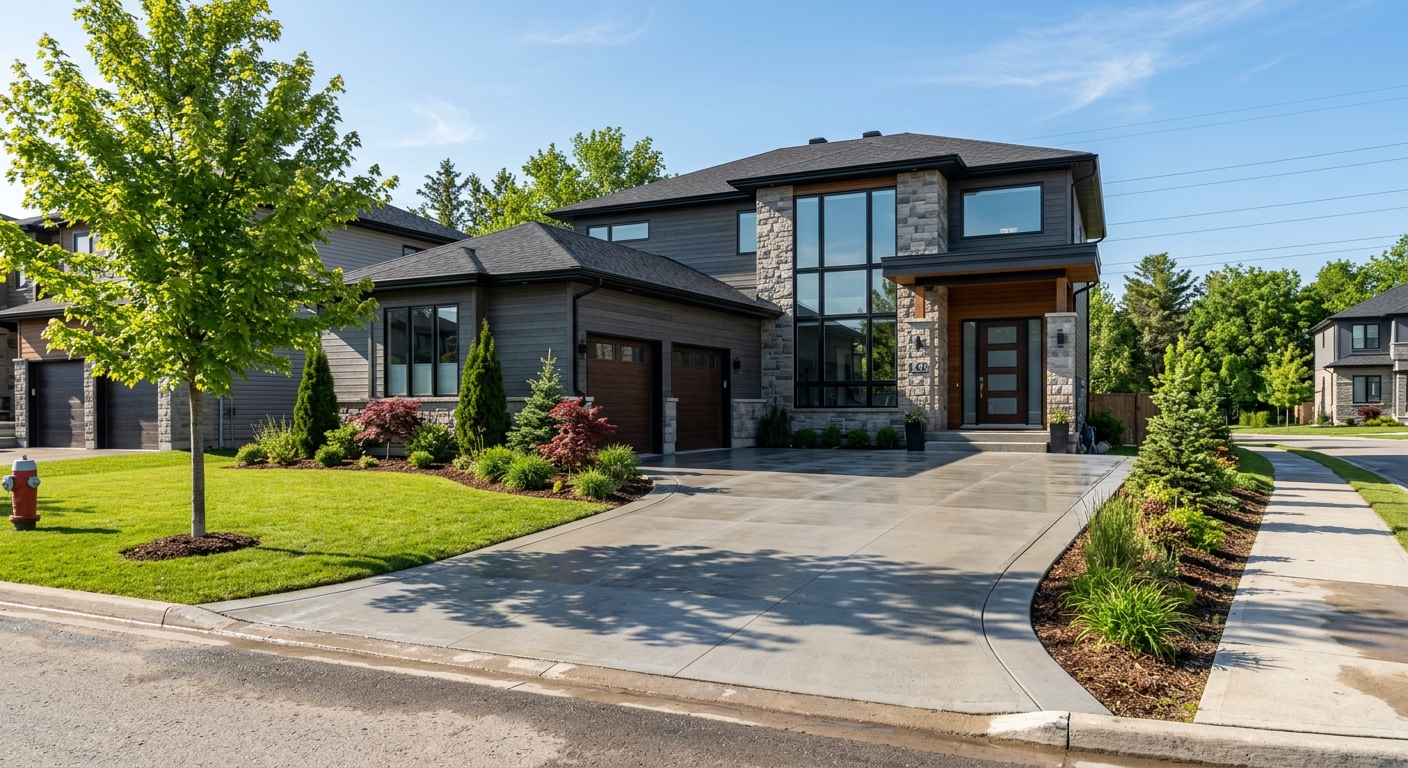
Concrete work options and costs in Fergus
Concrete work in Fergus—especially driveways, patios, and walkways—comes down to whether you want plain durability or a higher-end finish that stays tidy through our wet springs and freeze–thaw winters. In Fergus, most of the concrete demand is tied to the housing style in the area; detached and single-detached homes are the common backdrop for new flatwork upgrades, and the region’s population was 20,767 in the 2021 Census (Statistics Canada, 2021 Census). That kind of steady homeowner turnover supports consistent availability of crews, but it also means you’ll often see crews booking farther ahead for exterior pours.
In the Toronto economic region, concrete pricing is shaped by frost depth and repeated freeze–thaw cycles. For structural work, Ontario typically expects footings to extend at least about 1.2 m (roughly 4 ft) below grade to reduce frost heave and differential movement. For exterior flatwork, contractors commonly specify air-entrained concrete, adequate slab thickness, and well-planned control joints to manage cracking. The Toronto-area pour season is also more temperature-sensitive than many people expect: in shoulder months, even if it’s “not snowing,” curing can be slowed when temperatures drop toward 10 °C or below, which affects labour scheduling and add-on measures like protection blankets.
In Fergus, areas with more frequent landscaping and driveway replacements—like along residential streets near downtown and the busy commercial corridor—tend to see the most demand for standard broom-finished driveways, plus decorative options where homeowners are improving curb appeal. Next, use the comparison table to line up your needs with typical costs for this tier.
| Application |
Typical Size |
Key Spec |
Finish Option |
Price Range |
| Concrete driveway (standard broom finish) |
400–600 sq. ft. (typ. 20’ x 20’) |
Air-entrained mix, compacted granular base, control joints |
Broom finish |
$7,200 – $16,800 |
| Exposed aggregate driveway |
400–600 sq. ft. (typ. 20’ x 20’) |
Air-entrained mix, proper retard/cleaning schedule, good curing |
Exposed aggregate |
$10,000 – $21,000 |
| Stamped concrete driveway or patio |
300–600 sq. ft. |
Air-entrained mix, colour hardener/sealer plan, joint detailing |
Stamped & coloured |
$10,500 – $24,000 |
| Plain concrete patio or walkway |
200–500 sq. ft. |
Compacted base, air-entrained mix, edge forms and joints |
Float & broom finish |
$3,200 – $13,000 |
| Garage floor (interior slab) |
400–600 sq. ft. (typ. 20’ x 20’) |
Vapour barrier (when required), proper thickness, crack control |
Plain trowel/float |
$7,200 – $18,000 |
| Foundation footings (structural, below frost) |
Varies by house size; excavation per linear metres |
Below frost level bearing, engineered reinforcement details |
Structural concrete |
$6,000 – $30,000 |
Prices are estimates only and vary by project scope, site access and material selection.
What affects the price of concrete work in Fergus
You can absolutely see the same “driveway, same size” listed at meaningfully different numbers around the Toronto economic region—often by 30–50%—because concrete is not one material on a single price line. The real cost swings come from what the quote must include: how deep the base is, whether the soil is stable or needs removal/replacement, whether reinforcement is required, and how the contractor handles freeze–thaw durability specs (like air-entrainment and joint layout). Labour availability also matters in peak months when most exterior flatwork is scheduled to pour and cure in warmer weather windows.
In this region, frost depth and freeze–thaw cycles dictate the structure. Footings need to extend below design frost depth (Ontario commonly requires about 1.5–2.4 m in many parts of the province) to prevent frost heave. Exterior slabs are typically air-entrained so the concrete can resist repeated freezing and thawing. When cold weather hits—especially when overnight lows move toward 10 °C or below—cold-weather curing precautions (insulating blankets, heating enclosures, and longer protection) add cost and constrain scheduling. On top of that, de-icing salts can accelerate surface spalling if the concrete and finishing/sealing system isn’t set up correctly.
In Fergus, two common examples drive cost up: (1) soft or waterlogged spots after wet spring weather, which forces additional granular base and better drainage, and (2) narrow access where the truck can’t back up close, increasing labour for wheelbarrow hauling and form adjustments. Costs can be lower when the existing base is in good shape and drainage is already effective—then you may stay closer to the lower end of typical flatwork pricing like $18–$28 per sq. ft. for driveways or $16–$26 per sq. ft. for patios/walkways.
Homes built earlier often also mean more unknowns—old subgrade, settlement around steps, or drainage that directs water toward slabs. Those “surprises” are why detailed site prep and proper frost-proofing can swing a quote by thousands of dollars.
| Price Factor |
Why It Matters |
Cost Impact |
| Frost line depth |
Determines footing depth and excavation/form height |
Can add large excavation and rebar labour; impacts foundation pricing most |
| Site preparation |
Excavation, grading, and compacted granular base affect stability and settlement |
More removal/replacement and hauling increases cost quickly |
| Reinforcement |
Rebar or mesh helps manage cracking and supports loads |
Material + labour increase; required more often for thicker or higher-load slabs |
| Mix design |
Air-entrainment and compressive strength spec protect against freeze–thaw |
Specialty mix can cost more per yard but reduces failure risk |
| Finish type |
Broom vs. stamped vs. exposed aggregate changes labour time and materials |
Decorative finishes typically add significant cost vs. broom-finish |
| Pour size and concrete truck access to site |
Impacts how fast crews can place concrete and how much handwork is needed |
Limited access can increase labour and time-on-site |
| Cold-weather curing precautions |
Heating/protection helps achieve strength gain and surface integrity |
Add-on labour/materials and shorter scheduling windows |
| Control joint pattern and sealing cost |
Joints reduce random cracking; sealing supports salt resistance |
Proper joint saw-cutting and sealing add cost but extend service life |
Permits & regulations in Ontario
In Ontario, the key distinction is whether the concrete work is structural and affects a building’s load path or life-safety elements. Structural concrete work—such as footings, foundation walls, and grade beams—requires a building permit, and in many cases engineered drawings must be reviewed by the municipality. That means the permit process is typically tied to foundation design and structural reinforcement details, not just “pouring concrete.”
Concrete flatwork (patios, walkways, driveways) usually does not require a permit unless it affects lot grading, impervious surface coverage limits, or the municipal right-of-way. If you’re changing drainage patterns, altering slopes, or modifying how water runs off the property, you should confirm requirements before you break ground. As always, verify with the local authority for Fergus-specific direction for your lot.
To verify an Ontario contractor properly, do it step-by-step:
- Check whether the permit/engineering components are handled correctly for structural work—ask the contractor what drawing set or permit package they use.
- Request a certificate of insurance and confirm liability coverage is active and matches the job scale.
- Ask for WSIB/WCB clearance (or the applicable coverage documentation) and verify the paperwork is current.
- Look for references on similar-scale Ontario projects (same foundation scope or exterior flatwork complexity).
- If the contractor is recommending structural modifications, ask how those changes are documented for the permit and inspection steps.
Bottom line: permits are common for foundation/footing work; for driveways and patios, permits are often avoided, but drainage/grading and any right-of-way involvement can change the answer.
Getting concrete right in Fergus's freeze-thaw climate
Concrete failures in Fergus are rarely “mystery problems.” Most issues trace back to a few predictable causes: weak base support, insufficient air-entrainment, poor control joint planning, and rushed curing when temperatures drop. To spec the job correctly, start with the base: use compacted granular sub-base to the right depth for local soil conditions and to achieve the elevation you need without leaving voids where water can collect. In the Toronto region’s freeze–thaw cycle, trapped water near the slab edge or beneath the concrete is a common recipe for scaling and deterioration.
Next is the mix design. For exterior flatwork, you want air-entrained concrete (commonly in the 5–7% air range for durability) plus a minimum 32 MPa compressive strength target. Then plan control joints so cracking is directed, not random—joint spacing and timing matter. Curing is also crucial: plan for at least 7 days of proper curing conditions (including protection if it’s cold), because early freezing can weaken the surface and increase the chance of spalling. Finally, apply a penetrating sealer after cure (typically at 28 days) to repel de-icing salts and reduce moisture uptake.
If you’re choosing between options, remember that paying for durability specs often beats paying for “pretty.” For example, stamped concrete costs more than a plain broom-finished patio, but the best value is when both options use the correct base and air-entrained mix—otherwise the stamped finish can still spall or crack prematurely. The right question to ask isn’t just “how much per square foot?”—it’s “what’s the air content plan, base depth, joint plan, and curing plan?”
| Spec |
Why It Matters in Fergus |
What to Ask For |
Impact if Skipped |
| Compacted granular base (depth?) |
Prevents settlement and limits water movement under the slab during freeze–thaw |
Base depth for your soil + compacted lifts to spec |
Uneven cracking, pumping, and early surface failure |
| Air-entrained concrete mix (target air %?) |
Improves freeze–thaw durability against scaling/spalling |
Air-entrainment plan (commonly 5–7% for exterior flatwork) |
Higher risk of spalling and pitted surface in winter |
| Compressive strength (MPa rating) |
Strength gain supports structural integrity in Ontario weather swings |
Minimum 32 MPa compressive strength spec |
Lower performance and more cracking under stress |
| Control joints (spacing per ACI guidelines) |
Controls where cracks form as temperature cycles change |
Planned joint layout and saw-cut timing |
Random cracking and possible trip hazards |
| Minimum 7-day curing period |
Ensures proper strength development before exposure to cold snaps |
Protection plan if temps drop; curing method description |
Weakened surface, increased scaling, early deterioration |
| Penetrating sealer (when applied after cure) |
Repels moisture and de-icing salt, reducing freeze damage |
Penetrating sealer applied after cure (typically ~28 days) |
More salt-related wear and faster surface breakdown |
How to choose a concrete work contractor in Fergus
Choosing the right concrete contractor in Fergus isn’t just about finding the lowest number—it’s about making sure the quote reflects the durability specs your driveway or foundation needs for Ontario’s freeze–thaw cycle. Start by verifying coverage and licensing basics: ask for a current certificate of liability insurance and confirm the coverage matches the project size. For work performed in Ontario, request WSIB/WCB documentation or clearance evidence and verify it’s active. If the contractor is building something structural (footings/foundation walls), confirm they’re coordinating the permit and engineered requirements where needed.
Then compare quotes the right way: get 2–3 itemised written estimates rather than one lump sum. You want labour and material lines that clearly show excavation and disposal, granular base type and depth, reinforcement (if included), concrete mix description, finish labour, saw cutting for control joints, curing/protection steps, and whether sealing is included. Ask whether a permit is required for the scope you’re doing and whether they include the permit pull (for structural work) or if you’ll handle it.
Warranty matters too. Look for a workmanship warranty length, and ask whether product/manufacturer warranties apply to the materials (like sealers or admixtures). Confirm whether warranties are transferable if you sell your home.
Payment schedule should protect you: don’t pay more than about 10–15% upfront. Hold back the remainder until the job is complete and cleaned up. Finally, get a start date and a realistic completion estimate in writing—peak-season scheduling in the GTA can shift, but you should still have timelines tied to pour and curing conditions.
- Ask for a site visit and base-depth confirmation for your soil condition.
- Require air-entrainment confirmation for exterior flatwork.
- Confirm reinforcement (mesh/rebar) is included if needed for thickness and load.
- Get control joint layout and saw-cut timing in writing.
- Ask how they will protect curing concrete if temperatures drop.
- Confirm disposal/removal of excess soil and concrete is included (not a surprise add-on).
- Verify sealing is included and when it’s applied (typically after cure).
- Request proof of liability insurance and active WSIB/WCB clearance.
- Check whether they handle permits for structural concrete work.
- Make sure quote scope includes forms, edging, and site cleanup/restoration.
- Confirm concrete truck access plan (where they’ll pour from, placement method).
- Get everything itemised: materials, labour, and allowances clearly stated.
Concrete red flags in Fergus: (1) quotes that don’t mention air-entrainment or joint layout for exterior work, (2) no plan for curing protection when the weather turns cool, (3) asking for a large upfront deposit (well beyond 10–15%), (4) unclear reinforcement/base specs, and (5) a refusal to provide proof of WSIB/WCB coverage and liability insurance.
Frequently asked questions — concrete work in Fergus
When is the best time to pour concrete in Fergus?
In Fergus (Ontario), the best time to pour concrete is typically during late spring through summer, when daytime temperatures are reliably warm and curing conditions are easier to manage. Toronto-area crews often schedule exterior work to avoid shoulder-season cold snaps, because concrete needs proper strength gain during the first days—especially when temperatures trend toward 10 °C or below. If you pour too late in the season, you may need insulating blankets or heating protection, which can change the total cost and timeline. For many homeowners, that means aiming for the warmer parts of the year for driveways and patios, and leaving foundation pours only when weather protection can be guaranteed. If you’re comparing prices, expect exterior flatwork to land closer to the band targets like $18–$28 for driveways when conditions are favourable and the base/prep stays straightforward.
How long does concrete take to cure?
Concrete cures in stages. For most exterior flatwork in Ontario, you should plan for at least 7 days of curing under proper conditions to reach a usable strength level before normal exposure. That said, full strength continues developing beyond the first week—often up to 28 days for the full design strength. In Fergus’s freeze–thaw climate, the early period matters most because a cold snap can weaken the surface and increase the chance of scaling or spalling. If work is done in cooler weather, contractors may extend protection time (blankets/heating) so curing isn’t interrupted. If you’re adding a sealer, plan around the cure schedule: penetrating sealer is commonly applied after cure (around 28 days). Don’t treat “hardened-looking” as cured—ask your contractor to describe curing and protection steps in the written scope.
Do I need a permit for concrete work in Ontario?
In Ontario, structural concrete work typically requires a building permit—especially footings, foundation walls, and grade beams. Concrete flatwork like patios, walkways, and driveways usually doesn’t require a permit, unless it affects lot grading, impervious surface rules, or the municipal right-of-way. For homeowners in Fergus, the practical approach is to confirm with the local authority before breaking ground, particularly if you’re changing drainage patterns or elevations near existing features (stairs, slopes, municipal edges). Also verify the contractor has liability insurance and active WSIB/WCB coverage, since permit/inspection jobs can involve multiple trades. If your project is a driveway replacement, you may not need a permit, and the quote may be positioned near typical driveway bands like $18–$28 per sq. ft. for well-prepped standard work—unless grading/drainage triggers extra steps.
Concrete vs pavers for a patio in Fergus?
Both options can work well for Fergus patios, but they fail differently. Concrete is often the best value when you want a uniform surface and the contractor designs base depth, air-entrained mix (for exterior), control joints, and correct curing. Decorative concrete can also deliver a “pavers look” with the right finishing approach, but the durability still depends on the same core specs—base support and freeze–thaw resistance. Pavers, on the other hand, can be easier to adjust or repair if a localized area shifts, but they still require proper base preparation and drainage to prevent movement. In Ontario’s freeze–thaw climate, both systems need drainage and well-compacted base; the difference is how cracks and settlements show up. If your priority is a smooth, low-maintenance finish and straightforward durability, plain concrete patio pricing often falls around $16–$26 per sq. ft. (depending on scope). If your priority is modular repair, pavers can be compelling even when the upfront cost is competitive.
How long does a concrete driveway last?
A well-built concrete driveway in Fergus can last decades, but “how long” depends heavily on what’s under the concrete and how the slab is protected from Ontario winters. Key factors include proper compacted granular base, adequate thickness, correct reinforcement where required, air-entrained mix for freeze–thaw durability, and sensible joint placement so cracks don’t become random. Sealing after proper cure (commonly around 28 days) can help repel moisture and reduce salt-related wear, which is important because de-icing accelerates spalling if the surface is not protected. Many homeowners notice performance differences within the first few winters if air-entrainment and curing were rushed. Pricing also ties into longevity: contractors who price near the low end of a driveway band may be competitive, but you should confirm the quote includes the durability spec details—otherwise you can pay again sooner. Typical driveway cost bands for Fergus tier work often land around $18–$28 per sq. ft., with better prep and finishes at the upper end.
What is air-entrained concrete and why does it matter here?
Air-entrained concrete is mixed with tiny, intentionally created air bubbles that help the concrete tolerate freeze–thaw cycles. When water inside concrete freezes, it expands—without air entrainment, that expansion can crack the surface and lead to scaling or spalling. In Fergus and across the Toronto economic region, freeze–thaw is a year-after-year reality, so exterior flatwork is commonly specified with air-entrainment for durability. The target air content is typically in the 5–7% range for many exterior flatwork applications, and the concrete should also meet a minimum compressive strength target (commonly around 32 MPa). You can ask your contractor to confirm the air-entrainment requirement and the mix details in writing. It’s one of the most important differences between “looks fine today” and “still solid after a few winters,” especially in Ontario where de-icing salts and wet conditions increase exposure.