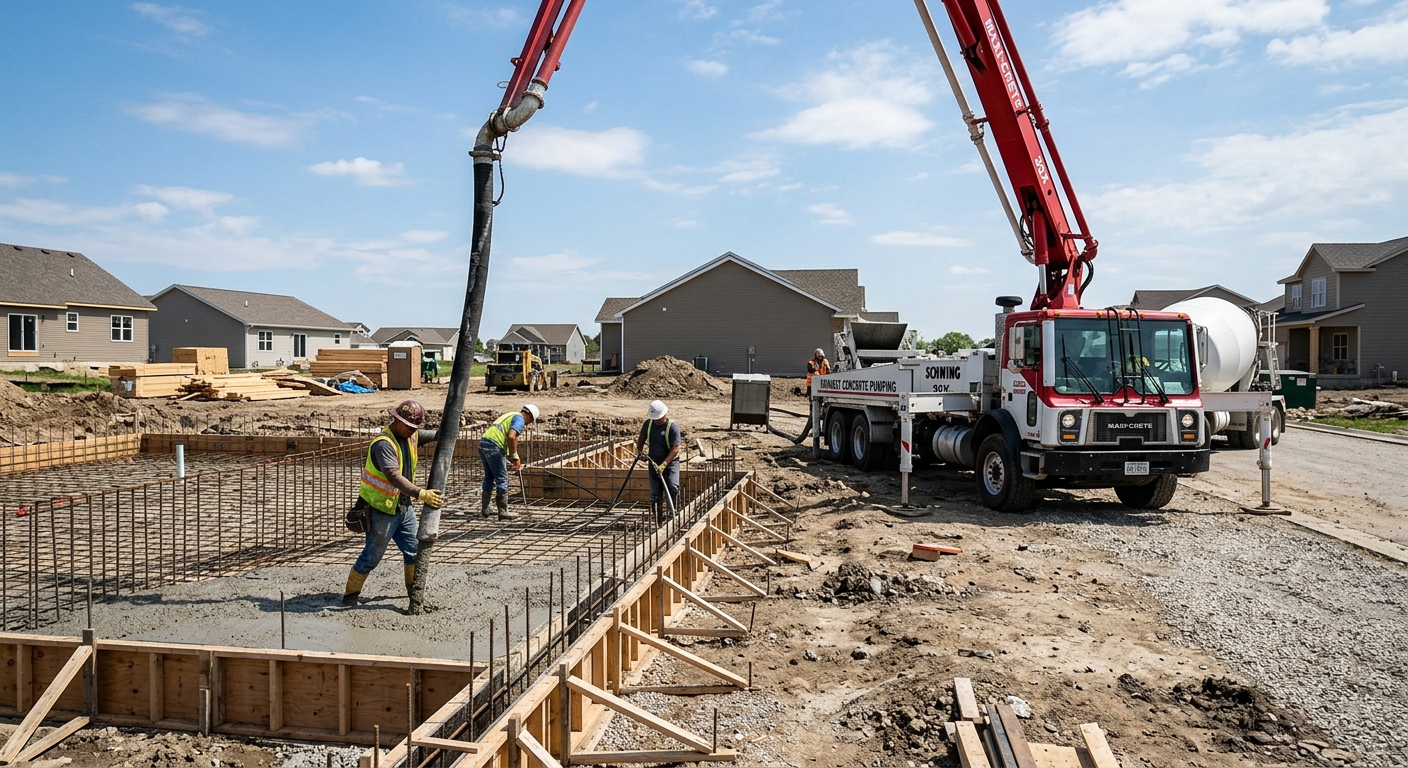
Concrete work options and costs in Woburn
Concrete work is a familiar part of life in Woburn, Ontario, especially for homeowners planning driveways, patios and walkways that have to perform through our Toronto-area freeze–thaw cycle. With a population of 53,485 (Statistics Canada, 2021 Census), Woburn sits in a growing housing pocket where durable exterior flatwork matters. Most residential projects are tied to single-detached neighbourhood demand, and that typically means higher walkability for contractors working around older lanes and newer infill streets. You’ll see crews busy in areas like the Woburn Road corridor, where access and drainage conditions can vary a lot block to block.
In the Toronto economic region, pricing isn’t just about “more or less concrete.” Frost depth and winter movement drive how deep footings must go, while exterior slabs need air-entrained mixes, solid base prep and a thoughtful control-joint plan to manage cracking. Pour timing also affects availability: contractors concentrate exterior work in warmer months to protect curing when temperatures drift toward 10 °C or below. That seasonal squeeze can make labour and truck scheduling tighter, which is one reason bids can move even when the square footage looks similar.
To compare options quickly, use the table below as a realistic starting point for Woburn. From standard broom-finish driveways to structural footing pours below frost, the differences in specs and site prep are what you’re really paying for.
| Application |
Typical Size |
Key Spec |
Finish Option |
Price Range |
| Concrete driveway (standard broom finish) |
400–600 sq. ft. |
4 in. slab, compacted granular base, air-entrained concrete, control joints |
Broom finish |
$18,000 – $28,000 |
| Exposed aggregate driveway |
400–600 sq. ft. |
4 in. slab with exposed stone selection, air-entrained mix, proper curing + sealing |
Exposed aggregate finish |
$22,000 – $33,000 |
| Stamped concrete driveway or patio |
300–500 sq. ft. |
Air-entrained mix, thicker edges/formed thickness where needed, release agent + color system, joints |
Stamped + colored |
$24,000 – $40,000 |
| Plain concrete patio or walkway |
200–400 sq. ft. |
4 in. slab, compacted base, air-entrained concrete where exterior-exposed |
Broom or light trowel/smooth finish |
$16,000 – $26,000 |
| Garage floor (interior slab) |
240–500 sq. ft. |
Engineered thickness as required, vapor barrier where specified, jointing, concrete mix for indoor use |
Power-trowel smooth |
$14,000 – $24,000 |
| Foundation footings (structural, below frost) |
Per linear foot (typical house: 50–120 ft total) |
Footings below design frost, concrete for structural elements, rebar as required by engineer |
Structural finish (utility work) |
$9,000 – $18,000 |
Prices are estimates only and vary by project scope, site access and material selection.
What affects the price of concrete work in Woburn
In the Toronto region, the same “square footage” can still come in 30–50% apart, because concrete pricing is driven by specs and site conditions, not just volume. Two contractors might both quote a 500 sq. ft. driveway, but if one company allows higher-quality base prep, includes better drainage details, specifies air-entrainment and joint layout correctly, or adds cold-weather protections when temperatures slide, you’ll see very different end prices. Labour rates and scheduling also tighten in peak season, and that impacts readiness for your pour date.
Every Woburn exterior job is shaped by frost depth and freeze–thaw cycles. Ontario practice typically requires structural footings to extend at least 1.2 m (about 4 ft) below grade to reduce frost heave and differential movement, and many designs go deeper depending on soil. For flatwork exposed to winter, contractors generally specify air-entrained concrete so the mix can resist repeated freezing and thawing. When crews pour near or during colder shoulder conditions, you may need cold-weather curing precautions—like insulating blankets or temporary heating—so the concrete reaches adequate strength before significant temperature swings. Also, de-icing salt can accelerate surface wear and spalling on poorly sealed exterior slabs; sealing is a small line item that often prevents large, future repairs.
In Woburn, cost can rise if your driveway needs extra excavation, swales or thickened edges for drainage, or if the lot has soft fill that must be removed and replaced with compacted granular base. Costs can also drop when access is straightforward and truck placement reduces labour time; the difference between a plain patio in the $16–$26 band and a stamped option in the $24–$40 band is usually justified by formwork complexity, stamping labour, and the added colour and finishing steps—not by concrete volume alone.
| Price Factor |
Why It Matters |
Cost Impact |
| Frost line depth — determines footing depth and form height |
Deeper footings reduce frost heave and movement in winter |
Can add significant excavation + concrete (often a major driver for foundations) |
| Site preparation — excavation, grading, compacted granular base |
Proper base prevents settlement and reduces cracking |
Higher if soil removal, regrading, or longer compaction time is needed |
| Reinforcement — rebar or wire mesh requirement |
Controls cracking and supports slabs/structural elements |
Adds material and labour; may be required for driveways/structural work |
| Mix design — air-entrainment and compressive strength spec |
Improves freeze–thaw durability and ensures performance |
Usually modest per-cubic-metre but impacts longevity and reduces call-backs |
| Finish type — broom vs. stamped vs. exposed aggregate |
Different materials, labour time, and finishing steps |
Stamped and exposed typically cost more than standard broom |
| Pour size and concrete truck access to site |
Access affects pumping/hosing time and potential extra equipment |
Hard-to-access lots can add labour and equipment charges |
| Cold-weather curing precautions — heating and blankets |
Protects early strength gain when temperatures drop |
Increases labour and materials if you’re near the shoulder season |
| Control joint pattern and sealing cost |
Manages shrinkage cracking and repels de-icing salt |
Joints add layout labour; sealing adds a materials line item but reduces surface damage |
Permits & regulations in Ontario
In Ontario, structural concrete work typically requires a building permit. That includes foundations and structural elements such as footings, foundation walls, and grade beams. Many of these projects also involve engineered drawings that the municipality reviews as part of the permit process. For flatwork—patios, walkways, sidewalks and driveways—permits are often not required, unless the work affects lot grading, changes drainage in a way that impacts neighbouring properties, triggers impervious surface or lot coverage considerations, or touches the municipal right-of-way (for example, any work tied to an entrance that impacts the curb/municipal servicing). Because rules can vary based on scope, confirm with your local authority before breaking ground.
For homeowners in Woburn, verifying the contractor is as important as verifying the permit. Step by step, start with the Ontario licence/registration status using the appropriate online registry for general contractors (or the specific trade when applicable). Next, ask the contractor for a current certificate of insurance for liability and ensure the coverage amount is appropriate for the job size. Then request WSIB/WCB proof of coverage—this is critical for worker safety and compliance. Finally, ask for references on similar-scale projects (e.g., exterior driveways in freeze–thaw conditions), and verify those references are recent. Before work begins, insist on a written scope that states whether they handle permit pulls (when required), demolition/disposal, and traffic protection if the job affects access.
Getting concrete right in Woburn's freeze-thaw climate
Concrete in Woburn has to survive repeated freezing and thawing, plus humid spring and wet fall conditions that can trap water at the base. The most common failures we see aren’t “mystery cracks”—they’re predictable outcomes of inadequate base prep, weak mix design, poor air-entrainment, or sloppy curing. That’s why the spec matters as much as the finish.
(1) Base preparation: ensure the granular sub-base is excavated to the right depth, placed in lifts and compacted properly for local soil and frost expectations. If base is under-compacted or too thin, the slab can settle and crack even if the concrete is good. (2) Mix design: for exterior flatwork, air-entrainment is key. A target of about 5–7% air helps concrete resist freeze–thaw damage, and many exterior specs call for at least 32 MPa compressive strength. (3) Control joints: install joints at spacing that limits random cracking—then seal or treat the joints as recommended. (4) Curing: plan for at least 7 days of proper curing under suitable conditions; in colder weather, curing needs protection (blankets/heating) so the concrete gains strength before freeze events. (5) Sealing: apply a penetrating sealer after the concrete has cured properly (commonly at about 28 days) to repel de-icing salts and reduce surface damage.
Ask technical questions like: “What air content will you specify for the exterior mix?” and “How are you maintaining curing temperature if nights drop?” As a practical budget example, homeowners sometimes choose broom-finish in the $18–$28 driveway band. If you add sealing and insist on correct air-entrained mix and jointing, you avoid paying again later. Stamped concrete in the $24–$40 band can be justified for curb appeal, but the durability details—base, air-entrainment, curing and joint layout—should be just as rigorous as the standard finish option.
| Spec |
Why It Matters in Woburn |
What to Ask For |
Impact if Skipped |
| Compacted granular base (depth?) |
Reduces settlement and frost-related movement under the slab |
Ask for base thickness, lift compaction method, and sub-base material spec |
Early cracking, uneven surfaces, and accelerated wear |
| Air-entrained concrete mix (target air %?) |
Improves freeze–thaw durability in Toronto-area winter conditions |
Ask what air content is specified for exterior flatwork (commonly 5–7% target) |
Spalling and scaling, especially after freeze with de-icer exposure |
| Compressive strength (MPa rating) |
Ensures strength gain so the slab performs under loading |
Ask for minimum MPa requirement (commonly 32 MPa for many exterior specs) |
Surface weakness, premature damage, and reduced long-term durability |
| Control joints (spacing per ACI guidelines) |
Controls where shrinkage cracking will occur |
Ask for joint layout drawings and proposed spacing for your slab dimensions |
Random cracking patterns and difficult-to-repair “network” cracks |
| Minimum 7-day curing period |
Protects early strength development before winter swings |
Ask how curing will be maintained if nights get cold |
Reduced strength and higher risk of scaling/spalling |
| Penetrating sealer (when applied after cure) |
Helps repel moisture and de-icing salts from the surface |
Ask when sealing is applied (commonly after proper cure, often ~28 days) |
Faster surface deterioration and more frequent maintenance |
How to choose a concrete work contractor in Woburn
Start by verifying Ontario compliance in a way you can document. Ask for the contractor’s current proof of liability insurance and confirm the certificate includes your address/project location details where possible. Next, request WSIB/WCB coverage documentation for their workers; a credible contractor will provide it without pushing you to “trust them.” Then confirm licensing/registration status in Ontario for the contractor and, where relevant, the specific trade responsibilities. You can usually verify via the appropriate online registry listings, and you should also cross-check their company details against customer reviews and reference calls.
For pricing, don’t accept a single lump-sum number without a breakdown. Get 2–3 itemised written quotes that separate labour and materials (concrete supply, rebar/mesh, granular base, forms, finish and any sealing/cure protection). Read the exclusions: Are excavation and disposal included? Is site drainage addressed? Is permit pulling included where required? What happens if temperatures drop and curing needs protection?
Warranty matters too. Look for a workmanship warranty (how many years) and separate notes for product/manufacturer warranty where applicable; also ask whether warranty coverage is transferable if you sell the home. Payment should be staged: never more than about 10–15% upfront, and hold back a meaningful portion until you confirm final grading, cleanup, and any required joint sealing/sealer steps are completed. Finally, get a written start date and a completion estimate—concrete scheduling depends on weather windows, and you want clarity if they can’t pour when expected.
- Request proof of liability insurance before signing anything.
- Confirm WSIB/WCB coverage for workers (ask for current certificates).
- Verify Ontario contractor registration/licensing status using the online registry.
- Get itemised quotes: labour, concrete, reinforcement, base prep, forms, finishing, sealing.
- Ensure the scope states who handles excavation, disposal, and hauling.
- Ask how drainage will be managed to prevent water pooling at slab edges.
- Confirm air-entrainment and minimum strength specs for exterior pours.
- Require joint layout details (where control joints go and sealing plan).
- Ask about cold-weather curing precautions if nights are forecast to be cold.
- Clarify what’s included in surface protection and how curing will be handled.
- Use a payment schedule with a 10–15% upfront cap and holdback until completion.
- Get a written schedule with weather-dependent milestones.
Red flags in Woburn include: quoting without base thickness or compaction details, refusing to provide proof of WSIB/WCB or insurance, skipping air-entrained mix language for exterior slabs, promising “no cracks ever” (no reputable contractor can), and asking for large upfront payments or avoiding a written scope with disposal and drainage included.
Frequently asked questions — concrete work in Woburn
Why does concrete crack in Woburn and how is it prevented?
Concrete in Woburn commonly cracks due to shrinkage, temperature movement, and—most importantly for Ontario—freeze–thaw stress when water gets trapped at the slab edges or base. Prevention starts before the pour: a properly excavated and compacted granular base helps reduce settlement, and the right exterior mix (air-entrained) improves freeze–thaw durability. Next, control joints give the concrete a planned place to crack rather than letting shrinkage create random splits. Finally, curing and sealing matter in our climate; inadequate curing when temperatures drop near or below about 10 °C can reduce strength early, and de-icing salt can accelerate surface damage if the slab isn’t sealed after it properly cures. When you compare bids, even at $18,000–$28,000 for a driveway band, the winning quote usually includes the correct base prep, joints, and air-entrainment—those details stop most “avoidable” cracking.
Stamped vs broom-finish concrete — cost difference?
Stamped concrete costs more than broom-finish because it’s labour-intensive and requires a multi-step system: additional materials (release agent, colour), careful placement for the stamp timing, and detailed finishing to achieve the pattern and colour consistency. In the Toronto-area freeze–thaw climate, stamped surfaces also need the same durability groundwork—compacted base, air-entrained mix and joint planning—so you should never treat stamping as the only difference. In Woburn, a standard broom-finish driveway often lands around the $18–$28 band, while stamped driveways or patios typically fall into the $24–$40 band. That extra cost is mostly craftsmanship and product system time, not just extra thickness. If you’re aiming for long-term performance, insist that the stamped option includes proper curing and sealing (often applied after about 28 days) so the surface handles our winters instead of just looking good on day one.
When is the best time to pour concrete in Woburn?
The best time to pour concrete in Woburn is during late spring through early fall when daytime temperatures stay reliably warm and overnight freezes are less likely. In the GTA, crews concentrate exterior pours because curing performance depends heavily on temperature stability; when conditions drop toward about 10 °C or below, contractors may need cold-weather curing precautions like insulating blankets or temporary heating. If you pour too late and the concrete doesn’t gain strength properly before cold swings, durability suffers—especially for exterior flatwork exposed to de-icing salts. Practically, you’ll often get your highest reliability and most consistent scheduling during warmer windows, with fewer change orders. If you’re comparing quotes, ask for the pour date and how they plan to protect the slab if a cold night is forecast.
How long does concrete take to cure?
Concrete “cures” in stages. For many exterior flatwork projects in Ontario, you should expect a minimum of about 7 days of proper curing before treating it as ready for normal conditions, assuming temperatures are within a workable range and the contractor follows correct curing procedures. However, full durability and sealing readiness are typically based on reaching appropriate strength development—many contractors plan to apply penetrating sealer after the concrete has cured properly, commonly around 28 days. In Woburn’s freeze–thaw climate, curing quality matters because early weakness can lead to surface scaling or spalling later when water freezes in the pores and around micro-cracks. If weather shifts in the shoulder season, ask your contractor how they’ll maintain curing (blankets/heating) to reduce risk. A good contractor will schedule inspections and set expectations based on your exact pour conditions.
Do I need a permit for concrete work in Ontario?
In Ontario, structural concrete work—such as footings, foundation walls, and grade beams—generally requires a building permit, often alongside engineered drawings that municipalities review. Concrete flatwork like patios, walkways and driveways usually does not require a permit unless the work affects lot grading, changes drainage in a way that impacts compliance, or involves the municipal right-of-way or impervious surface coverage rules. For Woburn homeowners, the simplest approach is to confirm with the local authority (and ask the contractor whether they’re familiar with what applies to your specific address and scope). Even when permits aren’t required, you should verify the contractor’s liability insurance and WSIB/WCB coverage. A well-prepared quote should clearly state whether any permits are included and, if not, who is responsible for the paperwork.
Concrete vs pavers for a patio in Woburn?
Concrete and pavers both work in Woburn, but they fail differently. Pavers can shift or settle if the base isn’t correctly compacted or if drainage isn’t planned, and individual stones can heave over time. Concrete can crack, but with the right base, air-entrained mix, and control joints, it can perform well through Ontario freeze–thaw cycles. In terms of cost, a plain concrete patio or walkway often fits the $16–$26 band, while decorative upgrades like stamped concrete fall into the $24–$40 range. Pavers can land in a comparable budget depending on thickness, labour, edging and base depth, but they tend to require more careful layout and more frequent attention to drainage lines. The “better” choice depends on your site access, soil conditions, desired maintenance level, and whether you want the clean, monolithic look of concrete or the visual flexibility of pavers.