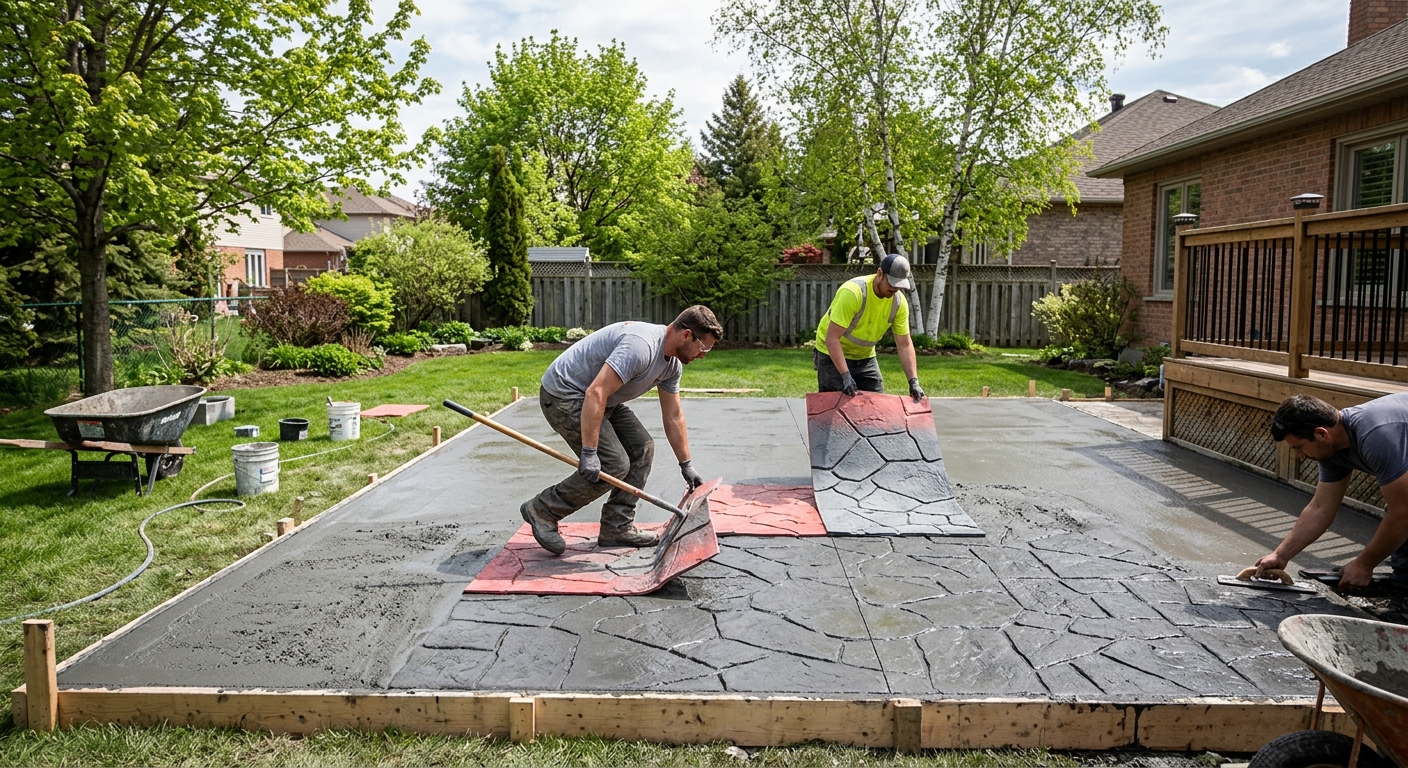
Concrete work options and costs in Christopher-Champlain
Concrete work is a common home improvement in Christopher-Champlain, and the costs you see from contractors usually line up with the type of flatwork you’re building. In the area, many homeowners are upgrading the exterior around established, single-detached neighbourhoods—one of the main housing types that drives demand for driveways, patios and walkways (Statistics Canada, 2021 Census). With a local population of 15,372 (Statistics Canada, 2021 Census), there’s steady competition among crews, but not every contractor is equally strong with freeze–thaw durability specs, which is what protects your concrete during winter.
In the Toronto economic region, concrete pricing is shaped by frost depth and repeated freeze–thaw cycles. Local practice typically requires structural footings to sit at least about 1.2 m (roughly 4 ft) below grade to limit frost heave and differential movement. Exterior slabs (driveways, patios, walkways) also need air-entrained mixes, correct thickness, and control joints so you don’t get random cracking and surface scaling. Because concrete curing is harder when temperatures drop toward 10 °C or below, many crews schedule exterior pours during the warmer months, and they may add protection (tarps, blankets, curing control) when weather turns—both of which affect the final quote.
In Christopher-Champlain’s residential pockets such as the broader east end/established neighbourhood blocks where lots are being reworked for better parking and drainage, it’s especially common to see driveway replacement + new walkways bundled together to reduce mobilization and excavation costs. Below is a quick comparison of typical options and what you can expect to budget before you request a detailed, itemized quote.
| Application |
Typical Size |
Key Spec |
Finish Option |
Price Range |
| Concrete driveway (standard broom finish) |
400–600 sq. ft. |
Air-entrained mix; compacted granular base; control joints |
Broom finish |
$18,000–$28,000 |
| Exposed aggregate driveway |
400–600 sq. ft. |
Air-entrained mix; proper curing; higher cement paste durability |
Exposed aggregate |
$22,000–$35,000 |
| Stamped concrete driveway or patio |
300–500 sq. ft. |
Air-entrained mix; thicker pour for stamping durability |
Stamped pattern + release + seal coat |
$24,000–$40,000 |
| Plain concrete patio or walkway |
200–400 sq. ft. |
Compacted base; air-entrainment; scoring/control joints |
Broom or trowel finish |
$3,200–$10,400 |
| Garage floor (interior slab) |
400–600 sq. ft. |
Vapour barrier (where required); thicker slab if for vehicles |
Steel trowel or broom finish |
$6,800–$16,800 |
| Foundation footings (structural, below frost) |
Varies by foundation plan |
Below design frost; engineered reinforcement; proper bearing |
Formwork + structural pour |
$180–$300 |
Prices are estimates only and vary by project scope, site access and material selection.
What affects the price of concrete work in Christopher-Champlain
Even for the “same” concrete project, quotes across Toronto and Ontario can swing by 30–50% because contractors aren’t all pricing the same package of labour, site prep and durability requirements. One crew might include a proper compacted granular base and air-entrained mix with the right thickness and joint plan; another may price a thinner pour with less excavation, or assume easier access. In the Christopher-Champlain market, that difference often shows up as the labour and material costs behind the scenes—especially once you factor in freeze–thaw durability (air entrainment, curing protection and sealing) and the realities of mobilizing a concrete truck to your driveway length and gate widths.
Here’s the big driver: frost line depth and freeze–thaw cycles dictate every structural decision. Footings generally must extend below the design frost depth—typically around 1.2 m in Ontario practice—to prevent frost heave and differential movement. For exterior flatwork, air-entrained concrete mixes are standard to survive repeated freezing and thawing, and the job needs a control joint plan to manage shrinkage and random cracking. In colder seasons, the pour season can shorten, so you may see higher costs for cold-weather curing precautions (heaters, insulated blankets and extended protection). De-icing salt can accelerate spalling, which is why sealing is often recommended after cure.
Two local examples in Christopher-Champlain that move the price: (1) lots with soft or saturated soil may require deeper excavation and thicker granular base before you pour; that can add several thousand dollars compared to a straightforward grade. (2) choosing stamped concrete (often in the $24,000–$40,000 band for driveways/patios) can be worth it when you’re also reworking drainage and drainage slopes, because the added cost buys longer-term curb appeal—whereas a plain patio in the basic range ($16–$26 per sq. ft. typical band) can be the better value if you only need function and good drainage.
| Price Factor |
Why It Matters |
Cost Impact |
| Frost line depth |
Determines footing depth and form height |
Higher excavation and labour; can significantly change foundation-related pricing |
| Site preparation |
Excavation, grading, compacted granular base |
More removal/haul + more base material increases total cost |
| Reinforcement |
Rebar or wire mesh requirement |
Materials + placement labour; increases strength and crack control on slabs |
| Mix design |
Air-entrainment and compressive strength spec |
Better durability to reduce freeze–thaw damage; modest to moderate material premium |
| Finish type |
Broom vs. stamped vs. exposed aggregate |
Stamps/aggregate require more labour and materials; higher finishing hours |
| Pour size and concrete truck access to site |
Shorter pours can cost more per sq. ft.; access affects equipment use |
Longer carry times, smaller truck options, or extra pumps can raise costs |
| Cold-weather curing precautions |
Heating and blankets |
Can add labour and rental costs; often needed near colder evenings |
| Control joint pattern and sealing cost |
Manages cracking and reduces de-icing salt exposure |
Joint layout affects labour; sealing is an added but durability-focused cost |
Permits & regulations in Ontario
In Ontario, structural concrete work—such as footings, foundation walls and grade beams—typically requires a building permit, and it often involves engineered drawings reviewed through the municipal process. Concrete flatwork like driveways, patios and walkways usually does not require a building permit when it’s simply replacing surface concrete and staying consistent with lot grading. That said, permits or approvals may become necessary when the work changes lot grading, affects impervious surface coverage limits, or impacts municipal right-of-way or drainage requirements. When in doubt, confirm with the local authority before breaking ground.
To verify a contractor in Christopher-Champlain, start with licensing and insurance documentation. First, ask for proof of liability insurance and check that it’s current and matches the company’s legal name. Second, confirm WSIB/WCB coverage (or the appropriate exemption/coverage documentation) before work begins. Third, request the certificate of insurance and a clearance letter (where applicable) and verify the dates. You can also check the contractor’s details on provincial or public business/registration resources if available, then compare it to the company named on the insurance documents.
Finally, ask for references on similar-scale jobs: a driveway replacement is not the same as foundation footings, and you want evidence the contractor can handle excavation, reinforcement placement, and concrete protection under Ontario’s freeze–thaw conditions.
Getting concrete right in Christopher-Champlain's freeze-thaw climate
Concrete failure in Christopher-Champlain is usually the same story: water gets into vulnerable areas, then freeze–thaw expands it, and the surface scales or spalls. The fix isn’t “stronger concrete only”—it’s the full system: base prep, correct mix design, jointing and curing. To spec the job correctly, begin with (1) base preparation: a compacted granular sub-base to the right depth for your soil and drainage conditions. A thick, well-compacted base reduces settlement and prevents water from sitting under the slab.
Next (2) mix design: exterior flatwork should use air-entrained concrete with a target air content around 5–7%, and it should meet a minimum compressive strength spec such as 32 MPa. This is what resists freeze–thaw damage, and it’s where some “cheap” installs cut corners. (3) control joints should be placed to encourage cracking at predictable locations rather than random field cracks. (4) curing matters a lot in Ontario: plan for at least 7 days of proper curing under suitable conditions, and when temperatures drop, crews should use protection to keep curing on track. (5) sealing: a penetrating sealer is typically applied after the concrete cure window—commonly around 28 days—to repel water and help reduce de-icing salt-driven deterioration.
In practice, a broom-finished driveway in the local $18,000–$28,000 band can last for decades when the air-entrained mix, thickness and joints are done correctly. Spending for stamped concrete in the $24,000–$40,000 range is justified when you want both the look and the upgraded sealing/protection plan—especially if you’re also improving drainage and base design. However, if the base prep is weak, paying for decorative finishes won’t stop freeze–thaw spalling.
| Spec |
Why It Matters in Christopher-Champlain |
What to Ask For |
Impact if Skipped |
| Compacted granular base (depth?) |
Controls settlement and limits water under the slab during freeze–thaw |
Granular depth and compaction method based on site soil and drainage |
Premature cracking, uneven surfaces, and faster deterioration |
| Air-entrained concrete mix (target air %?) |
Prevents surface scaling/spalling from repeated freezing and thawing |
Target air content around 5–7% for exterior flatwork |
More freeze–thaw damage and spalling even if cracks are “controlled” |
| Compressive strength (MPa rating) |
Supports structural durability and wear resistance |
Minimum 32 MPa compressive strength spec |
Reduced durability under traffic and winter stress |
| Control joints (spacing per ACI guidelines) |
Limits random cracking caused by shrinkage and temperature swings |
Joint spacing plan and saw-cut or formed joint timing |
Random cracking and more water intrusion pathways |
| Minimum 7-day curing period |
Builds strength before the concrete faces winter temperature swings |
Curing protection plan when temperatures fall near 10 °C |
Lower strength gain, surface defects and higher early-life cracking |
| Penetrating sealer (when applied after cure) |
Repels water and reduces de-icing salt impact |
Apply after full cure window (often 28 days) and confirm product type |
More water uptake and faster surface wear/spalling risk |
How to choose a concrete work contractor in Christopher-Champlain
Choosing the right concrete contractor in Ontario comes down to proof: licensing/registration (where applicable), liability insurance, and WSIB/WCB coverage. Start by asking for an insurance certificate showing current coverage limits. For WSIB/WCB, request the clearance letter or proof of coverage documentation before the first shovel of excavation moves. If a contractor won’t provide paperwork up front, that’s a major warning sign.
Then get 2–3 itemized written quotes. An itemized quote should separate labour from materials (concrete, rebar/mesh, base/granular, forms, curing blankets if needed, saw-cutting, and sealing). It should also clearly list inclusions and exclusions: is demolition/haul-away included? Is permit pulling included when required? Are drainage corrections included if the site needs regrading for stormwater control? A lump-sum number without details is hard to compare and often hides the true differences.
Warranty should be specific: ask for workmanship warranty length and whether it covers crack repair or only certain defects, and confirm product/manufacturer warranties for materials if applicable. Also discuss transferability if you sell the home. For payment schedule, avoid paying more than about 10–15% upfront; hold back a portion until the final inspection or completion checklist is done. Finally, get a written timeline with a start date and realistic completion estimate based on weather—important in the Toronto region when exterior curing can be affected as temperatures drop.
- Ask for insurance certificate and confirm dates and company name match the contract.
- Request WSIB/WCB clearance (or coverage documentation where applicable) before work starts.
- Get at least three quotes with labour and materials broken out, not lump-sum only.
- Confirm whether demolition and concrete disposal/haul-away are included.
- Make sure the quote lists base depth, granular type, and compaction requirements.
- Verify air-entrained concrete is included for exterior slabs and driveways.
- Confirm thickness, reinforcement (if any), and joint pattern are specified.
- Ask how they handle cold evenings and curing protection near 10 °C.
- Request a protection plan for curing and a sealing plan (if included).
- Check that finish details (broom, exposed aggregate, stamped and sealing) are spelled out.
- Review warranty terms in writing before signing.
- Agree on payment milestones aligned to inspections and completion, with a holdback.
Concrete contractor red flags in Christopher-Champlain: they won’t show insurance/WSIB paperwork; they quote without specifying base depth, air-entrainment, or jointing; they dismiss freeze–thaw curing precautions when temperatures are dropping; they ask for large deposits (more than 10–15%); or they provide a vague scope that leaves drainage, disposal, or sealing “to be determined.”
Frequently asked questions — concrete work in Christopher-Champlain
Do I need a permit for concrete work in Ontario?
In Ontario, structural concrete work like footings, foundation walls and grade beams typically requires a building permit and, in many cases, engineered drawings reviewed through the municipal process. For concrete flatwork—such as driveways, patios and walkways—permits are often not required if you’re replacing like-for-like and not changing lot grading or stormwater behaviour. However, if your project affects drainage, changes slope/grade, impacts impervious surface limits, or touches municipal right-of-way concerns, you may need approval. For Christopher-Champlain homeowners, the safest approach is to confirm with the local authority before you demo existing concrete, and then ensure your contractor’s scope clearly states whether permit paperwork is included or excluded.
Concrete vs pavers for a patio in Christopher-Champlain?
Concrete and pavers both work well in Ontario’s freeze–thaw climate, but they fail differently. Concrete patios rely on proper base compaction, air-entrainment, and control joints; if those are wrong, you’ll see random cracking or surface spalling from salt and water. Pavers can tolerate minor movement better and allow easier spot repairs, but they require careful base grading and joint sand maintenance—especially where drainage is poor. In Christopher-Champlain, a plain concrete patio typically fits the local “concrete patio/walkway” budget band around $16–$26 per sq. ft. (site conditions and thickness matter). If you want the lowest maintenance and long, uniform performance, good concrete specs usually win; if you’re prioritizing flexible repairs and visual segmentation, pavers can make sense.
How long does a concrete driveway last?
A well-built concrete driveway in Ontario commonly lasts for decades, but “how long” depends on your exposure to water, de-icing salt, and whether the mix and base were done for freeze–thaw. The biggest durability wins come from air-entrained concrete, correct thickness, properly compacted granular base, and a joint plan that reduces uncontrolled cracking. In Christopher-Champlain, winter moisture plus thawing cycles can punish weak installations—thin slabs on poor base are the usual early-failure scenario. Budget-wise, driveway projects often land in the local $18,000–$28,000 range for standard broom-finish work, with higher costs when you add decorative finishes like exposed aggregate or stamping. Paying more for the right base and air-entrainment is usually the smartest way to extend service life.
What is air-entrained concrete and why does it matter here?
Air-entrained concrete is formulated with tiny, evenly distributed air bubbles that give freezing water somewhere to expand. In Christopher-Champlain and the Toronto region, repeated freeze–thaw cycles and winter de-icing conditions make this critical for exterior concrete durability. Without air-entrainment, water can expand in the paste and near the surface, leading to scaling and spalling—flaking or chipping you often see after a few seasons. For exterior flatwork, local GTA practice typically targets about 5–7% air content and uses a minimum compressive strength spec like 32 MPa. When you’re comparing quotes in Ontario, insist the mix is explicitly identified as air-entrained for driveways, patios and walkways; otherwise you may get a low price now and expensive repairs later.
How do I prepare the base for a concrete slab?
Base preparation is where concrete projects are won or lost in Ontario. For a driveway or patio, the goal is a level, well-drained, well-compacted granular base to the required depth based on your soil and site conditions. Contractors should excavate to sound material, install granular base, and compact it in lifts (not just “spreading and hoping”). Good grading also matters: if water collects under the slab, freeze–thaw will accelerate deterioration even with air-entrainment. In Christopher-Champlain, ask your contractor to specify granular depth, compaction method, and whether they’re accounting for drainage and existing soil saturation. If your quote doesn’t mention base depth and compaction, treat it as incomplete—even if the concrete price looks attractive.
How do I compare concrete quotes?
To compare quotes fairly in Christopher-Champlain, you need the same inclusions across each proposal. Ask for itemized breakdowns separating labour and materials: excavation, granular base and compaction, concrete thickness, reinforcement (rebar/mesh if applicable), forms, concrete finishing, saw-cutting joints, curing protection, and sealing (if included). Confirm whether demolition and disposal are covered, and whether any permits are included when required. Prices for concrete work can vary widely in the Toronto region due to frost depth specs, access, and freeze–thaw durability requirements—so don’t compare only total dollars. For example, a standard driveway may fall into the $18,000–$28,000 band, while stamped/decorative work often climbs toward $24,000–$40,000. The “best” quote is usually the one that matches the spec you need, not the one with the lowest number.