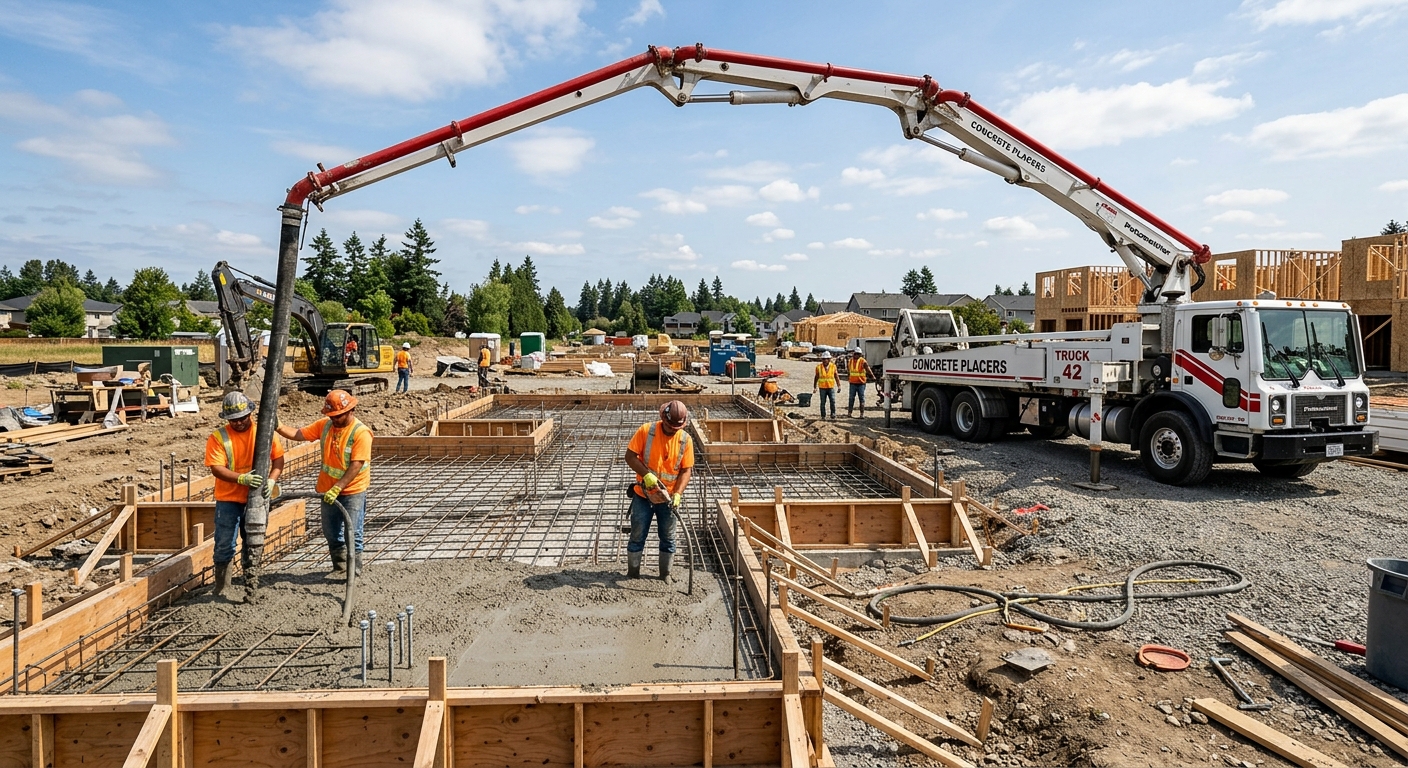
Concrete work options and costs in Oakwood Village
Oakwood Village, Ontario is a great place for durable concrete flatwork, but pricing depends on the freeze–thaw reality of the Toronto area and how the job is built from the ground up. With a population of 21,210 (Statistics Canada, 2021 Census), most concrete demand is driven by owner-occupied homes and growing infill that keep driveways, patios and walkways in steady rotation. In this part of the GTA, the typical “repeat” work homeowners notice—resurfacing an aging slab, replacing cracked driveway edges, or building a new patio—often lines up with the region’s older housing stock, where repairs are common rather than entirely new construction. Toronto-area weather also shapes contractor availability and costs: the ground can be wet in shoulder seasons, and curing gets harder as temperatures drop toward 10 °C or below. That’s why GTA crews plan exterior pours in the warmer months, and why they price extra protection and curing time when a schedule slips.
We also see especially strong demand in established residential pockets around the neighbourhood core and along the busiest collector-road corridors, where access constraints make base prep and hauling planning more labour-intensive. For homeowners comparing quotes, the fastest way to understand value is to match the finish and structural scope, not just the total price. Next, use the table below to compare common options in Oakwood Village.
| Application |
Typical Size |
Key Spec |
Finish Option |
Price Range |
| Concrete driveway (standard broom finish) |
400–600 sq. ft. |
Air-entrained mix, compacted granular base, control joints |
Broom finish |
$7,200–$12,600 |
| Exposed aggregate driveway |
400–600 sq. ft. |
Air-entrained mix, consistent wash depth, sealed finish-ready surface |
Exposed aggregate |
$9,200–$15,900 |
| Stamped concrete driveway or patio |
300–500 sq. ft. |
Air-entrained mix, integral colour, release agent workflow |
Stamped |
$10,800–$20,000 |
| Plain concrete patio or walkway |
200–400 sq. ft. |
Air-entrained mix, proper drainage, jointing |
Exposed broom / smooth trowel |
$3,200–$10,400 |
| Garage floor (interior slab) |
300–500 sq. ft. |
Moisture/vapour consideration, dowels where needed, thickened edges |
Broom / light steel-trowel |
$5,400–$12,500 |
| Foundation footings (structural, below frost) |
Varies by home footprint |
Engineered sizing, below frost depth, rebar placement as specified |
Structural concrete |
$6,000–$28,000 |
Prices are estimates only and vary by project scope, site access and material selection.
What affects the price of concrete work in Oakwood Village
In Oakwood Village and across the Toronto economic region, you can see the same concrete scope come in 30–50% apart between quotes. That usually isn’t because “concrete is different today”—it’s because the labour and materials that protect the slab through freeze–thaw aren’t always priced the same. The Toronto area’s frost depth and freeze–thaw cycles drive nearly every spec decision: structural footings must extend below design frost depth (Ontario commonly lands around 1.2 m or more below grade), and all exterior flatwork needs air-entrained concrete to resist repeated expansion and contraction. When temperatures drop toward 10 °C or below, cold-weather curing precautions—like insulating blankets and heating where applicable—can add cost, but they’re essential for strength development. And because de-icing salts are common on driveways, surface durability depends heavily on proper drainage, jointing, and sealing.
Two practical examples from local jobs: first, the same 450 sq. ft. driveway might price like standard broom at the lower end of the $18,000 – $28,000 band, but if the contractor discovers weak subgrade and needs deeper, better-compacted granular base, you’ll pay closer to the high end because excavation and haul-off increase labour. Second, a patio that “looks simple” can shift from plain concrete toward the higher end of the $16 – $26 per sq. ft. band if you want adequate thickness, proper slope, and control joints in the right locations to prevent random cracking. Finally, the pace of outdoor work matters: Ontario pours outside the reliable warm window may require added crew time and protection, which shows up directly in the quote—especially on narrow city lots where pump access or extra truck trips are needed.
| Price Factor |
Why It Matters |
Cost Impact |
| Frost line depth — determines footing depth and form height |
Deep footings reduce frost heave and differential movement |
Higher excavation depth increases labour, shoring and concrete volume |
| Site preparation — excavation, grading, compacted granular base |
Prevents pumping, settlement and base expansion under freeze–thaw |
Weak soils and poor drainage push costs upward via extra material and haul-off |
| Reinforcement — rebar or wire mesh requirement |
Controls cracking and supports loads in structural and thicker slabs |
Material and labour add cost, but reduce long-term failure risk |
| Mix design — air-entrainment and compressive strength spec |
Air entrainment is critical for exterior durability in freeze–thaw climates |
Upgraded mix and specified strength generally raise material cost |
| Finish type — broom vs. stamped vs. exposed aggregate |
Finish complexity adds labour time and materials (colour, release, wash) |
Stamped/exposed typically costs more than broom-finished work |
| Pour size and concrete truck access to site |
Access affects pour speed, safety, and the need for pumps or extra trips |
Poor access can add truck/pump charges and crew time |
| Cold-weather curing precautions — heating and blankets |
Ensures strength gain and reduces cold-joint and surface defects |
Protection measures add daily costs and can extend timelines |
| Control joint pattern and sealing cost |
Jointing manages shrinkage cracks; sealing helps resist de-icing salts |
Proper jointing and sealing add line-item cost but reduce premature spalling |
Permits & regulations in Ontario
In Ontario, structural concrete work is typically treated as a building/structural matter, so it usually needs a building permit and often engineered drawings before anything is poured. That includes foundation walls, grade beams, footings, and other structural elements that carry loads and interact with the building’s overall stability. For Oakwood Village homeowners, the key point is that structural concrete is not “just a pour”—engineered sizing and municipal review are often required.
Concrete flatwork (driveways, patios, walkways, and many garage slabs) typically does not require a permit unless the work affects lot grading, drainage plans, impervious surface coverage rules, or the municipal right-of-way. Even when a permit isn’t required, a contractor should still consider how runoff and downspout discharge connect to your property’s drainage so the new concrete doesn’t fail early.
Here’s a homeowner-friendly way to verify contractor readiness in Ontario, step by step: (1) request the contractor’s certificate of insurance and confirm it’s active for the job scope (liability coverage); (2) ask for proof of workers’ compensation coverage (WSIB/WCB); (3) confirm the contractor is properly registered/licensed for the type of work they’re doing; and (4) ask for references on similar driveway/patio builds in the GTA. When you see a contractor who can’t provide a certificate or clear documentation, treat it as a red flag before you sign.
Getting concrete right in Oakwood Village's freeze-thaw climate
Concrete fails in Oakwood Village winters mainly through freeze–thaw damage and moisture movement. If water gets into the concrete and the mix lacks enough air voids, surface scaling and spalling can start over a few seasons—especially where de-icing salt and repeated ploughing occur. The fix is not “stronger concrete only.” It’s a complete system: base preparation, correct mix design, jointing, curing, and sealing.
To spec the job correctly for Toronto-area conditions: (1) start with a compacted granular base sized to support the slab through local frost action; poor base prep is the silent cause of settlement and uneven cracking. (2) use an air-entrained mix with a target air content typically in the 5–7% range for exterior flatwork in GTA practice; pair that with a minimum compressive strength of 32 MPa to support durability and performance. (3) control joints should be planned to limit random cracking—spacing depends on slab thickness and geometry. (4) curing matters more than many homeowners expect: plan for at least a 7-day curing period under proper conditions, and in cooler weather be ready for insulating blankets or other cold-weather curing measures. (5) seal after the concrete has cured long enough—commonly 28 days post-pour—for a penetrating sealer that helps repel de-icing salts.
Price-wise, this is where options make sense. A broom-finished driveway might sit near the lower end of the local $18 – $28 per sq. ft. range, but spending toward the higher end is often justified if it includes the right granular base, air-entrainment verification, correct thickness, and sealing. If someone quotes “cheap concrete” without those items, you can end up paying twice for patching and rework.
| Spec |
Why It Matters in Oakwood Village |
What to Ask For |
Impact if Skipped |
| Compacted granular base (depth?) |
Prevents settlement and water-driven freeze damage under exterior slabs |
Confirm base depth and compaction method for your subgrade |
Uneven slab movement and early cracking/spalling risk |
| Air-entrained concrete mix (target air %?) |
Air voids protect concrete from freeze–thaw scaling |
Ask for target air content (commonly 5–7% for exterior flatwork) |
Scaling and spalling, especially with de-icing salt exposure |
| Compressive strength (MPa rating) |
Supports long-term durability under loads and freeze–thaw stress |
Minimum 32 MPa for exterior flatwork (as specified) |
Surface weakness, faster deterioration, and cracking |
| Control joints (spacing per ACI guidelines) |
Directs shrinkage cracking into predictable locations |
Ask for joint spacing based on slab thickness and dimensions |
Random cracking patterns and water infiltration |
| Minimum 7-day curing period |
Strength gain must occur before you subject concrete to temperature swings |
Confirm curing plan; ask what happens in cool/wet weather |
Surface defects, reduced strength, and durability issues |
| Penetrating sealer (when applied after cure) |
Helps reduce salt penetration and moisture uptake |
Ask for penetrating sealer applied after full cure (commonly 28 days) |
Higher risk of scaling and shortened service life |
How to choose a concrete work contractor in Oakwood Village
Choosing the right concrete contractor is mostly about proof. In Ontario, verify licensing/registration for the trade (where applicable), request current liability insurance, and confirm workers’ compensation coverage (WSIB/WCB). The practical steps are simple: (1) ask for a certificate of insurance and review the effective dates and jobsite coverage; (2) request WSIB/WCB clearance or proof of coverage for their workers; (3) check references for similar driveway, patio, or footing work in the GTA; and (4) confirm the contractor uses a written scope that includes base prep, mix type, reinforcement (if required), finishing, and curing steps.
Next, get 2–3 itemised written quotes. You want line items for labour and materials rather than only a lump-sum number. Ask what’s included in removal and disposal, whether permit costs (if any) are covered, and what the schedule assumptions are for weather and curing protection. A reputable crew will also explain their warranty plainly: workmanship warranty length, whether there’s a product/manufacturer warranty, and whether it transfers if you sell your home.
Finally, be careful with payment. Avoid large down payments; never pay more than about 10–15% upfront. Hold back a portion until the work is complete and any final sealing, joint finishing, and cleanup are done. For timelines, insist on a start date and an estimated completion date in writing, along with weather-dependent contingencies.
- Written scope that specifies thickness, base preparation and drainage plan.
- Concrete mix type confirmed as air-entrained for exterior flatwork.
- Control joint plan included (spacing and location on drawings/sketch).
- Curing method and protection plan for cool or wet weather.
- Sealing included or clearly excluded, with an application timing statement.
- Reinforcement details (where required) stated clearly—rebar/wire mesh and placement.
- Line-item removal and disposal costs spelled out.
- Concrete truck access method documented (direct chute vs. pump vs. multiple trips).
- Permit responsibility clarified (who pulls it, if required for the scope).
- Insurance and WSIB/WCB proof provided before work begins.
- Warranty terms in writing, including what defects are covered and timeline.
- Payment schedule that holds back funds until final inspection/cleanup.
Concrete red flags I see in Oakwood Village include: vague scopes that don’t mention air-entrainment or base depth; quotes that ignore curing protection for late-season pours; “one price covers everything” without listing removal/disposal; and contractors who can’t provide insurance/WSIB proof or references for similar projects.
Frequently asked questions — concrete work in Oakwood Village
What causes concrete to spall in Oakwood Village winters?
Spalling (flaking/peeling) in Oakwood Village is usually a freeze–thaw moisture problem. Water enters the concrete through tiny pores or through cracks, then expands as it freezes, breaking down the surface. In the Toronto area, this is made worse by de-icing salts and by ploughing traffic that repeatedly impacts the slab edge and high-wear zones. A major cause is inadequate air-entrainment—if the mix doesn’t include enough air voids, the concrete surface can scale and spall after a few seasons. Poor drainage and a weak granular base can also let water sit near the slab, increasing freeze stress. If your contractor is quoting near the lower end of typical driveway pricing (for example, $18 – $28 per sq. ft. in the GTA tier), ask whether the quote explicitly includes air-entrained mix, correct thickness, jointing, and sealing.
What is rebar and when is it required in Ontario?
Rebar (reinforcing steel bars) is used to control cracking and strengthen concrete sections that experience tension or heavier structural loads. In Ontario, whether rebar is required depends on the engineered design, the slab thickness, and the structural role of the concrete element. For example, foundation footings and grade beams are structural and typically require reinforcement placed at specific cover depths, spacing, and configurations per engineering drawings. For exterior flatwork like patios and driveways, reinforcement is often project-dependent—some slabs use wire mesh or rebar in thicker sections, especially if the area is subject to heavier loads or if the design calls for it. The best approach in Oakwood Village is to ask your contractor to reference the plan/spec for your section (and where applicable, the engineer’s drawings). Also confirm placement details—reinforcement that sits too close to the surface can corrode and accelerate deterioration.
How long does a concrete project take in Oakwood Village?
Concrete timelines in Ontario vary mainly due to cure time, weather conditions, and how complex the site prep is. For many residential flatwork projects in Oakwood Village, you’ll typically see excavation and base prep done first, then the pour, then finishing and curing. A patio or walkway might be in the ground-prep phase for a day or two, poured the same day as completion of subgrade prep, and then left to cure for at least 7 days under proper conditions before normal use. Driveways can take longer because of removal, granular base rebuild, forms, and sometimes reinforcement or thicker edges. Scheduling also matters: Toronto-area contractors often focus exterior pours in warmer months to ensure proper curing and strength development. If temperatures near 10 °C or below appear during or soon after the pour, expect additional protection measures, which can extend the calendar. Your best estimate comes from the written scope and the contractor’s weather contingency plan.
What is a concrete overlay and is it suited to Oakwood Village?
A concrete overlay is a new concrete layer placed over an existing slab, usually after surface preparation (often grinding, patching, and ensuring there’s a stable base). In Oakwood Village, an overlay can be a good option when the existing driveway is mostly sound but looks worn—like surface pitting, minor scaling, or uneven finish wear. It’s less suitable when the old concrete is badly cracked with movement, has major base failure, or shows widespread structural deterioration—because the new layer can simply reflect the old problem and crack again. Overlays also need proper bonding strategy, joint planning, and drainage considerations. If the existing slab has significant spalling or settlement, replacement is often more durable. For budgeting, overlays are not always the cheapest path: compared with a full replacement that may fall in the typical driveway range (for example, $18 – $28 per sq. ft. in the Toronto tier), an overlay can be competitive only when the demolition/base rebuild cost is minimal and the slab is still structurally stable.
How do I seal concrete to protect it in Oakwood Village?
Sealing helps protect exterior concrete in Ontario from moisture and de-icing salt penetration, which reduces scaling/spalling risk over time. For Oakwood Village, plan on sealing a penetrating sealer after the concrete has cured—commonly after 28 days post-pour—so the sealer can properly bond and repel water. Before sealing, ensure the surface is clean and dry (no curing compounds or heavy dust), and confirm it’s the correct product for your finish type (broom, stamped, or exposed aggregate). After sealing, maintain by limiting heavy de-icing salt exposure where possible and using recommended de-icing practices. Note that sealing doesn’t replace good construction: air-entrainment, adequate base prep, correct slope/drainage, and control joints are still the foundation for long-term durability. If you’re comparing quotes for a patio, walkway, or driveway, ask whether sealing is included and what brand/type is being used.
What is the difference between concrete and cement?
Concrete and cement are related, but they’re not the same thing. Cement is one ingredient inside concrete—it’s the binder that reacts with water to create strength. Concrete is the full mixture: cement plus water, fine and coarse aggregates (sand and gravel/crushed stone), and often additives like air-entrainment admixtures for freeze–thaw durability. In Oakwood Village and across Ontario, the concrete spec matters because exterior flatwork needs performance, not just “more cement.” That’s why contractors talk about air-entrainment and compressive strength (commonly minimum 32 MPa for exterior flatwork in GTA practice) and about curing/finishing steps. This also explains pricing variation: a quote for a broom driveway vs. stamped concrete may differ because of additives, mix performance requirements, and labour-intensive finishing—not because the “cement” alone changed. When you see a range in pricing such as $16 – $26 per sq. ft. for patios/walkways, ask what mix spec and finishing steps are included so you understand what’s actually being purchased.