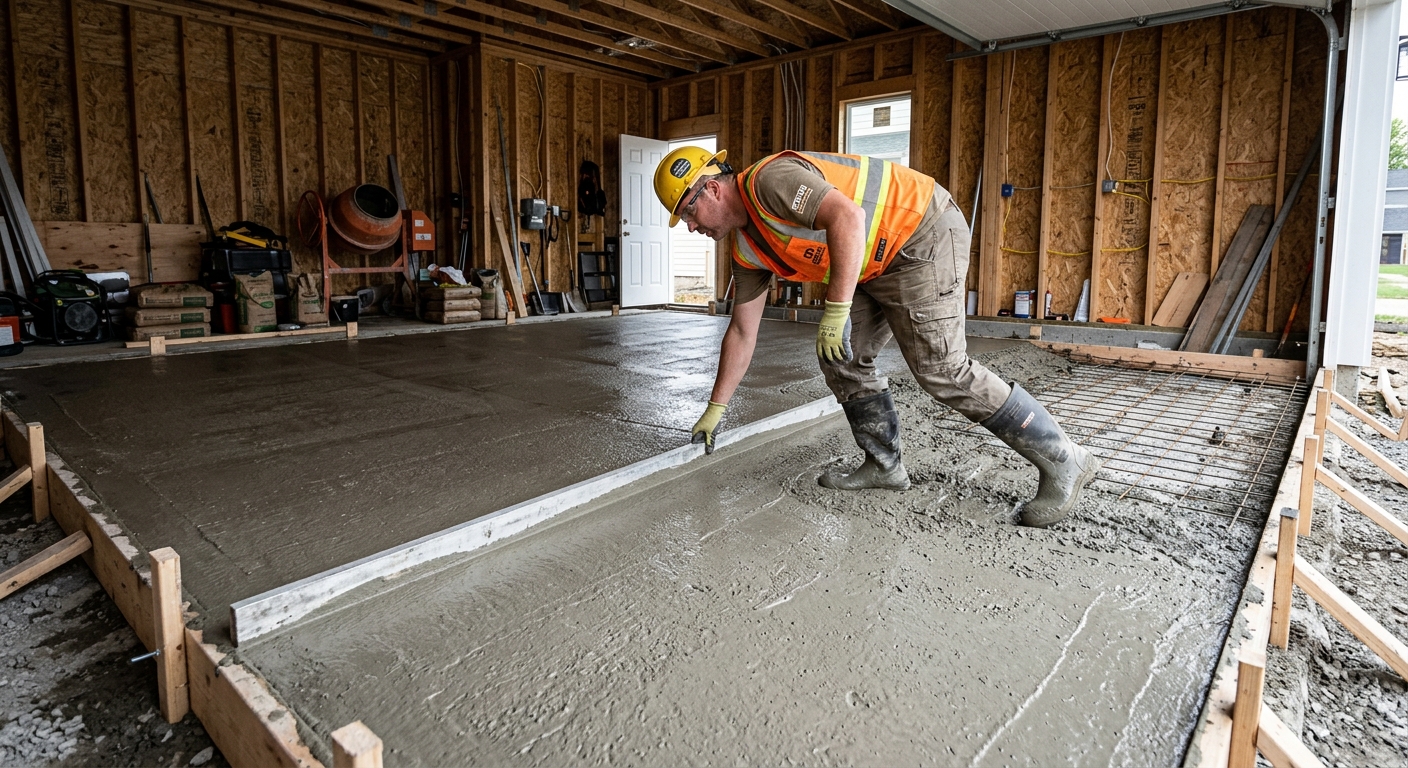
Concrete work options and costs in Lappe
Lappe is a small community in the Toronto economic region, and most homeowners there are using concrete for the same practical reasons: a driveway that handles winter traffic and a patio/walkway that stays safe through repeated freeze–thaw. With a population of 1,436 (Statistics Canada, 2021 Census), the local customer base is tight, so contractor availability can swing by season—especially when the GTA starts getting steady repair and new-build demand. In Lappe, the market is dominated by owner-occupied homes, with concrete flatwork typically tied to single-detached properties where families invest in exterior durability. That means your driveway, patio and walkways are often designed as long-term “maintenance-managed” assets rather than quick upgrades.
In the Toronto area, concrete pricing is strongly shaped by frost depth and freeze–thaw cycles. Ontario Building Code expectations drive most structural footings to extend to at least about 1.2 m below grade (regionally consistent with frost protection practice), and exterior flatwork needs air-entrained concrete, proper base preparation, and control joints to limit cracking. Pour seasons are also practical: when temperatures trend toward 10 °C and below, contractors either schedule carefully around curing or add cold-weather protection like insulating blankets and heated enclosures, which raises costs. Access matters too—long driveway approaches and limited truck turning radius can increase labour and site time.
Because of these factors, two quotes for the “same size” slab can differ, especially between standard broom finishes and decorative options. To help you compare apples to apples, start with the table below for common Lappe projects.
| Application |
Typical Size |
Key Spec |
Finish Option |
Price Range |
| Concrete driveway (standard broom finish) |
400–600 sq. ft. |
Air-entrained concrete; compacted granular base; control joints |
Broomed surface, simple edge details |
$18,000–$28,000 |
| Exposed aggregate driveway |
400–600 sq. ft. |
Air-entrained concrete; consistent stone exposure; stronger surface wear |
Exposed aggregate finish |
$22,000–$34,000 |
| Stamped concrete driveway or patio |
300–500 sq. ft. |
Air-entrained concrete; proper release/texture; jointing plan |
Stamped pattern with colouring |
$24,000–$40,000 |
| Plain concrete patio or walkway |
200–400 sq. ft. |
Air-entrained concrete; compacted base; slope and drainage |
Broom finish or light trowel |
$3,200–$9,800 |
| Garage floor (interior slab) |
300–600 sq. ft. |
Vapour barrier (as needed); mesh/reinforcement; saw-cut joints |
Broom or hard trowel (depending on use) |
$6,000–$15,000 |
| Foundation footings (structural, below frost) |
Varies by home size |
Engineered footing size; concrete placed below frost protection depth |
Structural concrete |
$3,600–$12,000 |
Prices are estimates only and vary by project scope, site access and material selection.
What affects the price of concrete work in Lappe
In Lappe and across the Toronto economic region, it’s common to see concrete quotes for what looks like a similar job swing by 30–50%. The difference usually isn’t the concrete itself—it’s the “hidden” scope: how much base is removed and rebuilt, whether reinforcement is included as required, how joints are laid out, and what curing protection is planned when night temperatures drop. Labour rates and scheduling also tighten when multiple projects overlap, and in smaller communities the timeline can affect how many crews you can book.
Frost depth and freeze–thaw cycles dictate almost every spec. Even when decorative flatwork “looks simple,” exterior slabs should use air-entrained concrete to survive repeated freezing and thawing. Structural footings must extend below design frost depth (Ontario practice commonly places footings at roughly 1.2 m or more below grade to prevent frost heave and differential movement). When contractors can’t rely on warm curing conditions, cold-weather precautions—like insulating blankets and temperature monitoring—add cost. De-icing salt also matters: if you don’t seal and protect the surface, spalling risks increase over time.
In Lappe, a driveway on native clay or seasonally wet soil typically costs more because excavation and granular base depth increase. If you’re upgrading from plain patio to stamped concrete, the price jump is justified—stamps, colouring, and more careful finishing tend to push projects into the $24,000–$40,000 band for decorative jobs—while a standard broom driveway often lands closer to $18,000–$28,000 depending on size and access. Older housing stock and mature landscaping can also raise the cost by requiring extra demolition time and careful regrading around existing services; every extra truckload and hour of equipment time shows up on your quote.
| Price Factor |
Why It Matters |
Cost Impact |
| Frost line depth — determines footing depth and form height |
Deeper, frost-protected footings prevent heave and differential settlement. |
Higher excavation and formwork can add material and labour; increases structural scope. |
| Site preparation — excavation, grading, compacted granular base |
Proper drainage and compaction reduce pumping, settling and premature cracking. |
Often the biggest swing factor; poorly prepared sites cost more to correct. |
| Reinforcement — rebar or wire mesh requirement |
Controls cracking and improves slab performance under loading. |
Cost increases with additional steel and labour placement time. |
| Mix design — air-entrainment and compressive strength spec |
Air entrainment helps manage freeze–thaw; strength supports long-term durability. |
More engineered mixes can raise material costs but reduce failure risk. |
| Finish type — broom vs. stamped vs. exposed aggregate |
Decorative finishes require added steps and tighter workmanship controls. |
Stamped/exposed options typically cost notably more than broom-finish work. |
| Pour size and concrete truck access to site |
Smaller access-constrained pours may require additional logistics and labour. |
Limited access increases equipment time, re-handling and labour hours. |
| Cold-weather curing precautions — heating and blankets |
Protection is needed when conditions drop toward cold overnight temperatures. |
Heating/blankets and monitoring can add measurable cost to exterior work. |
| Control joint pattern and sealing cost |
Jointing limits random cracking; sealing helps manage de-icing salt exposure. |
Proper joint layout and sealing add cost, but reduce long-term surface damage. |
Permits & regulations in Ontario
In Ontario, structural concrete work generally needs permits, and municipalities often review details through the building permit process. Work such as foundation footings, foundation walls, and grade beams typically requires a building permit and is usually tied to engineered drawings. For concrete flatwork—like driveways, patios, and walkways—permits are often not required unless the work affects lot grading, impacts drainage plans, changes impervious surface coverage limits, or interferes with municipal right-of-way/sidewalk areas. Because rules can vary depending on circumstances, it’s smart to confirm with the local authority before breaking ground.
For a homeowner in Lappe, the best way to protect yourself is to verify the contractor is properly covered and then document it. Step-by-step:
- Ask for their WSIB/WCB clearance or proof of coverage (paper or PDF) and confirm the policy is current.
- Request a Certificate of Insurance showing liability coverage (including property damage and general liability) and ensure the coverage dates are active.
- Check their licence/registration status through the Ontario consumer/building trade registry where applicable for contractors you hire; if they claim a specific certification, ask for the number and expiry.
- Verify they carry appropriate coverage for concrete removal and formwork-related activities (not just finish work).
- Confirm whether they will coordinate permit-related items when structural work is included—especially for footing/foundation scopes.
- Require references for similar jobs at a comparable scale, because flatwork and footing work involve different crews and risks.
Do not rely on verbal assurances—collect copies before work starts.
Getting concrete right in Lappe's freeze-thaw climate
Concrete fails in Lappe’s winter mostly when water gets into the slab structure and then freezes, expanding against weak points. In the Toronto economic region, repeated freeze–thaw cycles and de-icing salt accelerate surface wear. The two biggest technical fixes are (1) base preparation and drainage—so the slab doesn’t sit on saturated soil—and (2) air-entrained concrete with the right jointing and curing to manage internal stress. If those aren’t done, you’ll often see random cracking, scaling, or spalling within a few seasons.
To spec the job correctly, focus on five steps. First, make sure the sub-base is excavated to the required depth, then graded and compacted before concrete goes down. Second, require air-entrained concrete with an exterior target air content in the ~5–7% range and a minimum compressive strength (commonly 32 MPa for exterior durability targets). Third, plan control joints so cracks occur in the joint lines rather than through the slab. Fourth, curing matters: exterior slabs should receive at least 7 days of proper curing conditions; in cooler weather, contractors may need curing blankets and temperature management. Fifth, after the cure period, apply a penetrating sealer to repel de-icing salts—usually around 28 days after pour.
Ask the contractor why spalling won’t happen on your driveway. For example, if sealing and correct air-entrainment adds a few hundred to about a thousand dollars to the project but helps avoid surface scaling and early replacement, it’s usually better value than “saving” on mix or skipping protection. Decorative upgrades can be worth it too: if you’re comparing stamped concrete in the $24,000–$40,000 band to a broom-finish driveway closer to $18,000–$28,000, the premium is justified when jointing, base prep, and curing are still done to the same durability standard.
| Spec |
Why It Matters in Lappe |
What to Ask For |
Impact if Skipped |
| Compacted granular base (depth?) |
Prevents water retention and reduces freeze–thaw pumping in Lappe’s winters. |
Minimum base depth as required for your soil conditions, plus proof of compaction. |
Settlement, cracking, and uneven slab movement from saturated subgrade. |
| Air-entrained concrete mix (target air %?) |
Air voids help concrete tolerate freezing and thawing cycles. |
Outdoor/flatwork air entrainment targeting about 5–7% air content. |
Higher risk of spalling and scaling from de-icing exposure. |
| Compressive strength (MPa rating) |
Higher strength supports durability under traffic and thermal stress. |
Minimum 32 MPa (or the specified engineered strength for the application). |
Faster surface wear and increased cracking risk over time. |
| Control joints (spacing per ACI guidelines) |
Controls where cracks form during shrinkage and temperature changes. |
Joint layout and saw-cut timing based on slab thickness and planned dimensions. |
Random cracking that can widen and trap water. |
| Minimum 7-day curing period |
Strong, durable concrete depends on curing—especially when nights cool down. |
Written curing plan and protection method if temperatures drop. |
Reduced surface strength leading to premature scaling and poor long-term performance. |
| Penetrating sealer (when applied after cure) |
Helps block salt and moisture movement across the slab surface. |
Apply after full cure—typically around 28 days post-pour—for best penetration. |
More scaling/spalling risk where salt hits and water cycles during thaw periods. |
How to choose a concrete work contractor in Lappe
Choosing the right concrete contractor in Lappe comes down to verification and documentation. Start by confirming Ontario compliance and coverage. For licensing/registration, ask which trade registration or qualification they hold and request the number or proof; then check it through the appropriate online registry process. For liability, request a Certificate of Insurance with active dates and confirm the coverage is adequate for both the worksite and third-party risks. For workers, require proof of WSIB/WCB coverage (a clearance letter or equivalent document). Avoid contractors who won’t provide documents up front—especially on excavations and demolition.
Next, get 2–3 itemised written quotes. Ideally, the quotes should break down labour and materials (demo/excavation, base and compaction, reinforcement, concrete supply, finishing, joints, sealing, and any saw cutting). A good quote tells you what’s included and what isn’t—disposal? Permit coordination? Regrading around downspouts? If a quote is “too good,” it often omits base depth, reinforcement, or sealing.
Also read the warranty details. Ask for the workmanship warranty length, whether product/manufacturer warranties apply (like for sealers/admixtures), and whether anything is transferable if you sell the home. For payments, don’t pay more than 10–15% upfront; a larger deposit reduces your leverage if quality issues appear. Use a holdback until the job is complete and surfaces are accepted. Finally, request a written timeline with start date, pour date, and completion estimate—schedule changes are common in the GTA due to temperatures, but you should still have a plan.
- Request insurance certificate with active coverage dates.
- Provide current WSIB/WCB clearance documentation.
- Confirm who pulls any permit when structural work is involved.
- Get itemised pricing (no single “lump” number only).
- Confirm base thickness targets and drainage/slope approach.
- Ask whether the concrete is air-entrained for exterior work.
- Check reinforcement details (mesh/rebar and placement method).
- Require control joint layout and saw-cut timing.
- Ask about curing plan for cool nights (blankets/heating if needed).
- Confirm sealing is included (and when it’s applied).
- Verify disposal of concrete/asphalt and site restoration scope.
- Use a clear payment schedule with a holdback until acceptance.
Concrete red flags in Lappe: contractors who won’t discuss air entrainment or show mix details; vague specs like “we’ll pour and it’ll be fine” without joint spacing and curing protection; skipping a proper granular base plan (or arguing that drainage doesn’t matter); requesting large deposits (over 15%) before any work starts; and inconsistent references—especially no similar exterior freeze–thaw projects you can visit or compare.
Frequently asked questions — concrete work in Lappe
How do I compare concrete quotes?
In Lappe and the Toronto economic region, comparing concrete quotes starts with details, not totals. Ask each contractor for an itemised breakdown: excavation/demo, compacted granular base (depth), reinforcement (mesh/rebar), concrete mix spec (including air entrainment for exterior flatwork), control joint plan, finishing method, curing protection, and sealing (if included). Then compare equal scopes—because a “driveway quote” can differ by base depth, truck access costs, and whether cold-weather curing blankets are budgeted when temperatures trend below about 10 °C. A decorative driveway should not be priced like a broom-finish driveway; if one quote lands in the $18,000–$28,000 range and another is closer to $24,000–$40,000, confirm what finishing steps are included. Finally, verify insurance and WSIB/WCB coverage before you sign—quality issues and site injuries can be costly.
Can concrete be poured in cold weather in Lappe?
Yes, concrete can be poured in cold weather in Lappe, but it needs a plan. In the GTA corridor, contractors typically concentrate exterior pours in warmer months to ensure proper curing, because cold nights slow strength gain and can increase surface scaling risk. If you must pour when temperatures drop toward 10 °C or below, the contractor should use cold-weather curing precautions such as insulating blankets, wind breaks, temperature monitoring, and sometimes internal heating methods to protect the slab during the early curing period. Don’t accept a quote that only says “we’ll pour anyway” without a written curing protection method. Also, remember that structural footings need to meet frost protection requirements; for flatwork, the base and drainage still matter because freeze–thaw cycles keep stressing the slab and subgrade. If the weather changes mid-schedule, ask how the contractor will adjust protection and timelines.
How do I maintain concrete in Lappe's freeze-thaw climate?
Maintenance in Lappe is mostly about keeping moisture and salt from attacking the surface. Start with proper drainage—make sure downspouts discharge away from the slab and that the driveway or patio has correct slope, so water doesn’t pool. In winter, use de-icing salts carefully; heavy salt exposure can worsen scaling when combined with freeze–thaw cycles. That’s why sealing is a practical step: apply a penetrating sealer after the slab has fully cured, typically around 28 days post-pour, so it can repel moisture and reduce salt penetration. Inspect seasonally for early signs: small surface scaling, hairline cracking that keeps widening, or joint seal failures. If cracks open or joints separate, address them promptly—water intrusion is what turns minor issues into freeze damage. Good maintenance also protects your value, especially if you used a higher-cost finish.
What causes concrete to spall in Lappe winters?
Spalling is usually a freeze–thaw and water issue. In Lappe’s winter conditions, water gets into the concrete through pores, minor cracks, or joint edges. When temperatures drop and freeze, expansion creates pressure that flakes the surface. De-icing salt makes it worse by accelerating surface breakdown, especially if the concrete wasn’t properly air-entrained or if curing/finishing allowed weak surface paste to form. Another common cause is inadequate base preparation—if the slab sits on a saturated or poorly compacted granular base, it can pump moisture during freeze events, increasing water trapped at the underside and edges. Missing or poorly planned control joints can also contribute, because random cracking creates water pathways. The cure: require a properly air-entrained exterior mix (commonly targeting about 5–7% air), correct jointing, solid curing (at least 7 days under proper conditions), and sealing around 28 days for salt resistance.
What is rebar and when is it required in Ontario?
Rebar (reinforcing steel) is used to strengthen concrete and help control cracking under loads and shrinkage. In Ontario, whether rebar is required depends on engineering requirements and the type of concrete element—not a one-size rule. Structural components like certain foundation elements and engineered grade beams commonly require specified reinforcement. For exterior flatwork such as driveways, reinforcement may be recommended or required based on slab thickness, soil conditions, vehicle loading, and the contractor’s engineering/jointing plan. Some jobs use wire mesh, others use rebar, and sometimes both are used—placement quality matters as much as the material. If you’re quoting foundation work, ask for the engineered footing/foundation drawing and reinforcement schedule. For driveways and patios, ask whether reinforcement is included, where it sits (on chairs/spacers rather than directly on soil), and how it pairs with a properly compacted base.
How long does a concrete project take in Lappe?
Timelines vary by scope, access and weather, but you can estimate the “active” concrete window fairly well in Lappe. Demolition and excavation for a driveway or patio typically takes 1–3 days depending on landscaping and access. Base preparation and compaction are commonly 1–2 days, but could be longer if the contractor needs to rebuild additional depth due to wet or soft soil. The pour day itself is usually a few hours, followed by finishing and protection work. Curing is where time matters: concrete strength develops over time, and contractors usually plan minimum 7 days before you treat the slab as fully serviceable for many uses, with longer wait times for heavy loads depending on mix, weather and thickness. Sealing is typically done after full cure, often around 28 days. To keep your schedule realistic, ask for written start and completion dates and confirm how freeze–thaw season affects your pour window—Toronto region contractors often shift exterior work to warmer periods to avoid delays.