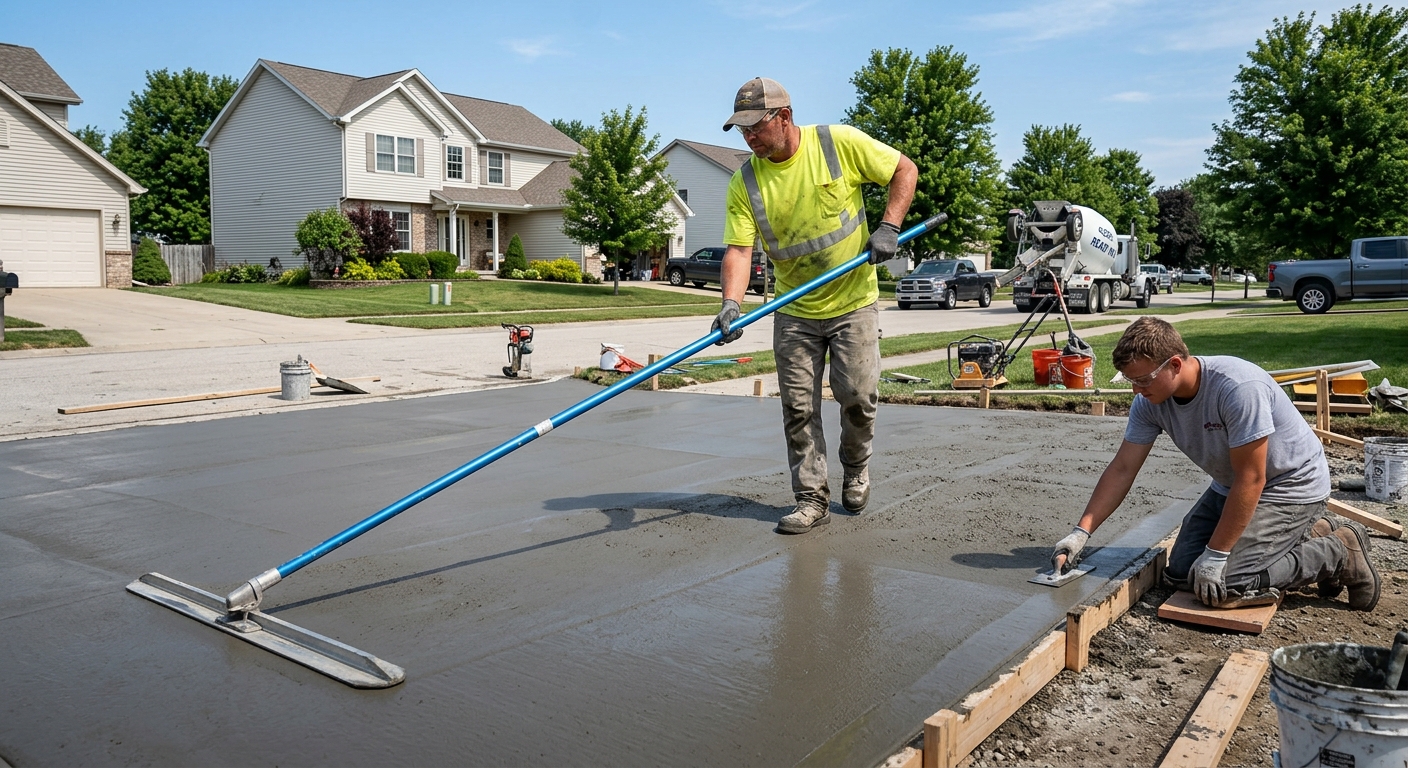
Concrete work options and costs in Mississauga Beach
Concrete work in Mississauga Beach is shaped by a very “GTA reality”: freeze–thaw cycles, humid shoulder seasons, and the need for properly drained, well-compacted bases. Mississauga Beach has a small population of 4,662 (Statistics Canada, 2021 Census), and that smaller local construction market means fewer crews on shorter notice—so timing, access, and scheduling can noticeably affect pricing. Most owners are dealing with established residential lots, where driveway and patio replacements often happen as homes are refreshed and landscaping is upgraded. Toronto’s broader housing mix is heavily dominated by single-detached communities, and that’s the primary market for exterior flatwork like driveways, patios, and walkways.
In the Toronto economic region, contractors must plan for frost depth and differential movement. For exterior slabs and flatwork, local practice also emphasizes air-entrained mixes, adequate thickness, and control joints to manage cracking from seasonal movement. Pours are often concentrated in the warmer months to protect curing when temperatures trend down toward 10 °C or below, because slower strength gain can raise the risk of surface scaling and early wear. Even without “coastal” conditions, the area’s wet fall and spring can keep subgrades saturated longer, which increases excavation and base-replacement costs if drainage isn’t corrected.
Where this trade is especially in demand is in the older residential pockets near Lake Ontario—areas with higher likelihood of weathered asphalt or cracked walkways that homeowners want replaced with something longer-lasting. Below is a practical cost comparison to help you align contractor options with your budget before you request quotes.
| Application |
Typical Size |
Key Spec |
Finish Option |
Price Range |
| Concrete driveway (standard broom finish) |
300–450 sq. ft. |
Air-entrained mix, compacted granular base, control joints |
Broom finish |
$7,200 – $12,600 |
| Exposed aggregate driveway |
300–450 sq. ft. |
Air-entrained mix, proper retarder/cleaning process, sealer |
Exposed aggregate (light brushing) |
$10,800 – $16,200 |
| Stamped concrete driveway or patio |
200–350 sq. ft. |
Air-entrained mix, darker/solid colour option, release agent |
Stamp pattern + integrated colour (optional) |
$8,200 – $14,000 |
| Plain concrete patio or walkway |
150–300 sq. ft. |
Slab thickness suitable for loads, compacted base, control joints |
Smooth or broom finish |
$2,400 – $6,900 |
| Garage floor (interior slab) |
300–500 sq. ft. |
Proper sub-base, vapour considerations if needed, curing attention |
Standard trowel finish (or broom) |
$6,300 – $13,000 |
| Foundation footings (structural, below frost) |
Per-project; forms/rebar vary |
Concrete below grade, engineered footing width/depth, rebar as required |
Structural concrete only |
$180 – $300 |
Prices are estimates only and vary by project scope, site access and material selection.
What affects the price of concrete work in Mississauga Beach
Even when you request “the same concrete,” quotes across Toronto and Ontario can differ by 30–50% because the real cost drivers aren’t just the concrete—it’s the excavation depth, base thickness, reinforcement, mix design, finish complexity, and how carefully the contractor manages curing and drainage. In Mississauga Beach, freeze–thaw is the big story: frost and ice expansion demand that exterior footings and structural elements go below design frost depth to prevent heave and differential settlement. Local practice for Ontario commonly targets footing depths around 1.2 m (about 4 ft) below grade for structural work, and exterior flatwork still depends on a strong, drained base. That means the “cheapest” quote often has lower assumed excavation, thinner base, or a finish that doesn’t stand up to de-icing salts and wet winters.
Freeze–thaw also changes mix selection and finishing timing. Exterior concrete is typically air-entrained to survive repeated cycles, and in colder stretches of the season contractors may add cold-weather protection (insulating blankets, tenting, or heated curing) so the concrete gains strength properly. Those precautions matter when curing conditions drop toward 10 °C or below. If sealing is skipped, surface scaling and spalling can show up faster, especially where owners rely on salt.
Two common Mississauga Beach pricing examples: (1) replacing an old, poorly draining driveway often forces deeper excavation and granular base rebuilding, pushing pricing toward the higher end of the driveway band ($18–$28 per sq. ft.). (2) A stamped patio might look like “just decorative,” but the added labour for forms, stamp mats, integrated colour (if selected), and tighter control-joint planning can move the project closer to the stamped band ($24–$40 per sq. ft.), while a plain broom patio stays closer to the lower range ($16–$26 per sq. ft.). Lastly, foundation/footing changes are especially expensive because they scale with engineered rebar and excavation; in Toronto-area builds, footing pricing commonly falls in the $180–$300 range per unit/set based on scope and depth.
| Price Factor |
Why It Matters |
Cost Impact |
| Frost line depth — determines footing depth and form height |
Footings must extend below design frost depth to reduce heave risk |
Higher depth = more excavation, forms, rebar, and concrete |
| Site preparation — excavation, grading, compacted granular base |
Saturated soils and weak subgrade lead to settlement and cracking |
Unexpected soft spots can add removal and re-compaction |
| Reinforcement — rebar or wire mesh requirement |
Controls cracking and improves load capacity for slabs and footings |
Labour and material cost; also affects slab thickness |
| Mix design — air-entrainment and compressive strength spec |
Air-entrainment helps resist freeze–thaw damage; strength affects performance |
Specialty mix and testing/QA can add to per-m³ cost |
| Finish type — broom vs. stamped vs. exposed aggregate |
Finish affects labour time, tooling, and curing/clean-up steps |
Stamped/exposed usually higher than broom-finished slabs |
| Pour size and concrete truck access to site |
Access restrictions can require pumping or smaller truck logistics |
Pumping/extra handling adds truck time and crew labour |
| Cold-weather curing precautions — heating and blankets |
Ensures proper strength gain and reduces surface scaling/spalling |
Blankets/heaters can materially increase job time and material use |
| Control joint pattern and sealing cost |
Joints manage where cracks can form; sealing repels moisture/salt |
More joints/layout time + sealer labour/extra cure scheduling |
Permits & regulations in Ontario
In Ontario, structural concrete work—footings, foundation walls, and grade beams—typically requires a building permit and, in many cases, engineered drawings that the municipality (or its approved process) will review as part of the permit package. That includes work that affects load-bearing elements, structural integrity, or the building’s ability to resist frost and water movement. For Mississauga Beach homeowners, the key practical point is to treat anything “below grade and structural” differently from simple patio replacements.
Concrete flatwork such as driveways, patios, and walkways usually does not require a permit by default, unless your project changes lot grading, affects impervious surface coverage limits, or interferes with municipal right-of-way conditions (for example, driveway approaches or drainage tie-ins). If you’re changing drainage, adding a new curb cut, or altering how water flows, ask the municipality directly before the first shovel moves.
To verify a contractor in Ontario step-by-step, start with their licensing/registration information through the provincial online resources available for construction trade verification. Then request a current certificate of liability insurance showing your address as an interested party (if they’re willing) and ensure coverage is active for the job dates. Confirm WSIB/WCB clearance for Ontario work (or equivalent clearance where applicable) by requesting the clearance letter or proof of coverage before work begins. Finally, ask for references on similar-scale foundation and flatwork projects so you can compare finish quality, joint patterns, and how they handled base prep.
Getting concrete right in Mississauga Beach's freeze-thaw climate
Concrete failure in Mississauga Beach is usually predictable: weak or waterlogged base, inadequate drainage, incorrect mix air content, and curing problems during cold snaps. Freeze–thaw cycles expand moisture in soil and in the concrete surface pores. If the concrete isn’t air-entrained and properly cured, the surface can spall and scale—especially after de-icing salt hits a slab that was finished too quickly or protected too little. The spec isn’t just technical paperwork; it’s how you prevent the “pretty pour that turns rough” after a couple winters.
To spec correctly, focus on five areas. (1) Base preparation: excavate to stable material and rebuild with well-compacted granular base to the right depth for local soil conditions, not “minimum thickness” assumptions. (2) Mix design: for exterior flatwork, target air-entrainment typically in the 5–7% range for freeze resistance, and use a minimum 32 MPa compressive strength mix (or higher where required for load). (3) Control joints: place joints to limit random cracking and plan them to line up visually with patterns and edges. (4) Curing: plan for at least 7 days of curing under proper conditions; cold-weather curing needs protection so strength gain isn’t compromised. (5) Sealing: apply a penetrating sealer after the recommended cure window (commonly at 28 days) to repel moisture and reduce de-icing salt impacts.
When you compare quotes, ask the contractor to explain—plainly—how they’ll prevent spalling: “What air content are you using, how do you verify it, and what curing protection will you provide if temps drop?” A simple dollar example: a plain broom patio might land nearer the $16–$26 per sq. ft. band, but adding correct air-entrainment, better base thickness, and sealing (even if you skip decoration) is usually what keeps it in the “long-lasting” category rather than needing resurfacing early. Stamped work can cost more (often closer to the $24–$40 per sq. ft. band), but the durability pieces still apply—don’t pay for decoration while skipping the freeze–thaw safeguards.
| Spec |
Why It Matters in Mississauga Beach |
What to Ask For |
Impact if Skipped |
| Compacted granular base (depth?) |
Controls settlement and reduces water from freezing under the slab |
Base depth and compaction method; drainage plan for damp soils |
Low spots, cracking, rocking slabs, early failure |
| Air-entrained concrete mix (target air %?) |
Helps resist freeze–thaw damage in Ontario winters |
Target air content (commonly 5–7% for exterior flatwork) |
Higher risk of surface spalling and scaling |
| Compressive strength (MPa rating) |
Ensures adequate strength gain for durability and load resistance |
Minimum 32 MPa (and specify if thicker/heavier-load areas) |
Soft surface, wear, and reduced long-term performance |
| Control joints (spacing per ACI guidelines) |
Manages where cracks will open as the slab contracts/expands |
Joint layout plan and spacing rationale |
Random cracking, wider gaps, water infiltration |
| Minimum 7-day curing period |
Strength develops properly; reduces early surface defects |
Protection plan for temperature drops; curing method |
Scaling, weaker surface, increased cracking risk |
| Penetrating sealer (when applied after cure) |
Repels moisture and helps protect against de-icing salts |
Sealer type and timing (commonly after 28 days cure) |
Faster deterioration from salt exposure and wetting |
How to choose a concrete work contractor in Mississauga Beach
Choosing the right concrete contractor in Mississauga Beach is mostly about verification and clarity. First, confirm Ontario licensing/registration details that apply to the contractor and the scope of work they’re proposing. Next, request proof of liability insurance—a current certificate of insurance that covers the project period—and confirm they carry appropriate WSIB/WCB clearance for Ontario work. Don’t rely on verbal assurances; ask for the clearance letter or proof of coverage before the start date.
For pricing, ask for 2–3 itemised written quotes that separate labour, concrete supply, base prep (excavation and granular), reinforcement, formwork, and finish materials. A lump sum without breakdown is where “scope creep” hides. Also check what’s excluded: permit pull (if needed), demolition, hauling/disposal, temporary protection during curing, sealing, and any allowances for rework if subgrade conditions differ from initial assumptions.
Warranty matters in freeze–thaw climates. Look for a clear workmanship warranty length tied to specific defects, plus whether the product/manufacturer warranty is included and whether it’s transferable to you if you sell. For payment, never agree to pay more than 10–15% upfront; hold back a portion until the job is completed, cleaned, and cured. Finally, insist on a written timeline with start date and estimated completion; in Ontario, delayed weather protection can be the difference between a long-lived slab and an early-rough surface.
- Request proof of liability insurance and WSIB/WCB clearance before signing.
- Ask whether they follow air-entrainment requirements for exterior flatwork.
- Insist the quote lists base prep, granular depth, and compaction responsibility.
- Confirm slab thickness targets and reinforcement details (rebar/wire mesh).
- Ask how they manage curing if temps drop near 10 °C or below.
- Ensure control joint layout is included (not “we’ll see on site”).
- Ask whether sealing is included, and timing (commonly after cure).
- Verify demolition and disposal are either priced or explicitly excluded.
- Check access plan: driveway width, setbacks, and whether pumping is needed.
- Confirm de-icing salt avoidance guidance until sealing/curing is complete.
- Review the warranty terms in writing, including what triggers service.
- Use a payment schedule with holdback until final inspection/clean-up.
Concrete contractor red flags in Mississauga Beach: quoting without discussing base depth or drainage, refusing to state air-entrainment and curing practices, offering the lowest price with vague “standard mix” wording, skipping control-joint planning, and asking for large upfront payments (well over 10–15%) without a written schedule and staged holdback.
Frequently asked questions — concrete work in Mississauga Beach
Concrete vs pavers for a patio in Mississauga Beach?
For a patio in Mississauga Beach, concrete is often the lower-maintenance “set it and forget it” option when it’s built on a properly drained, compacted base. Pavers can be great for repairs because individual units can be lifted and replaced, but they still require excellent base compaction and correct edging to prevent movement during freeze–thaw cycles. Concrete can be broom-finished for value, or upgraded with stamping; in the Toronto region, patio work commonly falls around $16 – $26 per sq. ft. for plain flatwork, while stamped/decorative upgrades usually cost more. If you want a smooth, uniform surface and planned joint lines, concrete usually fits better. If you prioritize section-by-section future repairs and a more “modular” look, pavers can make sense—just insist on drainage and a base spec, not just stone choice.
How long does a concrete driveway last?
A well-built concrete driveway in Ontario commonly lasts decades, but the “how long” depends on what happens before the first pour. In the GTA freeze–thaw climate, longevity is driven by air-entrainment, adequate thickness, correct base prep, proper grading, and control joint placement. Sealing also helps reduce moisture and de-icing salt impact; without it, you can see surface scaling earlier. If your driveway is replaced with standard broom-finish concrete and built to handle saturated soils, homeowners typically see long service life rather than repeat patching. In Mississauga Beach, most properly executed driveway replacements land in the regional band of $18 – $28 per sq. ft., which reflects the real work—excavation, granular base, reinforcement, and cure protection. If someone promises a low price without discussing base/drainage and curing, that’s where early wear shows up.
What is air-entrained concrete and why does it matter here?
Air-entrained concrete is designed to include tiny, evenly distributed air bubbles in the mix. Those microscopic air voids give freezing water “space” to expand without tearing the concrete apart. In Mississauga Beach and across Ontario’s Toronto region, freeze–thaw cycles plus humid wet seasons are hard on exterior slabs and driveways, particularly when de-icing salts are used. That’s why reputable contractors specify air-entrainment for exterior flatwork rather than relying on a generic mix. The practical homeowner question is: what air content are you using and how will you ensure it? For exterior work, air content is commonly targeted around 5–7% (depending on mix design), and the contractor should plan curing conditions so strength develops before winter stress hits. If air-entrainment is skipped, spalling and surface scaling risk rises significantly, even if the slab looks fine at first.
How do I prepare the base for a concrete slab?
Base prep is the foundation of durable concrete. For a slab in Mississauga Beach, preparation means excavating to stable subgrade, removing topsoil/soft material, then rebuilding with compacted granular base to the required depth for the soil and the slab’s use (walkway vs. driveway loads). The contractor should also address drainage—slabs fail faster when water is trapped under or around them and then freezes. Ask your contractor to spell out excavation depth, base thickness, compaction method, and how they’ll correct any wet areas during the prep stage. For exterior flatwork, a strong, drained granular base reduces movement and helps the concrete tolerate Ontario winters. If you only compare finish price (for example, plain vs stamped), you can miss that two contractors might use different base depths—one will sit on a stronger foundation and typically cost more in the short term (but perform longer).
How do I compare concrete quotes?
To compare concrete quotes fairly in Mississauga Beach, demand itemised line items rather than a single lump sum. Compare the same scope: demolition, excavation, granular base depth, reinforcement type (rebar/wire mesh), concrete mix spec (including air-entrainment for exterior), slab thickness, formwork, and finishing. Confirm whether the quote includes control joints and what joint spacing plan they’ll use, because that affects cracking patterns. Also check whether sealing is included and when it will be applied—often after curing (commonly after 28 days). If you’re comparing driveway options, use the band to sanity-check pricing; for example, driveway concrete often sits around $18 – $28 for standard work, while more decorative choices like stamped or exposed aggregate can climb toward $24 – $40 per sq. ft. If a quote is dramatically lower, ask what essential spec or site prep they’ve omitted.
Can concrete be poured in cold weather in Mississauga Beach?
Concrete can be poured in cold weather in Ontario, but it must be handled correctly to protect curing and strength development. In Mississauga Beach and the Toronto region, contractors watch air and slab temperatures closely; when conditions drop toward 10 °C or below, cold-weather curing precautions often become necessary. That may include insulation blankets, wind protection, and sometimes heating to keep the concrete warm enough for adequate strength gain during the early curing period. If a contractor says they’ll “pour no matter what” without a cold-weather plan, that’s a major risk for durability. The difference in cost is usually the added labour and materials for protection, but it’s cheaper than dealing with scaling or spalling later. Best practice is to schedule exterior flatwork for the warmer part of the season and, if weather turns, insist on a written curing protection plan that matches your pour date and forecast.