Concrete work options and costs in Princess-Rosethorn
Concrete work is a big part of life in Princess-Rosethorn, Ontario, and homeowners here typically want flatwork that can handle Toronto-area freeze–thaw without heaving or spalling. In a community of 11,051 residents (Statistics Canada, 2021 Census), the dominant housing pattern is family living, and that usually means driveways, patios and walkways get used year-round and need to be durable. It’s also why local contractors stay busy in pockets where renovations and new builds cluster, especially around the Bathurst Street corridor where many properties see upgrades to entry paths and vehicle pads.
In the Toronto economic region, your quote depends heavily on frost depth requirements and how the contractor plans for winter performance. Footings for structural concrete generally need to extend below the design frost depth—commonly at least 1.2 m (about 4 ft) below grade in Ontario—to reduce frost heave and differential movement. For exterior slabs, Toronto crews usually specify air-entrained mixes, adequate thickness, and well-planned control joints to manage cracking during repeated freeze–thaw cycles. The pour season is also practical: many projects are concentrated in warmer months so concrete can cure properly, because when temperatures drop toward 10 °C or below, contractors have to add cold-weather protection (insulating blankets and sometimes heaters), which shows up in pricing.
Below are realistic Princess-Rosethorn estimate ranges you’ll see from reputable Toronto-area crews. Use the table to compare finish levels and scope, then align your final spec with the site conditions and drainage plan.
| Application |
Typical Size |
Key Spec |
Finish Option |
Price Range |
| Concrete driveway (standard broom finish) |
400–500 sq. ft. |
Air-entrained mix, reinforced base prep, control joints |
Broom finish |
$18,000–$28,000 |
| Exposed aggregate driveway |
400–500 sq. ft. |
Air-entrained mix, proper surface retarder timing, sealed finish |
Exposed aggregate |
$22,000–$34,000 |
| Stamped concrete driveway or patio |
300–500 sq. ft. |
Air-entrained mix, integral colouring, release agent, edging |
Stamped patterns (stone/brick look) |
$24,000–$40,000 |
| Plain concrete patio or walkway |
200–400 sq. ft. |
Compacted granular base, drainage slope, control joints |
Plain broom or smooth-trowel edge |
$16,000–$26,000 |
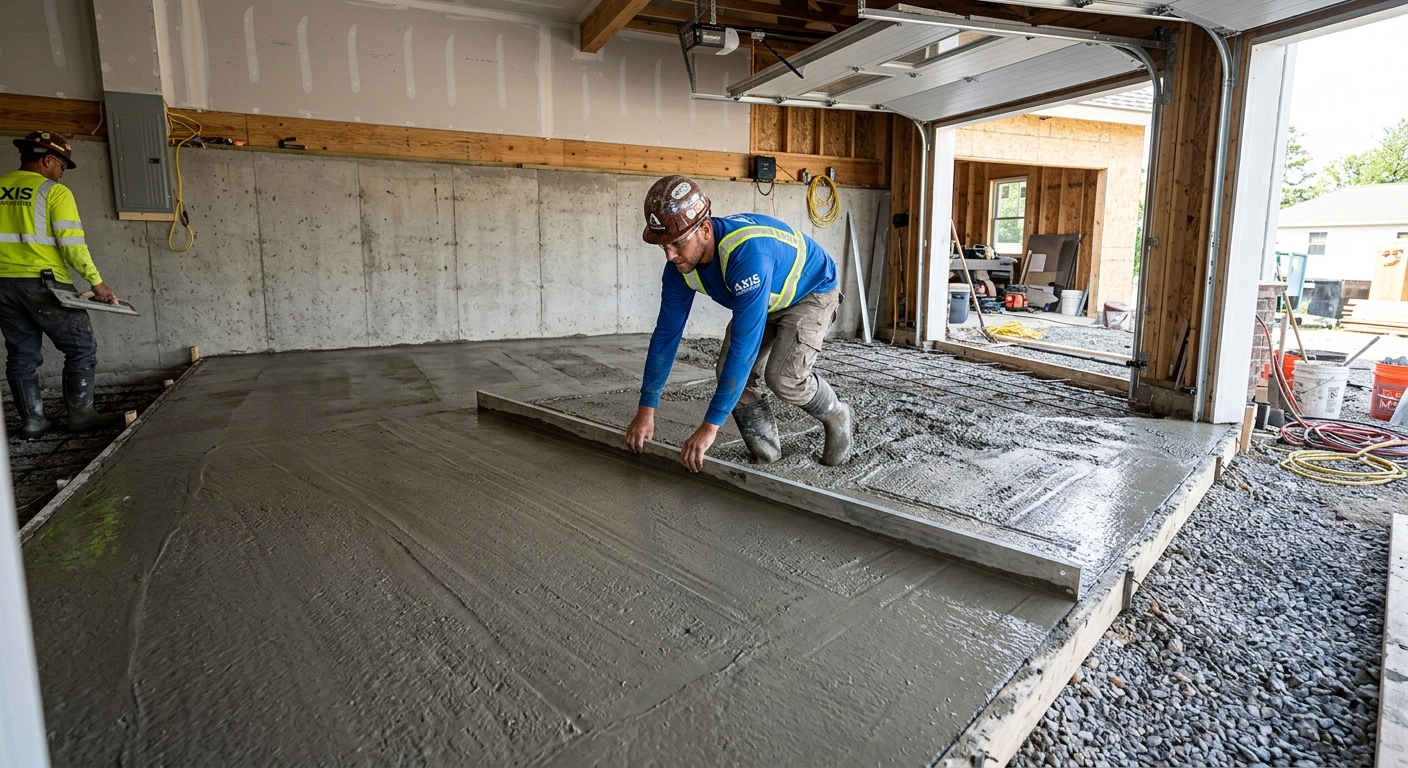
| Garage floor (interior slab) |
400–600 sq. ft. |
Vapour/ground prep as needed, reinforced slab, saw-cut joints |
Plain finish with hardener option |
$7,200–$14,500 |
| Foundation footings (structural, below frost) |
Per linear foot equivalent |
Excavation, rebar, concrete below design frost depth |
Structural concrete forming & placing |
$180–$300 |
Prices are estimates only and vary by project scope, site access and material selection.
What affects the price of concrete work in Princess-Rosethorn
Homeowners in Princess-Rosethorn often see wildly different quotes for what sounds like the “same” concrete job—think 30–50% variation across the Toronto region—because concrete pricing is mostly driven by what happens before the concrete arrives: excavation, base prep, reinforcement, mix design, protection during curing, and how detailed the finish is. A basic driveway can start around the lower end of the local $18–$28 per sq. ft. backbone range, but once you add thicker sections, proper granular depth, more reinforcement, or decorative options, the labour and materials climb quickly.
In Toronto’s climate, frost depth and freeze–thaw cycles dictate nearly every spec. Structural footings need to extend below design frost depth (commonly at least 1.2 m in Ontario) to prevent frost heave and differential movement. Exterior slabs also need air-entrained concrete to survive repeated freezing and thawing. Colder periods shorten the reliable pour season, and crews may need cold-weather curing precautions—insulating blankets, temperature monitoring, and sometimes heat—to protect strength gain. On top of that, GTA driveways and patios are exposed to de-icing salts; that drives the need for sealing to help reduce surface deterioration and spalling risk.
Local site conditions can raise or lower costs fast. For example, clay-heavy soils or poor drainage can require deeper granular base and more grading, which pushes a plain patio toward the middle of the $16–$26 range. In contrast, a driveway replacement on already-prepped, accessible property with good drainage may land closer to the lower band. Also, many Princess-Rosethorn homes are older and have existing entrances, which means saw-cutting and removal of old concrete (plus hauling/disposal) can add meaningful cost—especially when the job is tight or requires traffic-safe staging.
| Price Factor |
Why It Matters |
Cost Impact |
| Frost line depth — determines footing depth and form height |
Footings must sit below design frost depth to prevent heave and movement |
Higher excavation depth increases labour, forming, and concrete volume |
| Site preparation — excavation, grading, compacted granular base |
Good base prevents settlement and keeps drainage away from the slab edges |
Major cost swing if soils are soft or granular depth is insufficient |
| Reinforcement — rebar or wire mesh requirement |
Controls cracking and improves load capacity for exterior slabs and floors |
More steel and placement time adds material and labour |
| Mix design — air-entrainment and compressive strength spec |
Air-entrainment helps manage freeze–thaw; strength targets support service life |
Specialty mix often costs more but reduces failure risk |
| Finish type — broom vs. stamped vs. exposed aggregate |
Complex finishes require more steps, timing and labour control |
Stamped/exposed typically adds significant labour and materials |
| Pour size and concrete truck access to site |
Small/tight access may require pumping or additional finishing crew |
Pumping, longer carries, and staging can raise the final price |
| Cold-weather curing precautions — heating and blankets |
Protects early-age strength when temps fall toward ~10 °C or below |
Insulating materials and monitoring add cost and planning time |
| Control joint pattern and sealing cost |
Joints direct cracking; sealing improves resistance to de-icing salts |
Better detailing can raise cost slightly but improves durability |
Permits & regulations in Ontario
In Ontario, structural concrete work typically requires a building permit, and municipalities may also require engineered drawings reviewed as part of the approval process. Work that usually falls under “permit and/or engineered review” includes foundation footings, foundation walls, grade beams, underpinning, and other structural elements tied to the building’s load path. If you’re adjusting drainage in a way that impacts grading or adding hard surfaces near a foundation, the permit question can also come up depending on lot grading and municipal impervious surface rules.
Concrete flatwork—driveways, patios, walkways, and most exterior slabs—often does not require a permit by default. However, it can become permit-related if it affects lot grading, changes drainage patterns near the foundation, touches municipal right-of-way requirements, or triggers limits around impervious coverage. Because requirements can vary by site and municipality, the safest approach is to confirm with the local building department before you break ground.
For contractor verification in Princess-Rosethorn, start with the building permit information (if applicable) and then confirm the basics: ask for the contractor’s liability insurance certificate, proof of WSIB/WCB coverage where required, and a list of similar-scale projects. If you’re hiring for structural foundation-related work, also ask how they handle engineered drawings and inspection steps. You should be able to see documentation—clearances or letters when applicable—and you should never rely on a verbal promise.
To do it step-by-step: (1) request the contractor’s certificate of insurance (liability limits shown), (2) ask for WSIB/WCB status details, (3) verify the contractor’s business registration and Ontario licensing status using the appropriate online search tools, and (4) confirm references match the type of concrete work you’re planning.
Getting concrete right in Princess-Rosethorn's freeze-thaw climate
Concrete failures in Princess-Rosethorn are usually not “mystery problems”—they’re predictable outcomes of base preparation shortcuts, the wrong mix, or poor early-age curing. In Toronto’s freeze–thaw environment, the most common exterior issues are surface deterioration and spalling from de-icing salts, plus random cracking from settlement or inadequate joint planning. The fix starts with the foundation (the base) and ends with the protection plan.
First, base preparation: exterior slabs need a properly graded, compacted granular sub-base to the right depth so water can drain away and the slab isn’t sitting on unstable soil. Second, mix design: for exterior flatwork, specify air-entrainment (typically 5–7% air content) and a minimum 32 MPa compressive strength so the concrete handles repeated freezing cycles. Third, control joints: you want joints placed to “invite” cracking into planned lines rather than into random cracks across the field. Fourth, curing: in Ontario, aim for at least 7 days of appropriate curing conditions, and when temperatures drop, contractors should protect the pour with insulation/blankets to support early strength gain. Fifth, sealing: apply a penetrating sealer around 28 days after the pour (once cure is complete) to repel de-icing salts and water intrusion.
Here’s a real-world cost logic example: if you’re choosing between a plain broom patio and stamped concrete, stamped concrete can land around the $24–$40 band because of extra steps and timing. If your base drainage isn’t corrected and the air-entrainment isn’t right, that “decorative premium” doesn’t buy you longevity—so the best value comes from spending first on the spec that prevents spalling and water infiltration.
When you interview contractors, ask about their air-entrained mix plan, granular base depth and compaction method, joint spacing, curing protection when temperatures fall, and the exact sealing timeline.
| Spec |
Why It Matters in Princess-Rosethorn |
What to Ask For |
Impact if Skipped |
| Compacted granular base (depth?) |
Prevents settlement and manages drainage against frost action |
Granular depth details, compaction method, slope plan |
Uneven settling, cracking, and water pooling under/along edges |
| Air-entrained concrete mix (target air %?) |
Survives freeze–thaw cycles and reduces risk of spalling |
5–7% target air content for exterior flatwork |
Higher chance of surface scaling and freeze–thaw damage |
| Compressive strength (MPa rating) |
Ensures durability and adequate early-age strength |
Minimum 32 MPa rating specified and documented |
Lower strength gain can lead to premature wear and cracking |
| Control joints (spacing per ACI guidelines) |
Directs cracking into planned lines through seasonal movement |
Joint spacing and saw-cut timing approach |
Random cracking patterns and wider crack widths over time |
| Minimum 7-day curing period |
Early curing affects final strength and resistance |
How they cure in cool/wet weather (blankets/heating if needed) |
Weak surface, scaling, and inconsistent performance |
| Penetrating sealer (when applied after cure) |
Repels water and helps limit de-icing salt damage |
Application at ~28 days post-pour (after cure) and product type |
More salt/water absorption and accelerated surface deterioration |
How to choose a concrete work contractor in Princess-Rosethorn
Choosing the right contractor in Princess-Rosethorn comes down to proof, not promises. For Ontario concrete work, verify three things: (1) licensing/business authorization through the appropriate online registry tools, (2) liability insurance (ask for the certificate of insurance and confirm limits), and (3) WSIB/WCB coverage status where required. You can’t judge these by a truck logo or a social media post—ask for documents up front, then keep them for your records.
Next, get 2–3 itemised written quotes. A proper quote should separate labour, concrete supply, base preparation, reinforcement, saw-cutting/joints, finishing, sealing, and haul/disposal. Avoid lump sums that don’t explain what’s included (for example: “concrete only” versus “remove and replace,” whether disposal is included, and whether permits/inspections are included if structural work is involved). Also ask about protection during curing—Toronto-season planning matters when temperatures hover near 10 °C or below.
Warranty is another differentiator. Ask for the workmanship warranty length and whether it’s tied to surface defects, cracking due to base issues, or only cosmetic matters. Product/manufacturer warranties may exist for sealers or admixtures, but they’re not a replacement for a solid base and correct air-entrained mix. On payment terms, never pay more than 10–15% upfront. Hold back money until the final grading, joint sealing (where scheduled), and cleanup are complete. Finally, insist on a written timeline with start date and completion estimate; crews that won’t put schedule details in writing are often the ones who don’t plan for cure protection.
- Ask for insurance certificate showing liability coverage limits and effective dates.
- Confirm WSIB/WCB coverage status in writing (or ask how they handle worker coverage).
- Verify the contractor’s Ontario business details using the appropriate online registry search.
- Request an itemised quote (labour, materials, base prep, reinforcement, disposal, sealing).
- Confirm whether existing concrete removal and disposal are included.
- Ask for concrete mix details: air-entrainment plan and specified strength (e.g., 32 MPa).
- Ask granular base depth and compaction method (not just “we’ll prep the base”).
- Ask reinforcement specifics (mesh/rebar, placement, and whether it’s continuous where needed).
- Confirm joint plan: location and spacing, and whether saw-cut timing is scheduled.
- Ask how they protect curing in cool/wet conditions; request their cold-weather approach.
- Clarify sealing: product type and whether sealing is included after cure (around 28 days).
- Use payment milestones: small deposit, then holdback until completion and cleanup.
Red flags to watch for: vague scopes (“flatwork replacement” with no base depth or joint plan), quoting without discussing frost depth/freezing conditions, refusing to provide insurance/WSIB documentation, requiring large deposits (well beyond 10–15%), and promising “no cracking” or “no maintenance” warranties for exterior concrete in Ontario.
Frequently asked questions — concrete work in Princess-Rosethorn
How deep must footings be for Princess-Rosethorn's frost line?
In Princess-Rosethorn, footings for structural foundations are typically required to extend below the design frost depth to reduce frost heave risk and differential movement. For many Ontario foundation applications, that works out to at least about 1.2 m (roughly 4 ft) below grade, but your exact depth should follow the building design and local requirements on your project. This is why quotes vary: excavation depth changes the amount of concrete, forming, and labour. If the site has drainage issues, contractors may also propose additional base preparation and grading changes, which can affect the final price. When you’re planning foundation work, ask for the footing depth shown in the engineered drawings (if applicable) and confirm how inspections will be handled during placement.
Why does concrete crack in Princess-Rosethorn and how is it prevented?
Concrete cracks mainly because concrete shrinks as it cures, and because the soil and slab expand/contract with moisture and freeze–thaw. In Ontario’s Toronto area, repeated temperature swings plus de-icing salt exposure make it even more important to build exterior slabs with the right base, correct air-entrainment, and proper jointing. Prevention is mostly about directing where cracks occur: a well-compacted granular base, correct reinforcement placement, and control joints spaced to manage shrinkage and movement. Curing matters too—if temperatures drop toward 10 °C or below, contractors should protect the pour so early strength develops properly. If you’re comparing quotes, understand that a plain broom patio might fall around the $16–$26 range, but durability improves when the joint and curing plan is detailed, not when the finish alone is upgraded.
Stamped vs broom-finish concrete — cost difference?
Stamped concrete typically costs more than a broom-finish surface because it adds steps, timing, and materials: integral colouring or release agents, stamping mats, texture finishing, and extra crew labour to keep patterns consistent. In Princess-Rosethorn, you’ll commonly see stamped driveway or patio work referenced in the $24–$40 band, while standard driveway and broom-finish flatwork often sits closer to the $18–$28 backbone for driveways and $16–$26 for patios/walkways. The important point for homeowners is that stamped aesthetics don’t replace structural quality. If base prep, air-entrainment, and joint spacing are weak, you can still get cracking or early surface scaling. When you review quotes, ask whether the same frost-safe specs (base depth, air content, joints) are included for both options.
When is the best time to pour concrete in Princess-Rosethorn?
For Princess-Rosethorn, the best time to pour is generally during the warmer months when consistent curing is easier and the risk of temperature drops is lower. In the Toronto area, many exterior pours are concentrated in periods where crews can protect concrete through the curing window, because work becomes more complex when temperatures move toward 10 °C or below. When colder weather approaches, reputable contractors plan cold-weather curing measures—insulating blankets, temperature management, and sometimes temporary heating—so the concrete can reach strength targets reliably. This planning can add cost to a quote, even when the finish is simple. If you want predictable long-term performance, schedule earlier in the season if possible and ask your contractor how they handle curing and protection if the forecast turns cool or wet.
How long does concrete take to cure?
Concrete curing happens in stages. Early set and finishing occur quickly, but strength continues developing over days and weeks. For Ontario exterior flatwork, it’s common to plan for at least a 7-day period of proper curing conditions before you expect the slab to perform well under normal use. That doesn’t mean the concrete is fully “done” after one week—durability improves as curing continues. Sealing is typically scheduled after full cure, often around 28 days post-pour, especially for projects exposed to de-icing salts. If you’re comparing bids for a driveway or walkway in Princess-Rosethorn, ask what the contractor includes for curing protection and whether sealing is part of the scope. A cheaper quote sometimes saves money by rushing curing or skipping sealing, which can reduce longevity in freeze–thaw conditions.
Do I need a permit for concrete work in Ontario?
In Ontario, structural concrete work such as footings, foundation walls, and grade beams typically requires a building permit and may involve engineered drawings reviewed by the municipality. For concrete flatwork—driveways, patios, and walkways—permits are often not required by default, but they can be triggered if the work affects lot grading, drainage patterns near the foundation, impervious surface coverage limits, or municipal right-of-way concerns. Because details vary by site, the best practice is to confirm with the local authority before starting. For contractor hiring in Princess-Rosethorn, ask the contractor whether they intend to pull the permit (if required), and ensure they can provide the correct documentation. Also verify liability insurance and WSIB/WCB coverage so you’re protected during any permitted or inspection-dependent work.