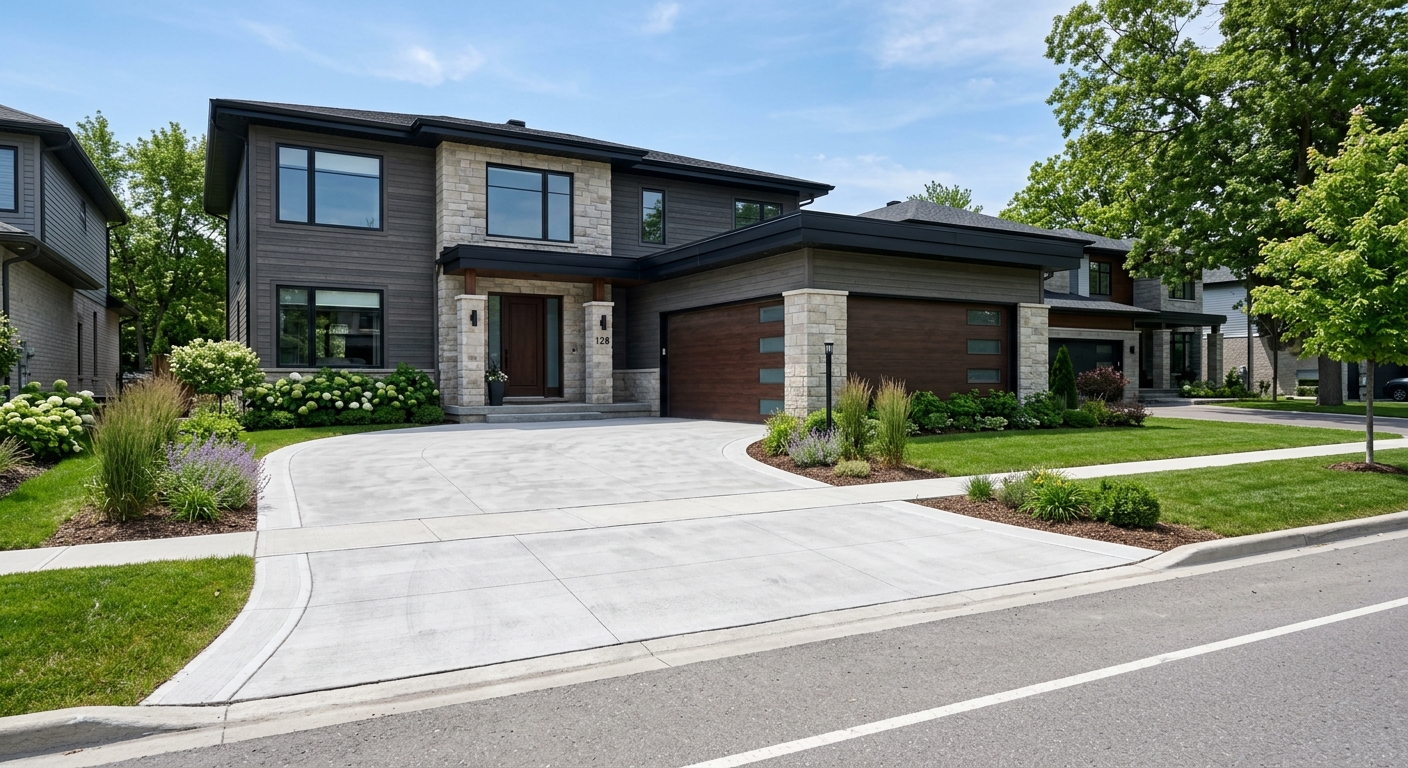
Concrete work options and costs in Brookhaven-Amesbury
Brookhaven-Amesbury, Ontario is a classic GTA concrete market: most homeowners here depend on durable exterior flatwork, especially in spring-to-winter weather. With a population of 17,757 in the area (Statistics Canada, 2021 Census), there’s steady demand for driveway and patio replacements, and many of those projects are tied to single-detached neighbourhoods where people want solid, low-maintenance surfaces. Two of the most common scopes—driveways and patios/walkways—are also the most sensitive to frost depth, freeze–thaw cycles, and drainage. That’s why you’ll see quotes move depending on base preparation, air-entrained mix, and the amount of reinforcement and saw-cut control joints included.
In the Toronto economic region, frost penetration and repeated freeze–thaw drive contractor specs. Most structural footings are required to extend at least 1.2 m (about 4 ft) below grade to help prevent frost heave and differential movement. Exterior slabs, too, typically use air-entrained concrete and proper jointing to manage cracking. Pricing is also influenced by the seasonal pour window: in Brookhaven-Amesbury, contractors generally concentrate exterior pours in warmer months so curing stays reliable, and protection is more labour-intensive when temperatures drop toward 10 °C or below. If you’re working near pockets like the Brookhaven/Amesbury residential lanes, traffic control and site access can add labour time—so “same size” projects can still come in differently.
Below is a practical comparison of typical options for Brookhaven-Amesbury homes, so you can understand where the money goes before you compare itemized quotes.
| Application |
Typical Size |
Key Spec |
Finish Option |
Price Range |
| Concrete driveway (standard broom finish) |
10 ft x 20 ft (200 sq ft) |
Air-entrained mix, compacted granular base, wire mesh |
Broom finish + control joints |
$3,600 – $5,600 |
| Exposed aggregate driveway |
10 ft x 20 ft (200 sq ft) |
Air-entrained mix, proper base drainage, surface retarder |
Exposed aggregate finish |
$4,200 – $6,400 |
| Stamped concrete driveway or patio |
12 ft x 18 ft (216 sq ft) |
Air-entrained mix, sealer plan, integral colour |
Stamped patterns + release + sealing |
$5,300 – $8,600 |
| Plain concrete patio or walkway |
10 ft x 12 ft (120 sq ft) |
Compacted base, air-entrained mix, edges formed |
Steel trowel or broom finish |
$2,000 – $3,800 |
| Garage floor (interior slab) |
20 ft x 20 ft (400 sq ft) |
Vapour barrier (if required), thicker slab, mesh/rebar |
Float + power-trowel (or broom) |
$6,800 – $11,500 |
| Foundation footings (structural, below frost) |
Typical mid-sized footing package |
Below frost depth; engineered rebar cage and formwork |
Structural concrete only (no decorative finish) |
$8,000 – $15,000 |
Prices are estimates only and vary by project scope, site access and material selection.
What affects the price of concrete work in Brookhaven-Amesbury
In Brookhaven-Amesbury and across the broader Toronto region, you can see 30–50% price swings for what seems like the “same” concrete job. The biggest reason is that two quotes often aren’t solving the same problem. One contractor may design for long-term durability (proper excavation to frost-influenced depths, compacted granular base, air-entrained mix, and a joint plan), while another may price the surface only. Labour availability in peak months also matters—when many crews are booked for exterior pours, mobilization, finishing time, and scheduling can push rates up.
Frost depth and freeze–thaw cycles dictate every spec here. Footings must extend below the design frost depth to prevent frost heave and differential movement, and exterior slabs need air-entrained concrete mixes to survive repeated freezing. In the GTA, colder snaps and wet fall/spring weather mean contractors must protect curing—insulating blankets, temperature monitoring, and sometimes temporary heat—especially when temperatures drift close to or below 10 °C. On top of that, de-icing salt use accelerates surface deterioration if the mix and finishing aren’t right, which is why sealing is commonly included in long-life driveway and patio scopes.
Two local examples: (1) If your driveway base is shallow or poorly drained, contractors often have to remove more material and rebuild the granular base—cost rises even if the slab footprint stays the same (typically $18–$28 per sq ft for standard driveway work, before upgrades). (2) If you choose stamped or exposed aggregate, you’re paying for extra materials and labour; stamped decorative often lands higher (about $24–$40 per sq ft for decorative concrete), which is justified when you’re trying to replace both appearance and longevity in one go.
Housing stock and layout also affect dollars. Older homes in established pockets tend to have tighter setbacks, older drainage patterns, and more buried utility conflicts—so excavation and disposal can add meaningful labour time to otherwise straightforward slabs or walkways.
| Price Factor |
Why It Matters |
Cost Impact |
| Frost line depth — determines footing depth and form height |
Controls excavation volume and prevents frost heave |
High impact on foundation/footing quotes |
| Site preparation — excavation, grading, compacted granular base |
Reliable base stops movement and improves slab longevity |
Medium-to-high impact; can swing totals by thousands |
| Reinforcement — rebar or wire mesh requirement |
Helps manage tensile cracking and load distribution |
Medium impact; depends on slab thickness and use |
| Mix design — air-entrainment and compressive strength spec |
Air entrainment improves freeze–thaw durability |
Medium impact; prevents early spalling |
| Finish type — broom vs. stamped vs. exposed aggregate |
Finish processes and sealing requirements differ |
Stamps/aggregate typically add labour and material costs |
| Pour size and concrete truck access to site |
Access affects labour time, pumping needs, and batching logistics |
Medium impact; tight sites can add significant fees |
| Cold-weather curing precautions — heating and blankets |
Reliable curing protects strength development in cool spells |
Medium impact when temperatures fall near 10 °C |
| Control joint pattern and sealing cost |
Joint spacing directs cracking and sealing reduces salt damage |
Lower line-item cost, high durability payoff |
Permits & regulations in Ontario
In Ontario, structural concrete work typically requires a building permit and often engineered drawings. That includes foundation walls, grade beams, footings, and other load-bearing concrete elements. For exterior flatwork—driveways, patios, and walkways—permits usually aren’t required by default, unless the work triggers municipal requirements around lot grading, drainage, or impervious surface coverage, or if you’re altering areas that affect the municipal right-of-way. Because rules can vary by site conditions, confirm with the local authority before breaking ground.
For homeowner confidence in Brookhaven-Amesbury, also verify contractor compliance. Ask for a current certificate of insurance showing general liability and proof of WSIB coverage (or applicable worker coverage documentation). If the job involves structural excavation, formwork, or work at elevation/adjacent to structures, you want a contractor who can show they’re insured for the risks involved.
Step-by-step verification: (1) Licence/registration: check the contractor’s business details and any trade-related registration through Ontario’s public business resources (and confirm they are who you hired). (2) Liability insurance: request the certificate and ensure coverage amounts are appropriate for the job size. (3) WSIB/WCB: ask for WSIB clearance/coverage proof for the crew who will work on-site. (4) References: request similar-scale projects in the GTA—driveways with proper air entrainment and jointing are a good benchmark for long-term performance.
Getting concrete right in Brookhaven-Amesbury's freeze-thaw climate
Concrete fails in Brookhaven-Amesbury mainly through freeze–thaw damage, poor drainage, and uncontrolled cracking. When water gets under or into the slab base, it freezes, expands, and pushes the concrete—creating voids that lead to settlement and surface cracking. On the surface, de-icing salts plus inadequate air-entrainment can cause spalling, which is that pitted, flaking concrete you don’t want on a driveway or patio. Getting the job right means treating the project as a system: base, mix, joints, curing, and sealing.
First, base preparation: contractors should excavate to the correct depth for your soil and local conditions, then place compacted granular sub-base in lifts and verify compaction. Second, mix design: for exterior flatwork, ask for air-entrained concrete with 5–7% air content and minimum 32 MPa compressive strength. Third, control joints: spacing should be planned to limit random cracking—joints need to be cut and sealed where appropriate in accordance with local best practice. Fourth, curing: minimum 7-day curing under proper conditions is critical, and in cooler weather the contractor should manage temperature and protection (blankets/heating) to reach strength reliably. Fifth, sealing: a penetrating sealer is typically applied after the cure—commonly around 28 days post-pour—so the surface repels water and reduces salt-driven deterioration.
Ask the technical question: “What air content and joint plan are you using, and how are you protecting curing during cool spells?” That’s how you avoid the most common failure: spalling from inadequate air entrainment.
As for price justification: upgrading from plain broom-finish to stamped concrete costs more, often within decorative concrete pricing around $24–$40 per sq ft. For a 216 sq ft stamped patio, that can put you in the $5,300–$8,600 range, compared with plain concrete that may land closer to $16–$26 per sq ft for similar sizes. The higher cost is justified when the project includes stronger mix specs, correct base work, and a sealing schedule—otherwise the “pretty” finish still won’t last through the winters.
| Spec |
Why It Matters in Brookhaven-Amesbury |
What to Ask For |
Impact if Skipped |
| Compacted granular base (depth?) |
Prevents frost-driven movement and keeps slab stable in wet/freezing seasons |
Granular base to engineered depth; proof of compaction and proper drainage |
Settlement, cracking, and premature surface failure |
| Air-entrained concrete mix (target air %?) |
Improves freeze–thaw durability in Ontario’s winter cycles |
5–7% air content for exterior flatwork; appropriate admixtures and mix design |
Spalling/pitting from freeze–thaw damage (often within a few winters) |
| Compressive strength (MPa rating) |
Strength development affects long-term wear resistance and cracking behaviour |
Minimum 32 MPa compressive strength (as specified for the use case) |
Weaker surface, more scaling under de-icing salt and traffic |
| Control joints (spacing per ACI guidelines) |
Controls where cracking happens so it doesn’t become random and wide |
Joint spacing and saw-cut timing plan; confirm location strategy |
Random cracking, increased water ingress, and reduced durability |
| Minimum 7-day curing period |
Cool/wet periods in the GTA can slow strength gain and increase defects |
Minimum 7 days protected curing; temperature monitoring and blankets if needed |
Lower strength, surface defects, and reduced freeze–thaw performance |
| Penetrating sealer (when applied after cure) |
Helps repel salt water and reduces moisture-driven deterioration |
Penetrating sealer after cure—typically around 28 days post-pour |
Faster salt scaling and more staining/absorption |
How to choose a concrete work contractor in Brookhaven-Amesbury
Choosing the right contractor in Brookhaven-Amesbury starts with compliance and transparency. In Ontario, verify (1) business/trade registration information, (2) liability insurance, and (3) WSIB coverage. How to check: request a certificate of insurance (make sure it’s current and matches the legal name of the company on the quote), and ask for WSIB clearance/coverage proof for the workers who will be on-site. If a contractor can’t provide these documents quickly, that’s a red flag.
Next, get 2–3 itemized written quotes. You want a breakdown that separates labour from materials and clarifies thickness, reinforcement, excavation/base, joints, and sealing. A quote that just lists “concrete installed” without specifying air-entrainment, thickness, joint plan, and curing protection usually leads to surprises. Also confirm inclusions: is permit pull included (when required), is debris/disposal included, and are forms, edge finishing, and saw cutting part of the scope?
Warranty matters for workmanship and materials. Ask for the workmanship warranty length and what it covers (typically cracking related to workmanship versus normal shrinkage). Also ask whether product/manufacturer warranties apply and whether they transfer to you as the homeowner.
For payment terms, never pay more than about 10–15% upfront. Hold back a portion until the job is complete and any final sealing schedule is satisfied. Finally, insist on a written start date and completion estimate—especially for exterior work tied to the warmer pour window—so you can plan around GTA weather and curing requirements.
- Confirm liability insurance is current and aligns with the quoted contract
- Confirm WSIB coverage/clearance proof for workers on your site
- Ask for proof of recent similar driveway/patio work in the GTA
- Demand itemized pricing: excavation, base, rebar/mesh, concrete supply, finishing, joints
- Verify concrete specs: air-entrainment and minimum compressive strength
- Ask how they manage drainage (slope, tie-ins, and avoiding water pockets)
- Confirm slab thickness and whether reinforcement is included
- Ask for curing method and winter readiness (blankets/heating if needed)
- Get the joint plan: spacing and when saw cuts happen
- Clarify sealing: product type and timing (often around 28 days post-pour)
- Discuss site access: pump? wheelbarrows? traffic control? disposal included?
- Review warranty details in writing and keep the contract copy
Red flags in Brookhaven-Amesbury concrete contracting include: “cheap” quotes that don’t mention air-entrained mix or jointing, promises that curing/blankets won’t be needed even if temperatures dip, no insurance/WSIB documentation, vague scopes that omit base depth and compaction, and payment schedules that ask for large upfront deposits (beyond roughly 10–15%).
Frequently asked questions — concrete work in Brookhaven-Amesbury
Why does concrete crack in Brookhaven-Amesbury and how is it prevented?
Cracking is common in Brookhaven-Amesbury because concrete shrinks as it cures and then expands/contracts with temperature changes. The GTA’s freeze–thaw cycle adds stress when water sits under the slab or within the base. The prevention strategy is not “no cracking,” but controlled cracking: proper compacted granular base, air-entrained concrete for exterior durability, and a planned control joint layout (with saw cuts timed correctly) so cracks form where they’re expected. Good drainage and slope also matter—flatwork that holds water is more likely to develop settlement cracks. If you’re comparing options, note that standard broom-finish driveway work often runs in the $18–$28 per sq ft range, while decorative finishes cost more; either way, the joint and mix specs are what keep cracking from becoming widespread and damaging.
Stamped vs broom-finish concrete — cost difference?
In Ontario, stamped concrete costs more because it includes extra materials and labour: colour, stamping mats/release agent, and careful finishing. In Brookhaven-Amesbury, stamped concrete driveway or patio scopes commonly land within the decorative band of about $24–$40 per sq ft, while standard broom-finish concrete driveways are often closer to $18–$28 per sq ft depending on thickness, base, and reinforcement. The “right” cost difference is usually justified when the contractor also does the durability basics: air-entrained mix for freeze–thaw, adequate base prep, proper jointing, and sealing after the concrete cures. If a quote for stamped concrete doesn’t clearly state air entrainment, thickness, and a joint/sealing plan, the savings aren’t real—stamped surfaces can still fail from spalling if the mix isn’t designed for Ontario winters.
When is the best time to pour concrete in Brookhaven-Amesbury?
The best time for exterior concrete pours in Brookhaven-Amesbury is typically late spring through early fall, when temperatures stay favourable for curing. In the Toronto region, contractors concentrate pours in warmer months because colder nights and wet weather can slow strength gain and increase risk of surface defects. That doesn’t mean you can’t pour earlier or later—many crews just need more protection, like insulating blankets, temperature monitoring, and sometimes heating to support proper curing when temperatures drift toward 10 °C or below. If you’re planning a driveway, patio, or walkway, aim for a window with stable weather so the slab can cure properly for at least 7 days. A properly planned schedule can keep you closer to the baseline pricing (for example, standard driveway work often falls within $18–$28 per sq ft).
How long does concrete take to cure?
Concrete curing depends on temperature and mix design, but the practical homeowner takeaway in Ontario is this: concrete should cure for at least 7 days under proper conditions before you treat it as fully serviceable, and it reaches more robust performance over longer periods. For exterior flatwork in Brookhaven-Amesbury, contractors often protect the concrete during the first week—especially if weather is cool or damp—to ensure strength develops. Sealing is usually scheduled after the concrete has fully cured, commonly around 28 days post-pour. That’s also when de-icing salt and moisture resistance become more reliable. If someone pressures you to seal early or load the slab immediately, ask questions—durability through freeze–thaw cycles relies on correct curing, not speed.
Do I need a permit for concrete work in Ontario?
In Ontario, structural concrete work—like footings, foundation walls, and grade beams—typically requires a building permit and often engineered drawings reviewed through the municipal process. For concrete flatwork such as patios, walkways, and driveways, permits often are not required by default, unless the project affects lot grading, drainage, impervious surface limits, or involves changes near the municipal right-of-way. For Brookhaven-Amesbury homeowners, the safest approach is to confirm with the local authority before work starts, especially if you’re adjusting slopes or redirecting runoff. Also, regardless of permit needs, verify the contractor’s insurance and WSIB coverage before signing. A well-prepared contractor will be clear about which parts of the scope need permits and which do not.
Concrete vs pavers for a patio in Brookhaven-Amesbury?
Concrete and pavers both work well in Brookhaven-Amesbury, but they solve durability differently. Concrete patio slabs—when built on a properly compacted granular base with air-entrained mix and planned joints—can be cost-effective and low maintenance. Typical plain concrete patio/walkway work often lands in the $16–$26 per sq ft range, while decorative work costs more. Pavers can be easier to repair section-by-section if a localized settlement happens, but they require excellent base prep and correct edging/drainage to prevent weeds, movement, and uneven surfaces over time. In the GTA freeze–thaw climate, the key factor is the base and drainage in either system. If you want the best long-term result with fewer lines of work, a properly detailed concrete patio can be the simplest path—provided the contractor specifies the air-entrained mix and curing/sealing plan.