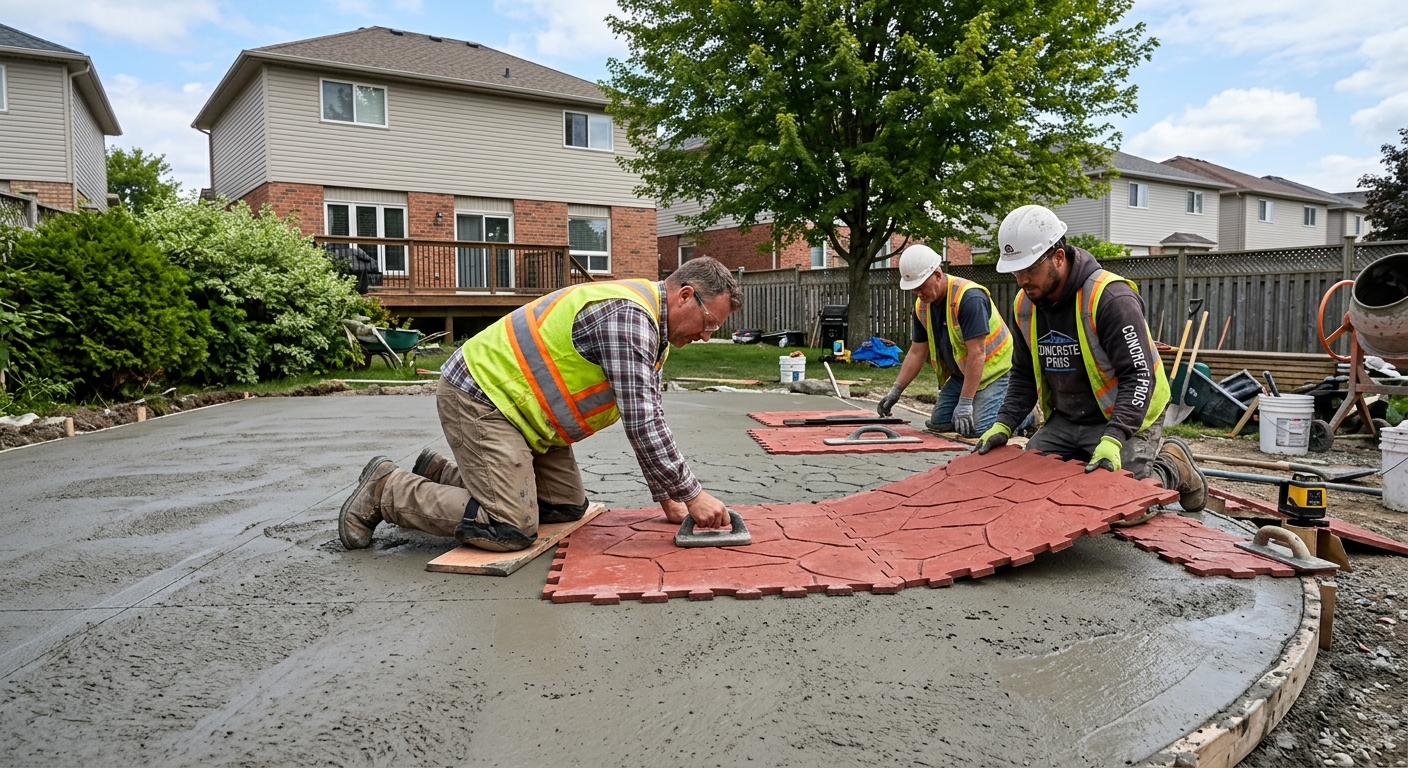
Concrete work options and costs in Markdale
Concrete work in Markdale is mostly driven by the need for durable exterior flatwork—driveways, patios and walkways that can handle Ontario’s freeze–thaw cycles. Markdale’s small population (1,216 residents, Statistics Canada, 2021 Census) means there are fewer crews available locally, so timing and scheduling can influence your quote. It also helps explain why many homeowners plan pours for the short window when crews can get the base prepped, forms set and concrete properly cured.
In this market, concrete flatwork is commonly built for established residential lots and newer infill, and the results you get depend heavily on how much attention is paid to soil conditioning, drainage and jointing. In the Greater Toronto area, municipal requirements and the Ontario Building Code push structural footings to extend below the design frost depth—costly, but essential to limit frost heave and differential movement. For exterior slabs, contractors typically use air-entrained concrete and appropriate thickness to manage cracking caused by repeated freezing and thawing.
In Markdale, trade demand is especially noticeable around Downtown Markdale and the surrounding residential streets where older driveways and walkway sections often need replacement or widening to improve access and drainage. If you’re comparing options, use the table below as a realistic budget starting point, then match the finish and base design to your site conditions.
| Application |
Typical Size |
Key Spec |
Finish Option |
Price Range |
| Concrete driveway (standard broom finish) |
300–500 sq ft |
Air-entrained mix, compacted granular base, control joints |
Broomed |
$18,000–$28,000 |
| Exposed aggregate driveway |
300–500 sq ft |
Air-entrained mix, consistent grading and curing protection |
Exposed aggregate |
$22,000–$35,000 |
| Stamped concrete driveway or patio |
200–400 sq ft |
Air-entrained mix, proper base, pattern set |
Stamping + sealer |
$24,000–$40,000 |
| Plain concrete patio or walkway |
150–300 sq ft |
Drainage slope, compacted base, joints as needed |
Float/ broom light finish |
$16,000–$26,000 |
| Garage floor (interior slab) |
240–480 sq ft |
Vapour barrier, thickness to suit use, perimeter control joints |
Broomed or smooth trowel |
$20,000–$32,000 |
| Foundation footings (structural, below frost) |
Per footing linear ft (typ. 20–60 ft total) |
Engineered design, below frost depth, rebar cage |
Concrete + rebar (utility access as required) |
$180,000–$300,000 |
Prices are estimates only and vary by project scope, site access and material selection.
What affects the price of concrete work in Markdale
In Markdale and across the broader Toronto economic region, the same general concrete scope can land with quotes that differ by 30–50%. The main reason is that “concrete” isn’t one product—it’s excavation, base preparation, mix design, reinforcement, finishing labour, then protection and curing to prevent early damage. Two contractors can both quote a driveway, but one may be building on a better-compacted granular base with a proper slope and joint plan, while the other is trying to keep excavation and rework to a minimum.
Frost depth and freeze–thaw cycles dictate every spec in the Toronto area. Structural footings must extend below the design frost depth (often in the ~1.2 m range and deeper depending on the engineered requirement) to prevent frost heave and movement. Exterior slabs also typically use air-entrained concrete so the paste can tolerate freezing without spalling. When temperatures trend down toward 10 °C or below, crews need cold-weather curing precautions—insulating blankets or short-term heating—so strength development isn’t compromised. Finally, because de-icing salts can accelerate surface breakdown, sealing and responsible curing timing become part of the “real” cost, not an afterthought.
In Markdale, cost changes fast with site conditions. For example, if your driveway ties into an older sloped entrance with poor drainage, you may need extra base thickness and regrading. If the soil is soft and requires deeper granular replacement, your broom-finished driveway budget in the $18,000–$28,000 band can move upward. On the other hand, if you’re adding a small patio/ walkway with easy access and stable subgrade, you might fit more comfortably in the $16,000–$26,000 range for plain flatwork. Housing age also matters: older lots often have buried services, thicker topsoil, or weak fill that adds excavation and disposal—sometimes hundreds to thousands of dollars—before concrete work begins.
| Price Factor |
Why It Matters |
Cost Impact |
| Frost line depth — determines footing depth and form height |
Deeper excavation and more concrete height/volume |
Major: can add 10–30% depending on engineered depth |
| Site preparation — excavation, grading, compacted granular base |
Controls settlement, pumping, and drainage failure |
Major: soft or wet soil replacement increases scope quickly |
| Reinforcement — rebar or wire mesh requirement |
Improves load capacity and reduces cracking under stress |
Moderate: mat design and bar size drive material/labour |
| Mix design — air-entrainment and compressive strength spec |
Freeze–thaw durability and long-term strength |
Moderate: air-entrainment and higher spec concrete can raise unit costs |
| Finish type — broom vs. stamped vs. exposed aggregate |
Finishing labour and curing/sealing workflow |
Moderate to major: stamped/exposed typically costs more per sq ft |
| Pour size and concrete truck access to site |
Impacts production rate and potential re-handling |
Moderate: restricted access can add labour and equipment charges |
| Cold-weather curing precautions — heating and blankets |
Prevents strength loss and surface defects when it cools |
Moderate: winter approach increases materials and labour hours |
| Control joint pattern and sealing cost |
Limits random cracking and repels de-icing salts |
Minor to moderate: small line items with meaningful durability benefits |
Permits & regulations in Ontario
In Ontario, most structural concrete work requires a building permit and often engineering review. That includes foundation walls, grade beams, footings, and other structural elements that support the house or transfer loads to the ground. For those scopes, you should expect engineered drawings (or an engineered check) and inspections tied to the permit process. Concrete flatwork—like driveways, patios, walkways and sidewalks—usually does not require a permit by itself, unless it impacts lot grading, changes drainage in a way the municipality needs to review, triggers impervious surface coverage considerations, or affects municipal right-of-way or entrance/sidewalk works. When in doubt, confirm with the local authority before breaking ground.
For a homeowner in Markdale, verifying a contractor starts with simple, step-by-step checks. First, ask for a copy of their liability insurance certificate and verify the coverage limits are appropriate for the job site (driveway excavation and hauling can create real damage risk). Second, confirm they carry WSIB coverage (in Ontario) or provide a clearance letter if applicable. Third, verify licensing/registration where required for the scope they’re doing, and ensure the quote matches the work described in their permit application (if a permit is needed). Finally, request references for similar-size concrete jobs and ask what they did to manage drainage and freeze–thaw durability.
Getting concrete right in Markdale's freeze-thaw climate
Concrete fails in Markdale’s climate mostly due to a predictable combination: moisture gets into the slab or surface, then freezing expands it, and repeated freeze–thaw cycles turn small defects into scaling and spalling. The fix is to spec the job so it resists water ingress and controls cracking. Start with base preparation: build a compacted granular sub-base to the correct depth for your soil and frost considerations, and ensure the slab has the right slope for drainage. Next, use an air-entrained mix; for exterior flatwork, a typical target is about 5–7% air, and many crews also specify a minimum 32 MPa compressive strength for durability. Then plan control joints so cracking happens where it can be monitored rather than randomly.
Curing matters as much as the mix. You want at least 7 days of proper curing conditions, and when temperatures drop toward 10 °C or below, contractors should protect the pour so strength keeps developing. Finally, seal with a penetrating sealer applied after the cure window (commonly around 28 days post-pour) to repel de-icing salts and reduce moisture uptake.
When homeowners compare options, the price difference is often justified. For example, upgrading a plain broom-finished patio in the $16,000–$26,000 band to a stamped patio in the $24,000–$40,000 band may be worth it for appearance—but only if the base, mix air content, joints, and sealing are still done correctly. If the cheaper quote cuts corners on base prep or air-entrainment, you can end up paying again to patch spalling and re-seal sooner.
| Spec |
Why It Matters in Markdale |
What to Ask For |
Impact if Skipped |
| Compacted granular base (depth?) |
Prevents settlement and keeps water from building up under the slab |
Base depth sized to site soil; granular thickness and compaction proof |
Early cracking, uneven slabs, pumping/soft spots |
| Air-entrained concrete mix (target air %?) |
Helps concrete survive freeze–thaw without spalling |
Exterior target air content about 5–7% with documented mix |
Scaling/spalling within a few seasons |
| Compressive strength (MPa rating) |
Supports long-term load capacity and abrasion resistance |
Minimum 32 MPa specified and confirmed by mix details |
Surface wear, higher risk of damage during freeze cycles |
| Control joints (spacing per ACI guidelines) |
Limits random cracking from shrinkage and thermal movement |
Joint layout drawn on the plan; spacing and saw-cut timing |
Wider, uncontrolled cracks; moisture intrusion into edges |
| Minimum 7-day curing period |
Ensures strength gain before weather stresses the slab |
Curing method and protections when cold nights are expected |
Reduced strength and surface deterioration |
| Penetrating sealer (when applied after cure) |
Repels de-icing salt and reduces water uptake |
Sealer applied after cure window (commonly ~28 days) |
Faster scaling and stains, especially in winter |
How to choose a concrete work contractor in Markdale
Choosing the right concrete contractor in Markdale is mostly about verification and clarity. Start by confirming Ontario coverage requirements: ask for a certificate of liability insurance and verify it matches the work being performed (excavation, hauling and formwork create risk). Next, ask for proof of WSIB coverage (or a clearance letter if they’re not required). In your conversation, don’t accept “we’re covered” without documentation you can review. Good contractors also provide recent references for similar-size driveway and flatwork jobs and show photos of projects done in freeze–thaw conditions, not just fresh builds.
Then get 2–3 itemised written quotes instead of one lump-sum number. You want a breakdown that separates labour and materials—especially excavation/disposal, base prep and compaction, reinforcement (if required), concrete mix type, finishing labour, and sealing (if included). Carefully read the exclusions: is re-grading included? Is site protection included? Is the permit pulled for structural work? Is disposal included for excess soil and old concrete? A quote that’s “cheap” but excludes haul-away and drainage fixes often ends up more expensive.
Ask about warranty in plain terms: workmanship warranty length, whether the product manufacturer warranty applies to the specific materials used, and whether it’s transferable to you. Finally, don’t rush payments—industry-typical good practice is keeping upfront deposits around 10–15% and holding back until the job is complete and reviewed. Get a written start date and completion estimate tied to weather-dependent curing realities.
- Request proof of liability insurance and confirm coverage limits (certificate should be current).
- Ask for WSIB clearance/coverage documentation before work starts.
- Confirm whether the scope needs a permit (structural footings/foundation) and who pulls it.
- Insist on an itemised quote: excavation, granular base, concrete supply, finishing, sealing, disposal.
- Ask what mix will be used and whether it’s air-entrained for exterior freeze–thaw durability.
- Verify joint plan: spacing and whether joints are saw-cut/formed on schedule.
- Ask how drainage slope is handled where the driveway/ patio meets the lot.
- Confirm reinforcement details (rebar/wire mesh) where the design calls for it.
- Ask about cold-weather procedures if the pour window is tight (blankets/heating if needed).
- Get curing and protection steps in writing, not just “we’ll protect it.”
- Review the warranty wording and ask what failures are covered (spalling, scaling, settlement).
- Set payment milestones: avoid large upfront payments; agree to a holdback until final inspection.
Concrete contractor red flags in Markdale include: quoting the same square footage without addressing base depth or drainage; promising “no cracks” (especially on exterior flatwork); skipping air-entrainment or sealing details; starting without verified WSIB/liability paperwork; and giving only a verbal timeline with no written start/completion date or curing plan.
Frequently asked questions — concrete work in Markdale
How long does a concrete driveway last?
In Markdale, a properly built concrete driveway commonly lasts 20–30 years, but longevity depends on the base, drainage and freeze–thaw durability—not just the concrete itself. Exterior driveways should be built with a well-compacted granular base and air-entrained concrete to handle Ontario’s repeated freezing and thawing. Control joints also matter because they give cracking a predictable path. If your driveway sits on soft or poorly drained soil, you’ll often see settlement and random cracking earlier.
When homeowners compare budgets, I often recommend aligning the “finish” decision with the durability spec. A standard broom-finished driveway typically falls around $18,000–$28,000 in this area, while upgrading finishes (like exposed aggregate) can raise the budget. The best value is usually the quote that clearly explains base prep, jointing and sealing—not the lowest price.
What is air-entrained concrete and why does it matter here?
Air-entrained concrete contains tiny, evenly distributed air bubbles designed to relieve internal pressure as water freezes inside the paste. In Markdale’s climate, freeze–thaw cycles are intense enough that this feature has a direct impact on whether the surface scales or spalls. Without adequate air entrainment, the concrete paste can deteriorate as moisture repeatedly expands, especially in exterior flatwork exposed to de-icing salts.
In practical terms, when contractors propose exterior work, ask for the mix details: the target air content (commonly around 5–7% for exterior flatwork) and confirmation that the design strength and curing plan meet Ontario expectations. A driveway or patio built to the same thickness but with a weak or non-air-entrained mix can fail years earlier, meaning you pay twice for repairs and rework.
How do I prepare the base for a concrete slab?
Base preparation is where good concrete jobs are won or lost. The slab needs a stable subgrade plus a compacted granular base sized for your local soil and frost considerations. For Markdale, the key is to control drainage and prevent saturated soils from expanding and contracting against the concrete each winter.
Ask your contractor to explain: how much topsoil will be removed, what granular material will be used, what compaction method they’ll use, and what the final base grade will be. If there’s soft fill or wet ground, expect deeper granular replacement. Make sure the quote includes excavation and disposal and not just “pour concrete.” A small difference in base prep can swing costs and also drive how long a driveway, patio or walkway holds up.
How do I compare concrete quotes?
To compare concrete quotes fairly in Markdale, treat it like an apples-to-apples spec comparison. Ask for itemised line items: excavation, granular base, reinforcement (if included), concrete supply and mix type, finishing labour (broom vs stamped vs exposed aggregate), control joint plan, curing/protection, and sealing (for exterior). Avoid comparing only the total price because two quotes can include very different base thickness, jointing, and drainage work.
Also compare what’s excluded: disposal of old concrete, site protection, regrading for proper slope, and whether the contractor plans for cold nights. Prices for exterior flatwork often sit in bands—plain patios and walkways commonly fall around $16,000–$26,000, while standard broom driveways often land around $18,000–$28,000. If a quote is far below the band, it’s worth investigating what durability items were removed.
Can concrete be poured in cold weather in Markdale?
Yes, concrete can be poured in cold weather in Markdale, but it requires the right process. The risk isn’t “cold weather exists”—it’s that strength gain can slow down and early freezing can damage the slab’s surface and long-term performance. Contractors need to plan for temperatures that drop toward about 10 °C or below by using cold-weather curing precautions such as insulating blankets and, in some cases, temporary heating around the work area.
Before agreeing to a pour date, ask the contractor how they’ll protect the slab, how long curing will continue, and what their plan is if it dips colder overnight. For structural work like footings, the schedule and protection requirements are even more critical because it impacts the engineered performance. A responsible contractor will explain the protection plan in writing rather than saying “we’ll just pour.”
How do I maintain concrete in Markdale's freeze-thaw climate?
Maintenance in Markdale focuses on limiting water uptake and controlling surface wear. After installation, keep traffic off the slab during the curing period recommended by the contractor, and if sealing is part of the plan, it’s typically applied after full cure (often around 28 days post-pour). A penetrating sealer helps repel moisture and reduces damage from de-icing salts.
In winter, avoid overusing salt or using aggressive blends that can increase surface scaling. Keep the driveway and edges free of trapped water—especially where drainage directs runoff toward the slab. If you notice small cracks early, address them promptly so moisture can’t work deeper into the slab during freeze–thaw cycles. Finally, plan a re-evaluation of seal condition every few years; it’s a lot cheaper than repairing spalling after the surface has opened up.