Concrete work options and costs in Schreiber
Concrete work in Schreiber, Ontario is closely tied to the region’s freeze–thaw cycle, and that’s one reason homeowners often see more variation in pricing than in southern Ontario. Schreiber’s housing stock is mostly single-detached: 85.4% of dwellings are detached, which is the primary market for driveways, patios, and walkways. With 81.6% of households owning, there’s steady demand for durable exterior flatwork—especially around older neighbourhoods where homeowners are refreshing entrances, replacing failing surfaces, or adding proper drainage.
Northwestern Ontario’s colder winters also change what “good” means for concrete. Frost can penetrate deeply (often 4–6 ft for residential foundations/footings), so excavation, granular base prep, and correct air-entrainment are not optional—they drive the spec and the labour. The short pour window (typically late spring through early fall) can reduce contractor availability, and cold, wet, or windy conditions can slow strength gain and increase the need for curing measures (blankets/compound/heated protection). As a result, a straightforward broom-finished driveway and a premium decorative option will not just differ in appearance—the build-up, curing attention, and crew scheduling are different.
In Schreiber, areas such as the Townsite and surrounding residential blocks are where concrete flatwork tends to be most in demand because driveway renewals and patio upgrades are common on older homes (many built before 1981). If you’re planning a project, the best place to start is a quick comparison of typical options and price bands.
| Application |
Typical Size |
Key Spec |
Finish Option |
Price Range |
| Concrete driveway (standard broom finish) |
12 ft x 24 ft (288 sq. ft.) |
Air-entrained exterior mix; compacted granular base |
Broom finish with control joints |
$4,200 – $6,300 |
| Exposed aggregate driveway |
12 ft x 24 ft (288 sq. ft.) |
Air-entrained mix; proper surface retard/cleanup |
Exposed aggregate finish with sealer-ready surface |
$5,200 – $7,900 |
| Stamped concrete driveway or patio |
10 ft x 20 ft (200 sq. ft.) |
Air-entrained mix; colour hardener/antiquing (as selected) |
Stamped pattern + release + optional border |
$4,500 – $6,600 |
| Plain concrete patio or walkway |
10 ft x 14 ft (140 sq. ft.) |
Air-entrained mix; drainage-friendly slope |
Float/trowel with broom edge or light broom texture |
$1,700 – $2,800 |
| Garage floor (interior slab) |
22 ft x 22 ft (484 sq. ft.) |
Vapour barrier + compacted base; typically 4 in thick |
Steel trowel finish (or broom depending on use) |
$8,000 – $12,200 |
| Foundation footings (structural, below frost) |
Example: 1,200 lin. ft total wall footing |
Reinforced concrete; designed depth below frost; granular bed |
Structural finish only (not decorative) |
$215,000 – $310,000 |
Prices are estimates only and vary by project scope, site access and material selection.
What affects the price of concrete work in Schreiber
In Schreiber and across Northwestern Ontario, quotes for the same type of concrete can swing by 30–50% because the real cost drivers aren’t just “concrete per yard”—they’re excavation, base preparation, reinforcement, crew timing, and curing conditions. A driveway sounds simple until you factor in deep frost protection needs, how long it takes to haul and compact granular base properly, and whether the crew can pour and finish during a weather window without slowing strength gain.
First, frost line depth and freeze–thaw cycles dictate the entire design and spec. In cold climates, exterior concrete must be built to handle movement and de-icing salts. That means footings need to extend below the design frost depth (often 4–6 ft below grade for residential/light commercial in this region) to reduce heave. For exterior slabs, contractors typically use air-entrained concrete to resist scaling and cracking from repeated freeze–thaw cycles. Second, the pour season is shorter here, so cold or rain can push pours and require scheduling premiums. Third, curing precautions matter: in shoulder-season conditions, blankets or heated enclosures may be needed to protect early-age strength.
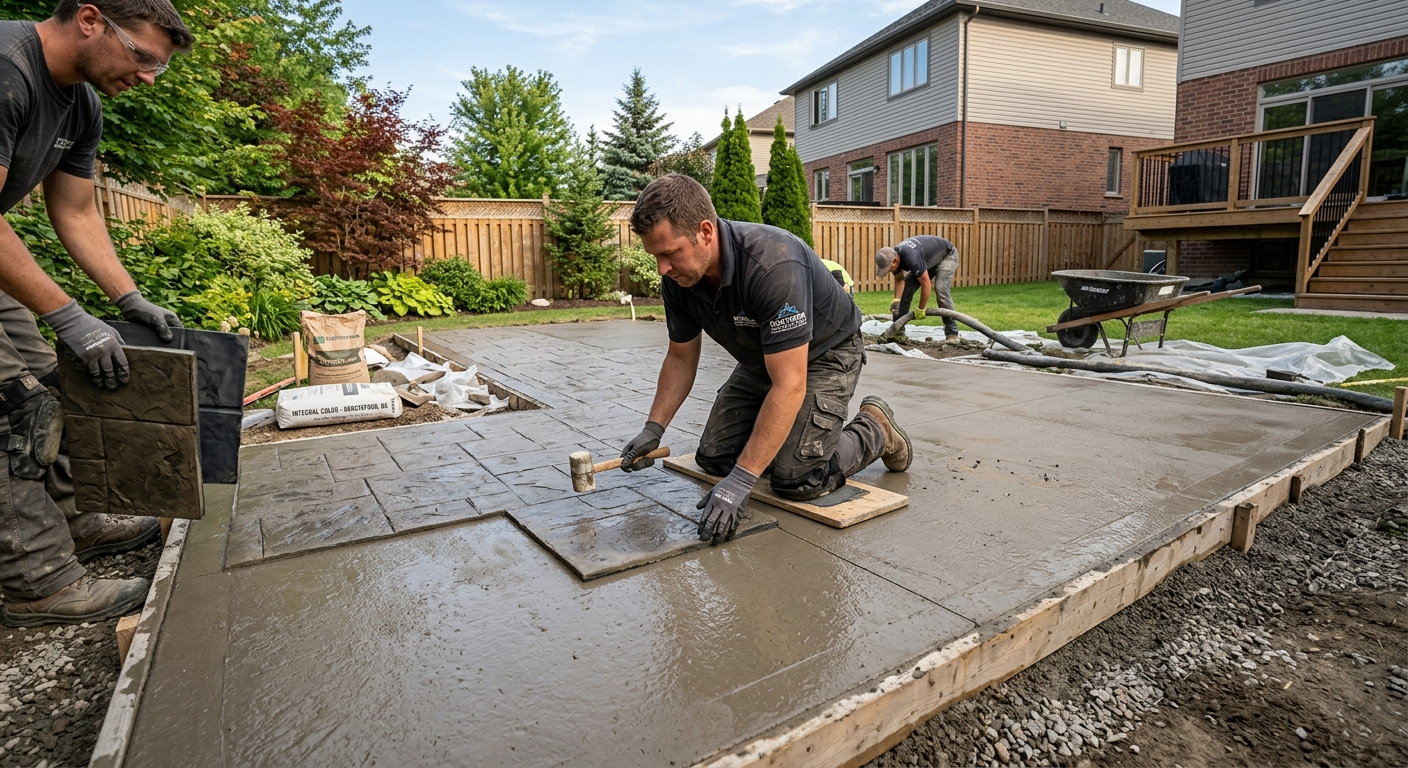
Here are a few real examples of how conditions raise or lower cost in Schreiber. If your site has soft subgrade, the base depth and compaction work increase—often moving a driveway from a baseline to a higher band (for instance, broom-finish work is typically closer to $14–$22 per sq. ft. equivalent total). If you choose decorative upgrades like stamped concrete (commonly $20–$32 per sq. ft. for material/finish complexity), the cost rises because of labour-intensive form setup, pattern tooling, and finishing discipline—especially when curing conditions are marginal. On older properties (many built before 1981), uneven settlement and drainage issues can also force extra excavation and regrading.
| Price Factor |
Why It Matters |
Cost Impact |
| Frost line depth — determines footing depth and form height |
Deeper frost protection increases excavation and concrete volume |
+10% to +30% |
| Site preparation — excavation, grading, compacted granular base |
Good drainage and compaction reduce future cracking and heave |
+5% to +25% |
| Reinforcement — rebar or wire mesh requirement |
Controls cracking and improves structural capacity |
+3% to +18% |
| Mix design — air-entrainment and compressive strength spec |
Air-entrainment is critical for freeze–thaw durability in Schreiber |
+2% to +15% |
| Finish type — broom vs. stamped vs. exposed aggregate |
Decorative work adds time for tools, colour system, and finishing |
+10% to +45% |
| Pour size and concrete truck access to site |
Small difficult access can mean multiple pours or extra labour |
+5% to +20% |
| Cold-weather curing precautions — heating and blankets |
Protects early strength gain and reduces surface scaling |
+5% to +25% |
| Control joint pattern and sealing cost |
Proper joints limit random cracking; sealing helps resist salt scaling |
+2% to +12% |
Permits & regulations in Ontario
In Ontario, structural concrete work typically requires a building permit and often engineered drawings reviewed by the municipality. That includes foundation walls, footings, grade beams, and other structural grade-supported concrete elements. If your project involves excavation for a new foundation, structural underpinning, or any work tied directly to the building’s structural system, plan on a permit path.
Concrete flatwork—such as driveways, patios, and walkways—usually does not require a permit when it’s limited to replacing/adding surface slabs and you’re not changing lot grading or drainage in a way that affects neighbouring properties, surface water routing, or municipal standards for impervious area and right-of-way conditions. Still, rules can vary based on where the work is located (for example, close to a municipal ditch/road right-of-way). When in doubt, confirm with the local authority before breaking ground.
For contractor verification in Schreiber, Ontario, take these steps. (1) Ask for the company’s certificate of insurance (general liability) and verify the coverage limits are appropriate and active for your project dates. (2) Confirm WSIB/WCB coverage (or equivalent provincial coverage proof as applicable) and request documentation in writing. (3) Verify their Ontario licensing/registration where required for the work category—many concrete contractors can be cross-checked through provincial and business registries online. (4) Request a clearance letter/coverage verification if they provide it for current job sites. (5) Ask for references from similar-scale projects in the same region and follow up before work starts.
Getting concrete right in Schreiber's freeze-thaw climate
Concrete failures in Schreiber usually trace back to one of five things: poor base preparation, missing or incorrect mix air-entrainment, weak early-age curing, poor control joint timing/spacing, or surfaces left unsealed and exposed to de-icing salts. In a freeze–thaw environment, water gets into micro-pores; when it freezes, it expands and can cause spalling and surface scaling. That’s why exterior slabs and driveways in Northwest Ontario should use the right granular base, the right air content, and a finish plan that works within the short pour season.
To spec the job correctly, focus on these items. (1) Base preparation: use compacted granular sub-base to the correct depth for local soil conditions and drainage—especially important where frost penetration can approach 5–6 ft and the active frost zone is deep. (2) Mix design: specify air-entrainment (typically about 5–7% air for exterior flatwork) and a minimum 32 MPa compressive strength spec. (3) Control joints: place and cut joints to limit random cracking as the slab shrinks. (4) Curing: plan for at least 7 days under proper conditions; in colder periods you’ll need blankets or other cold-weather methods to protect early strength. (5) Sealing: apply penetrating sealer after cure (often around the 28-day mark) to help repel de-icing salts and moisture.
Where price differences are justified: a standard broom-finished driveway may land closer to the lower end of regional pricing, but a decorative stamped option (often in the $20–$32 per sq. ft. band) can be worth it when you want a specific look that also gets the same durability spec—air-entrainment, correct base, and proper curing. Cutting corners on mix and curing to “save” a few dollars per square foot is usually the most expensive mistake later, because repair work often involves patching that doesn’t fully match joint patterns and can fail faster around edges.
| Spec |
Why It Matters in Schreiber |
What to Ask For |
Impact if Skipped |
| Compacted granular base (depth?) |
Controls drainage and reduces movement under freeze–thaw |
Base depth, compaction method, and drainage slope details |
Settlement, cracking, and premature edge failure |
| Air-entrained concrete mix (target air %?) |
Air bubbles give freeze–thaw resistance and reduce scaling |
Minimum air content target for exterior flatwork (about 5–7%) |
Spalling and scaling, especially where salt accumulates |
| Compressive strength (MPa rating) |
Strength gain affects durability and finishing quality |
Minimum 32 MPa with cold-weather handling plan |
Surface weakness, increased cracking, poor wear resistance |
| Control joints (spacing per ACI guidelines) |
Manages shrinkage cracking in a predictable pattern |
Joint spacing and cutting schedule (cut on time) |
Random cracks that open up with moisture and freeze cycles |
| Minimum 7-day curing period |
Protects early-age strength under Schreiber’s changing conditions |
Curing method (blanket/compound/insulation plan if needed) |
Reduced strength and worse scaling risk |
| Penetrating sealer (when applied after cure) |
Helps resist de-icing salt and moisture ingress |
Apply after curing (commonly around 28 days) and confirm product type |
Faster salt damage and surface deterioration |
How to choose a concrete work contractor in Schreiber
Choosing a concrete contractor in Schreiber should start with documentation. Ask whether they carry general liability insurance and request the certificate of insurance before work begins. Next, verify WSIB/WCB coverage so you’re not exposed if a worker gets injured on your property—request proof of clearance/coverage in writing. For licensing/registration, confirm the contractor’s Ontario registration appropriate to the scope (especially if the job involves forms, excavation, or any structural scope that triggers permit and engineered requirements). A reputable contractor will answer these questions quickly and provide paperwork without pressure.
Then get 2–3 itemised written quotes that break down labour and materials—not just a lump sum. Look for line items like excavation/grading, granular base, reinforcement, concrete supply, forms, finish labour (broom/stamped/exposed aggregate), curing provisions, disposal/hauling, and sealing (if included). Read the scope carefully: what’s excluded (for example, removal of old slab, dump fees, trenching for drainage), whether the permit is included (for structural jobs), and who handles inspections if required.
Ask about warranty: separate workmanship warranty length from any product/manufacturer warranty, and clarify whether it transfers if you sell the home. For payment, plan a schedule that keeps it safe—no more than 10–15% upfront, then hold back until key steps are complete. Finally, insist on a start date and completion estimate in writing, since the short pour season can affect timing.
- Verify insurance certificate dates and coverage limits
- Confirm WSIB/WCB coverage proof before signing
- Request at least two recent references in Northwestern Ontario
- Use itemised quotes with line-by-line material and labour
- Confirm concrete mix is air-entrained for exterior work
- Ask who supplies curing blankets/heaters if needed
- Check that joint spacing and cutting timing are included
- Confirm whether sealing is included (and when it will be applied)
- Clarify disposal: is removal/haul-away included?
- Confirm truck access plan and how they handle tight sites
- Ask for a pour plan: weather triggers and contingency steps
- Get a written schedule and a warranty in plain language
Red flags in Schreiber include: vague quotes with no breakdown, refusal to show insurance/WSIB/WCB documentation, promising exterior work without specifying air-entrained mix, skipping mention of curing/sealing, and “one price fits all” talk even when frost depth, base depth, and access are clearly different from site to site.
Frequently asked questions — concrete work in Schreiber
How long does a concrete driveway last?
In Schreiber, a well-built concrete driveway commonly lasts 20–30 years, and longer in many cases, if it’s designed for freeze–thaw and built with the right base and finishing. The biggest durability drivers are air-entrained concrete for exterior exposure, proper compacted granular base, correct control joint layout, and curing. Because de-icing salt can accelerate surface wear, sealing after cure (often around 28 days) is also important for longer-term appearance and reduced scaling. If you’re budgeting, know that “cheapest” can cost more later: for standard broom-finished driveway work, many projects land around $14–$22 per sq. ft. all-in depending on base prep and access. On older homes in Schreiber (where many dwellings were built before 1981), drainage issues sometimes shorten driveway life—fixing slope and runoff can extend the service span.
What is air-entrained concrete and why does it matter here?
Air-entrained concrete is a mix designed with microscopic air bubbles that give freezing water somewhere to expand. In Ontario’s Northwest, freeze–thaw cycles and de-icing salts can otherwise drive scaling and spalling at the surface. That’s why exterior flatwork in Schreiber should be air-entrained (commonly targeted around 5–7% air content for exterior). It’s not something you should treat as optional, because without it, cracks and pop-outs often show up sooner—especially near edges and where tires and shovelled salt deposit. This is also a common reason why two “similar-looking” driveways may perform very differently after a few winter seasons. When you compare quotes, ask the contractor to specify air-entrainment and include curing and sealing steps; decorative finishes like stamped concrete can cost more (often within the $20–$32 band), but the freeze–thaw protection should still be the same underneath.
How do I prepare the base for a concrete slab?
Base preparation is where many failures start, especially in Schreiber where frost penetration can be deep. Your contractor should excavate to a planned depth, then place a compacted granular sub-base with good drainage. The granular must be graded to the right slope so water doesn’t pond on the slab surface, and it must be compacted in lifts to reach the required density. Ask what granular material they use, how they’ll confirm compaction, and what happens if they encounter soft soils. If your project is replacing an old slab, removal and disposal may be required before you can build a stable base. Quotes can vary widely (often by 30–50%) because some crews underbuild base thickness or rush compaction. For budgeting, remember that driveway totals often reflect base preparation as much as they reflect the concrete itself; a standard broom-finish driveway commonly falls in the $14–$22 per sq. ft. range all-in depending on site conditions.
How do I compare concrete quotes?
To compare concrete quotes in Schreiber, don’t just look at the bottom line—compare what’s included. Ask for an itemised breakdown: excavation, granular base depth and compaction, reinforcement (if required), concrete supply, forms, finishing method (broom vs. exposed aggregate vs. stamped), curing/blankets if temperatures are marginal, and sealing if it’s part of the scope. Also verify whether old concrete removal and disposal are included, plus any trenching for drainage. For structural work like footings, confirm whether engineered drawings and permit steps are handled as part of the scope. It’s normal for exterior projects to show a price spread (often 30–50%) because base prep and cold-weather curing precautions change the labour and material needs. As a reference, broom-finished driveway work often prices closer to the lower end of $14–$22 per sq. ft., while stamped concrete can commonly land in the $20–$32 per sq. ft. band due to labour-intensive finishing. The “best” quote is usually the one that matches your durability spec, not merely the lowest number.
Can concrete be poured in cold weather in Schreiber?
Yes, concrete can sometimes be poured in cold weather in Schreiber, but it has to be done correctly. The risk isn’t just “freezing”—cold slows strength gain, and early-age damage can lead to later scaling, cracking, and weak surfaces. A competent crew will use cold-weather procedures such as insulating blankets, heated enclosures, or curing compounds to protect the concrete while it reaches adequate strength. They should also pay attention to wind, moisture, and the forecast, because a short pour season means work may be compressed into fewer suitable days. Ask how they handle curing if temperatures are borderline, and confirm the curing plan is included in the quote. If someone offers to pour exterior flatwork without any cold-weather protection plan, that’s a warning sign for freeze–thaw performance and long-term durability. For planning, many homeowners schedule exterior pours for late spring through early fall; if you need shoulder-season work, expect some added cost for protective measures that support proper cure.
How do I maintain concrete in Schreiber's freeze-thaw climate?
Maintenance in Schreiber is about limiting water and salt exposure. Start with prevention: keep the surface clean so salt and debris don’t sit in the same spots, and avoid repeated heavy chipping of ice directly on the concrete. If your driveway or walkway was sealed, maintain that coating according to the product guidance (often reapply every few years depending on traffic and salt use). Check expansion/control joints: if joints crack open or become filled with debris, cleaning them helps preserve their function and reduces moisture intrusion. If you spot early scaling, don’t ignore it—repairs are usually more successful when addressed early. For homeowners budgeting, sealing after cure is a key durability step, and it tends to be more cost-effective than patching later. Many concrete projects in the area fall within known pricing bands; for example, plain exterior work might be around $12–$20 per sq. ft. while decorative work can be higher. Regardless of finish, the durability goal is the same in Northwest Ontario: protect against moisture ingress and frost-driven movement.