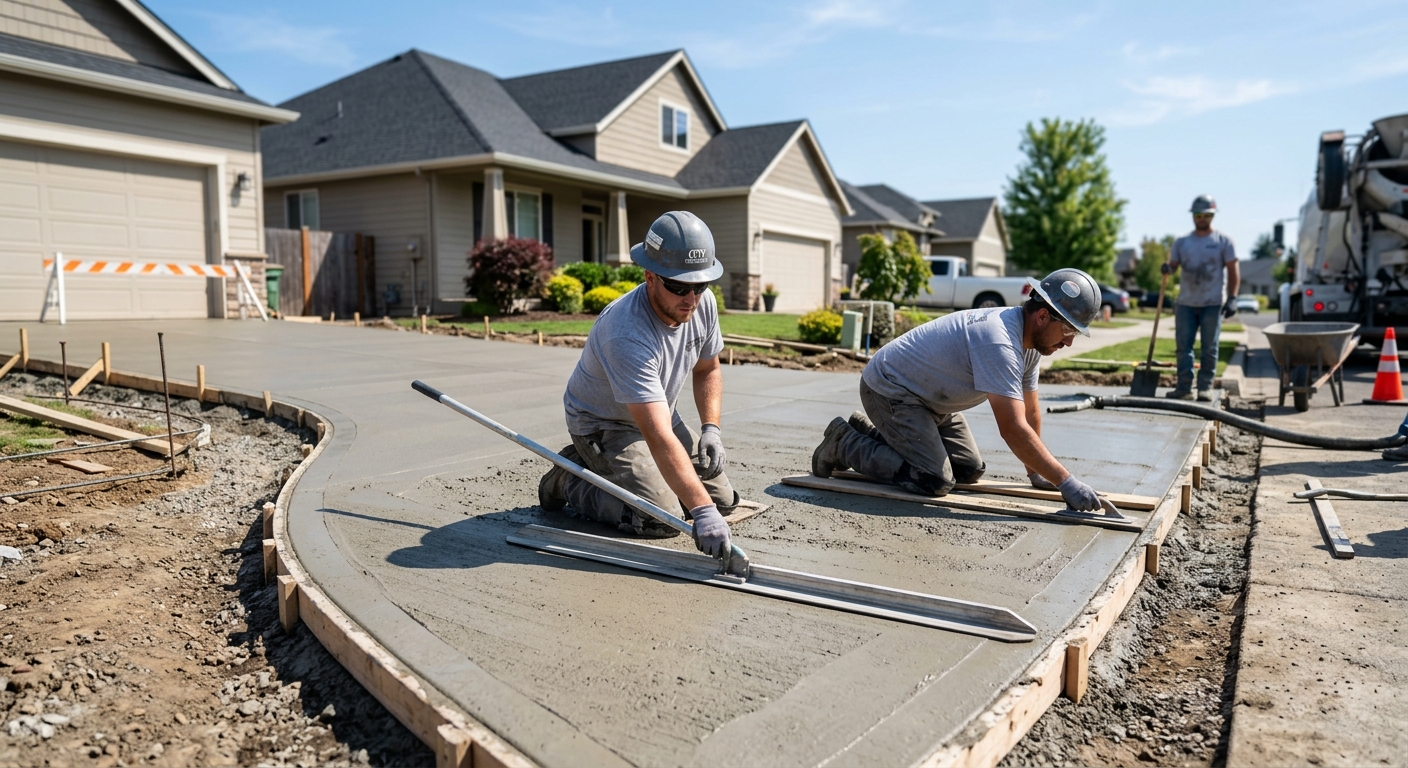
Concrete work options and costs in Islington-City Centre West
Concrete work in Islington-City Centre West is a practical, everyday upgrade—especially for homeowners who want low-maintenance curb appeal from street to garage. With a 2021 population of 43,965 in the area (Statistics Canada, 2021 Census), you’ll see steady demand for driveways, patios, walkways, and foundation repairs as older homes turn over and many properties get refreshed. This part of Toronto also has a high concentration of single-family housing patterns that typically rely on exterior flatwork: a new driveway, a brick-to-concrete transition, or a refreshed backyard patio can be one of the most visible improvements.
In the Toronto economic region, pricing is driven less by “aesthetic preference” and more by construction requirements. Freeze–thaw cycles and frost depth dictate how deep we excavate and how robust the mix must be. That means most structural footings are installed at least 1.2 m (about 4 ft) below grade, and exterior slabs are usually air-entrained with adequate thickness and control joints to manage cracking.
Neighbourhood-by-neighbourhood, demand tends to be highest near busier residential corridors with lots of older properties—areas closer to Islington Avenue and the West Deane Park vicinity often see more driveway replacements and patio renewals. Add tight access for concrete trucks, longer haul distances, or complicated tie-ins (existing interlock removal, sewer/water adjustments), and your quote can move quickly within Toronto’s typical price bands.
Use the comparison below as a starting point for budgeting before you decide on finish and thickness—then we’ll talk about what truly changes the number in your quote.
| Application |
Typical Size |
Key Spec |
Finish Option |
Price Range |
| Concrete driveway (standard broom finish) |
10 ft x 20 ft (200 sq ft) |
Air-entrained mix, reinforced where required |
Broom finish, control joints |
$3,600 – $5,600 |
| Exposed aggregate driveway |
10 ft x 20 ft (200 sq ft) |
Proper base, consistent reveal, sealer-ready surface |
Exposed aggregate |
$4,600 – $7,200 |
| Stamped concrete driveway or patio |
12 ft x 18 ft (216 sq ft) |
Air-entrained mix, control joints under pattern |
Stamped pattern + release + colour |
$5,400 – $8,600 |
| Plain concrete patio or walkway |
10 ft x 12 ft (120 sq ft) |
Compacted granular base, drainage plan |
Smooth or lightly broomed |
$1,900 – $3,100 |
| Garage floor (interior slab) |
20 ft x 20 ft (400 sq ft) |
Vapour control as needed, reinforced slab |
Plain float + hardener option |
$6,000 – $10,800 |
| Foundation footings (structural, below frost) |
Typical bearing perimeter |
Designed depth and reinforcement |
Structural concrete only (not decorative) |
$8,500 – $18,500 |
Prices are estimates only and vary by project scope, site access and material selection.
What affects the price of concrete work in Islington-City Centre West
In Islington-City Centre West, quotes for the “same” concrete type can differ by 30–50% across Toronto and Ontario because the hidden costs are usually what drive labour and materials: how much excavation is needed, how the base is built, whether reinforcement is required, and what it takes to control cracking in a freeze–thaw environment. Two neighbouring homes can have dramatically different soil conditions, drainage patterns, or access for a ready-mix truck, and that shows up in the final number.
Start with frost depth and freeze–thaw cycles. In Ontario, structural footings are typically installed at least 1.2 m (about 4 ft) below grade to limit frost heave and differential movement. For exterior slabs and flatwork, the concrete mix generally needs air-entrainment to survive repeated freeze–thaw damage. When temperatures drop toward 10 °C or below near the edges of the pour season, contractors often add cold-weather protection (insulating blankets, heating, and longer protection time) to keep curing on track—those precautions add real cost.
Severe winters and winter maintenance also matter. De-icing salt can accelerate surface wear and scaling if the mix, curing, or sealing isn’t handled correctly. For that reason, Toronto-area crews often recommend sealing after the pour cure, which can be a smart line item for long-term performance. On price, a plain patio might land around the $16–$26 per sq ft band, while stamped options commonly carry the $24–$40 per sq ft range because of labour, formwork, and finishing steps. If you’re comparing a $3,000 plain walkway versus a stamped pattern upgrade, the difference is usually justified only when the added aesthetic aligns with your drainage and joint plan.
| Price Factor |
Why It Matters |
Cost Impact |
| Frost line depth — determines footing depth and form height |
Deeper footings require more excavation, higher formwork, and more concrete |
Can shift structural costs by thousands |
| Site preparation — excavation, grading, compacted granular base |
Unsuitable soil or poor base leads to settlement and early failure |
Common driver of 15–25% variance |
| Reinforcement — rebar or wire mesh requirement |
Controls cracking and improves slab performance under load |
Usually adds material + placement labour |
| Mix design — air-entrainment and compressive strength spec |
Air entrainment helps resist freeze–thaw scaling and spalling |
Higher-spec materials cost more, but reduce failures |
| Finish type — broom vs. stamped vs. exposed aggregate |
More steps, timing control, and labour intensity |
Stamped/exposed finishes typically increase cost per sq ft |
| Pour size and concrete truck access to site |
Smaller pours may require more staging; blocked access increases placement labour |
Tight access can add hours and equipment |
| Cold-weather curing precautions — heating and blankets |
Protects concrete strength gain when temperatures fall |
Can add material/equipment and extend schedule |
| Control joint pattern and sealing cost |
Joints manage shrinkage cracks; sealing helps resist salt and moisture |
Often modest cost with major durability benefit |
Permits & regulations in Ontario
In Ontario, structural concrete work generally needs municipal involvement—most commonly a building permit and, for many foundation scopes, engineered drawings reviewed by the municipality. Typical permit-required work includes concrete foundation walls, grade beams, structural footings, and other load-bearing elements. If you’re replacing or underpinning a foundation, altering a foundation bearing layout, or doing any work tied to structural stability, assume you’ll need a permit.
Concrete flatwork (driveways, patios, and walkways) often does not require a building permit by itself, unless it affects lot grading, drainage, impervious surface coverage limits, or the municipal right-of-way. Even when a permit isn’t required, local approvals can still come into play if you’re changing runoff patterns toward a neighbouring property or altering sidewalk/road interfaces.
For Islington-City Centre West homeowners, the simplest step-by-step contractor verification is: (1) request their certificate of insurance (liability) and confirm the coverage is current; (2) ask for proof of WSIB/WCB coverage for workers; (3) verify they carry adequate liability for concrete operations (excavation, hauling, and site protection); and (4) check their licence/registration status using the appropriate online registry listings for Ontario contractors (your contractor should provide licence details or you can confirm through provincial search tools). Also ask for references on similar-scale projects in the GTA—look for the same type of pour (exterior vs interior, thickness, and jointing approach).
Getting concrete right in Islington-City Centre West's freeze-thaw climate
Concrete fails in Islington-City Centre West mostly because water gets into the slab edge and surface, then expands during freeze–thaw cycles. If the base isn’t built to grade, the concrete can settle; if the mix isn’t properly air-entrained, freeze–thaw can lead to surface scaling and spalling. The fix isn’t “stronger concrete only”—it’s a complete system: correct sub-base, correct mix, correct joints, proper curing, and sealing.
First, base preparation: build a compacted granular sub-base to the right depth for local soil and frost exposure. Toronto-area exterior work is sensitive to drainage; saturated soil under a slab can expand and push the concrete at every winter cycle. Second, mix design: exterior flatwork typically targets 5–7% air content and a minimum 32 MPa compressive strength. Third, control joints: place them to limit random cracking to predictable lines; your joint pattern should match the slab layout and expected movement. Fourth, curing: plan for at least 7 days of curing under appropriate protection. When temperatures are near or below about 10 °C, crews often need insulating blankets and longer protection time to achieve strength gain. Fifth, sealing: apply a penetrating sealer after the concrete has cured (commonly at about 28 days) to repel water and reduce salt impacts.
If a contractor cuts corners here, you may see scaling within a few winters. For a budget reality check: the difference between a basic broom-finished driveway and a stamped driveway or patio often lands in the stamped range (commonly $24–$40 per sq ft), but the cost is only justified when the base, air-entrainment, and jointing are done right—otherwise the “prettier” surface still fails.
| Spec |
Why It Matters in Islington-City Centre West |
What to Ask For |
Impact if Skipped |
| Compacted granular base (depth?) |
Reduces pumping and movement during freeze–thaw |
Granular base depth plan based on soil and slab type |
Settlement cracks and uneven wear |
| Air-entrained concrete mix (target air %?) |
Protects against freeze–thaw scaling/spalling |
Confirm air content target of about 5–7% for exterior |
Surface deterioration within 1–3 winters |
| Compressive strength (MPa rating) |
Supports durability and long-term load capacity |
Minimum 32 MPa (or higher if required) |
Slower strength gain and increased cracking risk |
| Control joints (spacing per ACI guidelines) |
Controls where cracks will form |
Planned joint spacing for your slab size and layout |
Random cracking and difficult-to-repair failure |
| Minimum 7-day curing period |
Strength gain depends on temperature and protection |
Protection plan if nights are cold; curing duration confirmed |
Reduced strength and increased early surface damage |
| Penetrating sealer (when applied after cure) |
Helps repel water and de-icing salt impacts |
Sealer scheduled at about 28 days post-pour (once cured) |
Faster scaling and staining |
How to choose a concrete work contractor in Islington-City Centre West
Choosing the right concrete contractor in Islington-City Centre West starts with verification. In Ontario, confirm the contractor’s licensing/registration status through the correct provincial search tools (the contractor should provide licence details), then request two documents: a current liability insurance certificate and proof of WSIB/WCB coverage for workers. Don’t accept “we’re covered” verbally—ask for the certificate copies and expiry dates.
Next, request 2–3 itemised written quotes. For concrete, the best quotes break down labour and materials rather than one lump number. You want to see excavation and removal, granular base and compaction, reinforcement details (if included), concrete mix description (especially air-entrainment for exterior), forming, finishing, joints, curing/protection plan, and sealing (if included). Clarify exclusions: is disposal of concrete and spoils included? Is a permit pull included where required? Are there traffic control or sidewalk/right-of-way provisions if the work touches adjacent municipal areas?
On warranty, look for a workmanship warranty length and what it actually covers—crack control, spalling exceptions, and surface issues under normal use. Also ask about the product or manufacturer warranty for sealers, stains, or specialty products, and whether it transfers if you sell the home.
For payment, avoid large deposits; a common approach is no more than 10–15% upfront, with a holdback until the job is complete and cleaned. Finally, get a start date and completion estimate in writing, including weather contingencies for Toronto’s shorter, temperature-sensitive pour windows.
- Written quote with line items (not just “labour + materials”).
- Exterior work explicitly specifies air-entrained mix and jointing plan.
- Proof of current liability insurance (certificate of insurance provided).
- Proof of WSIB/WCB coverage for workers (not subcontractor promises).
- Schedule includes curing protection if overnight temperatures drop.
- Base build-up details: granular type, depth, and compaction method.
- Reinforcement plan stated clearly (mesh/rebar and placement).
- Control joint spacing and timing explained in the scope.
- Sealing included or clearly excluded, with “when applied” noted.
- Material delivery and concrete truck access plan confirmed for your address.
- Site protection and cleanup responsibilities listed.
- Warranty terms in writing: workmanship + product coverage.
Concrete red flags in Islington-City Centre West include: refusing to discuss air-entrainment for exterior flatwork, vague joint spacing (“we’ll see how it goes”), promises of “no cracks ever,” missing insurance/WSIB paperwork, and quotes that don’t explain curing and cold-weather protection. If you see any of these, slow down and ask for a revised, detailed scope.
Frequently asked questions — concrete work in Islington-City Centre West
How much does concrete work cost in Islington-City Centre West?
Costs in Islington-City Centre West generally follow Toronto-area price bands, but your exact number depends on thickness, base prep, access for the truck, reinforcement, and how much cold-weather protection is needed. For example, a plain concrete patio or walkway often falls in the $16–$26 per sq ft range, while stamped concrete driveway or patio work commonly sits in the $24–$40 per sq ft range because of labour and finishing steps. For driveways, a standard broom-finished pour often lands around the $18–$28 per sq ft range. If you’re budgeting for foundation footings, that work is usually quoted separately and commonly runs about $180–$300 per linear foot depending on scope, soil conditions, and reinforcement requirements. Expect quotes to vary notably when excavation, drainage fixes, or rebar placement are more extensive than first assumed. (Statistics Canada, 2021 Census)
How deep must footings be for Islington-City Centre West's frost line?
For Ontario, structural footings are typically installed at least 1.2 m (about 4 ft) below grade to stay below the region’s frost influence and reduce frost heave risks. In practice, the exact depth for your foundation is based on the design and site conditions (soil, bearing capacity, and structural requirements), and your engineer’s drawings—if required—govern the final spec. In the Islington-City Centre West area, contractors commonly excavate to that frost-protected depth, then build forms and reinforce to match the structural design. If you have existing foundation issues or different soil conditions than expected, depth and reinforcement can increase, which is why a proper site assessment and engineered requirements matter. Always confirm the required depth with the project engineer/permit documents for your specific foundation type.
Why does concrete crack in Islington-City Centre West and how is it prevented?
Concrete cracking in Islington-City Centre West is usually a movement problem, not just “cheap concrete.” Freeze–thaw cycles, water movement, shrinkage as concrete cures, and temperature swings all create stresses. The most common prevention approach is a correct base build (compacted granular, drainage-ready), an exterior air-entrained mix, and a control joint plan that tells the slab where to crack. Control joints should be spaced appropriately for the slab dimensions and placed early enough that shrinkage cracks develop in the joint lines rather than randomly. Proper curing for at least 7 days—especially when temperatures drop toward the colder edge of the season—also reduces early cracking. Finally, sealing after cure (often around 28 days) helps limit water and salt impacts at the surface. If these steps are skipped, cracks and scaling tend to show up sooner.
Stamped vs broom-finish concrete — cost difference?
Stamped concrete usually costs more than a broom finish because it involves additional labour and careful timing. In the Toronto market, broom-finished exterior flatwork commonly falls around the $18–$28 per sq ft range, while stamped concrete driveway or patio work is more often in the $24–$40 per sq ft range. The price jump isn’t just about the stamp tool—it includes colour, release agents, surface finishing coordination, and often more attention to joint placement so the pattern doesn’t hide or worsen crack issues. If you’re comparing options in Islington-City Centre West, the best value comes when the contractor still nails the fundamentals: air-entrainment, correct thickness, proper base prep, and a correct control joint layout. If those core steps are weak, stamped concrete won’t “hide” failure—surface scaling and cracking will still happen.
When is the best time to pour concrete in Islington-City Centre West?
For Islington-City Centre West, the best timing is typically late spring through summer, when the weather supports curing and consistent placement. Toronto’s freeze–thaw pattern and humid shoulder seasons can complicate early pours, and when temperatures approach about 10 °C or below—especially overnight—contractors often need extra curing protection like insulated blankets or temporary heating. That doesn’t mean you can’t pour in cooler periods, but it changes cost and scheduling because curing conditions must be managed to reach strength gain safely. Even in warmer months, a wet fall or rainy spring can affect the excavation and base prep timeline. If you’re planning a driveway, patio, or walkway replacement, booking earlier in the season usually gives you more reliable access to crew scheduling and reduces the chances of start/finish delays due to weather windows.
How long does concrete take to cure?
Concrete curing is a process, not a single day. In Ontario, a key planning standard for many exterior flatwork projects is a minimum 7-day curing period under appropriate conditions. Early strength development matters for joint integrity, finishing, and safe traffic on the slab. For sealing, most contractors recommend applying penetrating sealer after full cure—commonly around 28 days—so the surface can repel water and de-icing salt effectively. In colder or damp conditions, curing may require extra protection to achieve the same results, and that’s why many Toronto-area schedules are sensitive to temperature. If a contractor starts later or uses less protection when nights get cold, you can end up with weaker near-surface durability even if the concrete “looks fine” at first. Ask your contractor to specify curing and protection details in the written scope.