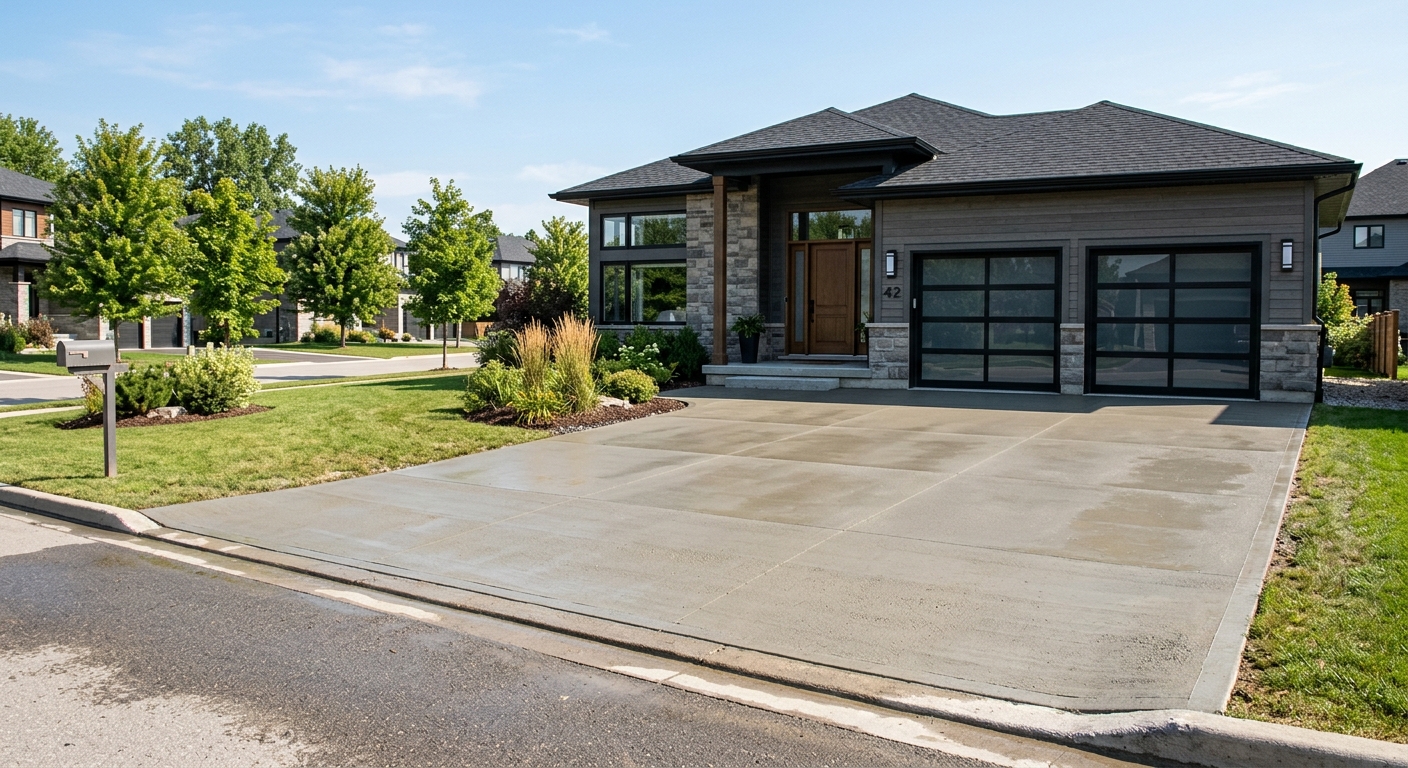
Concrete work options and costs in Clairlea-Birchmount
In Clairlea-Birchmount, concrete projects are a year-round reality for many homeowners, especially where driveways, patios, and walkways are tied to older neighbourhood streets and established landscaping. With a population of 26,984 (Statistics Canada, 2021 Census), the Toronto area supports steady demand for both practical slab work and decorative upgrades. Most concrete flatwork in this part of the city is built for single-family properties, and that means high expectations for performance through winter—cracking and surface wear aren’t “cosmetic” when freeze–thaw cycles keep stressing the slab every year.
Toronto-area concrete costs tend to be higher than you’d expect in milder climates because exterior work must be designed around frost depth and freeze–thaw movement. In practice, that means footing and grade specs are more conservative, exterior slabs use air-entrained mixes, and crews schedule pours around the warmer portion of the season so curing isn’t compromised when temperatures dip toward 10 °C or below. Local wet fall and spring weather also affects site prep and drying time—if the ground can’t be stabilized and compacted properly, the job gets more labour-intensive.
In pockets like Birchmount Park and the broader east-of-Don Mills corridor, contractors often see a steady stream of driveway replacements and backyard patio builds as homeowners update curb appeal and improve drainage. To help you compare quotes, here are typical options and the price range most GTA contractors budget for, based on current local pricing tiers.
| Application |
Typical Size |
Key Spec |
Finish Option |
Price Range |
| Concrete driveway (standard broom finish) |
400–600 sq. ft. |
Air-entrained mix, 4 in slab, compacted granular base |
Broom finish + control joints |
$7,200 – $13,200 |
| Exposed aggregate driveway |
400–600 sq. ft. |
Air-entrained mix, proper curing and aggregate exposure timing |
Exposed aggregate + seal |
$8,800 – $16,800 |
| Stamped concrete driveway or patio |
300–500 sq. ft. |
Air-entrained mix, colour hardener, release agent system |
Stamped pattern + sealer |
$12,000 – $20,000 |
| Plain concrete patio or walkway |
200–400 sq. ft. |
Air-entrained mix, compacted base, edge forms |
Float & broom finish |
$3,200 – $9,000 |
| Garage floor (interior slab) |
300–600 sq. ft. |
Minimum thickness, fibre or mesh depending on spec |
Standard finish (trowel or broom) |
$5,400 – $14,000 |
| Foundation footings (structural, below frost) |
Per linear foot |
Below frost depth, rebar cage, engineered spec |
Structural finish (not decorative) |
$180 – $300 |
Prices are estimates only and vary by project scope, site access and material selection.
What affects the price of concrete work in Clairlea-Birchmount
If you get two quotes for what looks like the “same” driveway or patio in Clairlea-Birchmount, it’s common to see a 30–50% swing across Toronto and Ontario. The difference is usually not the concrete itself—it’s the total spec and how much labour it takes to build it to survive our freeze–thaw cycle. In this region, frost depth drives footing and form height, and every exterior slab needs air-entrainment to resist surface scaling and internal freeze damage. Even when the Ontario Building Code doesn’t change, your design depth and base detail will, because soils and drainage vary block to block.
Concrete contractors also price in curing and weather windows. In the Toronto economic region, exterior pours are concentrated in warmer months to protect curing quality. When temperatures fall toward 10 °C or below, cold-weather protection (insulating blankets, heaters on larger sites, and tighter scheduling) can add cost and affect the finishing timeline. De-icing salt in our winters also accelerates spalling if the surface is porous—sealing becomes a small line item that can prevent bigger repairs later.
Two practical examples from Clairlea-Birchmount: first, a driveway on a sloped lot with soft topsoil may require extra excavation, geotextile and thicker compacted granular base—raising the budget toward the upper end of the concrete driveway band. Second, if you choose stamped concrete, the “higher price” is justified when you get colour hardener, controlled curing, and proper jointing rather than just a superficial stamp; that’s why stamped work often lands closer to the $24–$40 band for decorative styles. If you’re replacing a 400 sq. ft. driveway, moving from plain broom finish to exposed aggregate or stamped can look like a big jump, but it’s usually tied to prep time, materials and finishing labour—not just pattern or texture.
| Price Factor |
Why It Matters |
Cost Impact |
| Frost line depth — determines footing depth and form height |
Footings must extend below design frost depth to prevent frost heave and differential movement |
Higher depth increases excavation, rebar, concrete volume |
| Site preparation — excavation, grading, compacted granular base |
Base stability controls settlement cracks and edge failure in freeze–thaw climates |
Soft soils, extra haul, or thicker base pushes costs up |
| Reinforcement — rebar or wire mesh requirement |
Improves crack control and slab stiffness depending on load and thickness |
Mesh/rebar and labour to place it can add material + time |
| Mix design — air-entrainment and compressive strength spec |
Air-entrainment helps concrete survive repeated freezing while strength supports durability |
Specialized mix and QC can move the quote higher |
| Finish type — broom vs. stamped vs. exposed aggregate |
More steps, tighter timing, and sealer systems needed for exterior longevity |
Stamped/exposed typically increases finishing labour and materials |
| Pour size and concrete truck access to site |
Shorter access can increase pump time, labour, and delivery planning |
Limited access can add truck/pump and handwork costs |
| Cold-weather curing precautions — heating and blankets |
Protects early-age strength development when temperatures drop |
Blankets/heaters and schedule changes can add significant cost |
| Control joint pattern and sealing cost |
Joints manage cracking; sealing helps reduce salt-driven surface damage |
Often modest cost relative to avoiding premature spalling |
Permits & regulations in Ontario
In Ontario, structural concrete work generally requires a building permit, and the municipality often expects engineered drawings—especially for foundation footings, foundation walls, grade beams and other load-bearing components. For example, when you’re doing foundation repairs, underpinning, or any work that changes structural capacity, you should plan on permits and inspections. Concrete flatwork like patios, walkways and driveways usually does not require a permit by default, but it can require approval if it affects lot grading, drainage, or impervious surface limits, or if it involves municipal right-of-way work (such as modified driveway crossings).
To verify a contractor in Clairlea-Birchmount before ground is broken, do it in this order: (1) Request the contractor’s certificate of insurance and confirm it matches the job scope (liability limits appropriate for the project and property damage coverage). (2) Ask for proof of WSIB/WCB coverage (or the applicable clearance evidence). (3) Confirm they carry adequate workmanship coverage and provide references on projects of similar scale—driveway and patio work is different from structural footing pours. (4) For licence verification, check the Ontario registry resources publicly available and confirm the company is in good standing for the scope they’re offering.
If you’re coordinating permitting, ask who pulls the permit and who schedules inspections. A transparent contractor will tell you what needs approval up front and provide written documentation for your records.
Getting concrete right in Clairlea-Birchmount's freeze-thaw climate
Concrete fails in Clairlea-Birchmount most often because water gets into the slab or base and then freezes, expanding and creating internal stress. The usual culprits are inadequate base prep, poor drainage, and—most critically—insufficient air-entrainment. When freeze–thaw damage shows up as scaling or spalling, it’s usually not fixed with “touch-up.” The fix starts with the right specs: build the base with the correct compaction and thickness, use an air-entrained exterior mix designed for our conditions, plan joints to control random cracking, and cure and seal properly so moisture and de-icing salt don’t attack the surface.
Here’s how to spec the job correctly for Toronto’s real-world weather. (1) Base preparation: excavate unstable soil and place a compacted granular sub-base to the required depth for your soil conditions and slab thickness; don’t pour over topsoil. (2) Mix design: for exterior flatwork, target air-entrained concrete with about 5–7% air content and use a minimum 32 MPa compressive strength where specified. (3) Control joints: include a joint pattern that limits crack width, especially near edges, steps and changes in elevation. (4) Curing: plan for a minimum 7-day curing period under proper conditions; if the crew is rushing finishing because it’s getting cool, ask how they will protect early-age strength. (5) Sealing: apply a penetrating sealer after the cure (typically around 28 days) to reduce salt-driven surface breakdown.
As a pricing reality check: if a broom-finish patio quote comes in at the low end (for example, around the $16–$26 per sq. ft. band for basic exterior flatwork) but the contractor can’t explain air-entrainment or joint spacing, that low price is often “paid back” through repairs. Spend a bit more on the right mix and sealing, and you’re protecting the same slab from the freeze–thaw cycle that will keep coming back.
| Spec |
Why It Matters in Clairlea-Birchmount |
What to Ask For |
Impact if Skipped |
| Compacted granular base (depth?) |
Prevents settlement and limits water pumping under the slab |
Confirm excavation depth, granular thickness and compaction method |
Cracking, uneven slab and faster edge failure |
| Air-entrained concrete mix (target air %?) |
Improves freeze–thaw durability for exterior slabs |
Ask for target air content (about 5–7% for exterior flatwork) |
Scaling and spalling after winters with de-icing salt |
| Compressive strength (MPa rating) |
Ensures adequate early-age and long-term performance |
Confirm minimum 32 MPa or project-specified strength |
Surface wear, reduced durability and early damage |
| Control joints (spacing per ACI guidelines) |
Controls where cracks form as moisture and temperature move the slab |
Ask for joint spacing plan and where joints are placed |
Random cracking that can trip and admit water |
| Minimum 7-day curing period |
Develops strength before heavy exposure to cold or moisture |
Ask how curing will be protected if temperatures drop |
Reduced strength and increased risk of surface damage |
| Penetrating sealer (when applied after cure) |
Helps repel salt water and reduces moisture intrusion |
Confirm sealer type and timing (typically after ~28 days) |
Faster spalling and premature staining |
How to choose a concrete work contractor in Clairlea-Birchmount
Choosing the right contractor in Ontario is about proof, not promises. Start by verifying licensing and compliance: ask for their Ontario documentation for the scope of work, then request a current certificate of liability insurance. For coverage, confirm they have WSIB/WCB protection (or the appropriate clearance evidence). You can also cross-check insurance details against the dates of coverage shown on the certificate—don’t accept “it will be valid soon.”
Next, get 2–3 written, itemised quotes rather than a single lump sum. You want line items for excavation and disposal, granular base, reinforcement, concrete supply, forming, finishing, curing protection, and sealing (if included). If a quote is missing base depth, joint layout, or mix requirements, it’s not truly comparable. Also ask whether the permit process is included for any structural work; for flatwork, ask what drainage or grading approvals they consider.
Warranty should be clear: workmanship coverage length, what it covers (cracking vs. surface scaling), and whether any product/manufacturer warranty is included and transferable. For payments, never pay more than 10–15% upfront; hold back until the work is complete and cured/finished to the agreed standard.
Finally, timeline matters in Toronto’s season: request a start date and completion estimate in writing, plus what happens if weather delays curing. A contractor who can explain their cold-weather plan is usually the one building the slab you’ll want to live with.
- Request proof of liability insurance and confirm coverage dates.
- Verify WSIB/WCB coverage and ask for clearance evidence.
- Ask who pulls permits (structural concrete) and who schedules inspections.
- Require itemised pricing: base, rebar/mesh, concrete mix, finishing, sealing.
- Confirm base depth and granular specification, not just “proper base.”
- Ask for concrete mix details: air-entrainment target and strength spec.
- Confirm reinforcement placement method (supported chairs, coverage).
- Get the control joint plan and where joints will be placed.
- Ask curing plan for cool snaps and how long the concrete will be protected.
- Clarify disposal/recycling of excavated material and any dumping fees.
- Verify equipment/approach for truck access and how they manage limited access.
- Use a payment schedule with a small deposit and a holdback until final completion.
Concrete red flags in Clairlea-Birchmount include: skipping or underspecifying air-entrainment for exterior work, promising “no cracking” instead of joint planning, not providing any base depth/compaction detail, requesting large deposits up front, or refusing to put cure/finish timing and sealing expectations in writing.
Frequently asked questions — concrete work in Clairlea-Birchmount
How long does a concrete driveway last?
In Clairlea-Birchmount and across the Toronto region, a well-built driveway often lasts 20–30 years, but that depends heavily on base preparation, drainage, and how it’s detailed for freeze–thaw. The biggest durability driver is whether the slab is built with a proper compacted granular base and exterior air-entrained concrete, because Ontario winters repeatedly cycle moisture through the slab. If you de-ice heavily, a penetrating sealer can help slow surface deterioration, especially near edges and expansion points. At the pricing tier level, a standard broom-finish driveway commonly falls in the $18–$28 per sq. ft. range; paying attention to whether your quote includes the “invisible” specs (base depth, air content, and joints) matters more than selecting a cheaper finish. (Statistics Canada, 2021 Census)
What is air-entrained concrete and why does it matter here?
Air-entrained concrete is mixed with tiny, evenly distributed air bubbles that give freezing water room to expand without shattering the paste. In Ontario’s freeze–thaw climate, that’s crucial for exterior concrete like driveways, patios and walkways. Without adequate air-entrainment, you often see surface scaling and eventual spalling—usually after winters where salt and moisture sit on the surface. A contractor should specify a target air range (commonly about 5–7% for exterior flatwork) and confirm the mix design meets durability needs. If a quote doesn’t mention air content or the reason for it, ask directly. In practical terms, this is one of the easiest ways to predict quality: the “best” decorative finish can fail quickly if the mix isn’t built for Toronto-area conditions.
How do I prepare the base for a concrete slab?
Base preparation is where most concrete longevity is decided in Clairlea-Birchmount. The contractor should excavate unsuitable topsoil, then place compacted granular material in layers to the required depth for your soil and slab thickness. The key is compaction and uniform grade—if the base is soft or uneven, the slab will settle and crack, letting water in and accelerating freeze–thaw damage. Ask your contractor to describe the base depth and compaction approach, and whether they’re using a geotextile where needed. Also confirm drainage: exterior flatwork should be built to shed water and avoid ponding. A driveway quote in the typical $18–$28 per sq. ft. band should include the base and labour required to do this properly, not just the concrete pour.
How do I compare concrete quotes?
To compare concrete quotes fairly in Ontario, treat it like a technical specification exercise, not just a price comparison. Ask for an itemised breakdown: excavation/disposal, granular base depth, reinforcement (rebar or mesh), concrete mix requirements (including air-entrainment and strength), forms, finishing, curing protection, and sealing if included. Confirm the same size and thickness are being quoted—“about the same” can hide major differences. Make sure control joints and their spacing are included in the scope, because joint planning affects cracking behaviour. If one quote is for stamped concrete in the decorative range (often around $24–$40 per sq. ft.) but the other is “stamped style” with no mention of colour/curing details, that’s not equivalent. The lowest number isn’t automatically wrong, but it should match the same specs and protections for our climate.
Can concrete be poured in cold weather in Clairlea-Birchmount?
Yes, concrete can be poured in cold weather in Clairlea-Birchmount, but it has to be managed correctly. In the Toronto region, crews typically avoid the worst cold snaps for exterior pours and schedule around the warmer portion of the season. When temperatures drop toward 10 °C or below, you may still proceed with cold-weather curing precautions—heating, insulation blankets, and stricter curing timelines—to protect early-age strength development. Ask the contractor what temperatures trigger a stop/work change, what protection they use, and how long the concrete will be kept within acceptable curing conditions. If your quote doesn’t mention winter protection, you should assume the schedule is based on standard curing conditions and might not protect the concrete if weather shifts. For higher-quality results, insist on a written cold-weather curing plan and protection details.
How do I maintain concrete in Clairlea-Birchmount's freeze-thaw climate?
Maintenance in Clairlea-Birchmount is about reducing water and salt exposure. Start by keeping the surface clean—use sand for traction instead of overusing de-icing salt when possible, because heavy salt can accelerate surface spalling. If you sealed your driveway or patio, re-check the condition in a few years; penetrating sealers wear gradually. If you notice scaling, small cracks, or spalled edges, don’t ignore them—small issues can widen as freeze–thaw cycles pump water into the concrete. For routine care, sweep debris, remove standing water sources, and keep downspouts draining away from slabs. If you’re planning sealing, timing matters: penetrating sealer is typically applied after the cure (often around 28 days post-pour). When you build correctly at the start, your long-term maintenance is much simpler.