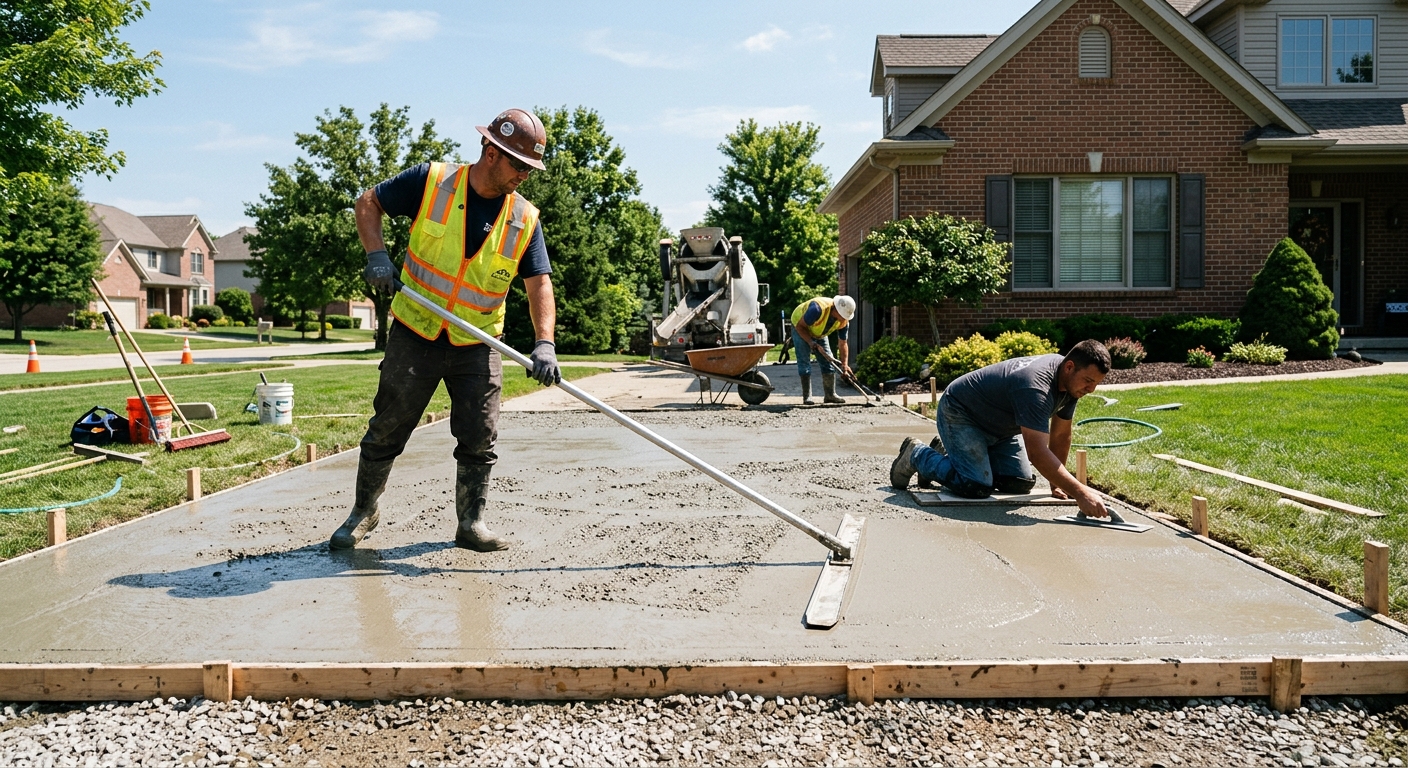
Concrete work options and costs in Concord
Concrete work in Concord is mostly driven by the everyday needs of local homeowners—especially in established areas like Winston Park, where driveways, patios, and walkways get replaced as homes age and families renovate. With 8,255 residents (Statistics Canada, 2021 Census), the market is smaller than downtown Toronto, so good contractors can be busy when the pour season hits. That said, concrete demand stays steady because flatwork is a practical upgrade and a common replacement after poor drainage or settlement.
In Concord and the wider Toronto economic region, the freeze–thaw cycle and frost depth requirements affect almost every line item in your quote. For example, Ontario Building Code practice typically places structural footings at least 1.2 m (about 4 ft) below grade to help prevent frost heave and differential movement. Exterior slabs and driveways also require air-entrained mixes and adequate thickness, because repeated wetting, freezing, and de-icing can accelerate spalling if the mix and curing aren’t right.
On the pricing side, Toronto-area labour and scheduling can tighten during warmer months, so timing matters. If you’re comparing options, it’s useful to look at the “what you get” differences: standard broom finishes are generally the lowest cost; exposed aggregate and stamped finishes cost more due to formwork, extra finishing labour, and higher material requirements. When you’re ready, review the cost bands below to ground your expectations before you contact contractors for itemised quotes.
| Application |
Typical Size |
Key Spec |
Finish Option |
Price Range |
| Concrete driveway (standard broom finish) |
16 ft x 24 ft (384 sq. ft.) |
Air-entrained exterior mix; compacted granular base; control joints |
Broom finish |
$6,900 – $10,700 |
| Exposed aggregate driveway |
16 ft x 24 ft (384 sq. ft.) |
Air-entrained exterior mix; wash/surface exposure; sealed for salt resistance |
Exposed aggregate |
$9,000 – $13,800 |
| Stamped concrete driveway or patio |
12 ft x 20 ft (240 sq. ft.) |
Stamped system; integral colour; release agent; proper jointing |
Stamped (pattern + colour) |
$6,000 – $9,600 |
| Plain concrete patio or walkway |
10 ft x 14 ft (140 sq. ft.) |
Compacted base; air-entrained mix; light broom finish; jointing |
Plain (broom or smooth trowel) |
$2,200 – $3,700 |
| Garage floor (interior slab) |
20 ft x 22 ft (440 sq. ft.) |
Vapour barrier as needed; thickened edges; crack control; proper curing |
Broom or power trowel |
$7,200 – $12,300 |
| Foundation footings (structural, below frost) |
Typical small re-build/underpinning allowance |
Excavation + rebar cage; below-grade depth (often ≥ 1.2 m); engineered layout |
Structural concrete/formed footings |
$180,000 – $300,000 |
Prices are estimates only and vary by project scope, site access and material selection.
What affects the price of concrete work in Concord
In Concord, it’s common to see quote differences of 30–50% for what looks like the same concrete job. The biggest reason isn’t “how good the concrete is”—it’s what’s included in the scope: excavation depth, granular base thickness, drainage details, whether reinforcement is used, and how the contractor plans for freeze–thaw and curing. In the Toronto economic region, contractors also price around the realities of supply and scheduling during the pour season, which can tighten labour availability when weather cooperates.
Here’s how the climate drives specs and costs. Frost protection means footings must extend below the design frost depth to prevent frost heave and movement. That requirement cascades into extra excavation, higher form height, and more concrete volume—especially on homes with thicker foundation walls or uneven soils. Exterior slabs and flatwork need air-entrained mixes to survive freeze–thaw. When temperatures drop toward 10 °C or below, cold-weather curing precautions—like insulating blankets, tenting, or heated curing areas—can add cost but protect early-age strength development.
De-icing salt is another practical factor in Concord winters. If the concrete is left unsealed or is under-specified, surface scaling and spalling become more likely, and repairs cost more than proper sealing at install. For example, a standard broom driveway might land around the region of $18–$28 per sq. ft., while an exposed aggregate approach commonly pushes higher where finishing labour and surface exposure increase scope; many homeowners only choose stamped or exposed when the long-term surface performance and curb appeal are worth the premium.
Local site conditions also swing budgets. On older properties in Concord where soil is disturbed or drainage is poor, you’ll often see added cost for deeper base prep and re-grading. On the other hand, a straightforward backyard with easy access can keep costs closer to the lower end of flatwork pricing.
| Price Factor |
Why It Matters |
Cost Impact |
| Frost line depth |
Footings must sit below design frost to limit frost heave |
Higher excavation and concrete volume; commonly a major line-item |
| Site preparation |
Correct grading and well-compacted granular base reduce pumping and settlement |
Extra labour/equipment for excavation and base placement |
| Reinforcement |
Rebar or mesh controls cracking and supports loads |
Adds material and install time; affects slab thickness too |
| Mix design |
Air-entrainment and strength spec help concrete survive freeze–thaw and loading |
Special mix and QC can increase unit costs |
| Finish type |
Broom vs. stamped vs. exposed aggregate changes labour and materials |
Stamped/exposed typically adds significant finishing hours |
| Pour size and concrete truck access to site |
Smaller pours may require more forms; narrow access can force pumping |
Access constraints increase equipment and handling charges |
| Cold-weather curing precautions |
Insulation/heating protects early strength when temperatures drop |
Blankets/tenting labour can add cost during shoulder season |
| Control joint pattern and sealing cost |
Joints manage cracking; sealing helps resist salt scaling |
Precise layout reduces random cracks; sealer adds a measurable materials cost |
Permits & regulations in Ontario
In Ontario, structural concrete work such as footings, foundation walls, and grade beams typically requires a building permit, and municipalities often expect engineered drawings reviewed as part of the permit process. That’s because these elements affect the structure’s safety and load paths. For concrete flatwork—like driveways, patios, and walkways—a permit often is not required, unless the work affects lot grading, drainage, or municipal impervious surface coverage/right-of-way conditions. As a homeowner in Concord, the safe approach is to confirm with your local authority before breaking ground, especially if you’re changing elevations near a driveway apron or altering stormwater flow.
Before you hire a contractor, verify three essentials: (1) licensing/registration where applicable for the type of work, (2) liability insurance, and (3) WSIB/WCB coverage (or the applicable coverage documentation for subcontractors). Step-by-step:
- Ask the contractor for their insurance certificate showing liability coverage and dates.
- Request proof of WSIB/WCB account and clearance letter (or documentation for coverage status).
- Confirm references for similar-scale projects (same general scope: driveway/flatwork versus foundation work).
- Check contractor details on relevant provincial/industry registries (where available) and verify they match the company name on the quote.
- Make sure the permit responsibility is clearly stated: who applies, who pays, and what drawings/specs are included for structural pours.
Getting concrete right in Concord's freeze-thaw climate
Concrete failure in Concord is usually about one thing: the concrete doesn’t handle moisture movement and freeze–thaw well enough. The most common outcomes are surface scaling and spalling (often from inadequate air-entrainment and poor curing) and settlement-related cracking (from insufficient base preparation or drainage). In the Toronto region, contractors design for frost protection by using below-grade footing depths (often at least 1.2 m for structural footings) and by specifying air-entrained mixes for exterior flatwork. Proper control joints then help “steer” cracking into predictable lines.
To spec your job correctly, focus on five areas. First, base preparation: concrete is only as good as the granular foundation under it—use compacted granular sub-base to the required depth for the soil and frost conditions. Second, mix design: exterior concrete commonly targets 5–7% air content and should meet a minimum 32 MPa compressive strength spec for structural and durable applications. Third, control joints: they should be cut or formed on a pattern that limits random shrinkage cracking. Fourth, curing: you need minimum 7-day curing under proper conditions; in cold weather that can mean extra protection so the concrete gains strength. Fifth, sealing: a penetrating sealer applied after the concrete has cured helps repel de-icing salts and water from reaching the surface pores.
If you’re deciding between options, the price difference can be justified. For instance, moving from a basic broom-finish driveway to an exposed aggregate driveway might add roughly $3,000 to $5,000 on a typical sized job, but that premium often buys better surface texture management and, when paired with good sealing, more durable curb appeal in freeze–thaw.
| Spec |
Why It Matters in Concord |
What to Ask For |
Impact if Skipped |
| Compacted granular base (depth?) |
Prevents pumping and settlement; supports frost-stable slab performance |
Granular base type and compacted depth; proof of compaction method |
Cracking, dips, and premature failure at edges |
| Air-entrained concrete mix (target air %?) |
Reduces freeze–thaw damage from absorbed water |
Target air content typically 5–7% for exterior flatwork |
Higher risk of surface spalling and scaling |
| Compressive strength (MPa rating) |
Early and long-term strength supports loads and resists deterioration |
Minimum 32 MPa (confirm mix design on quote) |
Weaker surface; accelerated wear in salted winters |
| Control joints (spacing per ACI guidelines) |
Controls where cracks form during shrinkage and thermal movement |
Planned joint spacing and timing (saw cut schedule) |
Random cracking that can allow water ingress |
| Minimum 7-day curing period |
Ensures strength gain before freeze–thaw stress |
Curing plan for cold or damp weather |
Lower strength; increased risk of scaling/spalling |
| Penetrating sealer (when applied after cure) |
Repels moisture and de-icing salts from the concrete pores |
Sealer type and application timing (often 28 days post-pour) |
Faster surface damage and salt-related deterioration |
How to choose a concrete work contractor in Concord
Choosing the right concrete contractor in Concord comes down to proof and clarity. Start with Ontario licensing/registration where applicable for the scope you’re hiring for, then verify liability insurance (certificate of insurance with project coverage) and WSIB/WCB clearance for the company and any subcontractors. To check: request documents directly, verify dates are current, and ensure the insured company name matches the contractor on your quote. If they can’t provide coverage documentation promptly, that’s a red flag.
Next, get 2–3 itemised written quotes—not lump-sum only. A good quote breaks down labour and materials (excavation, granular base, rebar/mesh, concrete supply, finishing, sealing, disposal). Make sure the scope is comparable: what’s included for site access, grading, drainage ties-in, and saw-cutting control joints? Also confirm whether a permit is required and whether the contractor includes permit pulling/coordination for structural work.
Warranty matters too. Ask for the workmanship warranty length, any manufacturer/product warranty (and exclusions), and whether warranties are transferable if you sell your home. For payment scheduling, avoid large advances: keep deposits to about 10–15% upfront, and hold back a portion until the finish work is complete, joints are sealed as specified, and clean-up meets expectations. Finally, insist on a start date and an estimated completion timeline in writing.
- Ask for proof of liability insurance and WSIB/WCB clearance before scheduling.
- Confirm the contractor’s scope includes base prep and compaction—not just concrete placement.
- Request the air-entrained mix and target strength spec on the quote.
- Compare reinforcement details (mesh vs. rebar; thickness and cover).
- Verify control joint timing and spacing (and whether saw-cutting is included).
- Ask how they protect curing if temperatures drop during the pour.
- Confirm sealing is included (and when it’s applied after cure).
- Check disposal and haul-away: is demolition and excess material included?
- Clarify site access: do they pump concrete if the truck can’t reach?
- Ensure the quote includes forms, edges, and finishing items (not “allowances” only).
- Get references from similar Concord-sized projects (driveways/flatwork vs. foundations).
- Review payment terms: never pay the full amount before completion and walkthrough.
Concrete contractor red flags in Concord: they won’t discuss air-entrainment or joint layout; quotes that omit granular base depth/compaction; “cheap” pricing without clear reinforcement or curing protection; pressure to pay most of the job upfront; and no written warranty terms tied to workmanship and sealing timelines.
Frequently asked questions — concrete work in Concord
What is air-entrained concrete and why does it matter here?
Air-entrained concrete is mixed with tiny, evenly distributed air bubbles that give freezing water space to expand. In Ontario’s Toronto-area freeze–thaw climate, that significantly lowers the chance of surface scaling and spalling, especially on exterior flatwork like driveways and patios that get wetted, then frozen, then hit with de-icing salts. When contractors specify an exterior mix with target air content (often 5–7%), they’re designing for the reality of winter moisture movement.
It also affects how you compare quotes: a bargain price for a driveway can be misleading if it uses the wrong mix design or skips curing protections. For context, typical concrete driveway pricing in this area often falls around $18–$28 per sq. ft. depending on prep and finish. The lowest number isn’t always the best value if the mix and curing aren’t right.
How do I prepare the base for a concrete slab?
Base preparation is what keeps your slab from settling and cracking, and it’s where many “cheap” concrete jobs cut corners. In Concord, you want excavation and grading to achieve the designed elevations, followed by placement of a compacted granular sub-base to the required depth and compaction level for local soil and drainage conditions. A proper base helps prevent water from pooling under the slab and reduces frost-related movement.
Ask your contractor what granular material is being used, how they’ll compact it, and what thickness they’re placing before concrete delivery. Also confirm drainage: if your site can trap water, even the strongest concrete won’t last as long. For larger exterior slabs, comparable jobs in the GTA are sensitive to access and excavation scope—so two quotes for the “same size” can vary widely if one includes full base prep and the other doesn’t.
How do I compare concrete quotes?
To compare quotes fairly in Concord, insist on itemised line items and confirm specs rather than just totals. Ask each contractor to list excavation scope, granular base thickness and compaction, reinforcement (rebar/mesh and slab thickness), concrete mix design (including air-entrainment), and finishing steps (including control joints). Also clarify curing and sealing timelines—sealing is commonly applied after adequate cure (often around 28 days), and it’s part of long-term performance against de-icing salts.
Look for exclusions like permit handling (for structural work), disposal/haul-away, and truck access or pumping allowances. Quote differences of 30–50% are usually explained by these scope details. As a benchmark for exterior work, broom-finish driveways can land near $18–$28 per sq. ft., while stamped or exposed finishes are typically higher. If one quote is far below the range, ask what they’re leaving out.
Can concrete be poured in cold weather in Concord?
Yes, concrete can be poured in cold weather in Concord, but it needs a plan. The core issue is early-age strength development: if temperatures drop enough, curing can be compromised, increasing the risk of scaling and spalling later when freeze–thaw cycles continue. Contractors often use cold-weather precautions—insulating blankets, tenting, or heating strategies—so the concrete stays within required temperature ranges during the critical initial curing period.
When it’s near or below about 10 °C, ask the contractor to describe their protection method and timeline. A good contractor will not just “pour and hope”—they’ll explain how they maintain curing conditions for at least a week under proper conditions and how they manage form removal and joint timing. If a quote doesn’t mention cold-weather curing, treat that as missing scope.
How do I maintain concrete in Concord's freeze-thaw climate?
Maintenance in Concord is about keeping water and salt exposure from damaging the surface. Start with sealing: after the concrete has fully cured (commonly around 28 days), apply a penetrating sealer to help repel moisture and de-icing salts. For day-to-day care, avoid harsh scraping that gouges the surface, and remove excess salt promptly when practical.
Inspect annually for early signs—small scaling patches, joint widening, or cracks that allow water penetration. Control joints are designed to manage cracking, but they still need to be kept clean and sealed if your system includes joint sealants. If you notice settlement dips, address drainage first; sealing won’t fix movement caused by a weak base.
If your driveway is in the $18–$28 per sq. ft. range, maintenance is still essential because de-icing and moisture are a constant in Ontario winters. The durability gap is usually driven by prep, mix, curing, and sealing quality.
What causes concrete to spall in Concord winters?
Spalling in Concord is most often tied to moisture + freeze–thaw acting on concrete that wasn’t properly specified or cured. The biggest technical cause is insufficient air-entrainment: if the mix doesn’t have the right air content, freezing water can damage the concrete’s internal structure, leading to surface scaling and then spalling. Inadequate curing also contributes—especially if temperatures drop during the first days after the pour.
De-icing salts make the problem worse by accelerating surface breakdown. Base and drainage issues can also drive spalling indirectly: if water pools, the slab stays saturated, exposing more concrete to freeze cycles. Finally, missed or poorly spaced control joints can lead to uncontrolled cracking, giving water an easy path into the slab.
When comparing quotes, ask specifically about air-entrainment and curing protection. If you’re paying toward the higher end (for example, exterior work closer to $24–$40 per sq. ft. for decorative options), you should still expect the fundamentals—air content, jointing, and proper curing—to be fully addressed.