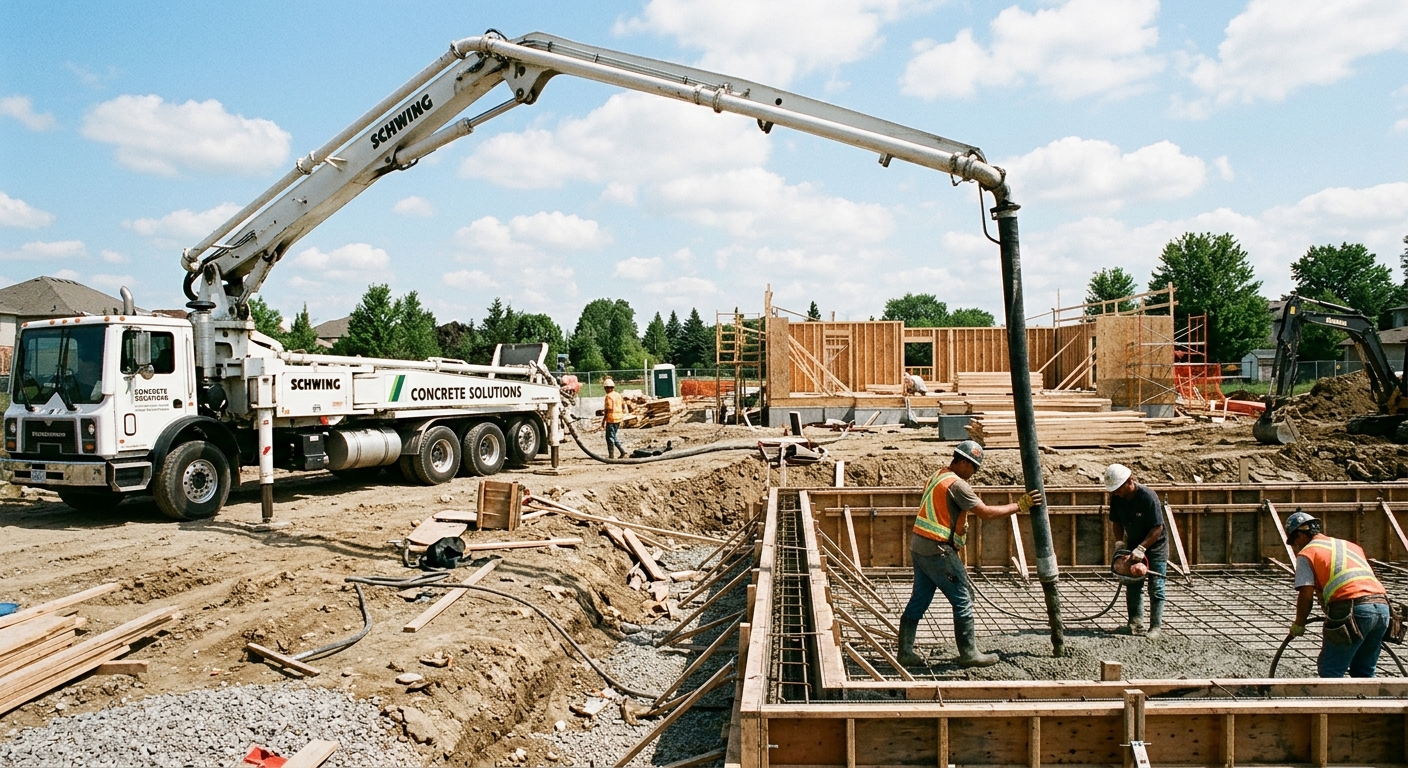
Concrete work options and costs in Iroquois Falls
Iroquois Falls homeowners usually start with a practical question: “What will a new concrete driveway or patio cost?” In a town of 4,418 people, and where about 75.9% of dwellings are single-detached homes, concrete flatwork is a steady, high-demand upgrade—especially around older neighbourhoods with mature lots. Even with strong local ownership (74.9% of households own), many homes in the area were built before 1981, which often means older grading, changing drainage patterns, and drive approaches that need rework before we can pour a durable slab. (Statistics Canada, 2021 Census)
Pricing in Northeastern Ontario is influenced by contractor availability and the reality of winter-ready materials and workmanship. While Iroquois Falls doesn’t have the same deep frost excavations you see in Northeast BC, we still face frequent freeze–thaw conditions that demand a correctly prepared granular base, air-entrained concrete for exterior work, and a tight control-joint layout. If the weather window is short at your address (wind, rain, or cold snaps), crews may need curing protection and faster scheduling, which can push costs toward the upper end of the typical ranges.
In Iroquois Falls, concrete work is especially in demand near the downtown core and along busier residential corridors where driveways, walkways, and small approaches get heavy seasonal use. Once you know your finish choice—standard broom versus exposed aggregate versus stamped—the rest of the job cost comes down to size, excavation, reinforcement, and access for the concrete truck. Use the table below to compare common options and typical price bands for local projects.
| Application |
Typical Size |
Key Spec |
Finish Option |
Price Range |
| Concrete driveway (standard broom finish) |
12 m x 3 m (about 108 sq. ft.) |
Reinforced slab; air-entrained mix for exterior |
Broom finish + control joints |
$1,950 – $3,000 |
| Exposed aggregate driveway |
12 m x 3 m (about 108 sq. ft.) |
Granular base prep + reinforcement; air-entrained |
Exposed aggregate with sealer |
$2,500 – $3,900 |
| Stamped concrete driveway or patio |
100 sq. ft. to 200 sq. ft. |
Reinforced slab; stain/release + air-entrained |
Stamped pattern with clear sealer |
$2,500 – $6,800 |
| Plain concrete patio or walkway |
10 m x 2 m (about 108 sq. ft.) |
Compact base; air-entrained; proper drainage |
Broom or smooth finish + joints |
$1,600 – $2,700 |
| Garage floor (interior slab) |
20 ft x 20 ft (about 400 sq. ft.) |
Interior mix; vapour considerations per design |
Standard broom finish |
$6,000 – $11,000 |
| Foundation footings (structural, below frost) |
Typical house perimeter + piers |
Structural concrete; excavation to frost level |
Formed footings; ready for foundation walls |
$55,000 – $90,000 |
Prices are estimates only and vary by project scope, site access and material selection.
What affects the price of concrete work in Iroquois Falls
In Iroquois Falls and across Ontario, it’s common to see the same “concrete driveway” quoted 30–50% apart once you compare the actual specs. A low number often assumes minimal excavation, standard base prep, and a basic finish, while a higher quote may include deeper removal, better drainage, more reinforcement, tighter joint spacing, and cold-weather protections. The bigger the scope, the more those differences show up in labour hours and equipment time—especially when crews have to work around short seasonal conditions and schedule availability.
Two technical drivers are non-negotiable in colder climates: frost protection and freeze–thaw durability. Footings must extend below design frost depth to prevent frost heave and related slab movement, and exterior slabs should be built with an air-entrained mix to survive repeated freezing and thawing. Sealing matters too—salt and moisture can accelerate surface wear and spalling, so we often budget for a penetrating sealer on decorative work and exterior flatwork. When weather cools down faster than expected, contractors may add insulation blankets or heating strategies to protect curing, which adds cost but improves long-term strength.
Here are a few Iroquois Falls examples that typically push price upward or allow savings. If you’re replacing a driveway with poor drainage or soft spots, excavation and compacted granular base prep will likely move you from the lower end of driveway pricing ($18–$28 per sq. ft. band) toward the upper end. If you choose stamped concrete (commonly $25–$40), the labour-intensive forming, texture mats and colour process justify the higher cost—however, if your base prep is weak, even the premium finish won’t perform. For homes built before 1981, we often see older base conditions and altered slopes, which can require more grading and rework; that’s where the “hidden” dollars come from.
| Price Factor |
Why It Matters |
Cost Impact |
| Frost line depth |
Determines footing depth and form height so the foundation doesn’t heave |
Higher excavation and concrete volume; significant swing in foundation work |
| Site preparation |
Excavation, grading, and compacted granular base control settlement |
Soft soil removal and hauling can materially increase labour/equipment hours |
| Reinforcement |
Rebar or wire mesh helps control cracking and supports loads |
Material + tying labour; omission can reduce cost short-term |
| Mix design |
Air-entrainment and specified strength affect freeze–thaw durability |
Premium mix and QC checks; essential for exterior longevity |
| Finish type |
Broom vs. stamped vs. exposed aggregate changes labour and material steps |
Decorative options typically add the most cost after base prep |
| Pour size and concrete truck access to site |
Large pours require staging; tight access increases labour time and risk |
Additional equipment, smaller loads, or extra crew time |
| Cold-weather curing precautions |
Protects early strength gain; prevents surface damage and weakened slabs |
Blankets/heaters/admixtures can add noticeable line-items |
| Control joint pattern and sealing cost |
Joints manage cracking; sealing protects against salt and moisture |
More saw-cut labour and sealer materials if included properly |
Permits & regulations in Ontario
In Ontario, structural concrete work generally requires a building permit. That typically includes footings, foundation walls, grade beams, and other elements that are part of the structural system. Municipalities often require engineered drawings for structural components before issuing a permit, and inspections are usually scheduled at key stages. For concrete flatwork—driveways, patios, and walkways—the permit requirement is often not automatic, but it can apply if the work affects lot grading, stormwater drainage, impervious surface limits, or any municipal right-of-way conditions (for example, work near sidewalks or regulated frontage). Always confirm with the Town/City office in Iroquois Falls before breaking ground.
Before you hire anyone, verify insurance and coverage. Ask for their certificate of liability insurance (and ensure the coverage includes your property/work site), and confirm they carry WSIB/WCB clearance for the workers who will be on your jobsite. Then check licensing: Ontario contractors who perform construction activities should be able to provide proof of their business status and required registration where applicable.
Simple step-by-step for you:
- Ask for a current COI (certificate of insurance) listing you as additional insured, if available.
- Request WSIB/WCB clearance or equivalent proof for the contractor and any subcontractors.
- Confirm the scope: ask whether they’re pulling a permit for any structural elements and who is responsible for it.
- Check contractor references on similar driveway/patio and foundation-scale jobs.
- Get written confirmation of what’s included (excavation, disposal, drainage, curing methods).
Getting concrete right in Iroquois Falls's freeze-thaw climate
Concrete failures in Iroquois Falls are usually preventable, but the specs matter. The common culprits are poor base preparation (insufficient compacted granular sub-base), inadequate air-entrainment (leading to freeze–thaw spalling), weak curing protection, and control joints placed without a plan. If water can get trapped under or on the surface—especially with de-icing salt—freeze–thaw cycles expand moisture within the concrete and accelerate surface breakdown.
To spec your job correctly, start with base prep: we excavate to the proper depth for your soil conditions, then place and compact granular base in lifts so the slab won’t settle. For the mix, exterior flatwork should use air-entrained concrete (targeting 5–7% air content for durability in cold regions) and a minimum 32 MPa compressive strength. Next comes control joints: they need to be cut on a plan so cracking happens where you intended, not randomly across a driveway or walkway. Curing is the next critical step—plan for at least 7 days of protected curing under the right conditions, and if the pour happens near cold weather thresholds, expect insulation blankets or other protection. Finally, apply a penetrating sealer after the concrete has cured (commonly at 28 days) to repel water and reduce the impact of de-icing salts.
Here’s an honest budget example: if your driveway quotes show standard broom finish at the typical $18–$28 band but stamped is priced toward $25–$40, the difference is usually justified only if the contractor is also including strong base prep, reinforcement, correct air-entrainment, joints, and sealing. If either quote is missing those fundamentals, you may pay more twice—once for the pour and again for repairs.
| Spec |
Why It Matters in Iroquois Falls |
What to Ask For |
Impact if Skipped |
| Compacted granular base (depth?) |
Controls settlement and supports the slab through freeze–thaw movement |
Ask for the total excavation depth and compacted base thickness, plus lift/compaction method |
Settlement, slab cracking, and uneven driveway performance |
| Air-entrained concrete mix (target air %?) |
Prevents freeze–thaw spalling in cold Ontario winters |
Ask for target air content (commonly 5–7% for exterior flatwork) on the ticket/spec |
Surface scaling, pop-outs, and faster deterioration |
| Compressive strength (MPa rating) |
Ensures design strength and durability for vehicle loads |
Ask for minimum 32 MPa (and whether it’s for 28 days strength) |
Weakened slab and increased risk of cracking and raveling |
| Control joints (spacing per ACI guidelines) |
Directs shrinkage cracking so it doesn’t become uncontrolled |
Ask for proposed joint spacing and saw-cut timing plan |
Random cracking and more visible, costly repairs |
| Minimum 7-day curing period |
Develops strength before exposure to freeze conditions |
Ask how curing is protected during cold snaps (blankets/heating plan) |
Loss of strength and early surface damage |
| Penetrating sealer (when applied after cure) |
Reduces salt and moisture intrusion during winter use |
Ask for seal type and application timing after cure (often at 28 days) |
More water uptake, quicker surface wear and scaling |
How to choose a concrete work contractor in Iroquois Falls
Choosing the right concrete contractor in Iroquois Falls starts with verifying Ontario basics and then reading the quote like it’s a contract—because concrete performance is determined before the truck arrives. First, confirm liability insurance and worker coverage. Ask for their certificate of liability insurance (COI), and request WSIB/WCB clearance or proof for the crew and any subcontractors. If a contractor can’t provide current documentation quickly, treat that as a serious risk.
Next, don’t accept a single lump-sum number. Get 2–3 written quotes with an itemized breakdown: excavation and removal, granular base and compaction, reinforcement, formwork, concrete supply, finishing, saw-cut joints, curing protection, disposal, and sealing (if included). Ask whether permits are included for any structural components—structural footings/foundation work usually needs a permit, while typical flatwork often doesn’t unless it affects grading or right-of-way conditions.
Warranty matters too. Ask for the workmanship warranty length and whether it’s tied to proper curing and surface sealing. Also confirm whether product/manufacturer warranties apply to admixtures/sealer systems and whether they’re transferable if you sell the home.
For payments, never pay more than about 10–15% upfront. Use progress payments tied to milestones and hold back a final portion until completion and cleanup are verified. Then request a start date and completion estimate in writing, including weather-dependent contingencies for cold snaps.
- Ask for COI and verify it matches your job address and coverage limits.
- Request WSIB/WCB clearance for workers and subcontractors.
- Confirm whether they pull permits for structural work (footings/foundation) and who pays.
- Insist on itemized labour + materials (not just “concrete supply and install”).
- Ask for granular base thickness and compaction method, not just “we prepped the base.”
- Confirm air-entrainment and minimum strength on the mix spec.
- Ask about reinforcement type (rebar vs mesh) and slab thickness.
- Clarify joint pattern: spacing and saw-cut timing.
- Ask how they handle cold weather curing (blankets/heating plan).
- Confirm sealing plan for exterior and decorative concrete (when applied).
- Get disposal included (or confirm hauling/removal is extra).
- Review the payment schedule and holdback terms before signing.
Concrete red flags in Iroquois Falls include: promises of “no joints needed,” skipping air-entrainment, curing practices that rely on “it’ll be fine,” vague scopes that don’t mention base compaction depth, and quotes that don’t itemize disposal/grading or sealing for exterior work.
Frequently asked questions — concrete work in Iroquois Falls
When is the best time to pour concrete in Iroquois Falls?
The best time to pour concrete in Iroquois Falls is during consistently milder weather, typically late spring through summer, when air temperatures stay above freezing and curing conditions are stable. You can pour earlier or later, but only if the contractor has a cold-weather plan—insulation blankets, curing protection, and (in some cases) heating—because early freezing can weaken slabs and exposed driveways. Many homeowners plan around driveway and walkway needs ahead of winter, but the real goal is protecting the first days of curing so your air-entrained mix develops strength and resists freeze–thaw damage. If you’re comparing quotes, ask whether the pricing assumes normal temperatures or includes cold-weather precautions.
How long does concrete take to cure?
Concrete “sets” within hours, but curing is a longer process. For most exterior flatwork, you should plan on a minimum 7-day protected curing period before assuming full performance, and then allow about 28 days for the concrete to reach design strength under proper conditions. Cold weather can slow hydration dramatically, so crews may use blankets or heating. If you’re installing a driveway or patio, remember that finishing work and traffic restrictions should match the curing plan—rushing load-bearing exposure increases cracking and surface damage. Also, for decorative concrete or anything receiving de-icing salt exposure, sealing is often applied after cure (commonly at 28 days) to help repel moisture and reduce spalling risk.
Do I need a permit for concrete work in Ontario?
In Ontario, structural concrete work—like footings, foundation walls, and grade beams—typically requires a building permit, often with engineered drawings reviewed by the municipality. Concrete flatwork such as patios, walkways, and most driveways usually does not need a permit by default, unless it affects lot grading, impervious surface limits, or municipal right-of-way conditions. For Iroquois Falls homeowners, the safe move is to confirm with the local authority before work starts, especially if you’re changing drainage, lowering/raising grade, or adding a new driveway apron. Also verify your contractor’s responsibility: ask who handles any permit and inspections if the work becomes structural.
Concrete vs pavers for a patio in Iroquois Falls?
Both concrete and pavers can work well in Iroquois Falls, but concrete is often more cost-predictable for large slabs and can be simpler to maintain if properly built. A plain concrete patio typically falls around the $15–$25 band (based on size and site prep), and a stamped option can run higher, especially with decorative labour. Pavers can look great and are repairable in sections, but they depend heavily on base prep and jointing materials; if water management isn’t right, you’ll still get heaving or shifting in freeze–thaw cycles. If your soil is sensitive or drainage is tricky, a properly drained, compacted granular base under either system is the deciding factor. Ask for how each option handles water movement.
How long does a concrete driveway last?
A well-built concrete driveway in Ontario commonly lasts decades, but the lifespan depends on construction details and winter chemistry. With freeze–thaw cycles and de-icing salts, the biggest drivers are air-entrainment, proper base preparation, correct joint spacing, curing, and sealing strategy. If a driveway is built at the right thickness over a compacted granular base and finished with a plan for control joints, it usually holds up far better than a driveway poured over weak or poorly drained sub-base. If you choose a standard broom finish (often in the $18–$28 band) and include proper sealing for salt exposure, you can significantly reduce early scaling and spalling. Skimping on air content and curing is what shortens service life.
What is air-entrained concrete and why does it matter here?
Air-entrained concrete is mixed with carefully controlled air bubbles that provide relief space for expanding water during freezing. In Iroquois Falls and across Ontario’s freeze–thaw climate, that air system is one of the most important protections against surface spalling, scaling, and pop-outs. Exterior slabs and driveways should typically use an air-entrained mix so the concrete can survive repeated moisture-to-ice cycles. When quotes differ, this is where you can see hidden quality: one contractor may assume a basic mix, while another targets the proper air content (commonly 5–7% for exterior flatwork) and strength. If you’re paying for better finishes—like decorative stamped work in the higher bands—air-entrainment must still be included, or the finish won’t last.