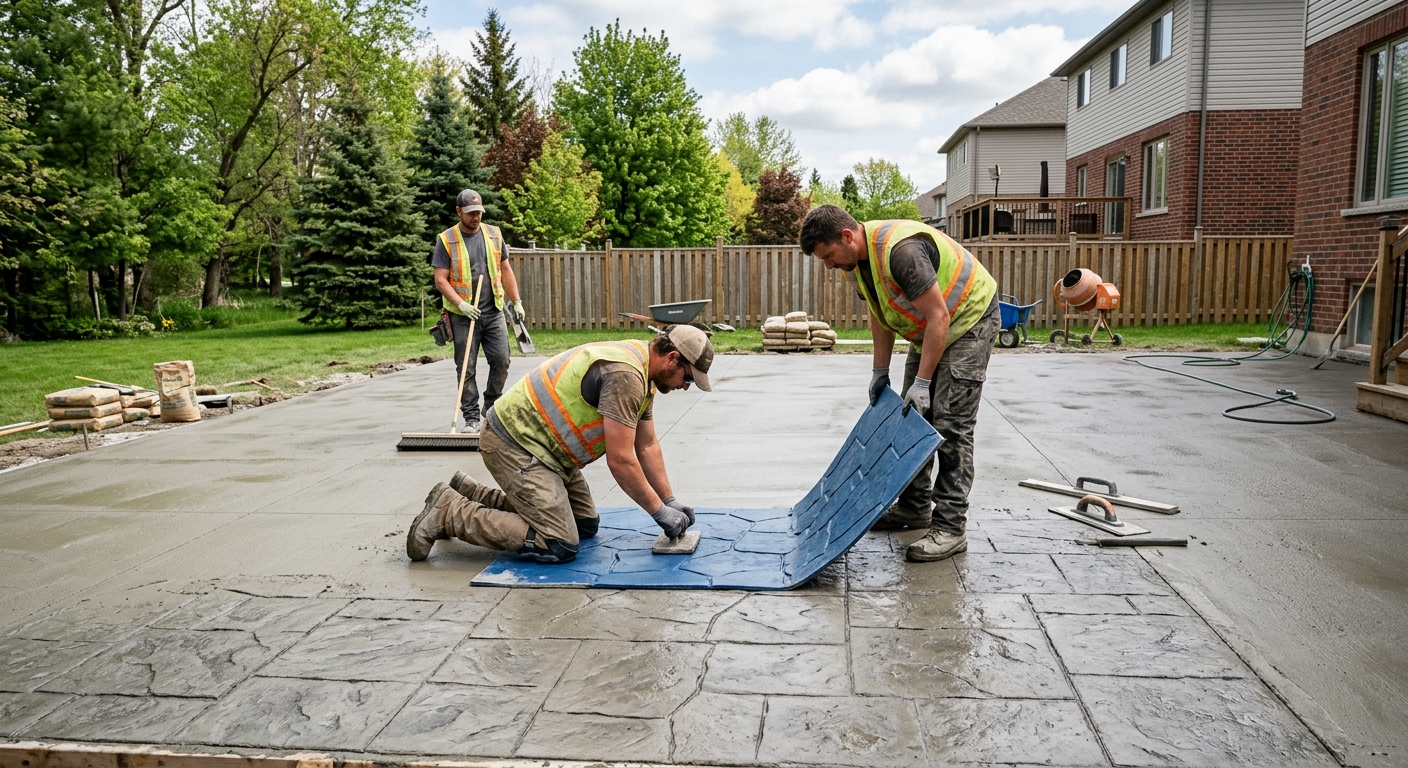
Concrete work options and costs in Humewood-Cedarvale
In Humewood-Cedarvale, concrete flatwork is a big part of home upkeep—whether you’re refreshing a driveway, adding a patio for summer gatherings, or setting new walkways to match the character of the neighbourhood. With a 2021 population of 14,365 (Statistics Canada, 2021 Census), this is a compact, well-established pocket of Toronto where trades stay busy, especially around residential streets near transit and school routes. That demand matters when you’re timing a pour in the GTA, because availability often tightens in late spring and again as homeowners plan upgrades before winter freeze-thaw really ramps up.
Most concrete work here targets exterior surfaces that must handle repeated winter expansion and contraction. Toronto-area freeze–thaw cycles drive the specs: contractors typically use air-entrained concrete, build a properly compacted granular base, and plan control joints to manage cracking. In many homes and lot profiles, foundation work is also common—structural footings and below-grade concrete need to extend at least about 1.2 m below grade to reduce frost heave and differential movement, even though the exact design depends on soil and drawings.
Labour and materials pricing can also shift with the pour season. When temperatures drop toward 10 °C or below, curing management becomes more expensive because crews may need protection or longer scheduled cure times. That’s one reason a basic broom-finished driveway can be meaningfully cheaper than a stamped or exposed aggregate finish.
Below are realistic price ranges you’ll see for typical projects in the Toronto market, then you can compare what each option includes in your own scope.
| Application |
Typical Size |
Key Spec |
Finish Option |
Price Range |
| Concrete driveway (standard broom finish) |
300 sq ft (approx. 20 ft x 15 ft) |
4 in (100 mm) thickness, compacted granular base, control joints |
Broom finish |
$18,500–$27,500 |
| Exposed aggregate driveway |
300 sq ft (approx. 20 ft x 15 ft) |
Air-entrained mix, proper base drainage, patching/level adjustment |
Exposed aggregate (wash finish) |
$24,000–$35,000 |
| Stamped concrete driveway or patio |
250 sq ft (approx. 20 ft x 12.5 ft) |
Air-entrained mix, integral colour, release agent, control joints |
Stamped patterns |
$25,000–$40,000 |
| Plain concrete patio or walkway |
150 sq ft (approx. 10 ft x 15 ft) |
4 in thickness, compacted base, edge forms, joints |
Broom/float finish |
$11,500–$24,000 |
| Garage floor (interior slab) |
400 sq ft (approx. 20 ft x 20 ft) |
Thickness per design, vapour barrier where required, reinforced slab |
Smooth trowel or light broom |
$20,000–$33,000 |
| Foundation footings (structural, below frost) |
Varies by plan (e.g., 60–120 lin ft) |
Below-frost depth as required, reinforcement per engineered drawings |
Structural concrete |
$8,000–$18,000 |
Prices are estimates only and vary by project scope, site access and material selection.
What affects the price of concrete work in Humewood-Cedarvale
In Humewood-Cedarvale and across the Toronto economic region, it’s normal to see quote-to-quote differences of 30–50% for what sounds like the “same” concrete job. The sticker shock usually isn’t the concrete itself—it’s the groundwork, the design choices that address frost performance, and how well the contractor can sequence the work during the short, productive pour window. When crews can’t pour in steady weather or need extra protection for curing, your schedule costs rise even if the square footage stays the same.
Here’s the big driver: frost depth and freeze–thaw cycles dictate the entire system. Structural footings generally must extend at least about 1.2 m below grade to reduce frost heave and differential movement. For exterior slabs, contractors also typically specify air-entrained concrete mixes to survive repeated freezing and thawing, and they plan thickness plus control joints to manage random cracking. In colder periods of the season, curing management becomes more involved (insulating blankets, heating where practical, and tighter supervision), which adds cost. Finally, winter de-icing salts can accelerate surface deterioration, so sealing is often treated as a durability requirement—not a luxury.
Two real examples of local cost movement: (1) A driveway replacement with poor drainage or saturated soils often requires additional grading and thicker granular base before any concrete is placed—this can push a basic broom-finished job toward the top end of the $18–$28 band. (2) A stamped patio or exposed aggregate driveway may cost more per square foot, but the added labour and materials can be justified when you want texture and appearance that match existing stonework; that’s where the $24–$40 stamped/decorative range shows up more clearly.
Even foundation scope can swing price quickly: small changes in engineered reinforcement quantities or footing length can shift totals by thousands. And because many homes in Toronto are older (and sometimes have later infill or drainage issues), you may be paying to correct site conditions as much as you’re paying for concrete.
| Price Factor |
Why It Matters |
Cost Impact |
| Frost line depth — determines footing depth and form height |
Footings must be below design frost influence to prevent heave |
Higher excavation and rebar = higher cost |
| Site preparation — excavation, grading, compacted granular base |
Proper drainage and compaction prevent settlement and pump-out |
Unforeseen soil issues can add days of work |
| Reinforcement — rebar or wire mesh requirement |
Reinforcement controls crack widths and helps slab performance |
More steel and labour can add significant cost |
| Mix design — air-entrainment and compressive strength spec |
Air-entrainment reduces freeze–thaw damage and surface scaling |
Better mix costs more but extends service life |
| Finish type — broom vs. stamped vs. exposed aggregate |
Surface treatment drives labour and specialty materials |
Stamped/exposed typically costs more per sq ft |
| Pour size and concrete truck access to site |
Access affects pumping, wait time, and staging |
Lane restrictions or pump needs can add fees |
| Cold-weather curing precautions — heating and blankets |
Concrete needs protection to reach adequate strength and durability |
Winter work can increase labour and equipment rental |
| Control joint pattern and sealing cost |
Joints reduce random cracking; sealing helps resist salt scaling |
Materials + extra labour days |
Permits & regulations in Ontario
In Ontario, structural concrete work typically needs a building permit, and it’s common for municipal staff to review engineered drawings before work starts. That includes foundation-related scope such as footings, foundation walls, grade beams, and other structural elements that affect load-bearing performance and frost-protection design. For flatwork like patios, walkways, and driveways, permits are usually not required unless the work affects lot grading, drainage, impervious surface coverage rules, or requires changes near the municipal right-of-way.
For a homeowner in Humewood-Cedarvale, the safest approach is to treat permits as a verification step, not a guess: call or check with your local authority before you break ground, especially if you’re re-grading or tying new concrete into existing drainage systems. You should also confirm the contractor carries liability insurance and is properly registered for worker protection coverage (commonly referred to as WSIB/WCB coverage). Ask for references on similar-scale Toronto projects so you’re not relying on “we’ve done concrete before” as your risk control.
Step-by-step checks that work well in practice: (1) Verify the contractor’s Ontario licence/registration and any required business registration status through the appropriate online registry channels; (2) Request a certificate of insurance and confirm the named insured matches the company that will pour; check that coverage is current before the pour date; (3) Ask for proof of worker protection coverage and, if offered, a clearance letter number or document copy; (4) Confirm the permit responsibility in your written contract—who pulls it, what inspections are scheduled, and what happens if the inspector requires changes.
Getting concrete right in Humewood-Cedarvale's freeze-thaw climate
Concrete failures in Humewood-Cedarvale are usually tied to the same root causes: weak or saturated base preparation, insufficient air-entrainment, poor curing, and cracks that aren’t controlled (or aren’t sealed where needed). Toronto’s repeated freeze–thaw cycles expand damage through the surface, and once salt and moisture get into micro-cracks, the problem accelerates. The good news is that you can spec around these risks with a straightforward system—base, mix, joints, curing, and sealing—so the concrete performs year after year rather than season by season.
Start with (1) base preparation: excavate to the proper depth for your soil and expected frost performance, then place and compact a granular sub-base with the right thickness and drainage slope. (2) mix design: for exterior flatwork, require air-entrainment (commonly targeted around 5–7% air for durability outdoors) and a minimum 32 MPa compressive strength spec. (3) control joints: plan the joint spacing to limit random cracking and keep movement consistent. (4) curing: protect and maintain curing conditions for at least 7 days; when temperatures drop near 10 °C or below, you may need blankets or controlled protection to reach strength and reduce surface scaling. (5) sealing: plan a penetrating sealer applied after cure (often around 28 days post-pour) to help repel de-icing salts and reduce water absorption.
When you’re evaluating quotes, ask technical questions about air content, curing protection, and joint layout—those choices are what prevent spalling. For example, if a “cheaper” driveway is priced near the low end of the $18–$28 band, but it can’t clearly confirm air-entrainment, curing approach, or base depth, the apparent savings can backfire quickly. A properly detailed broom finish can last well; a shortcut mix can fail even if the price looks good on paper.
| Spec |
Why It Matters in Humewood-Cedarvale |
What to Ask For |
Impact if Skipped |
| Compacted granular base (depth?) |
Durable slabs need firm support and drainage through winter |
State granular base thickness and compaction plan by site soil |
Settlement, pumping, and early cracking |
| Air-entrained concrete mix (target air %?) |
Air voids protect against freeze–thaw scaling in humid GTA winters |
Target 5–7% air for exterior flatwork |
Spalling, scaling, and surface breakdown |
| Compressive strength (MPa rating) |
A minimum strength helps the slab resist freeze–thaw damage and loading |
Minimum 32 MPa |
Lower durability and increased cracking risk |
| Control joints (spacing per ACI guidelines) |
Controls where cracks happen so they stay predictable and manageable |
Joint layout and spacing plan in the quote |
Random cracking and more water intrusion |
| Minimum 7-day curing period |
Cold evenings and wet conditions can slow strength gain in Toronto |
Protection plan if temps fall toward 10 °C or below |
Surface weakness and reduced long-term performance |
| Penetrating sealer (when applied after cure) |
Helps repel salt and water that drive freeze–thaw deterioration |
Application timing after cure (commonly around 28 days) |
Faster salt scaling and staining |
How to choose a concrete work contractor in Humewood-Cedarvale
Choosing the right concrete contractor in Humewood-Cedarvale comes down to verifying three things before you sign: Ontario compliance, real jobsite coverage, and a scope that reflects freeze–thaw best practices. First, verify the contractor’s Ontario licence/registration and ask for a certificate of liability insurance with coverage amounts that match the project size. Next, confirm worker protection coverage—commonly WSIB/WCB—and ask how they can document it (some provide a clearance letter or current account status). Don’t accept “our workers are covered” without proof.
Then get 2–3 itemised written quotes. You want labour and materials broken out (concrete supply, reinforcement, formwork, excavation, granular base, disposal, and finishing). Avoid lump-sum quotes that don’t explain inclusions. Read the exclusions line-by-line: is permit pulling included where required, is demolition/disposal included, what’s the plan for removing unsuitable base material, and who handles re-grading or tie-ins to existing drains?
Warranty matters too. Ask for the workmanship warranty length, whether the product/manufacturer warranty applies to the specific mix/finish, and if it’s transferable if you sell the home. For payment, use a schedule that protects you: never pay more than 10–15% upfront, and hold back until the job is complete and cured-ready (especially for exterior sealing timing). Finally, insist on a written timeline with a start date, weather contingency note, and a completion estimate that reflects curing and protection requirements.
- Request air-entrainment and compressive strength specs in writing for exterior pours.
- Confirm granular base thickness and compaction method for your soil conditions.
- Ask about reinforcement (mesh/rebar) and where it’s placed (base vs. mid-depth).
- Check that control joint spacing and edges will be formed as designed.
- Verify cold-weather protection plan if temperatures drop toward 10 °C or below.
- Get disposal included (or clarify who hauls away broken concrete).
- Confirm site access and whether pumping is needed for the concrete truck route.
- Ask whether they seal and/or provide sealer as a separate line item after cure.
- Require proof of liability insurance and worker protection coverage before work starts.
- Review warranty terms in plain language—what’s covered and for how long.
- Use a payment schedule with a holdback until completion and cleanup.
- Walk the site with the estimator and mark elevations/drainage points before quoting.
Concrete red flags in Humewood-Cedarvale include: a quote that won’t specify air content or curing protection, vague base prep (“we’ll dig and pour”) without thickness/compaction details, missing joint layout leading to unpredictable cracking, no proof of insurance/coverage provided upfront, and requests for large upfront payments with unclear warranty coverage.
Frequently asked questions — concrete work in Humewood-Cedarvale
How long does a concrete driveway last?
In Humewood-Cedarvale, a well-built driveway often lasts decades, but the exact lifespan depends on freeze–thaw durability details. Exterior concrete is constantly challenged by moisture and salt, so the contractor’s base preparation, air-entrained mix, and joint pattern are what you should judge. If your concrete was properly built (compacted granular base, air-entrainment outdoors, correct thickness, and control joints), you can reasonably expect long service life with routine maintenance like periodic cleaning and sealing. If shortcuts were taken—like insufficient air content or rushed curing—surface scaling and spalling can appear much earlier, sometimes within the first few winters. When budgeting, it helps to understand typical local pricing: driveway projects often fall in the $18–$28 range depending on finish and site conditions.
What is air-entrained concrete and why does it matter here?
Air-entrained concrete is mixed with tiny, evenly distributed air bubbles that give freezing water somewhere to expand. In Ontario’s Humewood-Cedarvale winters, freeze–thaw cycles repeatedly stress the concrete surface. Without the right air entrainment (often around 5–7% target air for exterior flatwork), water can freeze within the paste and break it down, leading to scaling and spalling. This is one of the most common reasons “cheaper” exterior concrete fails early. It also affects how the finish holds up under de-icing salts, which are used widely across the GTA. When comparing quotes, ask what the mix spec is for air content and minimum compressive strength, not just what the driveway price is.
How do I prepare the base for a concrete slab?
Concrete base prep is the foundation of the whole job—literally. For a driveway, patio, or walkway in Humewood-Cedarvale, the contractor should excavate to a depth that supports frost performance, then place compacted granular sub-base to the specified thickness. The base should be graded for drainage, because saturated soils expand and contract, stressing the slab. Compaction matters as much as thickness: loose base can cause settlement and surface cracking even if the concrete mix is good. In a quote, you should see details like granular base depth, how the contractor compacts (and in lifts), whether they remove unsuitable material, and how edges and forms are set. If your site has drainage issues, you may be paying extra—often worth it—so the pour isn’t built on unstable soil.
How do I compare concrete quotes?
To compare concrete quotes in Humewood-Cedarvale, don’t focus only on the total. Ask for itemised breakdowns that separate labour and materials: excavation, compacted granular base, reinforcement, concrete supply, finishing, curing protection, disposal, and sealing (if included). Confirm the specs: exterior pours should be air-entrained and include minimum strength (commonly 32 MPa). Make sure thickness and joint layout are described, too—joints are not optional in freeze–thaw climates. Also check what’s excluded: is demolition included, is permit work included where required, and who handles any re-grading or drainage tie-ins? Finally, look at the finish line item. Stamped options often land in the $24–$40 decorative range, while standard broom-finished driveways often land in the $18–$28 band.
Can concrete be poured in cold weather in Humewood-Cedarvale?
Yes, concrete can be poured in cold weather in Ontario, including Humewood-Cedarvale, but it has to be managed properly. The main risk is that concrete may not reach adequate strength before the cold conditions damage early-stage curing. Many contractors schedule exterior pours in the warmer months and use cold-weather procedures when temperatures drop toward around 10 °C or lower. That can include insulating blankets, heated enclosures where practical, and strict monitoring of curing conditions. A good contractor will tell you their cold-weather plan and what protections they provide, rather than promising “we’ll pour and it’ll be fine.” If a quote doesn’t mention curing protection or extra measures for cold nights, you should treat that as a gap. Proper curing is one of the key cost drivers in the Toronto market because it adds labour and protection equipment.
How do I maintain concrete in Humewood-Cedarvale's freeze-thaw climate?
Maintenance in Humewood-Cedarvale is mostly about limiting water and salt exposure. Start with routine cleaning to remove dirt and grit that can trap moisture at the surface. Use de-icing practices carefully—avoid over-salting, and consider less aggressive products when possible. Most importantly, plan for sealing after the concrete has fully cured: many contractors apply a penetrating sealer around 28 days post-pour to help repel water and reduce salt-driven scaling. If you have a driveway or patio, keep an eye on joints and edges; small problems early (like failed caulking in a joint) can become wider freeze–thaw pathways for water. If you’re budgeting, consider that sealing can be a separate line item even when the concrete price is near the $18–$28 driveway band—it’s often worth it for longevity in Toronto’s wet fall/spring conditions.