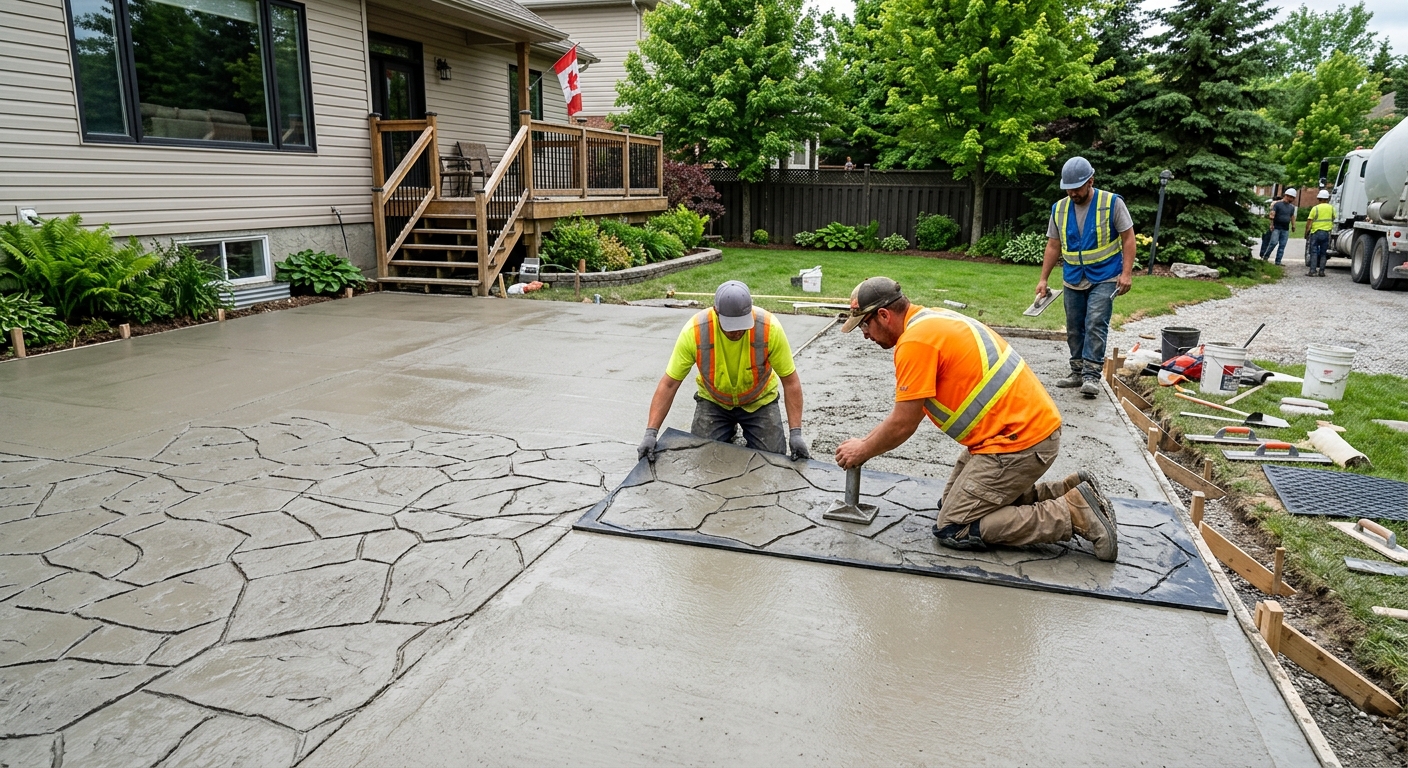
Concrete work options and costs in Mount Albert
Concrete contractors are busy in Mount Albert, Ontario, because homeowners here rely on durable flatwork—driveways, patios and walkways—for everyday use in a climate that swings hard between wet spring thaws and winter freeze–thaw. With a population of 4,925 (Statistics Canada, 2021 Census), the community is small enough that most projects funnel through the same GTA trade network, but the surrounding Toronto demand still pulls pricing upward. Mount Albert is also dominated by family housing, which typically means more frequent driveway and patio upgrades than you’d see in higher-density areas.
In the Toronto economic region, costs are shaped by frost depth and repeated freezing and thawing. Ontario building practice generally expects most structural footings to extend at least 1.2 m (about 4 ft) below grade to limit frost heave and differential movement. Exterior flatwork is usually specified with air-entrained concrete, proper granular base prep, and planned control joints to manage cracking. That combination—deeper preparation, more robust mixes, and seasonal scheduling—drives the range you’ll see in quotes.
Contractors tend to get especially steady demand around the Mount Albert village core and along busier access routes, where homeowners replace aging driveways before winter and want clean, quick finishes that won’t heave or spall after salt. When you compare options, the pricing differences come down to thickness, reinforcement needs, finish type and how much site work your yard requires—so the table below is a practical starting point for budgeting.
| Application |
Typical Size |
Key Spec |
Finish Option |
Price Range |
| Concrete driveway (standard broom finish) |
10 ft x 24 ft (240 sq ft) |
Reinforced slab; well-compacted granular base |
Broom finish + edge forms |
$4,320–$6,720 |
| Exposed aggregate driveway |
10 ft x 24 ft (240 sq ft) |
Air-entrained exterior mix; proper curing |
Exposed aggregate with sealer |
$5,200–$7,920 |
| Stamped concrete driveway or patio |
10 ft x 20 ft (200 sq ft) |
Air-entrained mix; control joints |
Stamp pattern + colour release |
$4,800–$8,000 |
| Plain concrete patio or walkway |
12 ft x 12 ft (144 sq ft) |
Granular base; sloped for drainage |
Float + light broom |
$2,300–$3,740 |
| Garage floor (interior slab) |
20 ft x 22 ft (440 sq ft) |
Vapour barrier; thickened edges (as needed) |
Broom finish or trowel finish |
$7,900–$12,320 |
| Foundation footings (structural, below frost) |
Per linear foot (typ.) |
Engineered size; below-grade excavation |
Form + rebar as designed |
$180–$300 |
Prices are estimates only and vary by project scope, site access and material selection.
What affects the price of concrete work in Mount Albert
In Mount Albert and the wider Toronto region, it’s common to see the same “concrete driveway” idea quoted 30–50% apart. The difference usually isn’t just the concrete—it’s the hidden scope: how deep the contractor excavates, whether the base is rebuilt with the right granular material, how much reinforcement is used, and what finish system (and curing protection) your project requires to perform through Ontario winters.
Frost line depth and freeze–thaw cycles dictate every major spec. Ontario projects generally require structural footings to extend at least 1.2 m (about 4 ft) below grade, which means more excavation, more form height, and more disposal for tougher digs. Exterior slabs also need air-entrained concrete mixes so the freeze–thaw cycle doesn’t damage the surface over time. When temperatures drop toward 10 °C or below, proper curing becomes harder: crews often schedule pours in the warmer months and use blankets or heating where needed. That labour and protection can add cost versus milder seasons. De-icing salt further increases the risk of surface spalling, which is why sealing after cure matters for longevity.
Concrete costs in Mount Albert can also swing with site conditions. For example, a driveway over saturated soil may require more granular base and better drainage before concrete goes down—pushing your budget toward the higher end of the driveway band (about $18–$28 per square foot). On the other hand, a straightforward patio with good access might land closer to the patio band (about $16–$26 per square foot), especially if thickness and base build-up are consistent and reinforcement is minimal.
If you’re replacing a driveway in an older subdivision, you may also pay more for removals and hauling. Many homes in this area were built long before today’s durability specs, so demolition can uncover weak base or fill that needs full re-grading and re-compaction—often turning a “same size replacement” into a larger scope.
| Price Factor |
Why It Matters |
Cost Impact |
| Frost line depth — determines footing depth and form height |
Footings must sit below design frost to reduce heave and movement |
Higher excavation/disposal increases foundation/footing budgets |
| Site preparation — excavation, grading, compacted granular base |
Bad base prep leads to settlement and cracking, especially after wet seasons |
Can shift a job by thousands if base rebuild is required |
| Reinforcement — rebar or wire mesh requirement |
Controls cracking and improves slab durability under load |
Additional steel/labour pushes costs toward the upper band |
| Mix design — air-entrainment and compressive strength spec |
Air entrainment helps survive freeze–thaw; strength supports long-term performance |
May raise material costs but reduces future repairs |
| Finish type — broom vs. stamped vs. exposed aggregate |
Finish systems add placement steps, labour time and sometimes sealer |
Stamped/exposed typically costs more per square foot |
| Pour size and concrete truck access to site |
Limited access increases pumping/extra labour and can slow placement |
Access constraints often move quotes toward the higher end |
| Cold-weather curing precautions — heating and blankets |
Protects concrete until it reaches adequate early strength |
Extra equipment and labour increase costs during shoulder seasons |
| Control joint pattern and sealing cost |
Proper joints reduce random cracking; sealing helps resist salt damage |
Skipping both can cause early surface failure and costly rework |
Permits & regulations in Ontario
In Ontario, most structural concrete work needs municipal involvement. That includes foundation walls, grade beams and footings for structural systems—work that typically requires a building permit and, in many cases, engineered drawings that the municipality reviews. For concrete flatwork like driveways, patios and walkways, a permit is often not required when the work doesn’t change lot grading, drainage patterns, or impervious surface coverage limits. However, if your project affects grading, ties into municipal right-of-way considerations, or changes drainage in a way that impacts runoff, you may need approval. Always verify with the local authority before breaking ground.
For a homeowner in Mount Albert, a good process is: (1) ask for the contractor’s project permit responsibilities in writing (who pulls the permit, if required); (2) confirm they carry liability insurance and the appropriate WSIB/WCB coverage; and (3) request references from similar-scale Ontario jobs. To verify quickly, you can look up the contractor’s company details and licence status in the applicable online registry (for Ontario, check the contractor licensing/registration information available through provincial and municipal guidance). For insurance, ask for a current certificate of insurance showing coverage in Ontario. For WSIB/WCB, request the contractor’s clearance documentation and ensure the effective dates are current. If anything can’t be provided on request, treat that as a major red flag and seek another quote.
Getting concrete right in Mount Albert's freeze-thaw climate
Concrete fails in Mount Albert mainly when it’s installed without the right base, mix, joints and curing protection for our Toronto-area freeze–thaw cycle. The most common problem is spalling and surface scaling, often caused by insufficient air entrainment plus exposure to de-icing salt. Moisture gets into the slab’s surface or pores; then freezing expands it, gradually breaking down the top layer.
Spec the job around five key steps. First, insist on proper base preparation: compacted granular sub-base to the correct depth for local soils and to achieve drainage away from the house. Second, require an air-entrained exterior mix—typically targeting about 5–7% air content for exterior flatwork—and a minimum compressive strength around 32 MPa (or higher if your design requires it). Third, use a control joint plan with spacing that limits random cracking paths. Fourth, plan for curing: in cold or shoulder-season weather, concrete needs a real curing window with protection; a minimum of 7 days under appropriate conditions is the baseline. Fifth, budget for sealing after full cure, usually around 28 days, so the slab repels salt and moisture.
When you’re comparing options, a higher quote for a driveway can be justified. For example, if one contractor proposes a broom-finish driveway at the low end of the band (around $18 per square foot) but another provides a thicker reinforced slab, proper drainage, and a sealer-ready finish system, you might move toward the higher end (around $28 per square foot). That spread is often the difference between “cheapest concrete” and a slab that survives winter cycles without early repairs.
| Spec |
Why It Matters in Mount Albert |
What to Ask For |
Impact if Skipped |
| Compacted granular base (depth?) |
Reduces settlement and keeps water from pooling under the slab in freeze–thaw season |
Ask for base depth, granular type and compaction method/proof |
Uneven cracking, heaving and shortened lifespan |
| Air-entrained concrete mix (target air %?) |
Improves freeze–thaw durability by giving ice expansion room inside the paste |
Ask for exterior air target (commonly 5–7% for flatwork) and mix confirmation |
Higher risk of spalling and scaling after salt exposure |
| Compressive strength (MPa rating) |
Ensures the slab reaches adequate structural and surface performance for traffic |
Ask for minimum 32 MPa (or higher if specified) test and documentation |
Surface wear, scaling and premature repairs |
| Control joints (spacing per ACI guidelines) |
Controls where shrinkage and temperature cracking happens |
Ask for joint layout plan and spacing for your slab dimensions |
Random cracks and difficult-to-repair pathways for water |
| Minimum 7-day curing period |
Cold snaps slow strength gain, increasing risk if the slab is left unprotected |
Ask what the crew does to protect curing in cooler periods |
Weak surface layer and early cracking |
| Penetrating sealer (when applied after cure) |
Salt and moisture resistance matters in Ontario winter |
Ask for a penetrating sealer plan applied after curing (commonly after 28 days) |
Faster salt-driven deterioration and staining |
How to choose a concrete work contractor in Mount Albert
Choosing the right concrete contractor in Mount Albert comes down to documentation, scope clarity and proof they know Ontario freeze–thaw requirements. Start by verifying Ontario coverage: ask for liability insurance (current certificate with project/address details), and request confirmation they carry WSIB/WCB coverage with clearance documentation. Then confirm their ability to perform the specific work you’re hiring for—structural concrete and engineered foundation work is not the same skill set as decorative flatwork. If they can’t provide insurance/coverage information promptly, that’s usually a sign of poor project controls.
Next, collect 2–3 itemised written quotes that break out labour and materials separately (not just a lump sum). Look for what’s excluded: removal and disposal, hauling, granular base rebuild, reinforcement type, rebar chairs, vapour barrier (for interior slabs), and whether joints and sealing are included. Ask if permit pulling is included for any structural work—footings and foundation elements typically need it—so you don’t get surprised later.
For warranty, request the workmanship warranty length and whether it covers cracking patterns related to installation (within reason). Also ask whether there’s a manufacturer/product warranty for sealers or decorative overlays and if it’s transferable to you. On payment schedule, avoid paying more than 10–15% upfront; hold back a portion until the job is complete and cleaned. Finally, insist on a written timeline with a start date and completion estimate, especially since local pours often need warmer-season scheduling for curing performance.
- Provide current certificate of liability insurance before work starts
- Confirm WSIB/WCB coverage with clearance documentation
- Get an itemised quote (labour vs materials vs equipment)
- Verify base prep scope: excavation depth, granular type and compaction
- Confirm mix design: air-entrainment for exterior flatwork
- Ask for reinforcement details (mesh vs rebar, and coverage/support)
- Review joint layout and spacing for your slab size
- Ask how they protect curing in cooler weather
- Confirm sealing plan and when it’s applied after cure
- Clarify disposal and site restoration (topsoil/levelling/cleanup)
- Check whether truck access requires pumping or smaller chute placement
- Require written start/completion timeline and a staged payment schedule
Concrete red flags I watch for in Mount Albert: vague quotes that omit base depth and reinforcement, promises to “pour anytime” without cure protection in shoulder weather, no written joint plan (leading to random cracking), refusal to show insurance/WSIB/WCB clearance, and missing cleanup/disposal details after demo.
Frequently asked questions — concrete work in Mount Albert
How much does concrete work cost in Mount Albert?
In Mount Albert, most homeowners budget using the local Toronto-region per-square-foot ranges for exterior flatwork. As a starting point, concrete driveways typically land around $18–$28 per square foot depending on thickness, base prep, reinforcement and finish. Patios and walkways are often about $16–$26 per square foot. Foundation footings are usually quoted separately, commonly around $180–$300 per linear foot for structural below-frost work. The bigger swings come from site conditions—poor drainage, saturated soil, or limited truck access can add thousands. Because Mount Albert follows Ontario freeze–thaw realities, contractors often include air-entrainment and proper curing protection, which may raise the quote but improves long-term durability.
How deep must footings be for Mount Albert's frost line?
For Mount Albert, Ontario concrete footings are generally expected to extend below the design frost depth to limit frost heave and differential movement. In the Toronto economic region, many structural footings are carried to at least 1.2 m (about 4 ft) below grade as a common requirement used to prevent frost impacts on foundations. Your exact depth, however, should follow your engineered foundation design and local application details, especially where soil conditions or house layout change. The key homeowner takeaway is that “shallow” isn’t a cost-saving strategy here—insufficient depth usually leads to cracking, settlement issues, and expensive remediation later.
Why does concrete crack in Mount Albert and how is it prevented?
Concrete cracks for several reasons in Mount Albert, but the most predictable drivers are freeze–thaw moisture movement and shrinkage/temperature changes. If the base isn’t properly compacted and drained, water can move under the slab, which increases stress during winter cycles. Cracking is also tied to how the slab shrinks as it cures, so a contractor should include an intentional control joint plan rather than hoping it “doesn’t crack.” Prevention is a combination: air-entrained exterior mix for durability, correct slab thickness and reinforcement, and control joints spaced appropriately for the slab dimensions (per common ACI guidance). Sealing after proper cure helps reduce salt-driven surface deterioration. If you’re getting a quote, ask specifically about joints and mix air content—those two items are often the difference between acceptable and early failures.
Stamped vs broom-finish concrete — cost difference?
Stamped and decorative finishes usually cost more than broom-finish concrete because they involve extra steps: formwork attention, colour/texture application, and a more controlled finishing process. In the Toronto region, you’ll commonly see driveways that start around $18–$28 for standard broom-finished work move upward when you add decorative systems. Stamped concrete driveway or patio work often lands in the $24–$40 range per square foot because labour time increases and finishing materials add cost. That said, a stamped driveway isn’t automatically “better”—it’s better when paired with the same Ontario durability specs (air-entrainment, proper base, reinforcement and a joint plan). If a decorative quote omits base depth or air-entrainment, it’s not a true upgrade; it’s just a different finish over a weak system.
When is the best time to pour concrete in Mount Albert?
For Mount Albert, the best time to pour exterior concrete is generally during the warmer part of the season when temperatures support proper curing—typically late spring through summer. Toronto-area crews usually concentrate exterior pours in months where the concrete can cure reliably and reach strength without excessive heating or blanket protection. When temperatures drop toward 10 °C or below, curing management becomes more demanding, and contractors may need insulated blankets, controlled curing practices, or heaters to reduce the risk of weak surface performance. You don’t always have to avoid late-season work, but ask how they plan to protect curing and maintain the right conditions. A well-timed pour plus proper protection is often less expensive in the long run than a rushed schedule followed by early scaling or cracking.
How long does concrete take to cure?
Concrete curing depends on temperature and mix design, but homeowners should think in practical stages. For everyday durability, a baseline expectation for exterior flatwork is at least 7 days of curing under proper conditions before you treat it as “ready” for normal use and traffic. Full performance keeps improving beyond that, and for surface protection like penetrating sealers, many contractors schedule sealing after full cure—commonly around 28 days—to ensure moisture levels have stabilized. In colder Toronto-area conditions (including Mount Albert), contractors may need blankets or heating to maintain curing temperature and slow strength loss. When you review a quote, ask for their curing plan, not just their pour date.