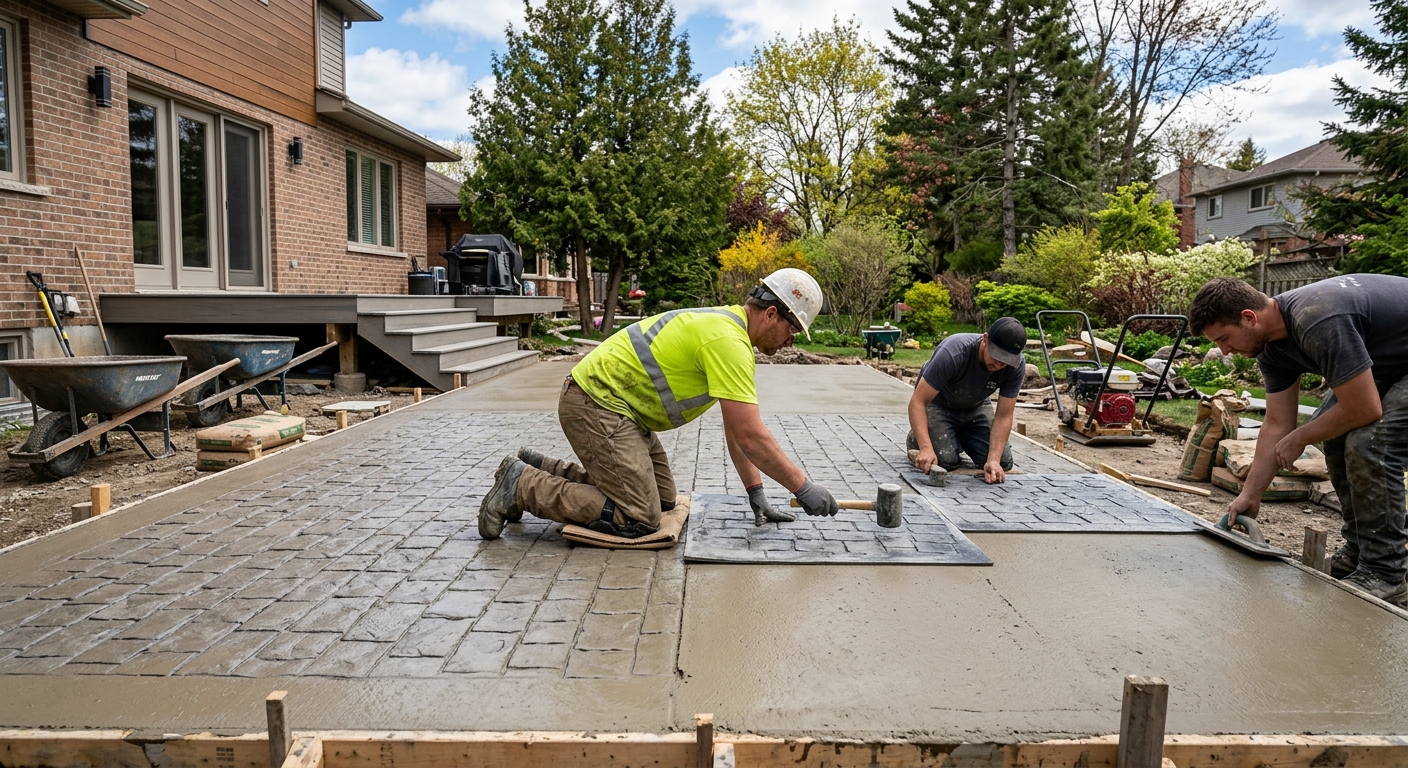
Concrete work options and costs in Elora
Concrete work in Elora, Ontario is in steady demand because homeowners are investing in durable flatwork for long, salt-exposed winters and wet spring thaws. With a population of about 7,800 (Statistics Canada, 2021 Census), Elora’s market is smaller than Toronto, so availability can depend on contractor schedules rather than constant throughput. Most projects are tied to the local housing stock—families upgrading driveways, adding patios and replacing worn walkways—where good drainage and freeze-thaw performance matter as much as appearance.
Costs in the Toronto economic region are shaped by frost depth requirements, repeated freeze–thaw cycles, and the need for air-entrained mixes on exterior slabs. In practice, that means excavation down to proper sub-base, well-compacted granular base, and concrete specs that resist spalling when de-icing salt and winter moisture combine. Pour timing also matters: when temperatures trend down toward 10 °C or below, contractors often schedule around curing performance and may add protection, which influences price. Elora crews also tend to price in travel time and staging when work comes from the wider Cambridge–Guelph corridor.
In and around Elora’s historic core and the surrounding residential pockets, driveways and backyard patios are especially common—often on lots that need careful grading so runoff drains away from foundations. Below is a practical comparison of typical options and budget ranges so you can line up apples-to-apples when you request quotes.
| Application |
Typical Size |
Key Spec |
Finish Option |
Price Range |
| Concrete driveway (standard broom finish) |
300 sq. ft. (about 3.0 m × 10.0 m) |
Air-entrained exterior mix, compacted granular base, control joints |
Broom finish |
$5,400–$8,400 |
| Exposed aggregate driveway |
300 sq. ft. (about 3.0 m × 10.0 m) |
Air-entrained mix, base prep, appropriate aggregate exposure method |
Exposed aggregate |
$6,600–$10,200 |
| Stamped concrete driveway or patio |
200 sq. ft. (about 6.1 m × 3.3 m) |
Air-entrained mix, reinforcement as needed, stamped surface with release |
Stamped & textured finish |
$5,000–$9,200 |
| Plain concrete patio or walkway |
160 sq. ft. (about 4.0 m × 4.0 m) |
Compacted granular base, air-entrained mix, proper slope and drainage |
Broomed/float finish |
$2,600–$4,200 |
| Garage floor (interior slab) |
400 sq. ft. (about 20 m²) |
Vapour barrier, reinforcement as specified, perimeter insulation if required |
Float finish (smooth trowel optional) |
$7,200–$11,800 |
| Foundation footings (structural, below frost) |
Varies by house design (typical per linear m) |
Excavation, forming, rebar, concrete placed below design frost depth |
Structural concrete |
$180–$300 |
Prices are estimates only and vary by project scope, site access and material selection.
What affects the price of concrete work in Elora
In the Toronto economic region, it’s common to see the same basic concrete project price swing by 30–50% across contractors and site conditions. The reason is that concrete “scope” isn’t just a slab thickness—it’s everything around it: excavation depth, granular base quantity and compaction, reinforcement, mix design (especially air content for exterior flatwork), and finishing time. In Elora, crews also price in travel, jobsite logistics and seasonal scheduling; if your project has to land in a tight window, labour costs and scheduling urgency can push quotes up.
Frost depth and freeze–thaw cycles dictate the foundation and slab specs for the region. Exterior slabs and driveways need air-entrained concrete mixes to survive repeated freezing and thawing, and Ontario Building Code expectations typically mean structural footings extend at least about 1.2 m below grade. When sites are wet or soils hold water, the granular base and drainage effort increases, and that’s often where quotes diverge. Colder evenings and early shoulder-season temperatures also affect curing: when temperatures drop toward 10 °C or below, contractors may add protection like insulation blankets to protect set and early strength gain—cost increases, but it’s cheaper than repairs later.
Concrete finishing choices also move prices. A standard broom finish driveway often lands closer to the $18–$28 per sq. ft. band, while stamped or exposed aggregate can climb toward the $24–$40 range because of labour, materials and careful curing/finishing. For example, a 300 sq. ft. driveway can be a few thousand dollars apart between a standard finish and stamped—money that’s justified if you want a decorative look and accept longer protection/cure steps.
| Price Factor |
Why It Matters |
Cost Impact |
| Frost line depth — determines footing depth and form height |
Deeper footings require more excavation, forming and concrete volume |
Higher excavation and material use can add significant cost, especially on sloped lots |
| Site preparation — excavation, grading, compacted granular base |
Weak base or poor grading leads to settling, cracking and drainage failures |
Can swing a quote by thousands if soil is wet/soft or base depth is increased |
| Reinforcement — rebar or wire mesh requirement |
Helps control cracking and supports load transfer |
Adds material and labour; may be required for driveways, ramps and structural scopes |
| Mix design — air-entrainment and compressive strength spec |
Exterior durability depends on freeze–thaw resistance and strength gain |
Usually moderate cost increase, but essential for longevity in Ontario winters |
| Finish type — broom vs. stamped vs. exposed aggregate |
Finish complexity changes labour time and curing/finishing steps |
Stamped/exposed typically costs more than broom-finished flatwork |
| Pour size and concrete truck access to site |
Limited access can require pumping or longer hose runs |
Pumping/extra labour can add noticeable cost on narrow or landscaped driveways |
| Cold-weather curing precautions — heating and blankets |
Early strength development is sensitive when temperatures fall |
Can add line-items for protection materials and crew time when pouring late in season |
| Control joint pattern and sealing cost |
Joints reduce random cracking; sealing helps repel de-icing salts |
Often small compared with the cost of repairs, but must be included explicitly |
Permits & regulations in Ontario
In Ontario, structural concrete work almost always requires a building permit. That includes footings, foundation walls, grade beams and any engineered structural elements that support the building. Municipal review is common, particularly when drawings are required to confirm reinforcement, elevations and load paths. For a homeowner in Elora, the key point is that structural scope triggers oversight—so don’t assume “it’s just concrete.”
Concrete flatwork—patios, walkways, driveways—typically does not require a permit by itself, provided it doesn’t significantly alter lot grading, create drainage issues, or conflict with impervious surface coverage rules and municipal right-of-way considerations. However, if the work changes how water runs toward a foundation, interferes with municipal servicing, or involves significant regrading, you may need approvals. The safest approach is to ask the local authority before breaking ground.
Before hiring, verify three basics: (1) the contractor has appropriate liability insurance, (2) the contractor has WSIB/WCB coverage where required for their workforce, and (3) you have a clear written contract showing what’s included. Step-by-step for Elora: ask for a certificate of insurance and confirm the insured parties match your address/job; request proof of WSIB/WCB coverage; then check the contractor’s licence/registration information through the appropriate Ontario registry channel they provide (your contractor should know what applies and can point you directly to their clearance details). Also ask for references on similar-scale exterior pours under freeze–thaw conditions.
Getting concrete right in Elora's freeze-thaw climate
Concrete can fail in Elora’s climate for predictable reasons: water finds pathways through hairline cracks, freezes, expands, and accelerates spalling—especially when de-icing salts are used on exterior flatwork. The fix is not “thicker concrete” alone; it’s a system: correct base preparation, an air-entrained exterior mix, controlled jointing, proper curing timing, and sealing after the concrete has reached sufficient strength.
Start with base preparation: excavate to the required depth and build a compacted granular sub-base that supports the slab without trapping water. If drainage is weak or the base is under-compacted, you’ll get settlement and random cracking. Next, specify a frost-durable mix. For exterior flatwork, many Ontario crews target air-entrainment around 5–7% air content and a minimum 32 MPa compressive strength so the concrete can resist freeze–thaw cycling.
Control joints matter because freeze–thaw cracking tends to be worse when cracks are uncontrolled. A good joint pattern limits where cracking occurs, and sealing later helps reduce moisture and salt intrusion. For curing, plan for at least 7 days under proper conditions, and if you’re pouring near shoulder season, protection (insulating blankets or heating) may be necessary to maintain early temperature and set conditions.
Sealing is typically applied after cure—often at 28 days—using a penetrating sealer designed to repel salt and water. For example, a homeowner may compare a plain broom-finish patio versus stamped concrete. If the broom finish is in the $16–$26 per sq. ft. band and the stamped option climbs toward $24–$40, the price difference is justified when you want decorative texture and you’re getting the same durability specs: air entrainment, base depth, joints and cure/protection. Skip one of those, and you’ll pay again sooner.
| Spec |
Why It Matters in Elora |
What to Ask For |
Impact if Skipped |
| Compacted granular base (depth?) |
Prevents settlement and reduces water retention that freezes/thaws |
Confirm excavation depth and granular base thickness, plus compaction testing approach |
Uneven slabs, cracking, and shortened service life |
| Air-entrained concrete mix (target air %?) |
Air void system protects concrete from freeze–thaw scaling and spalling |
Ask for exterior air entrainment target (commonly 5–7%) and mix designation |
Surface spalling within a few winters |
| Compressive strength (MPa rating) |
Supports adequate strength gain for early exposure in Ontario conditions |
Confirm minimum 32 MPa (or higher if specified) and curing timeline |
Higher risk of cracking and durability issues |
| Control joints (spacing per ACI guidelines) |
Directs shrinkage/cracking to planned locations |
Ask for joint spacing plan and whether joints are saw-cut or formed |
Random cracking and more water infiltration |
| Minimum 7-day curing period |
Early strength development is essential before winter exposure |
Ask how the crew will maintain curing conditions and protection if temperatures drop |
Weaker surface, higher permeability, and faster deterioration |
| Penetrating sealer (when applied after cure) |
Helps repel de-icing salt and limits moisture ingress |
Confirm sealer type and application timing (often around 28 days post-pour) |
More salt scaling and spalling risk |
How to choose a concrete work contractor in Elora
Choosing the right contractor in Elora starts with verification. In Ontario, confirm the contractor carries liability insurance and has WSIB/WCB coverage where applicable for their workers. How to check: request a current certificate of insurance (showing coverage remains active for your project timeframe) and ensure the coverage is tied to your job address; ask for WSIB/WCB clearance details or proof of coverage; and keep copies with your contract. If they can’t provide documentation quickly, that’s a red flag.
Then get 2–3 itemised written quotes. “Itemised” matters because you want labour and materials broken out: excavation, granular base, reinforcement, concrete mix design, forms, finishing, saw-cutting (if included), disposal, sealing and any cold-weather protection. If one quote is much lower, look for exclusions—like missing base depth, no air-entrainment, no reinforcement allowance, or no disposal for waste concrete.
Warranty should be clear: workmanship warranty length, product/manufacturer warranty (if any), and whether warranty coverage is transferable if you sell the home. Payment schedule should also be sensible—never pay more than 10–15% upfront. Holdback until the job is complete and final cleanup is done. Finally, require a start date and completion estimate in writing, not just “this season.” In the Toronto region, scheduling depends on weather and curing conditions, so a firm timeline is part of quality control.
- Ask whether exterior work uses an air-entrained mix and confirm target air content in writing.
- Confirm footing/frost depth expectations and ask how they’ll protect base from saturation.
- Require itemised breakdowns (base, rebar/mesh, concrete, finishing, joints, sealing).
- Check disposal is included (spoils and broken concrete removal).
- Verify concrete truck access plan; ask if pumping is needed and whether it’s priced.
- Confirm control joint pattern and whether saw-cutting is included (and when).
- Ask curing/protection plan if temperatures drop near your pour date.
- Request proof of liability insurance and WSIB/WCB coverage before signing.
- Look for references on similar exterior flatwork in Ontario freeze–thaw conditions.
- Make sure warranty terms are written and cover workmanship, not just materials.
- Hold back 10–20% until final grading/cleanup and walk-through completion.
- Get a written schedule with start date, pour date window, and completion estimate.
Concrete red flags in Elora: they can’t show insurance/WSIB/WCB documentation, they quote “thin slab” without discussing base depth, they promise no air-entrainment for exterior concrete, they skip or vaguely describe control joints and curing, or they ask for large upfront payments (beyond 10–15%) without a signed completion-based holdback.
Frequently asked questions — concrete work in Elora
Do I need a permit for concrete work in Ontario?
In Elora, Ontario, the permit question depends on what concrete work you’re doing. Structural concrete—like footings, foundation walls, or grade beams—typically requires a building permit and often engineered drawings reviewed by the municipality. By contrast, concrete flatwork such as patios, walkways and driveways usually does not require a permit by itself unless it affects lot grading, drainage, impervious surface limits, or municipal right-of-way concerns. Before you break ground, confirm with the local authority so you don’t end up reworking drainage. Also, make sure your contractor has liability insurance and WSIB/WCB coverage for their crew, and request references on projects with similar scope to yours.
Concrete vs pavers for a patio in Elora?
Concrete and pavers can both work well in Elora’s freeze–thaw climate, but the failure modes differ. Concrete relies heavily on air-entrainment, base compaction and control joints; if those aren’t done, spalling and cracking show up sooner. Pavers can shift if the base isn’t properly graded and compacted, and weeds can appear if jointing material washes out. For homeowners, concrete often offers a smoother budget path: a plain patio is commonly in the $16–$26 per sq. ft. band, while stamped concrete moves toward $24–$40 depending on pattern and finish. Pavers may cost more when you include excavation, proper bedding sand and edging. The best choice comes down to your priorities—integrated durability and sealing for concrete, or modular repair and flexibility for pavers.
How long does a concrete driveway last?
A well-built concrete driveway in Elora should last decades, but “how long” depends on the base, mix and workmanship—not just the surface look. In our region, the biggest threats are moisture and freeze–thaw cycling: poor drainage and under-compacted base allow water to move under the slab. Exterior concrete must be air-entrained to resist freeze–thaw damage, and control joints need to be properly placed so cracking is managed rather than random. If you’re comparing options, a standard broom-finish driveway often aligns with the $18–$28 per sq. ft. range; a higher-cost decorative finish still needs the same durability specs. Regular maintenance—like keeping de-icing use appropriate and planning for sealing—also affects lifespan. If your existing driveway is flaking/salt-scaled, ask about base condition before replacing.
What is air-entrained concrete and why does it matter here?
Air-entrained concrete is mixed with tiny, evenly distributed air voids that act like pressure relief chambers. When water in concrete freezes and expands during Ontario winters, the air void system reduces internal damage and helps prevent scaling/spalling. In the Toronto economic region—where Elora sits—freeze–thaw cycling is one of the main drivers of exterior concrete durability. That’s why many contractors specify air-entrained exterior mixes for driveways, patios and walkways. If you’re getting quotes, ask for the air-entrainment target (often in the 5–7% range for exterior flatwork) and confirm the crew will protect curing conditions when temperatures drop. Skipping air entrainment can make a “cheaper” mix far more expensive once repairs or early replacement are needed.
How do I prepare the base for a concrete slab?
Proper base preparation is where good driveways and patios are won. For Elora, you want excavation to the right depth, then placement of a compacted granular sub-base that’s graded for drainage. The goal is to support the slab without trapping water—because trapped moisture becomes freeze–thaw damage over time. Ask your contractor to explain base depth for your soil conditions and to describe how they’ll compact (and what they’re using as base material). Don’t accept vague answers like “we’ll level it”; you want a plan. Reinforcement, if included, should sit on the correct supports so it’s positioned properly within the slab. This groundwork is a major reason quotes can vary significantly in the Toronto region, even when finish styles look similar.
How do I compare concrete quotes?
To compare concrete quotes in Elora, you need to line them up by scope—not just by total price. First, request itemised written quotes that separate labour and materials: excavation, granular base depth, reinforcement (rebar/mesh), concrete mix specs (including air entrainment), finishing steps, jointing method, curing/protection and sealing. Confirm disposal is included and whether truck access affects costs (pumping, extra hose time, staging). Next, look for finish-level differences: broom finish versus exposed aggregate versus stamped. If one quote lands in the $18–$28 per sq. ft. style band for a driveway and another is closer to $24–$40, make sure the higher price includes the same durability specs. Finally, verify your contractor’s liability insurance and WSIB/WCB coverage before signing.