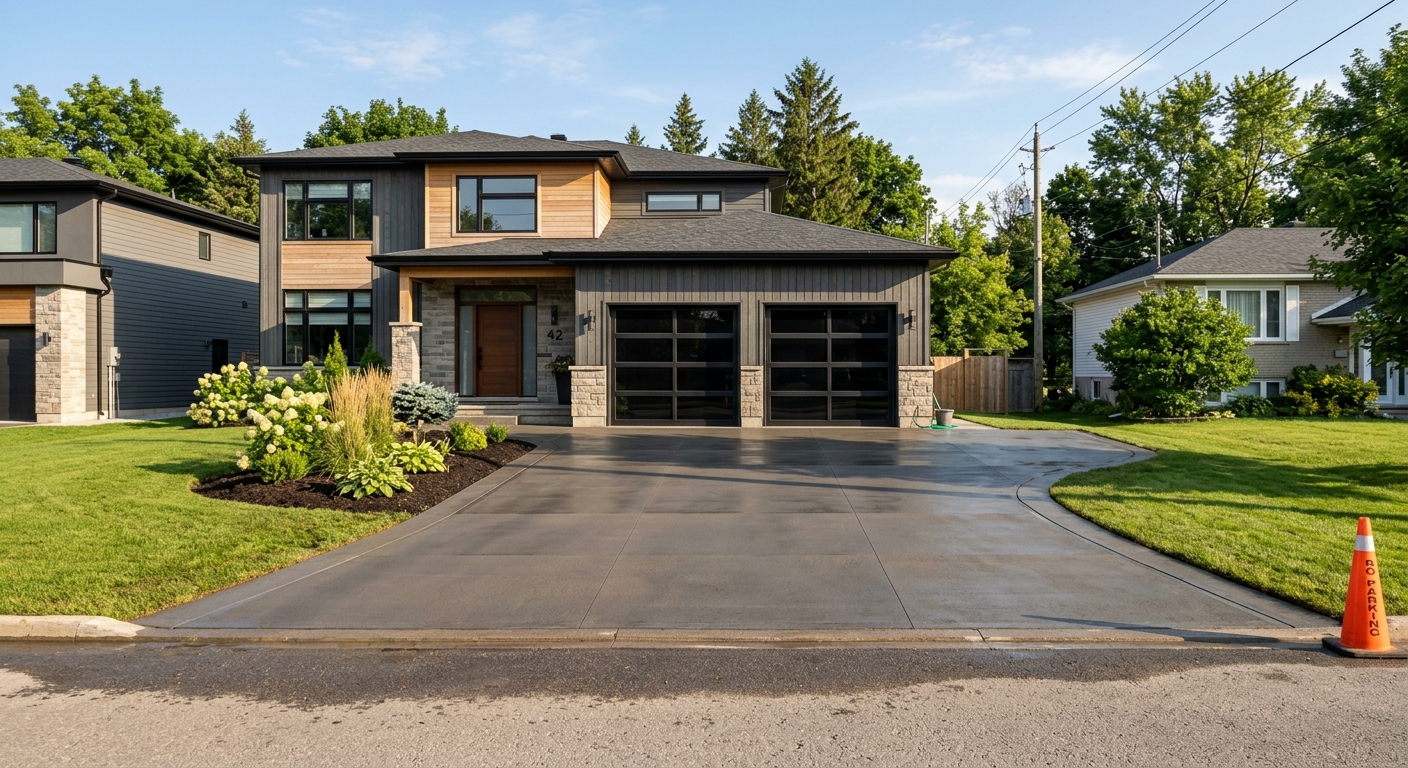
Concrete work options and costs in Kingsville
Kingsville homeowners typically choose concrete flatwork for its durability, and the market here is heavily driven by the type of housing that most people live in. With 83.0% of dwellings being single-detached homes (Statistics Canada, 2021 Census), you’ll see steady demand for driveways, patios and walkways—exactly the kinds of projects where mix design, jointing and base preparation matter. The area also has an older housing stock: 55.7% of homes were built before 1981 (Statistics Canada, 2021 Census), which often means retrofits, replacements, and upgrades to address settlement, drainage issues, or worn-out surfaces.
In the Windsor–Sarnia region, pricing is shaped by a cold, lake-influenced climate. Freeze–thaw cycles off Lake Erie and the broader moisture swings increase the risk of surface scaling and cracking, so contractors price in air‑entrained concrete, well-compacted granular bases, and proper curing. Expect additional labour for saw-cut control joints laid out correctly and cut on time, plus potential cold-weather placement precautions (heaters, blankets, and/or admixtures) when spring and fall pours are needed. These factors can make two “similar” jobs differ by thousands of dollars—especially when frost depth controls excavation depth for footings or when decorative finishes require more labour.
Trade activity is especially strong around older residential pockets and growing family areas where properties are being upgraded for curb appeal and long service life—commonly in and around neighborhoods like Maidstone Road and the broader west-end residential streets off Hwy. 3. Once you know what option you’re comparing, it’s easier to budget using typical ranges.
| Application |
Typical Size |
Key Spec |
Finish Option |
Price Range |
| Concrete driveway (standard broom finish) |
24 ft x 10 ft (240 sq. ft.) |
Rebar where required, 4 in. slab, compacted granular base |
Broom finish, edges formed |
$5,500–$9,500 |
| Exposed aggregate driveway |
24 ft x 10 ft (240 sq. ft.) |
Air-entrained mix, proper base and finishing timing |
Exposed aggregate (wash finish) |
$9,500–$13,500 |
| Stamped concrete driveway or patio |
20 ft x 12 ft (240 sq. ft.) |
Air-entrained mix, integral colour, reinforcing as needed |
Stamped pattern with release agent/colour |
$10,500–$18,000 |
| Plain concrete patio or walkway |
12 ft x 12 ft (144 sq. ft.) |
Minimum thickness with granular base, slope away from house |
Float + broom edge |
$3,500–$7,500 |
| Garage floor (interior slab) |
22 ft x 20 ft (440 sq. ft.) |
Vapour considerations, reinforcing as specified |
Steel trowel, light broom or smooth finish |
$8,500–$15,000 |
| Foundation footings (structural, below frost) |
Perimeter length varies (e.g., 40–60 ft) |
Excavation to frost line, reinforced structural concrete |
Structural finish for walls/blocks |
$12,000–$35,000 |
Prices are estimates only and vary by project scope, site access and material selection.
What affects the price of concrete work in Kingsville
In Kingsville and across Southwestern Ontario, it’s common to see bids for the “same” concrete scope vary by 30–50%. A big driver is how the Windsor–Sarnia climate forces specific engineering-like specs—especially where frost depth and moisture control dictate what’s under the slab, not just what you see on top. Contractors also price labour differently based on how tight the site is for trucks, how much excavation is needed, and whether cold-weather precautions (heaters, blankets, set control) are required to protect placement and curing.
Practically, frost line depth and freeze–thaw cycles dictate every structural decision. Exterior footings must extend below Ontario’s design frost depth—commonly in the 1.5–2.4 m range—to prevent frost heave. Similarly, exterior slabs and flatwork need air‑entrained concrete to survive repeated wet/dry and expansion/contraction cycles. When pours land in colder shoulder seasons, crews often add heat or use insulated blankets and admixtures; that’s extra labour and materials on top of the base cost. De-icing salt in driveways can accelerate surface spalling if the mix and curing aren’t right, and sealing later becomes a worthwhile, scoped add-on.
Two examples that frequently move cost up or down in Kingsville: (1) If your driveway needs full replacement and the base is soft due to past drainage issues, excavation and granular replacement add several thousand dollars—pushing standard driveways toward the upper end of the $5,500–$15,000 band. (2) If you choose stamped or exposed aggregate, the material and finishing time increases, often justifying more of the $7,500–$22,000 range versus a plain patio.
| Price Factor |
Why It Matters |
Cost Impact |
| Frost line depth |
Determines footing depth and excavation/form height |
$2,000–$12,000 |
| Site preparation |
Excavation, grading, compacted granular base performance |
$800–$6,500 |
| Reinforcement |
Rebar or wire mesh to control cracking under loading |
$500–$4,000 |
| Mix design |
Air‑entrainment and compressive strength spec durability |
$300–$2,500 |
| Finish type |
Broom vs. stamped vs. exposed aggregate labour intensity |
$600–$8,000 |
| Pour size and concrete truck access to site |
Smaller pours can mean more mobilizations; access affects time |
$250–$3,500 |
| Cold-weather curing precautions |
Heating/blankets/admixtures protect strength gain and curing |
$400–$4,500 |
| Control joint pattern and sealing cost |
Joint layout and timely sealing reduce random cracking and surface damage |
$200–$2,500 |
Permits & regulations in Ontario
In Ontario, structural concrete work—footings, foundation walls, and grade beams—typically requires a building permit, and municipalities often expect engineered drawings or design input for load-bearing components. If you’re doing a foundation rebuild, underpinning, or any work that changes a structural element, the permit and documentation become part of the process. Concrete flatwork like patios, walkways, and standard driveways usually does not require a permit unless the work affects lot grading, introduces or changes drainage, or triggers impervious surface coverage limits and related site-plan requirements. Because each property can have different drainage and grading conditions, confirm with the local authority before the first excavation.
Just as important as permits is contractor compliance. When you hire a concrete contractor in Kingsville, ask for proof they carry liability insurance and WSIB/WCB coverage (as applicable). Step-by-step, you can verify: (1) check the contractor’s licensing status through the Ontario government business/prescribed trade registry or licensing search tools available online; (2) request a current certificate of insurance showing liability limits and the project address (or a valid description of the project); (3) confirm worker coverage by requesting WSIB/WCB clearance information; and (4) ask for references with similar scope—driveway replacements in older neighbourhoods and foundation work in freeze–thaw conditions.
Do these checks before signing. It’s the simplest way to protect your schedule, your budget, and your liability exposure.
Getting concrete right in Kingsville's freeze-thaw climate
Concrete fails in Kingsville primarily from moisture and temperature cycling. When water gets into the slab or base and freezes, expansion can pop off the surface (spalling) and widen cracks. Poor compaction and inadequate drainage leave the sub-base saturated, increasing freeze–thaw damage over time. That’s why in the Windsor–Sarnia market, the “spec” starts below grade and includes mix design, jointing, curing and sealing—not just the top finish.
To spec the job correctly: (1) start with base preparation—use a compacted granular sub-base to the right depth for local soils and frost considerations, with correct grading and drainage away from the home; (2) require an air‑entrained concrete mix—commonly 5–7% air content for exterior flatwork—plus a minimum 32 MPa compressive strength for durability; (3) plan control joints so cracking happens where you want it, with joints cut on time and spaced appropriately; (4) cure properly—minimum 7 days under proper conditions, and in colder shoulder seasons you may need heating or insulated blankets to achieve strength gain; (5) seal after curing—typically a penetrating sealer applied 28 days post-pour—to help repel de‑icing salts and reduce moisture intrusion.
If you’re comparing options, remember that paying for air‑entrainment and correct base compaction is usually far cheaper than dealing with replacement. For example, a plain driveway might be in the $5,500–$9,500 range, while stamped or decorative work could land higher (often $7,500–$22,000). But skipping “invisible” durability items to save a few hundred dollars is where homeowners get burned—especially here, where freeze–thaw cycles punish weak slabs fast.
| Spec |
Why It Matters in Kingsville |
What to Ask For |
Impact if Skipped |
| Compacted granular base (depth?) |
Reduces settlement and keeps water from staying under the slab during freeze–thaw |
Granular base depth and compaction method stated in the quote |
$1,500–$10,000 in early repairs/replacement |
| Air-entrained concrete mix (target air %?) |
Protects against surface scaling/spalling from repeated freezing and thawing |
Target air content (typically 5–7% for exterior flatwork) and mix approval before pour |
$2,000–$12,000 risk of scaling and premature cracking |
| Compressive strength (MPa rating) |
Strength gain affects durability and resistance to wear and freeze damage |
Minimum 32 MPa specified on the proposal/mix ticket reference |
$800–$8,000 higher chance of surface deterioration |
| Control joints (spacing per ACI guidelines) |
Controls where cracks form as the slab shrinks and expands seasonally |
Joint layout plan and timing for saw-cutting |
$500–$6,000 for patching/renewal of sealed joints |
| Minimum 7-day curing period |
Ensures proper strength development through cold nights and temperature swings |
Curing method and any cold-weather measures if pouring in spring/fall |
$1,000–$9,000 in early failure risk |
| Penetrating sealer (when applied after cure) |
Repels de‑icing salt moisture that accelerates surface scaling |
Sealer applied after full cure (commonly 28 days post-pour) |
$300–$3,000 for accelerated surface damage and earlier re-sealing |
How to choose a concrete work contractor in Kingsville
Start by verifying Ontario compliance the right way. Ask for the contractor’s Ontario trade/licence information (where applicable for the scope), then request a certificate of liability insurance showing they’re insured for property damage and bodily injury. Next, confirm WSIB/WCB coverage by asking for clearance information or proof of account status—don’t rely on “we’re covered” statements. For older home sites in Kingsville, these checks are especially important because access routes and underground conditions can add unforeseen work and liability.
Get 2–3 itemised written quotes, not just a lump sum. You want a breakdown showing labour and materials (concrete supply, reinforcement, formwork, saw-cutting, hauling, disposal, base prep, and sealing if included). Read exclusions carefully: Is permit pulling included (for structural work)? Is granular base replacement included if the sub-base is weak? Is disposal of excess soil and concrete included, or billed separately?
Warranty matters too. Ask for a workmanship warranty length in writing, confirm whether product/manufacturer warranties apply to admixtures or sealers, and check if warranties transfer if you sell the home. For payment, don’t pay more than 10–15% upfront—hold back payment until the job is complete and deficiencies are corrected. Finally, get the start date and completion estimate in writing, including who coordinates concrete truck timing.
- Ask for mix design details: air content target for exterior work and minimum compressive strength.
- Confirm base thickness and compaction requirements before quoting thickness.
- Require a reinforcement plan (rebar/wire mesh) based on load and slab size.
- Check that saw-cut control joints are planned and scheduled for the same day or correct timing window.
- Ask whether curing will be temperature-protected in spring/fall pours (blankets/heaters if needed).
- Confirm sealing inclusion: product type and whether it’s penetrating sealer after cure.
- Ensure disposal and topsoil reinstatement are clearly itemised.
- Verify truck access plan and whether the contractor provides concrete pumping or cut-in logistics if needed.
- Look for photos of similar Kingsville projects (driveways/patios in freeze–thaw conditions).
- Confirm licensing/insurance/WSIB/WCB with documents, not verbal assurance.
- Get a written warranty and what it covers (cracking vs. spalling vs. uneven settlement).
- Clarify change-order pricing—how extras are calculated if excavation finds surprises.
Concrete red flags I see in Kingsville include: quotes that don’t mention air-entrainment for exterior slabs, “cheap” pricing that omits base prep or reinforcement, no clear control joint plan (or joints promised but not scheduled), vague curing language for cold shoulder-season pours, and contractors asking for large upfront deposits or refusing to provide proof of insurance/WSIB/WCB.
Frequently asked questions — concrete work in Kingsville
What is a concrete overlay and is it suited to Kingsville?
A concrete overlay is a new layer of concrete (or cement-based topping) placed over an existing slab after preparation. It can be a good fit in Kingsville when the original driveway is still structurally sound—no major base failure, heavy settlement, or extensive pumping water. The freeze–thaw climate around Lake Erie and seasonal wetness means overlays only perform well when prep is done properly: milling/scarifying, cleaning, bonding agent use where required, and an overlay thickness that matches the original condition. If your slab has widespread scaling, loose concrete, or repeating raised areas, a full replacement is often the more durable option. As a budget reference, a full plain concrete patio or walkway often lands around $3,500–$9,000, while overlays vary widely depending on prep and bonding system requirements.
How do I seal concrete to protect it in Kingsville?
For concrete in Kingsville, sealing is about moisture control—especially against de-icing salt and the repeated freezing and thawing that can drive surface scaling. The usual approach is to let the concrete cure properly first; then apply a penetrating sealer after cure, commonly around 28 days post-pour. Before sealing, the slab should be clean and dry (and free of dust, curing compound residue, and standing moisture). Use a contractor-applied penetrating product designed for freeze–thaw exposure rather than a glossy film that can fail in wet cycles. Ask your contractor to specify the sealer type in writing, confirm surface dryness testing if possible, and clarify whether resealing is recommended on a schedule. If you’re planning a project, a sealed finish is often a small add-on compared to replacing a failing driveway in this climate.
What is the difference between concrete and cement?
Concrete is the final building material—made by mixing cement with water, sand, gravel (or crushed stone), and sometimes additives like air-entrainment or plasticizers. Cement is one ingredient inside concrete. In Ontario, when contractors talk about a concrete “mix” for exterior driveways, they’re referring to the full concrete formulation (including the air-entrainment target for freeze–thaw durability). This matters in Kingsville because exterior flatwork needs the right air content and curing so the slab can resist spalling. If you compare quotes, don’t let wording confuse the issue: ask for the concrete mix design details (compressive strength and air-entrainment) rather than only the “cement” brand. Proper specification is one reason bids can differ by 30–50% for similar jobs in the Windsor–Sarnia region.
How much does concrete work cost in Kingsville?
Concrete pricing in Kingsville typically depends on what you’re building and how much base work and cold-weather protection is required. For concrete flatwork, a standard driveway often falls in the $5,500–$15,000 range, while a plain patio or walkway commonly lands around $3,500–$9,000. Decorative options cost more because of additional labour and materials—for example, stamped concrete driveways or patios often sit in the $7,500–$22,000 band depending on area, pattern complexity and site conditions. Foundation footings (structural, below frost) can be much higher, commonly $12,000–$35,000, largely because frost protection drives excavation depth, formwork and reinforcement. To control costs, focus on accurate site prep and correct specs first—cutting corners there usually costs more later.
How deep must footings be for Kingsville's frost line?
In Ontario, exterior structural footings need to extend below the design frost depth to reduce frost heave risk. In practice across the province, that design frost depth is often in the 1.5–2.4 m range, depending on the specific location and engineering assumptions used for the structure. Kingsville homeowners should expect deeper excavation than in milder areas because the Windsor–Sarnia region experiences freeze–thaw cycles and moisture movement that can amplify swelling forces. Your permit drawings/engineered foundation design should specify the required footing depth and minimum embedment. Ask your contractor to show how their excavation depth aligns with the design drawings and to explain what happens if they encounter unsuitable soils—because that’s another place where costs move quickly.
Why does concrete crack in Kingsville and how is it prevented?
Concrete cracks mainly due to shrinkage, temperature changes, and moisture movement—problems that get worse during freeze–thaw cycles common in Kingsville. Even well-built concrete will crack eventually, but the goal is to control where it cracks and to keep it tight enough to resist moisture penetration. Prevention comes from correct base preparation and compaction, proper reinforcement for the intended loads, and correctly planned control joints. Control joints must be spaced appropriately and cut on time so the slab relieves stress in the right place. Equally important is air‑entrainment: inadequate air can lead to spalling and surface deterioration when water freezes. Finally, proper curing (including cold-weather precautions when needed) and sealing after cure help keep moisture and de-icing salts from attacking the surface. A contractor should be able to describe the joint pattern, curing plan, and mix durability details before the pour.